
‹ All movies

Axel checking into the Beverly Palm Hotel with the Rolling Stone and Michael Jackson routine, running all the way through the Serge gallery scene

Nothing in the first 20 minutes is exceedingly rewatchable to one host, who flips channels waiting for Axel to reach Beverly Hills; another disagrees, saying the chase is really good, and would watch an hour and a half of the cigarette deal as a Jim Jarmusch movie, and loves the Mean Streets moment that takes it out of 80s blockbuster territory; without the title you would not know what to make of Axel.

Axel arriving in Beverly Hills and checking into the hotel, claiming to be a Rolling Stone reporter in town to interview Michael Jackson, might be the funniest thing he has ever done; he cries racism without saying racism, playing an entitled white person and an affronted black person at the same time, which gets the manager to give him the room at half price; he overhears the no-reservations phone call so he has an opening line, and the wordless take at $240 a night is an all-timer.

"Take those bananas"

The pick is 'take those bananas', the Damon Wayans line, which draws immediate agreement.

The film

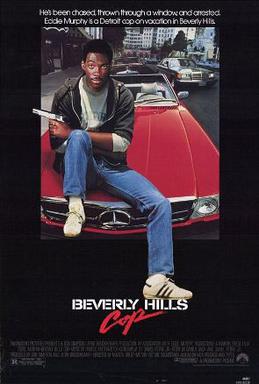
Beverly Hills Cop (1984)

Directed by Martin Brest · Action

105 minutes

Cast

Selected cast credits · Film reference

Eddie Murphy Detective Axel Foley
Judge Reinhold Detective Billy Rosewood
John Ashton Sergeant John Taggart
Lisa Eilbacher Jenny Summers
Ronny Cox Lieutenant Andrew Bogomil
Steven Berkoff Victor Maitland
James Russo Mikey Tandino
Stephen Elliott Chief Hubbard
Gilbert R. Hill Inspector Douglas Todd
Paul Reiser Detective Jeffrey Friedman
Frank Pesce cigarette buyer
Damon Wayans banana man
Rex Ryon bonded warehouse security guard
Martin Brest Beverly Palms Hotel checkout clerk (uncredited)

Everything from the episode

In the order the hosts got to it. Open a row for the discussion.

29:55

Roger Ebert's review

In the discussion (1)
Approx. transcript time · 00:29:55Read transcript
  • Ebert gave it two and a half stars and did not really like it, writing that Eddie Murphy looked like the latest victim of star magic syndrome, the assumption that a movie will be a hit simply because it stars an enormously talented person; the host retorts that this is exactly what happened.
31:39

Most Rewatchable Scene

Axel checking into the Beverly Palm Hotel with the Rolling Stone and Michael Jackson routine, running all the way thr...

Axel checking into the Beverly Palm Hotel with the Rolling Stone and Michael Jackson routine, running all the way through the Serge gallery scene

In the discussion (10)
Approx. transcript time · 00:31:39Read transcript
  • Nothing in the first 20 minutes is exceedingly rewatchable to one host, who flips channels waiting for Axel to reach Beverly Hills; another disagrees, saying the chase is really good, and would watch an hour and a half of the cigarette deal as a Jim Jarmusch movie, and loves the Mean Streets moment that takes it out of 80s blockbuster territory; without the title you would not know what to make of Axel.
  • Axel arriving in Beverly Hills and checking into the hotel, claiming to be a Rolling Stone reporter in town to interview Michael Jackson, might be the funniest thing he has ever done; he cries racism without saying racism, playing an entitled white person and an affronted black person at the same time, which gets the manager to give him the room at half price; he overhears the no-reservations phone call so he has an opening line, and the wordless take at $240 a night is an all-timer.
  • From there it goes straight to Jenny Summers and the $130,000 piece with Serge, an almost impeccable nine minutes of comedy; an 80s trope of the pop song over the montage being turned down for a scene and brought back is noted as Stir It Up returns when he passes the two Michael Jacksons; the Serge part is compared to Shawn Michaels making any wrestler better, and Bronson Pinchot got a whole career and a sitcom out of two scenes after Risky Business.
  • Other nominations: the banana in the tailpipe, ordering the shrimp sandwich room service in the suite where the Rosewood and Taggart interplay starts, and the strip joint scene leading into the Super Cops monologue where everybody is cracking up; the 'Billy, you don't have to be embarrassed' bit and the Phil, Vanity Six exchange are recited.
  • The first team's 'not gonna fall for the banana in the tailpipe' outside Maitland's house became an iconic Little League taunt with no idea of the context, and Tiger Woods talking like the tailpipe guy in 1997 gave it five more years; the ending is enjoyed for the inept guards hailing bullets without hitting anyone in the age of the poorly deployed Uzi.
  • Axel getting chewed out by Cobb (as transcribed) over the truckload of cigarettes from the Dearborn hijack, with Paul Reiser's 'this is not my locker', is nominated; Cobb and James Russo are called the only two people who go over the top of Murphy, going higher than Icarus.
  • Asked for 30 seconds on James Russo and granted 45, the Michael Tandino thing is framed as a weird love story at the start of the movie that sets everything up. — Chris Ryan
  • The setup is a 24-hour working-class man using his vacation to solve a murder instead of going to Hawaii; an aside confirms Beverly Hills is its own city with its own police department, expensive, good schools, safe; the pool, bar and apartment sequence with Tandino is one host's rewatchable pick, and 'before he dies, they're doing it' is raised and saved for later.
  • Why the movie happened is saved for half-assed research; Axel at the customs facility asking about the Porsche and 'then you're my fucking problem' is added; the final pick is checking into the hotel all the way to Serge.
  • During the super cop scene John Ashton is visibly fighting laughter with his head down like a Carol Burnett show sketch, Ronnie Cox can be seen fighting it too, and Judge Reinhold reportedly pinched the inside of his thigh to keep from laughing at Eddie's ad libs; one host says it changes how he will watch the movie forever.
41:27

What’s Aged the Best?

Lisa Eilbacher as Jenny Summers (disputed); Jenny's red Mercedes convertible; the title; Harold Faltermeyer's score a...

Lisa Eilbacher as Jenny Summers (disputed); Jenny's red Mercedes convertible; the title; Harold Faltermeyer's score and the soundtrack; the Mumford Phys Ed t-shirt and cropped sweatshirts; Taggart and Rosewood; Murphy's early run of good directors; the rival cop duo

In the discussion (11)
Approx. transcript time · 00:41:27Read transcript
  • One host is still in love with Jenny Summers, played by Lisa Eilbach (as transcribed); the objection is not to the actress but to Hollywood casting interchangeable blondes with the same Kate Capshaw haircut, and another did not recognize her at all; what one host wants from the token female character in an Eddie Murphy movie is to dress well, laugh at his jokes and look great.
  • She is not a love interest for either man, though she tried with Eddie, which is saved for later; she is serious about her career and it costs her nothing, and her damselification is believable because she insists on driving to the warehouse; 'great character' is countered with 'definitely not a great character' since nothing motivates her, she works at a coke lord's art gallery, and the Jenny, Tandino and Axel triangle of friendship makes no sense.
  • Jenny is called a TV actress annihilated by everyone else on screen who did nothing afterward because she cannot hold the screen; a joke pitch imagines a Jenny Summers sequel in Don Simpson's office; she may be the first female gallerist in a movie.
  • The defense of Jenny Summers is framed as a 15-year-old's crush recalled in the past tense. — Bill Simmons
  • Jenny Summers' red Mercedes-Benz convertible is a dope car you cannot see anymore and is hard to keep in shape; in Beverly Hills they just take whatever car is closest; the little back seat is the Mikey spot.
  • The title is great, as if they came up with it before they had a script; Harold Faltemeyer's run through Top Gun and Fletch is admired, the score fit an era of synth musicians like Howard Jones and Wang Chung.
  • Faltermeyer is credited alongside Hans Zimmer on Top Gun Maverick, presumably because they use his themes; the soundtrack with The Heat Is On, Neutron Dance, Stir It Up and Nasty Girl is strong.
  • Martin Brest draws 'the less said the better' from one host and a Midnight Run defense from another, who calls it a perfect movie and credits Brest with two of the best comedies of all time, alongside Gigi (as transcribed) and Son of a Woman (as transcribed); it is hard to know how much credit he gets here beyond being smart enough to let Eddie ad-lib, and Midnight Run also does not work without its two stars.
  • The Mumford Phys Ed t-shirts were really a thing in the mid 80s with no internet to buy them, and the high school was flooded with requests; the Lions jacket in Cop 2 was intentional merchandising; the cropped sweatshirts, like the Josh Brolin Goonies look, are almost as iconic, and the hosts tease one of them about adopting cropped sweats.
  • Taggart and Rosewood have aged best because this lays the groundwork for two heroic performances in Beverly Hills Cop 2 that could have been nominated; a key to Murphy is that, apart from Brest, he mostly worked with good directors early: Walter Hill, Tony Scott, Robert Townsend, John Landis, even Michael Ritchie on The Golden Child; Cop 3 is best left unmentioned.
  • The 'not gonna fall for the banana in the tailpipe' guy is enjoyed for setting it up earlier with the first team insult for Taggart, and the hosts miss the mid-80s cop movie rivalry duo with sarcastic comments; Eilbacher is put back in by a second and declared a law, with 'Eilbacher Mountain' floated.
51:21

What’s Aged the Worst?

The first 19 minutes; obvious stunt doubles; Victor Maitland's reaction to Mikey's death; the homophobia (nominated, ...

The first 19 minutes; obvious stunt doubles; Victor Maitland's reaction to Mikey's death; the homophobia (nominated, then partly defended); Taggart punching Axel; Maitland's useless bodyguards; the Rolling Stone and Michael Jackson name-drop

In the discussion (8)
Approx. transcript time · 00:51:21Read transcript
  • The first 19 minutes could zip by faster; 1984 was not the peak of masking stunt work, so a guy gets punched and a different man flies through the window, Magnum PI level stunts: the man thrown through the buffet table is not Jonathan Banks, the truck driver has a mullet while the man who climbs out has a bald spot, Victor's tumble down the steps and Eddie through the plate glass are doubles; tumbling action has gone out of style and now reads as farce.
  • Victor Maitland's reaction to Mikey's death is so bad that Stephen Burkoff (as transcribed) should have spent weeks in character; he has been in a Bond movie and is a good 80s guy; 80s villains were almost always played by sexy men, even Jonathan Banks, the future Mike Ermantrout (as transcribed), has an attractive energy.
  • The whole movie is pairs of men, five different pairs with no female interruption, like Don Johnson and Philip Michael Thomas driving and looking at each other; it only jokes about that once at the club, is not homophobic, and is not afraid of what it means to have two men in close proximity.
  • Homophobia is proposed for what aged worst, but one host finds it less homophobic than memory suggested: you simply see gay people be gay, Damon Wayans plays an effeminate man, and the one not-great moment is Eddie using a made-up disease, Herbie simplex 10 (as transcribed), as a weapon on the maitre d'; the defense is that the characters he invents are bits to get him into the next room, like the loudmouth journalist at the Beverly Palms; Eddie's early-80s homophobia is remembered from the stand-up specials and a little of 48 Hours, not this.
  • Taggart punching Axel is pretty bad given what has been seen of the LA police, though Taggart then comes out, apologizes and offers to let charges be pressed; Maitland's bodyguards aged badly because all of them were terrible, and the strategy is dissected: five guys come in, four huge ones carry Axel through the building and the fifth just walks in front, so they can throw him through the window as evidence of a public disturbance.
  • No white person thrown through that window ends up charged with public disturbance and in a police department; Axel never resists arrest because he is a cop from Detroit and a black man who knows what cops do, and he knows Todd will eventually vouch for him; the movie star's entitlement that the plot will give him something to do sits beside the reality of a black person in police presence, and there is a character logic in revealing less to learn how these officers act.
  • When 48 Hours was a rewatchable the fight between Eddie and Nick Nolte looked like Nolte would kill him, so two years later the formula seems tweaked so Axel is never roughed up beyond a punch in the stomach, the window and being knocked out in the opening.
  • Getting into the Beverly Palm by name-dropping Rolling Stone and a Michael Jackson profile is offered for aged worst; a follow-up, explicitly not offered as aged worst, is how magazines substitute for mobile phones: Rosewood reading Time about red meat, Victor Maitland flipping through a magazine in Jenny's office, and Jonathan Banks reading National Geographic, which is just how people passed time in 1984.
1:00:59

Casting What-Ifs

Mickey Rourke signed a $400,000 holding deal and left; Sylvester Stallone rewrote it as a straight action film with A...

Mickey Rourke signed a $400,000 holding deal and left; Sylvester Stallone rewrote it as a straight action film with Axel Cobretti and quit two weeks before filming; Martin Scorsese was offered the director's chair and dismissed the script; Eddie Murphy was hired two weeks before shooting

In the discussion (6)
Approx. transcript time · 01:00:59Read transcript
  • Mickey Rourke signed a $400,000 holding contract and then left the project; a New York Times quote has Don Simpson tearing a picture of Rourke out of a magazine, holding it up and saying 'isn't he great', which the hosts attribute to all the cocaine, although one says you did not need cocaine to want Rourke in 1984.
  • This is the movie missing from Rourke's run before he started messing up his face: Heaven's Gate, Body Heat, Diner, Rumblefish, Pope of Greenwich Village, then the gap where Beverly Hills Cop could sit, followed by Eureka, Year of the Dragon and Nine and a Half Weeks; the holding deal's schedules did not work out.
  • Stallone was more extreme: he made it a straight action film with the lead renamed Axel Cobretti, Michael Tandino as his brother and Jenny as his love interest, an opening meant to be like Saving Private Ryan on the beaches of Normandy, ideas deemed too expensive, and a climax of him driving a Lamborghini down the train tracks at a freight train driven by the villain; an urban legend has him quitting two weeks before filming over orange juice in his trailer.
  • Scorsese was offered the director's chair while trying to get Last Temptation of Christ made, was bewildered by the script and dismissed it.
  • Earlier context: Eddie was hired two weeks before filming on a script kicking around since the 70s, a cop-comes-to-another-town movie set up for various stars and directors, and he transformed it with improv; it does not work with Sylvester Stallone, who would have made it a dramatic action movie, and if Stallone is in that cigarette truck the movie weighs 150 pounds more; with anyone else it would be actively bad because we know who killed his friend in the first 30 minutes.
  • The parts of Bogomil, Rosewood and Taggart were probably not rewritten after the casting changes, so the other actors are playing a script written for Mickey Rourke or Stallone with Eddie as the star; it was hard for them to handle his ad libs because takes got ruined by laughter.
1:03:12

The Joey Pants “That Guy” Award

James Russo; Michael Champion

James Russo; Michael Champion

In the discussion (2)
Approx. transcript time · 01:03:12Read transcript
  • Jonathan Banks was a first-ballot that guy from Wiseguy and Beverly Hills Cop for 20 plus years until Breaking Bad made him Emmy winner Jonathan Banks; Ronnie Cox was a that guy who ripped off Vision Quest, Cop and Cop 2, RoboCop, Total Recall and San Elsewhere (as transcribed) and eventually became Ronnie Cox.
  • James Russo is one host's winner, though another cannot name anything else he has been in; a different pick is Michael Champion, one of Maitland's men alongside Banks, who was in Total Recall, Hill Street Blues and V as the slimy sidekick to the heavy; Russo is acting as if he is in a Michael Cimino movie and taking it out on Beverly Hills Cop; Stephen Elliott, the chief, is a TV actor to end all TV actors.
1:05:17

The Ruffalo / Hanna / Rubinek / Partridge Overacting Award

Stephen Elliott as the Beverly Hills police chief

Stephen Elliott as the Beverly Hills police chief

In the discussion (3)
Approx. transcript time · 01:05:17Read transcript
  • Stephen Elliott as the chief dialed it up, whether the first time he comes in or the second; pick a time, he is bad.
  • Earlier, after praise for Paul Reiser in the locker sequence, the only time someone goes over the top of Murphy is credited to Cobb (as transcribed) and James Russo, the two actors going higher than Icarus to see what happens.
  • Victor Maitland's reaction to Mikey's death is so bad that Stephen Burkoff (as transcribed) should have spent several weeks in character.
1:05:32

The Dion Waiters Award for Best Heat Check Performance

Bronson Pinchot

Bronson Pinchot

In the discussion (2)
Approx. transcript time · 01:05:32Read transcript
  • Bronson Pinchot has two scenes, knocks them out of the park and gets a sitcom and a five-year deal out of it, the biggest Dion Waiters success story the show has had, compared to Flip Murray's 13-game run; the brilliance is that you do not know what he is playing, only he knows, a joke on the art world where his sexual orientation and whether he is Middle Eastern are unknown.
  • Earlier the Serge scenes are compared to Shawn Michaels making any wrestler better in the ring; he got a whole career from two scenes, having been only one of Tom Cruise's friends in Risky Business before, and Balky followed two years later.
1:06:04

Half-Assed Internet Research

Michael Eisner and Don Simpson argued over who originated the idea until Simpson died; Gilbert Hill was a real Detroi...

Michael Eisner and Don Simpson argued over who originated the idea until Simpson died; Gilbert Hill was a real Detroit detective; the theme reached number three on the Billboard chart; a 2013 CBS pilot with Brandon T. Jackson as Axel's son failed; Eddie improvised much of an Oscar-nominated screenplay

In the discussion (5)
Approx. transcript time · 01:06:04Read transcript
  • The origin is claimed by Michael Eisner, who on a podcast with the host told the story of a 1975 speeding ticket from a cop who seemed a bit of a dick gave him the germ of a movie about a Hollywood police officer; Don Simpson, who worked for him, had a 1977 idea about an East LA cop transferred to Beverly Hills but could not get a screenplay done; Eisner's lesson that being pulled over in a beater meant he needed a Mercedes-Benz is called the most privileged thing ever heard.
  • Nobody planned on a black cop, so it is a high-level irony that a what-if-Stallone, pride of Italian Americans, vehicle became salient commentary neither Eisner nor Simpson intended; Simpson had just made Flashdance, and the two argued about the origin until Simpson died.
  • Gilbert Hill, the Detroit police lieutenant, was an actual Detroit detective who appeared in only three movies; 48 Hours is suggested as the first instance of giving the lone black character in a movie the most powerful job with 30 seconds of screen time, a pattern that kept happening.
  • The theme to Beverly Hills Cop reached number three on the Billboard chart, with Neutron Dance, The Heat Is On, Stir It Up and New Attitude also in the film; in 2013 The Shield creator Shawn Ryan tried a Beverly Hills Cop TV show, a CBS pilot with Brandon T. Jackson as Axel Foley's son that did not work.
  • Writer Daniel Petrie and director Martin Brest carried pieces of different screenplays; according to Petrie, Eddie would take a line, expand it and put it in a comic persona invented for the moment, and according to Brest, whenever they got in a jam he asked Eddie for something and it knocked him to the floor; the movie was nominated for best screenplay though Eddie improvised about two thirds of it.
1:09:37

Apex Mountain

Eddie Murphy; Lisa Eilbacher; LA cops as a possible apex that soon turned; Mumford High School; Harold Faltermeyer; K...

Eddie Murphy; Lisa Eilbacher; LA cops as a possible apex that soon turned; Mumford High School; Harold Faltermeyer; Kent cigarettes; the mansion, owner unknown to the hosts, reused in Commando

In the discussion (4)
Approx. transcript time · 01:09:37Read transcript
  • Eddie was covered earlier; Lisa Eylbacher (as transcribed) is a 100,000 percent yes, with the joke that by apex he means valley; LA cops are at a possible apex that turned dramatically, since Colors came three or four years later and a lighthearted LA cops comedy could not be made ten years on; Mumford High School and Harold Faltenmeyer (as transcribed) are yeses.
  • Kent cigarettes are a yes, as is the mansion, whose owner and location the hosts do not know, which was used again in Commando a year later.
  • The Commando mention prompts movie star physics: Eddie in Cobra, Commando or Raw Deal; Raw Deal is called an Eddie Murphy movie with Arnold Schwarzenegger doing the Eddie stuff, weird human touches that need a human being, and the softest Arnold of his peak.
  • At the top of the show the suggestion is to rename Apex Mountain after Eddie, Axel Foley Mountain or Mount Foley, for the SNL, 48 Hours, Trading Places, Beverly Hills Cop run.
1:12:39

Picking Nits

Mikey's bearer-bond theft and flight to Detroit; what a bearer bond is; Jenny and Axel not upset enough about Mikey; ...

Mikey's bearer-bond theft and flight to Detroit; what a bearer bond is; Jenny and Axel not upset enough about Mikey; machine guns in the strip club; Axel's car making the Detroit-to-LA drive; how Jenny affords her clothes and car

In the discussion (4)
Approx. transcript time · 01:12:39Read transcript
  • Mikey was a warehouse security guard who stole a bunch of German bearer bonds, threw them in his jacket, ran back to Detroit and thought nobody would notice, a tough plan; one host does not watch movies for logic but knows a movie is bad when asking why something is happening; it is also weird that he shows Axel the stolen bonds 30 seconds into seeing him again after prison.
  • Bearer bonds, transcribed as bear bonds, are still not understood since the Die Hard episode and sound like something from Provincetown in July; Jenny should have been more upset that Mikey was dead, and Axel too, though both seem to have expected he would end up that way.
  • In 1984 it was really fluid; the robbers were not subtle, walking into the strip club in long leather dusters with machine guns under their coats and just standing there, so Axel gets too much credit for spotting them, and their plan, robbing everyone or just the register, is unclear. — Chris Ryan
  • Axel's car could not have made the drive from Detroit to Los Angeles, and he drives it back even though they paid for his hotel; how much Jenny Summers made running the art gallery is questioned given her nice clothes and car, with the suspicion that she was a drug dealer and the expectation that she would make a heel turn.
1:15:33

The Neil McCauley “A Book about Metals” Award for Best Line from the Movie

"Take those bananas"

"Take those bananas"

In the discussion (2)
Approx. transcript time · 01:15:33Read transcript
  • The pick is 'take those bananas', the Damon Wayans line, which draws immediate agreement.
  • A couple more are thrown in: 'this is not my locker'; Axel asking the valet to put the car in a good spot because all this shit happened the last time he parked there, which one host does not love; and credit for how Eddie sells the super cop scene, taking a beat to say the super cop thing was working really well and the guys messed it up.
1:15:48

Sequel, Prequel, Limited Series, or All-Black Remake

No

No

In the discussion (1)
Approx. transcript time · 01:15:48Read transcript
  • Asked whether it could be remade as a 10-episode Netflix show, the answer is a flat no.
1:16:32

Probably Unanswerable Questions

Was Beverly Hills Cop 2 better than Beverly Hills Cop? Was Axel Foley gay?

Was Beverly Hills Cop 2 better than Beverly Hills Cop? Was Axel Foley gay?

In the discussion (17)
Approx. transcript time · 01:16:32Read transcript
  • Whether Cop 2 is better: it is a better story and a flat-out good, more fun movie with good music, the Taggart and Rosewood thing and Brigitte Nilsson (as transcribed), with Eddie still great; the fondness for Cop 1 comes from everything it meant for the Eddie arc.
  • Was Axel Foley gay gets a yes, but the answer first returns to the period reviews, which were also upset about how the movie made white people look.
  • Pauline Kale (as transcribed) did not believe in Eddie Murphy's stardom and found it offensive because he used it as a joke on how dumb white people could be made to look by a smart black person, a sort of pro-minstrel argument against an anti-minstrel work; LA Times letters in 1985 characterized Murphy's swagger with a racial slur and worried that black confidence would replace white comedians.
  • One host as a kid felt the opposite, that it was the greatest thing that ever happened; Kale was about 65, not a racist, but had an interesting take on how black audiences responded to The French Connection, and old guard critics felt that way, so the rewatch was done aware that people were nervous Eddie was someone white people should fear.
  • To one host it is a movie about a gay black man in the Detroit police whose former best friend, probably lover or hookup buddy, gets killed, sending him on a mission; not having sex with a woman does not make you gay, but a near two-hour movie whose protagonist on the verge of major stardom never gets a moment with the girl is striking, even allowing that Eddie arrived two weeks before filming and nothing was rewritten.
  • Evidence: Jenny looks completely enamored, goes to the big three-room suite and immediately lies on the bed batting her eyelashes, and the only thing on Axel's mind is ordering room service for Taggart and Rosewood.
  • The Mikey scenes are weird to watch: at the bar they look like they are about to make out, they exchange 'I love you', and when Axel gets home after the chewing-out by Inspector Todd to find Mikey broken in with the fridge open he is elated; the counter is that a friend out of prison eating a mayo sandwich in your kitchen would get 'get out of my house, you felon'.
  • Gay characters are sprinkled throughout; it is an unintended consequence of a movie made with a ton of cocaine by the seat of its pants; at the strip joint he only tells Rosewood to give the dancer a dollar and does not partake, and his pretending is for plot rather than character; the movie is all pairs of men with emotional energy who could be on the verge of kissing, so subtext becomes text; 'is Axel gay' is a long-running Reddit conspiracy theory; James Russo brings a wild method energy to a two-minute part, a reckless guy out of prison who almost cries seeing his friend, which feels very real.
  • Eddie is drawn into Russo rather than watching a method performance, they are on the same page; the original ending reportedly had Eddie back in his Detroit apartment opening the closet to find Mikey's shirt and sniffing it, prompting the joke that Martin Brest was robbed of an Oscar; the movie probably intended none of it.
  • Intent does not matter because those things are in the movie we got; one host noticed it independently and wrote about it in a 2010 mailbag because the Jenny Summers scene jumped out, and may have inspired the theory; no other 80s action or genre movie lacks some nod to the hero's romantic life.
  • Even in 48 Hours Nick Nolte's girlfriend calls to complain and Eddie gets laid by Olivia Brown, his primary obsession in that film; Eilbacher is a beautiful blonde, not a character actress like Joan Cusack, whose function in any other movie of the period, see Stripes, is to give a straight hero somewhere to put his sexuality; perhaps it was a black-white thing, since the sex scene was cut from The Golden Child and they were not ready for Eddie to do that in a mainstream movie.
  • The conspiracy theory is compared to early Will Smith, who had Vivica A. Fox to get back to but few romantic leads for someone in his position, and did not help himself by skipping the kiss in Six Degrees of Separation, after which he always has a girlfriend, wife or dead spouse; the wish is that movies would acknowledge gay people exist and have sex lives instead of flicking at it.
  • Damon Wayans giving him the fruit plate with the banana for the tailpipe is text, not subtext, and Eddie turns around on his way out to say thank you, perfectly comfortable with the man; the movie's own setup is the you-killed-my-lover revenge premise of other action movies, taken as a vacation; one host watched it for 26 years without noticing until the other wrote about it.
  • The passion for Jenny Summers is the giveaway, how could a man not kiss her; the wish for one line where she hits on him and he insinuates he does not do that anymore is answered with 'that makes it worse'; it makes her character more interesting and hornier, and Eddie's complicated history with homophobia in his comedy makes the whole thing more frictive.
  • A tangent on Eddie's homophobia turns into a bit about one host's bullies now being gay married with three kids: bully someone and your sexuality will come for you.
  • During the scene discussion, 'before he dies, they're doing it' was raised about Axel and Mikey and saved for later.
  • During what aged best, Jenny is said to be a love interest for neither man, though she really tried with Eddie, and the subject is parked until later.
1:31:21

Who Won the Movie?

Eddie Murphy

Eddie Murphy

In the discussion (1)
Approx. transcript time · 01:31:21Read transcript
Podcast choices
Speaker not identified
Eddie Murphy

More from the conversation

Opening facts: the movie is 35 years old, was the highest grossing film of 1984, is apparently still the number one comedy of all time on adjusted gross, was the highest grossing R-rated film for 19 years until The Matrix Reloaded in 2003, and adjusted for inflation is the third biggest R-rated movie behind The Godfather and The Exorcist.
Approx. transcript time · 00:01:34Read transcript
A personal movie: Eddie Murphy was one host's guy, this was Apex Mountain, and seeing it in theaters at seven made it a complete youth obsession on the level of Madonna, Prince and Bruce Springsteen; kids learned Axel F on the synth, everybody dressed, talked and cursed like Axel Foley, and it got one host smoking king-sized Kents.
Approx. transcript time · 00:02:08Read transcript
The guest has not seen the film in its entirety in maybe 20 years, knowing sequences from cable runs, and is struck by how soft and present Eddie is, connected with everyone in a scene rather than waiting for his moment the way Richard Pryor or Bill Murray can be seen calculating; it is compared to Michael Douglas trusting the movie to be on his side, and Axel is not the macho dude remembered.
Approx. transcript time · 00:03:07Read transcript
Nobody owns a scene like this now, not because of what Eddie is but because he is really sly here, with a quiet, almost whispery, not very actorly voice; unlike many stand-ups and sketch performers who cannot get off the stage, he has a defined persona but is not yet the Nutty Professor guy aware of himself.
Approx. transcript time · 00:05:22Read transcript
Reviews and think pieces at the time show people were scared of Eddie Murphy; he was 24, and the wardrobe of Mumford t-shirt, jeans and sweatshirts was changed to make him seem like someone who just joined the force; his sketch background shows in the character work within the story, the customs inspector, the Rolling Stone writer, Phil at the strip club, impersonations that serve the script; the country club scene handcuffing Victor Maitland is quiet, real acting unlike Kevin Hart or Schwarzenegger, and the movie is closer to Dirty Harry or a 70s crime movie than an 80s action blockbuster, a blaxploitation movie with a true movie star in the way Richard Roundtree was.
Approx. transcript time · 00:05:22Read transcript
Expectations were like LeBron in 2009 or Will Smith making the first Bad Boys: after 48 Hours with Nick Nolte and Trading Places as a Dan Aykroyd and John Landis movie, this was Eddie carrying everything, and it met them; a Grantland piece recalled early-80s TV with few black characters, the Jeffersons, Good Times, the White Shadow, Benson, Different Strokes and Isaac on the Love Boat, then Eddie on SNL at 19 became one host's prism to a culture he knew nothing about, and in four years he was the biggest star in the world except Michael Jackson, at 24.
Approx. transcript time · 00:08:34Read transcript
This is also the end of a phase: he got too famous, everything after feels self-conscious, even Coming to America leans back into the Gumby guy, and the fish-out-of-water movie he made three times cannot be made by someone that galactically famous; his Letterman appearances changed around 85-86, Michael Jackson suits and Bubble Hill, no normal interactions, which is death for comedy but weirdly fine for movie stardom; The Golden Child was a disappointment while Cop 2 and Coming to America were awesome, and a successful black actor faces a tension between what the movie wants and what he wants.
Approx. transcript time · 00:10:23Read transcript
The complaint that nobody would believe this man moves freely through Beverly Hills without being called a slur misses that we are watching a movie star be impervious to the racism built into the movie, so Teflon in his stardom that it does not stick; it is also a detective movie in the Bogart sense, so just go with it; he relates to the overlooked people of Beverly Hills, gay people, valets, waiters, Serge with the tray, the security guard, the back-room record guys, and pays them respect.
Approx. transcript time · 00:12:58Read transcript
One host's 2010 funny-person championship belt had Eddie holding it from 82 to 84, the best three-year run by a funny person ever, on SNL every weekend plus three huge hit movies across genres and demos, with maybe only Jerry Lewis comparable; he still almost got fired from 48 Hours and got this part two weeks before filming because star parts went to people like Sly.
Approx. transcript time · 00:14:18Read transcript
Is Eddie the most talented comic actor in movie history, the basketball GOAT question: Jack Lemmon, Danny Kaye and Donald O'Connor are raised, 1994 Jim Carrey and 2003 Will Ferrell ran the same playbook, but Eddie's effortlessness is the difference, he does not need you to laugh and is funny despite the joke, while Carrey and Ferrell put themselves in the hospital for the laugh and Chevy Chase would do anything physically; there is a classic movie star quality to how he is funny.
Approx. transcript time · 00:18:56Read transcript
The movie should have been bad: we know who did it 30 minutes in, the Detroit truck chase is unnecessary and reads as Don Simpson buying a mountain of cocaine, and by a baseball WAR measure like Mike Trout's Eddie's value is off the charts; action comedy of the period, Stripes, Ghostbusters, Blues Brothers, could have been made either way, and this changed what a comedy could be after the Neil Simon domestic one-liner model; blaxploitation redistributed the crime movie's power to a black underclass, and The French Connection is the atom, with Popeye Doyle recast as Axel Foley, down to the same apartment.
Approx. transcript time · 00:20:57Read transcript
1984 was a fascinating year with the Cosby Show and Purple Rain; ten years earlier Eddie being black would have been a major theme, here it is present only in moments like the banana in the tailpipe; Sidney Poitier, after his 1967 run, spent his capital to make love to Abby Lincoln (as transcribed) on screen because proof of equality was sex, and Eddie does not get that here, with the Golden Child scene cut; it is strangely artificial that a man from Detroit has no other black people in his life except Todd, his father figure; as a fish-out-of-water comedy like Some Like It Hot or In the Heat of the Night, the window-and-arrest sequence would communicate nothing with Stallone, Schwarzenegger or Michael Keaton, and the handling of race is subtle, maybe by accident.
Approx. transcript time · 00:24:22Read transcript
A tangent on one host's teenage crushes beyond Jenny Summers: Dana Wheeler Nicholson in Fletch for another host, Terry Garr, Jill Kleberg (as transcribed), Jane Kennedy replacing Phyllis George on NFL Today, Susan Day (as transcribed) and Olivia Brown from a list that ran to about 50 names.
Approx. transcript time · 00:44:54Read transcript
A fun game of which 80s movie Eddie should have starred in: Top Gun, where everything changes with James Russo as Iceman; Wall Street, though he would defer to a Sidney Poitier Gordon Gekko; Lethal Weapon, which he effectively made with 48 Hours; and Die Hard, which is called an Eddie Murphy movie since Bruce Willis was no more an action star then.
Approx. transcript time · 01:11:26Read transcript
Sign-off thanking Chris Ryan, Sean Fennessey and Wesley Morris, transcribed as Liz Morris.
Approx. transcript time · 01:31:50Read transcript

Mentions across The Rewatchables