The newly introduced Dorfler’s Door pain award goes to the close-range basketball hit; Nolte’s injuries are contrasted with the first film. — Bill Simmons
Nolte is the first explicit winner choice because his performance defines the film. — Bill Simmons
Cousy is a personal winner choice, defended for making ten consecutive free throws on camera despite an objection.
Cousy’s personal-win claim is repeated despite comparisons with Bird and Penny. — Van Lathan
Shaq receives two explicit winner choices, with the film called a lasting win and his most competent screen performance. — Van Lathan
Closing callbacks reiterate Cousy as a personal favorite, Nolte as the star choice and Shaq as the clear winner; Cousy’s free throws remain disputed and are not new ballots.
Nolte seems obvious but may go too far; Shelton’s screenplay is preferred because of his sports-writing skill. — Bill Simmons
Walsh is another choice despite doubt that anyone deserves an Oscar, followed by further support for the screenplay if an award must be given. — Van Lathan
Nolte is rejected. Cheating in a basketball movie prompts alternatives from White Men Can’t Jump and Above the Rim. — Bill Simmons
Mary McDonnell and Bob Knight are rejected, with Knight’s 1987 championship after A Season on the Brink recalled as an alternative.
Flunking television in college is accepted, followed by a joke about doing it again in 1996. — Chris Ryan
Rick Fox’s brief role is placed in a strong acting run including Eddie, He Got Game and Oz, leading to a joke about an Oz rewatch. — Bill Simmons
The Gambler remains the choice for basketball point-shaving scenes. Uncut Gems is suggested for sports betting but distinguished from point shaving. — Chris Ryan
If widened to taking a dive in sports films, The Longest Yard and the devastating ending of The Color of Money are considered. — Bill Simmons
Shaq and Penny as a pair are rejected, but Shaq as an actor is accepted emphatically. — Bill Simmons
Bob Cousy and Rick Pitino as actors are accepted; Algiers is introduced with another joke about how difficult it is to reach. — Bill Simmons
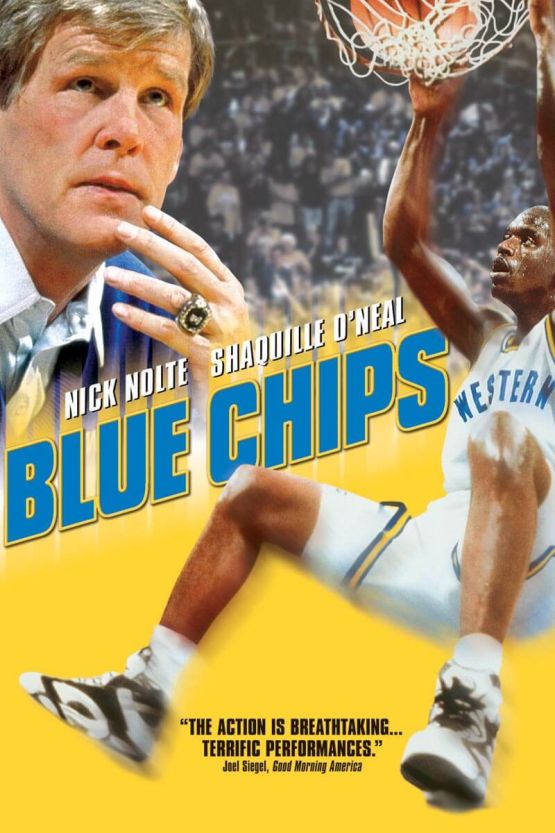
Blue Chips is named a favorite college basketball movie for capturing a generation of players, though 1970s films including Fast Break remain an alternative preference. — Van Lathan
Recruiting-scene competition includes Moneyball’s first-base pitch to Chris Pratt’s character. — Van Lathan
Hoosiers’ apparently indifferent approach to Jimmy Chitwood is preferred as another recruiting scene. — Chris Ryan
He Got Game’s sexually charged Tech visit is another recruiting-scene choice.
Jenny is proposed as an apex movie ex-wife for helping with tape, recruiting and emotional support while remaining physically separate from Pete. — Chris Ryan
Jenny is compared with the wet-blanket sports-movie partner tradition; her final disappointment is defended because she has the film’s moral conscience. — Chris Ryan
A first call goes straight to voicemail; a suggestion to try again leads to a successful call requesting an unprepared Blue Chips take. — Bill Simmons
The caller recalls seeing the film at college and finding Ricky the most ruthless and prepared negotiator; Shaq’s character understands the situation while Nolte is shattered by the requested benefits. — Bill Simmons
The short cameo ends abruptly after a question about the posting date; persistence and Craig’s second-call suggestion are credited for the format finally working.
A Shelton–Costner sports trilogy is imagined, with Costner playing a quieter Boeheim-like coach whose clean program is corrupted and whose edge recalls No Way Out.
Hackman is suggested as Happy, followed by a joke that Jenny would dress better for Costner.
Nolte’s resemblance to Bobby Knight and Jack Cates makes Pete hard to like; a defense places him among the era’s overbearing coaches, while Costner remains intriguing. — Van Lathan
Nolte is defended as perfect for this version of Pete. Hackman could play a Norman Dale losing control, while Pacino could suggest Pitino or Calipari, although excessive acting is a concern.
A Black coach is considered plausible for the 1990s; the casting is explained instead as a deliberate effort to make Pete resemble Bobby Knight. — Bill Simmons
Los Angeles feels incidental beyond good weather and discussion of Big East television dominance; an SMU-like Texas setting with Happy as an oilman is suggested. — Bill Simmons
Christian Laettner as Ricky alongside Shaq and Penny could have better captured the era, followed by speculation that Shaq would object.