‹ All movies
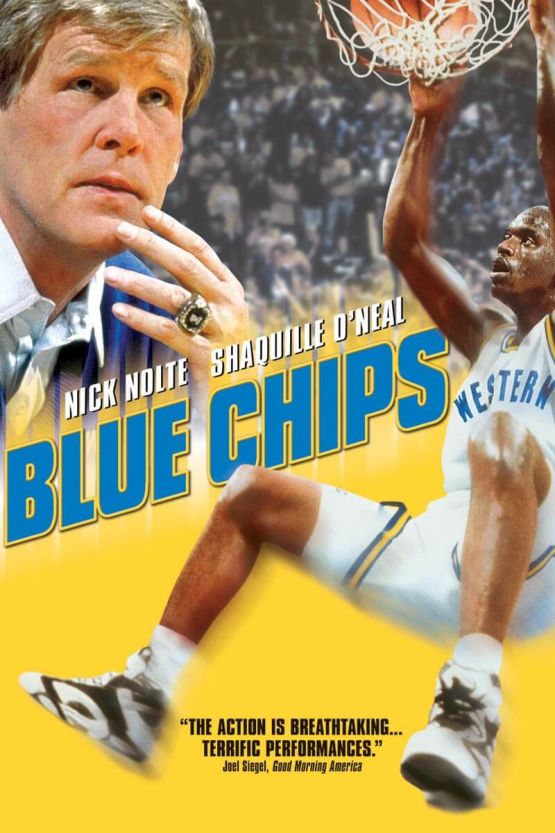
Blue Chips poster

Blue Chips

108 minutes

Cast

Selected cast credits · Film reference

Blue Chips | The Rewatchables

Explore episodeClose episode

Producer credits not yet identified.

Half-Assed Internet Research

Real basketball cast and games; Friedkin and Nolte preparation; production history

In the discussion (12)
Approx. transcript time · 00:13:24Read transcript
  • Friedkin’s basketball enthusiasm reportedly included considering a one-third Celtics purchase and consulting Cousy, explaining the latter’s appearance.
  • The production reportedly used real players, coaches and games before six thousand spectators, but authentic play alone does not solve basketball’s cinematic difficulty.
  • Anthony C. Hall is described as both actor and player; many real coaches and college stars supplied the basketball cast.
  • A claimed Kevin Garnett appearance cannot be located and his youth raises doubt; Geert Hammink is recognized.
  • Shelton reportedly developed the script in 1981, with studio delays before White Men Can’t Jump revived interest; Lansing brought in Friedkin while Shelton made Cobb.
  • Basketball was reportedly filmed at Frankfort High using full competitive games plus set plays; Knight repeatedly disrupted planned endings by coaching to win.
  • A $35 million budget and $26 million gross are reported; later home-video value and enduring cultural references are offered as qualifications.
  • Shaq’s reported worst-new-star Razzie nomination is rejected as unfair because his performance is good.
  • Friedkin’s reported claim that sports films cannot reproduce a real game’s unpredictable suspense is dismissed as sour grapes, with successful sports movies offered as the objection.
  • Shaq reportedly wore very thin soles to reduce height differences; framing him farther from Nolte and Mary McDonnell is discussed as another solution.
  • Shaq’s last college game is recalled as an Indiana loss to the team featuring Knight and the actor playing Ricky; Indiana’s subsequent Final Four loss to Duke is also recalled.
  • Butch’s Chicago gym is identified as Mount Carmel High School, and the crew including Shaq reportedly stayed at a Lafayette Howard Johnson’s for two weeks.

Picking Nits

College calendar; recruiting timeline; reporter surveillance; fictional schools; late-night ending

In the discussion (17)
Approx. transcript time · 00:17:00Read transcript
  • The deserted walkable neighborhood beside a giant arena raises doubts about its Los Angeles geography; UCLA and USC associations conflict.
  • Indiana’s authentic uniforms and Knight’s participation seem surprising in such a bleak portrait when other teams are fictional.
  • Bird casually shooting and retrieving rebounds after multiple back surgeries is doubted.
  • Algiers is described as ordinary West Bank New Orleans, not the remote swamp journey implied by the recruiting trip.
  • The coaches barely remember a game they won last year, unlike Mind the Game’s detailed recollections of individual plays.
  • A two-title coach facing dismissal after limited losing is questioned, with multiple disappointing Tony-era seasons offered as a qualification.
  • Western U apparently has no conference tournament; the treatment of an NIT season as successful also feels wrong for this program.
  • Neon’s tutoring, SAT results and immediate class attendance have an unclear and seemingly compressed calendar, despite a defense that he could already pass the exam.
  • The recruiting calendar is unclear: elite players would mostly be committed already, and Butch’s high school is still playing after Western’s season ends; AAU is offered as a possible explanation.
  • The Dolphins nickname feels wrong for a Los Angeles school never shown near the beach, though a coastal-location defense is offered and Pepperdine’s Waves are recalled.
  • Jacksonville University and the College of Mount St. Vincent are supplied as real examples using a dolphin mascot, tempering the naming complaint.
  • Ed O’Neill’s reporter having photographs of every recruiting violation and sophisticated surveillance-like technology seems implausible for a local reporter in 1994.
  • A local reporter devoted to exposing the beloved program would face intense hostility; a national reporter might make more sense, though the character is understood as a major Los Angeles journalist.
  • Freddie calling under-the-table recruitment his personal hell seems melodramatic, followed by an imagined failed Oklahoma State coaching tenure.
  • Indiana and Bobby Knight appear with real identities while other schools and the NCAA are fictionalized; universal real names would improve the film. Knight’s influence is only speculated as an explanation.
  • The ending’s children are playing outside late at night and fail to recognize supposedly famous Pete; a stranger interrupting their game would be unwelcome.
  • The late-night ending sparks jokes about social problems and how a disruptive stranger might be received today.

Probably Unanswerable Questions

Jalen Rose’s absence; Ricky’s father’s church remarks

In the discussion (3)
Approx. transcript time · 00:29:47Read transcript
  • The absence of the Fab Five, especially Jalen Rose, is questioned; Rose is proposed as an actor who could have played Tony.
  • Ricky’s father’s church comments are examined for racial undertones without a confident conclusion; Beaver’s performance is praised.
  • Why Jalen Rose was absent is the remaining unanswered question.

Roger Ebert's review

In the discussion (1)
Approx. transcript time · 00:32:41Read transcript
  • Ebert’s stated score is three stars; the quoted review praises accurate tone and a cynical morality play about high-pressure college sports. No denominator is stated.

Perfect Age to See This Movie

12–16 in 1994; older nostalgia audience today

In the discussion (1)
Approx. transcript time · 00:36:14Read transcript
  • Ideal first-viewing ages range from twelve or thirteen through fourteen or fifteen to sixteen in 1994; today’s nostalgia audience might instead be middle-aged.

Most Rewatchable Scene

Press conference; point-shaving review; Cousy free throws

In the discussion (23)
Approx. transcript time · 00:37:39Read transcript
  • Pete’s repeated opening tirade is nominated as an anti-motivational introduction, contrasting hunched vulnerability with Pitino’s smooth confidence.
  • Cousy’s free-throw conversation is nominated; a reported plan to alternate shooters failed when he made twenty-one straight, leaving Nolte’s complaint improvised.
  • The kindly athletic director is interpreted as a deliberately incurious figurehead who would also lose his job after the scandal.
  • The free-throw sequence is defended enthusiastically; Cousy reportedly recalled the crew’s reaction as contrasting his accuracy with Shaq’s misses the prior day.
  • The recruiting trip is called the best fifteen-minute stretch, with Chicago highlights and rival coaches appearing at every stop.
  • Gossett’s brief recruiter-facing school role is praised for balancing cynical control of the process with concern for the player; other actors accept small parts.
  • Woodard’s blunt millionaire answer and demands for a job and house are recruiting-sequence highlights.
  • The Indiana recruiting stop introduces Larry Bird and his actual French Lick home; the cameo leads into a commercial-location anecdote.
  • Bird’s house shares the driveway from the Magic Johnson Converse commercial; mismatched eyelines are noticed, but Bird’s presence carries the scene.
  • Shaq visiting the elementary classroom is praised for his gigantic yet childlike presence.
  • The barn basketball sequence is admired, while its abundance of elite players, half-court rules and geography are questioned.
  • Happy’s untraceable-money pitch and argument that players deserve compensation are admired as a precursor to modern collectives.
  • The payoff montage gives the mother a job and house, Ricky money and a tractor, and Neon an unsolicited Lexus; Neon remains the purest character.
  • Butch’s homesickness scene is a candidate.
  • Happy claiming ownership of Pete is a candidate; whether his point-shaving admission fits his earlier denial of wrongdoing is questioned.
  • Reviewing the 1991 point-shaving tape is a favorite, with comically obvious turnovers and clock checks; The Gambler’s version is considered better.
  • The tape-review confrontation is called the best scene, while the wording distinguishes best from most rewatchable.
  • Freddie’s detached needling of the assistant who recruited Tony builds the tape-review confrontation toward an explosion.
  • Pete’s rebuke to Tony is read as self-accusation; an explicit display of Tony’s leverage would better explain why he stays on the team.
  • The final game offers Knight’s referee arguments and Hurley’s play, but the improbable alley-oop and droning score disappoint; Tupac, Beastie Boys or The Natural music are imagined alternatives.
  • The final press conference is nominated for Ed’s probing question and Pete’s confession, with the final declaration compared to A Time to Kill’s emotional climax.
  • Two explicit choices favor the press conference; another response prefers the point-shaving review and adds Cousy’s free throws.
  • The tape-review staging lets Freddie needle the foreground assistant while Nolte remains behind them.

What’s Aged the Worst?

Missing hip-hop; unknown Neon; slur; Jenny’s wardrobe; Pete’s coaching and likability

In the discussion (17)
Approx. transcript time · 00:50:28Read transcript
  • The lack of hip-hop is considered a missed opportunity for a 1994 basketball movie.
  • Quotation marks around Penny in the opening credit are disliked; consistent naming is preferred.
  • Neon remaining unknown despite recruiting infrastructure, military service and junior college is implausible; the spectacular new class should attract national reporting.
  • The press-conference slur for Chinese people ages badly, as does the premise that China has little interest in basketball.
  • Neon’s joke to Jenny and Pete is enjoyed, but it is considered likely to be cut today.
  • Butch failing to run the motion offense is called absurd.
  • McDonnell’s hairstyle and clothing are criticized as making the 41-year-old actor look much older and less attractive, with disagreement about Jenny’s appeal.
  • Jenny’s ongoing involvement is interpreted as love of basketball and her role as the moral compass.
  • Marques Johnson’s character inviting Jenny for drinks and wings is interpreted as a possible romantic approach.
  • Pete’s shame and confession are contrasted with a contemporary expectation of persistent denial.
  • Cousy being called Vic is disliked; playful alternatives closer to his own name are proposed.
  • Dicky V’s scene is considered about forty seconds too long, despite recognition of his prominence.
  • Pete’s constant shouting and weak technical coaching prompt speculation that Freddie supplies the real tactical knowledge.
  • The complaint about McDonnell’s unflattering styling continues against disagreement that she still looks attractive; Dances with Wolves is used as a comparison.
  • Pete calling Happy about Butch is admired on paper for showing that Pete now works for the booster and has lost control.
  • Pete is criticized as too unlikable and spineless to root for; the defense is that helplessness is the point and winning changes how a volatile coach is perceived.
  • Ricky requesting only $30,000 and a tractor feels too modest for a major program; $50,000, $75,000 or $100,000 would fit better. A possible farm bill is offered as an explanation.

The most "year the movie came out" thing

Local sports TV; young Shaq and Penny; VHS tapes

In the discussion (2)
Approx. transcript time · 01:00:46Read transcript
  • The abrasive local sportscaster represents early provocative sports commentary.
  • Young, lean Shaq and young Hardaway, VHS game tapes and small low-quality coaching-room televisions are period markers.

What’s Aged the Best?

Authentic basketball; cameos; young Penny; Friends of the Program

In the discussion (6)
Approx. transcript time · 01:02:27Read transcript
  • Tony failing television class and Tarkanian doubting a recruit’s academic fit are enjoyed.
  • The UCLA-like setting is connected to O’Bannon’s later compensation lawsuit; this is a reported causal claim from the discussion.
  • Fictional college names are enjoyed, with Western University also recalled from One on One and uncertainty about the Texas opponent’s name.
  • Ricky’s returning-ball driveway hoop, Friends of the Program, the rules quotation and brooms used as shot blockers are praised.
  • Authentic coaching adjustments and strong Pitino, Bird and Cousy appearances hold up; the Richard Pitino credit and locker-room confidentiality sign are noticed.
  • Young Hardaway’s size, explosiveness, handling and unselfishness are praised as an unusually distinctive point-guard combination.

Nick Nolte’s 200-Page Pete Bell Novel Award for Most Ridiculous Commitment to a Movie

Nolte’s 200-page Pete Bell novel

The panel proposes a new category here.

In the discussion (2)
Approx. transcript time · 01:05:31Read transcript
  • A proposed Nick Nolte’s 200-Page Pete Bell Novel Award recognizes the reported character novel given to Friedkin, whose response was lukewarm.
  • The award name is debated against Nicole Kidman’s proposed neurosurgery classes, with a suggestion to combine names like the overacting award.

The Great Shot Gordo Award for Most Cinematic Shot

Press-conference camera push; Algiers court

In the discussion (2)
Approx. transcript time · 01:07:01Read transcript
  • The camera push through the audience toward Pete’s press-conference confession is selected.
  • The Algiers basketball setting is another admired image, with jokes about its exaggerated remoteness.

Sequel, Prequel, Limited Series, or All-Black Remake

Streaming series; Butch coaching; Pete’s return against Ricky or Western

In the discussion (5)
Approx. transcript time · 01:09:18Read transcript
  • A sequel with Butch coaching, drawing on Hardaway’s real coaching career, is proposed as Butch’s Boys.
  • The premise is considered especially well suited to an eight-episode streaming series from 2012 onward.
  • An early-2000s sequel would return Pete to coaching with Neon as assistant against Ricky, now the dirtiest college coach.
  • A 2025 variation pits Butch against Ricky with Neon assisting; the heckler would host an influential Take a Hike podcast calling for coaches’ firings.
  • Another sequel sends Pete to Montana State to rebuild honestly, then face Western and Freddie in a 15-versus-2 tournament matchup, recalling Friday Night Lights’ school rivalry.

Flex pick · Chris Ryan

In the discussion (3)
Approx. transcript time · 01:10:31Read transcript
  • An explicitly invited CR flex questions Pete’s recruiting and coaching despite two titles: household-object demonstrations, indignation about expected payments and a simplistic defensive adjustment are criticized.
  • The rigid offense fails to adapt to Hardaway’s gifts; pick-and-rolls and alley-oops are suggested instead of forcing players into the system.
  • Poor conditioning compounds the lack of tactical sophistication.

Best Possible Starting Five from the Actual Players in the Movie

Penny, Houston, Lynch, Cheaney, Shaq; Hurley sixth man

The panel proposes a new category here.

In the discussion (4)
Approx. transcript time · 01:22:01Read transcript
  • The flex asks for the best starting five from the actual basketball players appearing in the film, clarifying that the players rather than their fictional characters are eligible.
  • An initial lineup includes Shaq, Penny, Bobby Hurley and Calbert Cheaney; Allan Houston joins the core. Pre-accident Hurley is praised, but wanting Penny to handle the ball pushes Hurley out.
  • The final proposed five is George Lynch, Allan Houston, Penny, Shaq and Calbert Cheaney, with Hurley as sixth man. The lack of a conventional power forward is defended because Shaq anchors the team.
  • Ricky is suggested as a floor-spacing reserve; the lineup is criticized for insufficient shooting without Hurley, and Ricky is jokingly called a locker-room liability.

The Stephen A. Smith Hottest Take Award

Make a sequel; Shelton could make it great; Ricky’s imagined future

In the discussion (4)
Approx. transcript time · 01:23:37Read transcript
  • Blue Chips 2 should have happened, either continuing Butch and Neon in the late 1990s or making Butch a coach in the late 2000s.
  • A present-day sequel with the former players hosting a podcast is proposed, with Tommy Alter imagined as Tony.
  • Ricky’s constant sexual preoccupation inspires a deliberately crude hypothetical about increasingly adventurous behavior after a knee injury.
  • Ron Shelton directing could have made the good Friedkin film an all-time great basketball movie by adding fun and removing the self-righteous tone.

Recasting Couch

Costner, Hackman or Gossett as Pete; Laettner as Ricky; Texas setting

In the discussion (8)
Approx. transcript time · 01:26:02Read transcript
  • A Shelton–Costner sports trilogy is imagined, with Costner playing a quieter Boeheim-like coach whose clean program is corrupted and whose edge recalls No Way Out.
  • Hackman is suggested as Happy, followed by a joke that Jenny would dress better for Costner.
  • Nolte’s resemblance to Bobby Knight and Jack Cates makes Pete hard to like; a defense places him among the era’s overbearing coaches, while Costner remains intriguing.
  • Nolte is defended as perfect for this version of Pete. Hackman could play a Norman Dale losing control, while Pacino could suggest Pitino or Calipari, although excessive acting is a concern.
  • Lou Gossett is floated as Pete Bell.
  • A Black coach is considered plausible for the 1990s; the casting is explained instead as a deliberate effort to make Pete resemble Bobby Knight.
  • Los Angeles feels incidental beyond good weather and discussion of Big East television dominance; an SMU-like Texas setting with Happy as an oilman is suggested.
  • Christian Laettner as Ricky alongside Shaq and Penny could have better captured the era, followed by speculation that Shaq would object.

Casting What-Ifs

Friedkin wanted Nolte; Nolte wanted Friedkin

In the discussion (1)
Approx. transcript time · 01:26:38Read transcript
  • Friedkin reportedly wanted only Nolte for Pete; Nolte reportedly wanted to work with Friedkin after missing Sorcerer in the 1970s.

The Joey Pants “That Guy” Award

Unnamed assistant defending Tony; J. T. Walsh disputed

In the discussion (3)
Approx. transcript time · 01:27:13Read transcript
  • J. T. Walsh is immediately chosen, then disputed as too great an actor to count as a That Guy; Marques Johnson is another suggestion.
  • Silk Cozart as Slick is considered, with White Men Can’t Jump recalled; Anthony C. Hall is another suggestion.
  • The unnamed assistant who defends Tony is called the real answer, although nobody supplies his name or a certain other credit.
In the discussion (3)
Approx. transcript time · 01:28:04Read transcript
  • Happy/J. T. Walsh, the two blondes, Lou Gossett, Larry Bird and Bob Cousy are candidates; Shaq is rejected for too much screen time.
  • Alfre Woodard is added as eligible for two scenes and one of the film’s best lines.
  • Lou Gossett is preferred for an intense roughly three-minute appearance recalling An Officer and a Gentleman; Cousy is considered too prominent across about four scenes.

Call Russillo for an Unprepared Take

Successful second call: Ricky’s ruthless negotiation

The panel proposes a new category here.

In the discussion (3)
Approx. transcript time · 01:34:38Read transcript
  • A first call goes straight to voicemail; a suggestion to try again leads to a successful call requesting an unprepared Blue Chips take.
  • The caller recalls seeing the film at college and finding Ricky the most ruthless and prepared negotiator; Shaq’s character understands the situation while Nolte is shattered by the requested benefits.
  • The short cameo ends abruptly after a question about the posting date; persistence and Craig’s second-call suggestion are credited for the format finally working.

Apex Mountain

Shaq, Cousy and Pitino as actors; flunking TV; college basketball; Jenny as ex-wife

In the discussion (14)
Approx. transcript time · 01:37:09Read transcript
  • Nolte is rejected. Cheating in a basketball movie prompts alternatives from White Men Can’t Jump and Above the Rim.
  • Mary McDonnell and Bob Knight are rejected, with Knight’s 1987 championship after A Season on the Brink recalled as an alternative.
  • Flunking television in college is accepted, followed by a joke about doing it again in 1996.
  • Rick Fox’s brief role is placed in a strong acting run including Eddie, He Got Game and Oz, leading to a joke about an Oz rewatch.
  • The Gambler remains the choice for basketball point-shaving scenes. Uncut Gems is suggested for sports betting but distinguished from point shaving.
  • If widened to taking a dive in sports films, The Longest Yard and the devastating ending of The Color of Money are considered.
  • Shaq and Penny as a pair are rejected, but Shaq as an actor is accepted emphatically.
  • Bob Cousy and Rick Pitino as actors are accepted; Algiers is introduced with another joke about how difficult it is to reach.
  • Blue Chips is named a favorite college basketball movie for capturing a generation of players, though 1970s films including Fast Break remain an alternative preference.
  • Recruiting-scene competition includes Moneyball’s first-base pitch to Chris Pratt’s character.
  • Hoosiers’ apparently indifferent approach to Jimmy Chitwood is preferred as another recruiting scene.
  • He Got Game’s sexually charged Tech visit is another recruiting-scene choice.
  • Jenny is proposed as an apex movie ex-wife for helping with tape, recruiting and emotional support while remaining physically separate from Pete.
  • Jenny is compared with the wet-blanket sports-movie partner tradition; her final disappointment is defended because she has the film’s moral conscience.

Cruise or Hanks?

Hanks initially; Cruise reconsidered as Pete or Happy

In the discussion (4)
Approx. transcript time · 01:40:46Read transcript
  • Hanks receives the initial choices; Cruise is doubted as someone who would be involved in college basketball.
  • Cruise could instead play Happy with Les Grossman or evil Jerry Maguire energy.
  • A further flex invitation leads to jokes about Cruise teaching Neon footwork in hidden platform shoes and being lifted to dunk.
  • Cruise as Pete with Jerry Maguire energy is reconsidered favorably, especially for the final broken-man speech; present-day Cruise becomes a possible choice.

Is This Movie Better With…?

Walsh as Markinson; Nell in Algiers

In the discussion (2)
Approx. transcript time · 01:50:11Read transcript
  • J. T. Walsh’s A Few Good Men character Markinson is imagined responding to Pete’s press conference, followed by the heckler’s death-penalty line and suggestions for a drunk Cruise follow-up.
  • Happy is compared more to Jessup than Markinson; another joke inserts Nell into the Algiers woods while the coaches seek the gym.

Just One Oscar

Shelton’s screenplay; Walsh alternative

In the discussion (2)
Approx. transcript time · 01:52:01Read transcript
  • Nolte seems obvious but may go too far; Shelton’s screenplay is preferred because of his sports-writing skill.
  • Walsh is another choice despite doubt that anyone deserves an Oscar, followed by further support for the screenplay if an award must be given.

What Piece of Memorabilia Would You Want From This Movie?

Tony’s 44 jersey; championship ring; TV/VCR and game footage

In the discussion (3)
Approx. transcript time · 01:52:42Read transcript
  • Pete’s prominently shown championship ring is attractive, but Tony’s number-44 blue Western jersey from the point-shaving game is preferred.
  • A television–VCR combination with all the game tapes is another choice.
  • Unreleased practice and game footage is coveted, with over an hour of YouTube viewing proposed and Hurley in an Indiana uniform singled out.

The Andy and Red – Zihuatanejo Award for What Happens the Next Day?

Ricky farming; NBA careers for Butch and Neon; Jenny moving on; football scandal

In the discussion (5)
Approx. transcript time · 01:54:37Read transcript
  • Ricky’s title-card fate is a knee injury and farm work; his lack of character depth and limited basketball footage are criticized.
  • Ricky’s player type is compared with Matt Harpring, Austin Croshere and Gordon Hayward as a fading basketball archetype.
  • Butch and Neon are projected along their actors’ actual career arcs, although Neon would enter older and might make an All-NBA team; his spin-move question is read as quintessential Shaq personality.
  • Pete and Jenny seem unlikely to reunite; Marques Johnson’s character might return, while Jenny is urged to move away and update her wardrobe.
  • Vic suffering a heart attack is imagined, followed by speculation that the football program would also be exposed as corrupt.

The Coach Finstock Award for Best Life Lesson

Cheat without shame; film basketball wide

In the discussion (2)
Approx. transcript time · 01:56:24Read transcript
  • The cynical lessons are to cheat without shame, or simply cheat and win because nobody cares.
  • Shoot basketball scenes wide from a familiar viewing perspective rather than overcomplicating coverage.
In the discussion (4)
Approx. transcript time · 01:58:05Read transcript
  • White Men Can’t Jump is initially proposed, then corrected to Above the Rim.
  • The Program is another double-feature choice.
  • One on One should play first as a 1970s version of similar Western University themes; its soundtrack, Annette O’Toole and basketball scenes are praised.
  • Robby Benson’s genuine basketball skill and youthful appearance inspire jokes, with the film’s sexual-initiation scene also recalled.

Who Won the Movie?

Shaquille O’Neal; Nick Nolte (split choices)

In the discussion (5)
Approx. transcript time · 01:59:11Read transcript
  • Nolte is the first explicit winner choice because his performance defines the film.
  • Cousy is a personal winner choice, defended for making ten consecutive free throws on camera despite an objection.
  • Cousy’s personal-win claim is repeated despite comparisons with Bird and Penny.
  • Shaq receives two explicit winner choices, with the film called a lasting win and his most competent screen performance.
  • Closing callbacks reiterate Cousy as a personal favorite, Nolte as the star choice and Shaq as the clear winner; Cousy’s free throws remain disputed and are not new ballots.
Podcast choices
Speaker not identified
Nick Nolte
Speaker not identified
Shaquille O’Neal
Speaker not identified
Shaquille O’Neal

Producer review

Enthusiastic first viewing; nostalgia, basketball, pace and ending

In the discussion (4)
Approx. transcript time · 02:00:39Read transcript
  • The first-time response is enthusiastic, calling it an early top-five Rewatchables contender for nostalgia, ambition, romanticism, opening scene, pace, Happy’s speech and basketball.
  • The casual real-player and coach cameos are praised as a refreshing snapshot of an era, compared with an imagined contemporary football film.
  • Creedence Clearwater Revival, Jenny as a great ex-wife and Cousy’s natural acting are praised; Cousy’s shooting form receives a Stanley-from-The-Office joke.
  • The ending works because the film does not culminate in the decisive big game and the games matter less to the drama than usual; its conclusion follows the first game of a season.

Is There a Better Title for This Movie?

Friends of the Program; The Recruits; retain Blue Chips

In the discussion (3)
Approx. transcript time · 02:02:17Read transcript
  • Friends of the Program is proposed, but the objection is that it shifts focus from the players toward boosters.
  • Where the Dolphins Swim is joked about; Blue Chips is defended as teaching the term, though the title should perhaps have been spoken in the film.
  • The Recruits and a setup using top-ten blue-chippers are proposed; Friends of the Program might instead work for a separate Happy-centered film.

More from the conversation

A future Boston film festival at the Coolidge Corner Theater is promoted, separate from this episode’s setting.
Approx. transcript time · 00:00:00Read transcript
Panel members promote television and superhero-discussion podcasts, with teasing about avoidance of comic-book movies.
Approx. transcript time · 00:01:51Read transcript
Once disappointing compared with its potential, the film has become more endearing through nostalgia; its losing, compromise and career-collapse arc inverts an uplifting sports movie.
Approx. transcript time · 00:03:28Read transcript
Shaq’s star rollout and Hardaway’s emergence enhance the film’s appeal; legal athlete compensation makes its recruiting conflict easier to assess retrospectively.
Approx. transcript time · 00:05:14Read transcript
A first theatrical viewing with family and a nicknamed friend recalls high expectations during a shift toward more sophisticated sports films.
Approx. transcript time · 00:06:03Read transcript
The easy watch touches poverty and NCAA restrictions without going deeply into either; modern attitudes could reverse Happy and Pete’s moral roles.
Approx. transcript time · 00:07:12Read transcript
College basketball’s prominent long-term stars and distinctive programs made the real-player and coach cameos meaningful; recruiting once carried optimistic institutional loyalties.
Approx. transcript time · 00:08:12Read transcript
Friedkin’s bleak moral outlook complicates the fan-service premise; Shaq’s immediate multimedia ambitions drew backlash despite college-generated celebrity.
Approx. transcript time · 00:10:23Read transcript
Coaches, recognizable team styles and stars staying several years gave the period a rich college-basketball identity.
Approx. transcript time · 00:11:58Read transcript
Nolte is seen as central; a Shelton-directed version is imagined as warmer and funnier, while Nolte fits the irascible coach.
Approx. transcript time · 00:15:05Read transcript
The performance mixes Bobby Knight with Jack Cates but gains depth when professional and romantic setbacks humble the supposedly all-powerful coach.
Approx. transcript time · 00:15:54Read transcript
Wide basketball shots are preferred over frantic coach-perspective coverage; older television, Coach Carter and The Way Back offer comparisons, and widescreen helps this film.
Approx. transcript time · 00:18:39Read transcript
The Indiana game is favored for easily followed Hurley playmaking; his accident and unrealized professional potential are discussed.
Approx. transcript time · 00:21:08Read transcript
Practices and specific coaching instructions are considered the most authentic basketball material.
Approx. transcript time · 00:22:01Read transcript
Recruiting-compensation jokes lead to debate over whether the movie predicted influencer-era selling out or merely stated that players deserved pay; gambling helps preserve Happy’s villainy.
Approx. transcript time · 00:22:33Read transcript
Happy’s diving-board confidence, leisure wardrobe and forceful booster behavior dominate the discussion; his source of wealth is uncertain and the pool guests’ ages are disputed.
Approx. transcript time · 00:24:23Read transcript
Butch’s difficulty in the motion offense and familiar basketball-practice terminology evoke memories of coaching drills.
Approx. transcript time · 00:26:27Read transcript
Nolte’s renewed stardom and Knight preparation are recalled; Shaq is praised while other athlete performances divide opinion, with modern camera exposure suggested as improved preparation.
Approx. transcript time · 00:26:55Read transcript
Cobb is criticized as persistently unwatchable despite promising ingredients.
Approx. transcript time · 00:31:12Read transcript
The 1990s are proposed as the strongest sports-film decade, with many examples and a repeatable modest-budget business model.
Approx. transcript time · 00:32:58Read transcript
Sports culture, agents and marketing expanded dramatic subjects; later documentaries and freely available footage competed with fictional sports films, though Air is defended.
Approx. transcript time · 00:34:19Read transcript
Mid-2000s sports films are described as increasingly formulaic one-star inspirational projects.
Approx. transcript time · 00:35:31Read transcript
Cousy’s accent leads to uncertain claims about French immigration, corrected toward his parents’ immigrant background without resolving his birthplace.
Approx. transcript time · 00:40:10Read transcript
Ricky’s money-and-girls motivation and injury prompt jokes imagining his later life and politics.
Approx. transcript time · 00:48:11Read transcript
New Orleans scenes are jokingly limited to Susie Q or Baby Please Don’t Go; House of the Rising Sun and later local rap are alternative musical cues.
Approx. transcript time · 00:49:56Read transcript
Outbreak is offered as a favorite Walsh scene and Breakdown as a restrained contrast; Happy is considered the fullest expression of Walsh’s style.
Approx. transcript time · 00:52:18Read transcript
Pouring a drink and immediately watching game film invites personal teasing and an Around the Horn joke.
Approx. transcript time · 01:01:55Read transcript
Hardaway’s early accolades and Finals appearance prompt an uncertain recollection of a Proposition 48 magazine cover.
Approx. transcript time · 01:08:50Read transcript
The payment is estimated at $63,000 in contemporary money, followed by jokes about buying Jenny a blouse.
Approx. transcript time · 01:21:47Read transcript
The Friday morning recording schedule is jokingly blamed on Craig’s optimism about a San Diego State tournament game.
Approx. transcript time · 01:31:56Read transcript
LSU’s talent under Dale Brown prompts jokes about recruiting inducements; a claim that Chris Jackson was from the Northeast is corrected to Mississippi.
Approx. transcript time · 01:33:49Read transcript
Hurley’s head-up traditional point-guard style prompts discussion of whether it survives, with Bronny, Garland, Scoot, Maxey and Reed Sheppard compared.
Approx. transcript time · 01:53:40Read transcript
A first-time viewer is invited to respond, and Ricky’s consecutive jumpers on a dirt road are offered as a rival athletic feat to Cousy’s free throws.
Approx. transcript time · 02:00:10Read transcript
Friedkin working outside his expected genre is praised for making the sports imagery distinctive, with a joke that directors should try every genre before specializing.
Approx. transcript time · 02:03:50Read transcript
Other Friedkin films and possible future Rewatchables are discussed, including The French Connection and To Live and Die in L.A.; the latter’s credits are compared with Mulaney’s Netflix show.
Approx. transcript time · 02:04:15Read transcript
A future Boston show and Coolidge Corner film festival are promoted; Boston/heist programming is distinguished from this episode, with Oz and late-night coaching jokes.
Approx. transcript time · 02:06:18Read transcript
The closing conversation covers a father’s festival plans, a new golden-retriever puppy, living near Coolidge Corner, ticket information and teasing about Boston.
Approx. transcript time · 02:07:18Read transcript

Blue Chips | The Rewatchables

Explore episodeClose episode

Producer credits not yet identified.

Recasting Couch

Paul Newman, Al Pacino, Jack Nicholson, and Gene Hackman are considered as alternate Pete Bells.

In the discussion (2)
Approx. transcript time · 00:15:26Read transcript
  • A more charismatic actor in the Paul Newman mold is proposed as a way to change the character, though Newman is considered too old for the part at that time.
  • Al Pacino is preferred over Nolte. Jack Nicholson is considered in the correct age range, but the speaker is unsure how he would play despite his basketball knowledge and jokes that nobody would take his money. Gene Hackman is then offered positively, while also making the Hoosiers borrowing more obvious.
In the discussion (3)
Approx. transcript time · 00:31:51Read transcript
  • Bob Cousy and the opposing coach cameo are named as big winners, with Ed O'Neill's role also discussed.
  • Bob Cousy is selected when the conversation explicitly asks who wins the movie.
  • Matt Nover is named the biggest loser, and the Orlando Magic are then named another big winner.
Podcast choices
Speaker not identified
Bob Cousy

Sequel, Prequel, Limited Series, or All-Black Remake

A contemporary Blue Chips is developed as a streaming series with modern recruiting and booster plots.

In the discussion (8)
Approx. transcript time · 00:37:32Read transcript
  • The reboot is proposed as a streaming series that could recruit current young basketball players, including an observed Emmanuel Moodye example, for roles.
  • One participant volunteers to play a token white player imagined as Ricky Roe's son.
  • Rick Fox's ability to combine basketball, acting, and later television work is treated as a model for current players seeking a second public career.
  • A younger coach and an AAU subplot are proposed, with Jamie Foxx as a Shaka Smart-type lead. The scenario is compared to Andy Enfield at U.S.C. and to Shaka Smart moving from VCU to Texas and confronting booster pressure as results worsen.
  • A Duke and Olympic-team coaching model is outlined, and Jack Nicholson is separately joked about as Jerry Colangelo.
  • A successful Olympic coach who uses those connections in recruiting, hires a previously sanctioned assistant, and has a persistent retirement drama is outlined as another model.
  • An uncertain observed Koster or Costa candidate is rejected as insufficiently morally compromised. Alec Baldwin and Michael Douglas follow, but Baldwin is rejected because anything he appears in is said to turn into a sketch rather than a credible performance.
  • Paul Giamatti receives a positive response followed by a joking demand to stop selling him. Tom Hanks is proposed as Pete Bell and judged capable of making it a different movie, with A League of Their Own identified as the comparable prior role.

Unintentional Comedy Award

A− as unintentional comedy; C/C− for its intended effect

In the discussion (1)
Approx. transcript time · 00:46:46Read transcript
  • One assessment gives the movie an A minus as a comedy and a C or C minus for its intended form, explicitly calling the comedy unintentional.

More from the conversation

The archive introduction says the episode began as a March Madness Sports Movie Hall of Fame installment and was later placed in The Rewatchables feed. It explicitly calls Blue Chips a Sports Movie Hall of Famer while withholding Rewatchables Hall of Fame status.
Approx. transcript time · 00:00:27Read transcript
The film arrived in February 1994 with attention around real basketball play, college-player cameos, William Friedkin directing a Ron Shelton script, and an unflinching look at NCAA corruption.
Approx. transcript time · 00:00:57Read transcript
Roger Ebert is remembered as liking the film, without any stated star value. The movie is then judged unusually contemptuous of college basketball: Any Given Sunday is contrasted as admiring football players despite their dysfunction, while Ron Shelton's White Men Can't Jump is contrasted as affectionate toward basketball.
Approx. transcript time · 00:02:01Read transcript
The early-format prompt asks Mark Titus for the single most ridiculous thing in the movie. In his directly answered portion, he says the film feels nearly authentic but wrong and singles out Butch McCrae's inability to run a motion offense. The following discussion, without authenticated turn labels, objects that the scheme cannot use such a gifted player and that the Bob Knight-modeled program should have been Indiana given French Lick, the Indiana filming, and the implausibility of a Los Angeles/UCLA-like school being unable to recruit. The prompt remains unclassified rather than mapped to the later Improbable Moment award.
Approx. transcript time · 00:02:58Read transcript
Pete Bell begins from a commitment to doing things properly, then lets the booster enter the program as losses and pressure mount; the exposé may have landed more forcefully for a 1994 audience.
Approx. transcript time · 00:05:47Read transcript
A favorite J.T. Walsh performance exchange identifies Lieutenant Morrison, with the movie title garbled in the machine transcript. When Titus is directly asked, he says Walsh died before he had much chance to appreciate the actor's work.
Approx. transcript time · 00:06:05Read transcript
UNLV scrutiny, point-shaving scandals, and pre-internet limits on sports reporting are offered as context for what audiences knew about NCAA violations.
Approx. transcript time · 00:06:57Read transcript
Jerry Tarkanian's cameo is funny because his character says he cannot admit Butch McRae academically; Rick Pitino's brief delivery as an opposing coach is praised.
Approx. transcript time · 00:07:09Read transcript
The booster is framed as a villain but argues that players deserve compensation while coaches profit. His later admission to fixing a game undercuts his claim that he broke no laws.
Approx. transcript time · 00:08:16Read transcript
The discussion cannot settle on a satisfying hero: Bell compromises, wins an ordinary regular-season game, publicly ends his career, embarrasses the recruits, and receives a tacked-on playground redemption scene.
Approx. transcript time · 00:09:23Read transcript
Jack Cates from 48 Hrs. is proposed as a version of Pete Bell that might have made Blue Chips a classic. A participant who calls 48 Hrs. a favorite says the film and Jack Cates age worse each year. Separately, Nick Nolte's Blue Chips performance is placed between his stronger and weaker work, and the Hoosiers echoes become even more obvious when Gene Hackman is proposed.
Approx. transcript time · 00:09:23Read transcript
Boosters are compared with extreme youth-sports parents and wealthy patrons seeking identification with a team; Sam Gilbert and Houston's donor support are cited as examples.
Approx. transcript time · 00:10:22Read transcript
The conversation jokes that an additional speaker addressed only as Tate will become The Ringer's CEO and pay players. When directly asked, Tate says he would have paid for Wiggins. The first name is insufficient to authenticate a full identity or producer role.
Approx. transcript time · 00:11:38Read transcript
When directly asked, Mark Titus says he would not want to play for Pete Bell. Bell's nonstop rage is considered a poor copy of Bob Knight, whose calm severity and intermittent eruptions are contrasted with the character. Titus recalls an Indiana high-school coach repeatedly ordering timed sprints even as fatigue made the target less attainable. A later player-care scene is recognized as the standard argument that a harsh coach builds men.
Approx. transcript time · 00:13:10Read transcript
Hoosiers is remembered as the dominant sports movie of the late 1980s and 1990s, but its belief in basketball's purity is described as the opposite of Blue Chips' corruption thesis.
Approx. transcript time · 00:16:58Read transcript
Favorite basketball-film candidates in this exchange include Hoosiers and He Got Game, while The Natural is said to have aged poorly.
Approx. transcript time · 00:17:15Read transcript
Tate is directly asked for a favorite sports movie and the response sequence names Hoosiers and He Got Game, but unlabeled turns make the exact allocation uncertain. Another speaker chooses Hoosiers because of an Indiana connection.
Approx. transcript time · 00:17:15Read transcript
Nick Nolte reportedly shadowed Bob Knight during an Indiana Final Four season, followed by the joke that Nolte cursed Knight never to return.
Approx. transcript time · 00:18:01Read transcript
The college-player cameo list includes Calbert Cheaney, Bobby Hurley, Rick Fox, Rodney Rogers, Chris Mills, Allan Houston, George Lynch, Geert Hammink, and Travis Ford. Jalen Rose and Chris Webber are specifically noted as absent.
Approx. transcript time · 00:18:18Read transcript
The real players make the basketball fun, but the film does not use enough of them and shoots the games like a heightened television broadcast. White Men Can't Jump is preferred as a visual model because its slow motion and two-player structure allow more creative basketball action.
Approx. transcript time · 00:18:57Read transcript
Bob Cousy's improvised run of free throws, including a left-handed finish, is admired, but an athletic director casually shooting with a coach and comforting players after a loss are called unrealistic.
Approx. transcript time · 00:19:45Read transcript
A slick Calipari or Pitino type and a young Brad Stevens-style technician are proposed as alternate coaching models, followed by the objection that the Stevens version would be boring. The film is then imagined as a multi-season series whose point-shaving discovery could end the first season. Blue Chips' quick videotape solution is judged worse than the extended point-shaving sequence in The Gambler, whose roulette ending is also mocked.
Approx. transcript time · 00:21:23Read transcript
The point-shaving plot is criticized because a videotape resolves it immediately. A former college player recalls mandatory NCAA warning videos and says teammates were chiefly focused on scoring, professional ambitions, and postgame life.
Approx. transcript time · 00:22:11Read transcript
The plot is faulted for stacking academics, recruiting payments, and point shaving into one program at one moment. Washington landing Markelle Fultz and Michael Porter, Porter arriving after his father was hired, and SMU's recruiting under Larry Brown are cited as more recognizable warning signs; the speakers hedge and joke rather than present a verified case history. A workplace analogy recalls suspicion around low-key Grantland hires, followed by the joke that the speaker really was paying every person.
Approx. transcript time · 00:24:25Read transcript
The ex-wife functions as the story's moral compass but is defined almost entirely through Pete Bell's professional integrity. The Wet Blanket Girlfriend or Wife pattern prompts a counterargument that Rocky II's concern about brain damage is reasonable. An alternate version would ground her objection in Bell neglecting their marriage rather than make her care more about the program's integrity than he does. A deliberately absurd alternative proposes that Shaq slept with the ex-wife during a tutoring session.
Approx. transcript time · 00:26:46Read transcript
Shaquille O'Neal is judged lively and funny in several scenes, and Penny Hardaway draws sympathy. Matt Nover is reported to have played in Shaq's final college game, when Shaq reportedly went twelve for twelve at the free-throw line. Neon Boudeaux's implausibly hidden military and growth-spurt backstory is also discussed.
Approx. transcript time · 00:28:32Read transcript
The demand for cash and a tractor is considered audacious. A former Ohio State walk-on recalls being excluded from hosting recruits because coaches thought he would hurt recruiting.
Approx. transcript time · 00:30:59Read transcript
Ed O'Neill's reporter is criticized for confronting the coach publicly before building the story, and reporters applauding after the climactic game is called implausible. Mary McDonnell's 1990s run is recalled through Dances with Wolves, Independence Day, Grand Canyon, and Sneakers, with comparison to Penelope Ann Miller's run.
Approx. transcript time · 00:31:51Read transcript
Mary McDonnell's contemporary film list includes Dances with Wolves, Independence Day, Grand Canyon, and Sneakers; her run is compared with Penelope Ann Miller's period of prominent casting.
Approx. transcript time · 00:33:15Read transcript
Blue Chips is admitted to the Sports Movie Hall of Fame because it remains easy to rewatch despite its flaws, with strong blues music, recognizable songs, and no obvious stretch to skip.
Approx. transcript time · 00:33:50Read transcript
The soundtrack praise names John Mellencamp, a back-door themed song, and Jimi Hendrix's All Along the Watchtower around the point-shaving discovery, though the machine transcript leaves one title uncertain.
Approx. transcript time · 00:34:13Read transcript
The film is described as a pre-internet recruiting time capsule. Named examples move from Billy Owens, Chris Webber, and Penny Hardaway through rare earlier national recruit stories around Ralph Sampson and Patrick Ewing; Hakeem Olajuwon, Kenny Anderson, Dennis Scott, Brian Oliver, Larry Johnson, the Fab Five, Derrick Rose, and John Calipari's UMass, Memphis, and Kentucky programs extend the uncertain historical recollection.
Approx. transcript time · 00:34:40Read transcript
A Coastal Carolina coach, whose name is uncertainly remembered and transcribed as Russ Bergman, is reported to have played with Pete Maravich and confessed recruiting infractions after seeing Blue Chips. The speakers mark the story as alleged and uncertain.
Approx. transcript time · 00:37:14Read transcript
Rick Fox is praised as ahead of his time for combining Blue Chips, Eddie, He Got Game, Oz, an active basketball career, and impending Lakers titles; Shaq is contrasted as pursuing acting without the same sustained basketball-film path.
Approx. transcript time · 00:38:12Read transcript
A large glass of Hi-C during Ricky Roe's recruiting demand is singled out as the movie's strongest nostalgic detail and joked about as a relic of a time before sugar's health effects were treated seriously.
Approx. transcript time · 00:41:27Read transcript
Sports movies after roughly 1996 are said to become more character-focused and nuanced. He Got Game is preferred as a more effective treatment of college basketball. One on One joins the broader movie list; Fast Break is explicitly called a favorite sports movie, then qualified as likely absent from cable because its content has aged inappropriately.
Approx. transcript time · 00:42:01Read transcript
Larry Bird's cameo, his immediate disappearance before the recruit visit, Lou Gossett Jr., Bob Knight, and Bob Cousy are celebrated as an extraordinary collection of basketball cameos. A claim that this was Bird's only movie appearance is corrected when Space Jam is remembered; Celtics Pride is discussed but rejected as another Bird cameo.
Approx. transcript time · 00:43:07Read transcript
The claim that Blue Chips may be Larry Bird's only movie appearance is corrected within the conversation by remembering Space Jam; Celtics Pride is considered and rejected as another cameo.
Approx. transcript time · 00:44:36Read transcript
Matt Nover is named the biggest loser because he shares the player cast with Shaq and Penny and his character is repeatedly dismissed by the coach; the Orlando Magic are named another big winner.
Approx. transcript time · 00:44:56Read transcript
The speakers initially disagree or remain uncertain about whether Blue Chips was filmed before or after Orlando's Penny Hardaway trade, then settle on the account that Shaq liked playing with Hardaway during filming and strongly encouraged the Magic to draft him. Shaq and Penny together are compared to Durant and Westbrook appearing in a 2008 Blue Chips. The counterfactual leaves Chris Webber in Orlando, likely clashing with Shaq and changing Shaq's route to the Lakers; the pairing is compared with DeMarcus Cousins and Anthony Davis and judged awkward against modern floor spacing.
Approx. transcript time · 00:45:15Read transcript
A B-minus grade is offered because the dark film is neither lovable, campy, nor especially smart. Another assessment sees strong promise and an excellent opening followed by bumps and an unsatisfying finish, comparing that arc with Penny Hardaway's career.
Approx. transcript time · 00:46:46Read transcript
The movie is called fully watchable and slightly underrated but without the devoted following associated with He Got Game, White Men Can't Jump, or Fast Break; its poster and position among 1994 basketball movies are praised.
Approx. transcript time · 00:48:07Read transcript
Blue Chips is preferred to Above the Rim by one voice, while another immediately calls Above the Rim a masterpiece and treats it as a possible next installment.
Approx. transcript time · 00:48:47Read transcript
Hoosiers is excluded from the immediate suggestion request but remains Mark Titus's only initial answer and is reserved for him later. Remember the Titans is accepted as viable, temporarily rejected as a joke during a provocative tangent, then renewed when the speakers agree to save the material for that podcast. No unambiguous final next-episode selection is established.
Approx. transcript time · 00:49:19Read transcript
Future installment candidates include Hoosiers, Mighty Ducks 2 over the first Mighty Ducks, Creed, The Replacements, A League of Their Own, He Got Game, and Remember the Titans. Above the Rim is discussed separately at segments 160–163 rather than supported by this span.
Approx. transcript time · 00:49:19Read transcript
When directly asked for a future installment, Mark Titus gives Hoosiers as his only initial suggestion. Pressed for another, he offers the Mighty Ducks films and prefers D2 over the first movie.
Approx. transcript time · 00:49:35Read transcript
Remember the Titans prompts objections to the paralyzing injury, a provocative assessment of Kate Bosworth's racist character, and the trope of a child who understands sports like an adult.
Approx. transcript time · 00:50:42Read transcript