
Film credit
Nick Nolte
Also referred to as Nick Dolty, Nicole Nolte, Nolte, Dick Nolte, Nick Dalton
Stats
- Episodes featuring their films
- 7
- Movies in this archive
- 7
Rewatchables episodes featuring Nick Nolte’s films
Mentioned in discussions


Apex Mountain
James Remar; Frank McRae; Eddie Murphy (the other host puts his peak at Beverly Hills Cop); Walter Hill (states The Long Riders, then picks this one; speakers not separable)
In the discussion (5)
- Eddie Murphy: one host says yes, ahead of Beverly Hills Cop; the other thinks Cop was his Apex Mountain as a better overall performance carried alone, answered with the forty-and-twenty-five box score he puts up here; after Cop, without Nolte or Dan Aykroyd beside him, he and Michael Jackson were the two biggest stars in the world, and both films rank above Trading Places.
- Nick Nolte: no; Blue Chips and Prince of Tides are floated, Prince of Tides for success, North Dallas 40 as probably his best performance since you believe he played in the NFL, plus Rich Man, Poor Man watched by fifty million, Cape Fear and Who Will Stop the Rain; a lot of really good work but nothing definitively incredible, so no apex.
- Walter Hill: The Long Riders, his Western about the James gang from around the same time, is raised first, but this film is called very high and 'this one' is the answer given; San Francisco is a great movie character rarely maximized like this, with Mrs. Doubtfire, Pacific Heights, Dirty Harry and Bullitt as other San Francisco movies, and the film captures the city's old cow-town backwater quality.
- Sonny Landham: no, Predator is his apex, cutting his chest with a knife and waiting for the predator, on the same bill as Schwarzenegger, Carl Weathers and Ventura, his political mentor; James Remar: one hundred percent yes, though one host's wife wanted Sex and the City named instead.
- Remar is also great in The Warriors, and Gans has an ignominious ending, roughing up the female cop for no reason, which flips the audience from liking a badass to recoiling; he works constantly, turning up in What Lies Beneath at two in the morning; Olivia Brown's apex was Miami Vice; Frank McRae topped out here.

Half-Assed Internet Research
James Remar skipped sleep before shooting to look psychotic; Jack Cates inspired Sonny Crockett; two deleted scenes; Reggie Hammond was originally named Willie Biggs; the 1964 Cadillac is now owned by Vanilla Ice; Larry Gross's on-set diaries; Sonny Landham's career from adult films to Kentucky politics
In the discussion (7)
- James Remar often went without sleep before shooting to give Gans a more psychotic look, which the hosts believe, joking that it came from hanging out with Nick Nolte; one host lived in Remar's LA neighborhood in the early 2000s, saw him having coffee with his dog and always expected him to start shooting people; Jack Cates was apparently the inspiration for Sonny Crockett in Miami Vice, which now makes sense.
- Two deleted scenes are mentioned, one with Cates and his girlfriend and an extended Roman's scene with Eddie Murphy dancing, possibly a third Busboys song; Reggie's bit confronting a man whispering to his 'wife' is quoted, and the Roman's bartender's 'come here often, Holmes' greeting is loved.
- Reggie Hammond was initially named Willie Biggs until Eddie thought it too cliche and borderline racist and got it changed; the 1964 blue Cadillac has been restored, painted silver and is now owned by Vanilla Ice, which stuns the hosts; screenwriter Larry Gross kept diaries during the shoot that went online about ten years ago with many set stories.
- The diaries stop after about five entries but reveal Sonny Landham as a maniac who had to be bailed out of jail, alongside crazy Nick Nolte stories; a Sonny Landham research subcategory follows: he plays Billy Bear, was a former pornographic film actor and moved to mainstream films via Walter Hill.
- Landham's filmography is recited: a cop in The Warriors, then the really underrated Southern Comfort, then Poltergeist and 48 Hours in 1982, followed by Predator, Action Jackson and Lockup (as transcribed).
- The Southern Comfort recommendation, telling anyone who has not seen it to check it out, is directed at the listeners. — Chris Ryan
- He is good in Lockup; his character names are enjoyed, Hunter in Southern Comfort, Billy Soul in Predator (as transcribed), Billy Bear here, Mr. Quick in Action Jackson, and of his Lockup character name, a slur, the remark as transcribed is 'So that one still aged well', tone unresolved; he later ran for office in Kentucky several times, once for governor and once against Mitch McConnell as a libertarian Senate candidate, and died this year.

What’s Aged the Worst?
The rampant racism; the treatment of women
In the discussion (8)
- Annette O'Toole's girlfriend could have used a couple more scenes, though the film commits to her maitre d' job and shows her frustrated at the restaurant repeatedly; not seeing Eddie for twenty-five minutes, revealed like the shark in Jaws, is a weird choice in retrospect, although it grounds the desperation of turning to a federal prisoner after a prison break and a cop shooting within twenty-four hours.
- Reggie Hammond's stuntman is visibly not Eddie Murphy in two cutaways of the fight, looking twenty years older; the bleeped basic-cable version makes this one of the most savage cable movies, with Midnight Run the Mount Rushmore of films that cannot air on TNT; watching it knowing what happens in Another 48 Hours has not aged well, though one host does not really mind the sequel and is told to save that for the end.
- One host names the rampant racism the winner, saying it gets worse every year and wondering how this can be a favorite movie; the other says the treatment of women has aged worst, beyond Annette O'Toole's flat storyline: prostitutes, Jack choking Billy Bear's girlfriend at the end to learn whether he is upstairs, two women hit, and topless women on beds as eighties set dressing; conceded as great points.
- The film's one bad influence on a host was introducing the word 'trim', which had a short life in American vernacular and left that host alone on it; the other was thirteen and did not know what was going on, but hearing Eddie Murphy swear in a movie was part of the greatness of seeing it in 1982.
- Eddie is the greatest profanity user of all time, like watching Jordan shoot, with Pryor the only comparison; a Profanity Mount Rushmore draws Tupac, George Carlin, Sam Jackson and Pesci, and listeners are invited to send nominations to the mailbag.
- The racism leads to maybe the worst apology in movie history after Jack's slurs, some rarely heard; Nolte reportedly kept proposing slurs to Eddie Murphy on set, to Eddie's bafflement, and a 2008 documentary has Nolte saying much of their dialogue was improvised; Jack's apology that he was just doing his job keeping Reggie down meets Reggie's reply that doing your job doesn't explain everything, then a laugh and friendship, and Jack tells his captain Reggie has more integrity than any partner he has had.
- Whether the movie teaches anything about race relations or just rides a wow factor; the answer is that in 1982 America was still racist and a lovably irascible racist cop like Jack Cates was realistic, on the heels of the Detroit and Watts riots and the 1975 Massachusetts busing riots; it made sense for the character but ages badly because the audience is meant to really like him.
- One host still likes Cates despite his bad acts, being so used to them, though a fresh viewing shocks; later films such as Last Boy Scout, Die Hard 3 and Rush Hour soften the older cop into racially tinged condescension followed by a confrontation, and nothing dealt with it this explicitly; a comparison to rooting for Neil McCauley in Heat, and curiosity about how viewers under twenty-five would react, since Reggie defuses it in the bar scene.
Casting What-Ifs
Clint Eastwood and Richard Pryor nearly made it in the late seventies; Jeff Bridges turned down Jack Cates; Gregory Hines was the first choice for Reggie; Sylvester Stallone and Burt Reynolds reportedly turned down Jack Cates; the studio nearly fired Eddie Murphy days into the shoot
In the discussion (5)
- In the late seventies the film almost happened with Clint Eastwood and Richard Pryor until Eastwood did Escape from Alcatraz instead; that version would surely be far less racist and would become a Richard Pryor movie in the Brewster's Millions or Stir Crazy mold, probably sillier, and Pryor was coming apart on sets then, setting himself on fire in what the hosts date as 1982.
- Jeff Bridges turned down Jack Cates because he did not want another cop movie; nobody could be better than Nolte, though a method Bridges putting on twenty pounds and going dark might have been pretty good, and Nolte is still permanently Jack Cates in a way an Ed Harris version would not have been.
- Gregory Hines was the first choice for Reggie and dropped out to do Cotton Club, prompting a Running Scared tangent: a total 48 Hours ripoff in which Hines is really funny, and whose Florida Keys stretch with Michael McDonald is the movie one host wanted the whole time; Hines would have been pretty good, obviously not Eddie Murphy good.
- Sly Stallone and Burt Reynolds allegedly both turned down Jack Cates, the kind of claim attached to every movie of the era; Reynolds could have taken the part to a bad place and might have ruined the movie, though Longest Yard-era Reynolds was good in tight roles like this.
- Earlier, the studio nearly fired Eddie three or four days into the shoot because they did not think he was funny enough, with Michael Eisner running Paramount; called a good what-if that would have been a bad decision.

Most Rewatchable Scene
The Torchy's scene
In the discussion (6)
- The field is narrowed to the hotel shootout, now with the bonus of the Breaking Bad actor, Torchy's, Jack visiting Eddie in prison, the Reggie Hammond and Jack Cates fight, and the Busboys scene where Eddie phones Jack from Roman's; a tangent recalls the Busboys' two songs, their Delirious opener and Eddie trying to prop them up.
- It has to be Torchy's: the setup and the scene itself never get old, from the drink-order exchange to 'I'm your worst fucking nightmare', one of the best four minutes ever in a movie; the cutaways to Nolte deciding whether to jump in and glancing up when the glass breaks, the patron who ran because he is on parole, and the whole thing as an assertion of power over a room with nothing like it in movie history.
- A comparison to Julia Roberts in Pretty Woman, watched with a daughter two weeks earlier as the moment you knew she would be the biggest star in the world; the difference is that other variations of Roberts have come along, while there has still never been another Eddie.
- The hotel shootout is grimy and gruesome, 'probably 10 too violent' as transcribed, from a 1982 to 1983 stretch when Death Wish sequels and horror pushed the envelope; Gans is written as so psychotic that he loves shooting cops, not as a serial killer, just a convict who hates cops.
- For the prison visit there is a deleted scene sometimes restored when basic TV needs to stretch the runtime, Nolte walking and talking about rolling the dice on this crazy Gans before seeing Reggie; it is surprising it was cut since the film is so short, with so much spent on the two early shootouts that it is essentially a fifty-minute movie once Eddie Murphy arrives.
- The Busboys apology scene is beautifully edited with great music, Reggie happy at a bar with women after spending the whole movie trying to get laid while Jack veers his 1964 Cadillac around corners and rams into things; Torchy's is confirmed as the pick before moving on.

Casting What-Ifs
Alec Baldwin, Michael Douglas, Kevin Costner or Andy Garcia as Kimble; Jon Voight or Gene Hackman as Gerard; Walter Hill directing Nick Nolte
In the discussion (7)
- Alec Baldwin was the first choice to play Richard Kimble; he had also been first offered Ford's Patriot Games role, which suggests Baldwin had more juice than Ford in 1992-93.
- Baldwin reportedly wanted control of his career and too much money and did not want to be a franchise pawn; Patriot Games is contrasted with Hunt for Red October.
- A correction: this was not the end of Ford's heyday because Air Force One was still ahead; Six Days, Seven Nights, overshadowed by a controversy around its co-star, is called the real end.
- Michael Douglas, Kevin Costner and Andy Garcia were also considered for Kimble; only Costner is found believable because Kimble needs something wholesome, while Douglas and Baldwin seem like they might have done it.
- Jon Voight and Gene Hackman were both offered Sam Gerard, prompting a riff that Voight gets attached to many projects; Varsity Blues is teased for Zach Mack. — Chris Ryan
- Walter Hill wanted to direct with Nick Nolte, who thought he was too old; one participant would have loved a Walter Hill version but thinks it worked out.
- Ford is better the less he says; his doctor-talk scene with Julianne Moore almost pulls you out of the movie. — Andy Greenwald
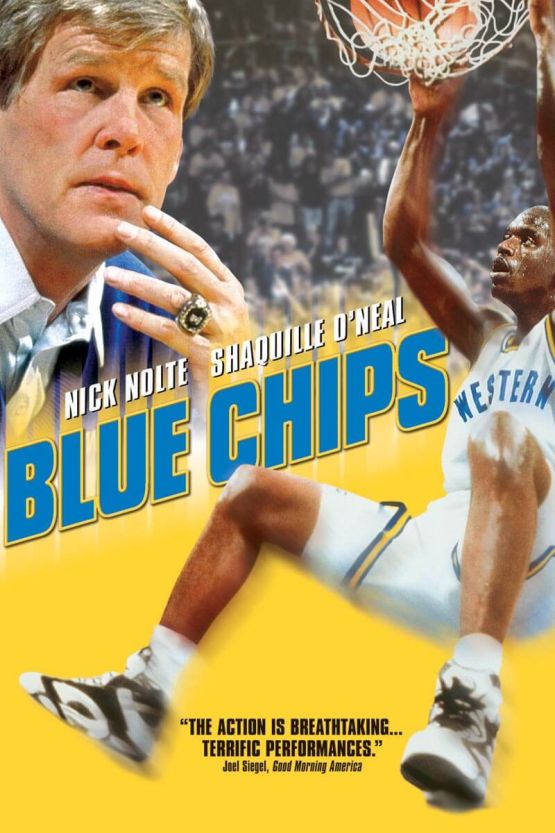
Recasting Couch
Paul Newman, Al Pacino, Jack Nicholson, and Gene Hackman are considered as alternate Pete Bells.
In the discussion (2)
- A more charismatic actor in the Paul Newman mold is proposed as a way to change the character, though Newman is considered too old for the part at that time. — Chris Ryan
- Al Pacino is preferred over Nolte. Jack Nicholson is considered in the correct age range, but the speaker is unsure how he would play despite his basketball knowledge and jokes that nobody would take his money. Gene Hackman is then offered positively, while also making the Hoosiers borrowing more obvious.
Films in the archive
48 Hrs.
1982



Another 48 Hrs.
1990
Blue Chips
1994
Cape Fear
1991

North Dallas Forty
1979

Tropic Thunder
2008

Warrior
2011