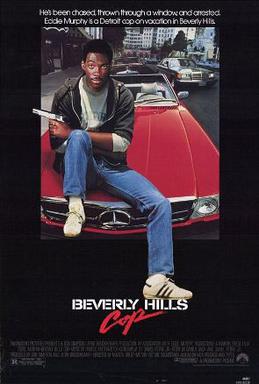
Whether Cop 2 is better: it is a better story and a flat-out good, more fun movie with good music, the Taggart and Rosewood thing and Brigitte Nilsson (as transcribed), with Eddie still great; the fondness for Cop 1 comes from everything it meant for the Eddie arc.
Was Axel Foley gay gets a yes, but the answer first returns to the period reviews, which were also upset about how the movie made white people look.
Pauline Kale (as transcribed) did not believe in Eddie Murphy's stardom and found it offensive because he used it as a joke on how dumb white people could be made to look by a smart black person, a sort of pro-minstrel argument against an anti-minstrel work; LA Times letters in 1985 characterized Murphy's swagger with a racial slur and worried that black confidence would replace white comedians.
One host as a kid felt the opposite, that it was the greatest thing that ever happened; Kale was about 65, not a racist, but had an interesting take on how black audiences responded to The French Connection, and old guard critics felt that way, so the rewatch was done aware that people were nervous Eddie was someone white people should fear.
To one host it is a movie about a gay black man in the Detroit police whose former best friend, probably lover or hookup buddy, gets killed, sending him on a mission; not having sex with a woman does not make you gay, but a near two-hour movie whose protagonist on the verge of major stardom never gets a moment with the girl is striking, even allowing that Eddie arrived two weeks before filming and nothing was rewritten.
Evidence: Jenny looks completely enamored, goes to the big three-room suite and immediately lies on the bed batting her eyelashes, and the only thing on Axel's mind is ordering room service for Taggart and Rosewood.
The Mikey scenes are weird to watch: at the bar they look like they are about to make out, they exchange 'I love you', and when Axel gets home after the chewing-out by Inspector Todd to find Mikey broken in with the fridge open he is elated; the counter is that a friend out of prison eating a mayo sandwich in your kitchen would get 'get out of my house, you felon'.
Gay characters are sprinkled throughout; it is an unintended consequence of a movie made with a ton of cocaine by the seat of its pants; at the strip joint he only tells Rosewood to give the dancer a dollar and does not partake, and his pretending is for plot rather than character; the movie is all pairs of men with emotional energy who could be on the verge of kissing, so subtext becomes text; 'is Axel gay' is a long-running Reddit conspiracy theory; James Russo brings a wild method energy to a two-minute part, a reckless guy out of prison who almost cries seeing his friend, which feels very real.
Eddie is drawn into Russo rather than watching a method performance, they are on the same page; the original ending reportedly had Eddie back in his Detroit apartment opening the closet to find Mikey's shirt and sniffing it, prompting the joke that Martin Brest was robbed of an Oscar; the movie probably intended none of it.
Intent does not matter because those things are in the movie we got; one host noticed it independently and wrote about it in a 2010 mailbag because the Jenny Summers scene jumped out, and may have inspired the theory; no other 80s action or genre movie lacks some nod to the hero's romantic life.
Even in 48 Hours Nick Nolte's girlfriend calls to complain and Eddie gets laid by Olivia Brown, his primary obsession in that film; Eilbacher is a beautiful blonde, not a character actress like Joan Cusack, whose function in any other movie of the period, see Stripes, is to give a straight hero somewhere to put his sexuality; perhaps it was a black-white thing, since the sex scene was cut from The Golden Child and they were not ready for Eddie to do that in a mainstream movie.
The conspiracy theory is compared to early Will Smith, who had Vivica A. Fox to get back to but few romantic leads for someone in his position, and did not help himself by skipping the kiss in Six Degrees of Separation, after which he always has a girlfriend, wife or dead spouse; the wish is that movies would acknowledge gay people exist and have sex lives instead of flicking at it.
Damon Wayans giving him the fruit plate with the banana for the tailpipe is text, not subtext, and Eddie turns around on his way out to say thank you, perfectly comfortable with the man; the movie's own setup is the you-killed-my-lover revenge premise of other action movies, taken as a vacation; one host watched it for 26 years without noticing until the other wrote about it.
The passion for Jenny Summers is the giveaway, how could a man not kiss her; the wish for one line where she hits on him and he insinuates he does not do that anymore is answered with 'that makes it worse'; it makes her character more interesting and hornier, and Eddie's complicated history with homophobia in his comedy makes the whole thing more frictive.
A tangent on Eddie's homophobia turns into a bit about one host's bullies now being gay married with three kids: bully someone and your sexuality will come for you.
During the scene discussion, 'before he dies, they're doing it' was raised about Axel and Mikey and saved for later.
During what aged best, Jenny is said to be a love interest for neither man, though she really tried with Eddie, and the subject is parked until later.
Jack handing over his gun; why Luther left the money in Reggie's car for years; Rosalie vanishes; no manhunt for Gans; the $957 suit; the lost twelve hours; Jack's dates with Annette O'Toole's character; Reggie leaving the hotel for Roman's; the easy return to Billy Bear's apartment; the Roman's girl; the night's timeline
Jack Cates giving up his gun when Jonathan Banks's cop has been shot but is not dead is not 1982 police procedure, and since these men have already shot cops one more hostage should not be enough; it should be a Mexican standoff.
Why was Reggie's car in the parking garage so long, and if Luther had the keys why did he wait for Gans to break out of prison instead of taking the money any time, and why does he have the keys at all; Rosalie screams when Luther is shot on the bus and is never seen again, presumably killed, perhaps cut because the movie had been hard enough on women.
Why there is no bigger manhunt for Gans after he kills two cops, unless it is the early-eighties feel of a city under budget siege; only Cates seems to be on it, and when he phones for messages after parting from Reggie at the subway the station of thirty people is business as usual.
Whether Reggie's suit would really cost $957, a lot of money then, perhaps a two-thousand-dollar suit adjusted for inflation or even ten thousand; it should have said $457.
The morning timeline: they wake, Luther crosses the street and gets the car, the chase leads to the subway and a near shootout, Gans and Billy Bear escape, Jack is nearly arrested by cops who do not know he is a cop, and Reggie runs after the money at about 9:30; the next scene is at night, so Reggie is gone ten to twelve hours before he phones from Roman's.
Is anyone worried that Jack has now lost the cop killers twice and lost the man he sprung for forty-eight hours; Reggie follows Luther to the hotel, eight hours pass, and he turns up at Roman's with a gun he somehow acquired, presumably from a friend.
The biggest nitpick is Jack making dates with Annette O'Toole's character during a cop-killer investigation, with her complaining that he makes her work too hard at it, which makes her a terrible girlfriend; Reggie leaving the hotel assuming Luther is in for twelve hours instead of hanging outside is an investigative faux pas, and Billy going back to his ex-girlfriend should have been staked out instead of abandoned after thirty seconds.
A tally of Jack and Reggie's interactions: a fistfight, Reggie coming clean, sleeping in the car without talking, the morning chase, the split, ten hours apart, Roman's, the bus chase and shooting at the bus; then Frank McRae's captain yells and Jack tells him Reggie has more guts than any partner after about ten minutes together and a stream of racial insults, which is movie magic.
Circling back to Billy Bear's apartment the second time is too easy, and if the girls there were harboring Billy why do they call the cops on Jack and Reggie; most importantly, Olivia Brown's character dances with Reggie once and is immediately ready to go across the street with him, paying since he has no money, until he spots Luther; the evening's clock is debated between 7:30, 8 and 10 with Roman's pumping.
After the bus crashes and the sheriff yells, there are drinks, Billy Bear, a big fight and Gans shot around two in the morning at a homicide scene, yet Eddie finds the Roman's girl, whose name he may not know, the same night; someone named Zach is asked when San Francisco bars closed in the eighties, and a reconstructed clock from a 7 o'clock Roman's to an 11 o'clock shootout leaves the girl waiting nine hours; a lot of holes.
Eddie Murphy: one host says yes, ahead of Beverly Hills Cop; the other thinks Cop was his Apex Mountain as a better overall performance carried alone, answered with the forty-and-twenty-five box score he puts up here; after Cop, without Nolte or Dan Aykroyd beside him, he and Michael Jackson were the two biggest stars in the world, and both films rank above Trading Places.
Nick Nolte: no; Blue Chips and Prince of Tides are floated, Prince of Tides for success, North Dallas 40 as probably his best performance since you believe he played in the NFL, plus Rich Man, Poor Man watched by fifty million, Cape Fear and Who Will Stop the Rain; a lot of really good work but nothing definitively incredible, so no apex.
Walter Hill: The Long Riders, his Western about the James gang from around the same time, is raised first, but this film is called very high and 'this one' is the answer given; San Francisco is a great movie character rarely maximized like this, with Mrs. Doubtfire, Pacific Heights, Dirty Harry and Bullitt as other San Francisco movies, and the film captures the city's old cow-town backwater quality.
Sonny Landham: no, Predator is his apex, cutting his chest with a knife and waiting for the predator, on the same bill as Schwarzenegger, Carl Weathers and Ventura, his political mentor; James Remar: one hundred percent yes, though one host's wife wanted Sex and the City named instead.
Remar is also great in The Warriors, and Gans has an ignominious ending, roughing up the female cop for no reason, which flips the audience from liking a badass to recoiling; he works constantly, turning up in What Lies Beneath at two in the morning; Olivia Brown's apex was Miami Vice; Frank McRae topped out here.
Not since the Heat episode have there been this many nominees: James Remar as Gans; Sonny Landham as Billy Bear, whose box score is likened to Ben Wallace in 2006, seventeen rebounds and five blocks in nine minutes, plus forty; and Jonathan Banks as the cop who gets shot, with the plea not to give Gans the gun.
Brian James as Kehoe (transcribed 'Keough') is hated because he becomes the bad guy in Another 48 Hours; Olivia Brown, future Miami Vice star, plays the girl who falls for Reggie Hammond in a minute.
One host names James Remar the winner; the other disputes it and goes with Frank McRae as Captain Hayden, quoting his suspension-and-review-board tirade; a tangent on great angry captains includes Cobb in Beverly Hills Cop; McRae is a great eighties cop captain who played the cop in about five movies and surprisingly never demands Jack's gun and badge here.
The Remar pick stands and the choice is respected as what makes the category great; the objection is that Gans is so evil, though believably and never-not evil, killing something like nine cops over five hundred thousand dollars because he likes it.