
‹ All movies
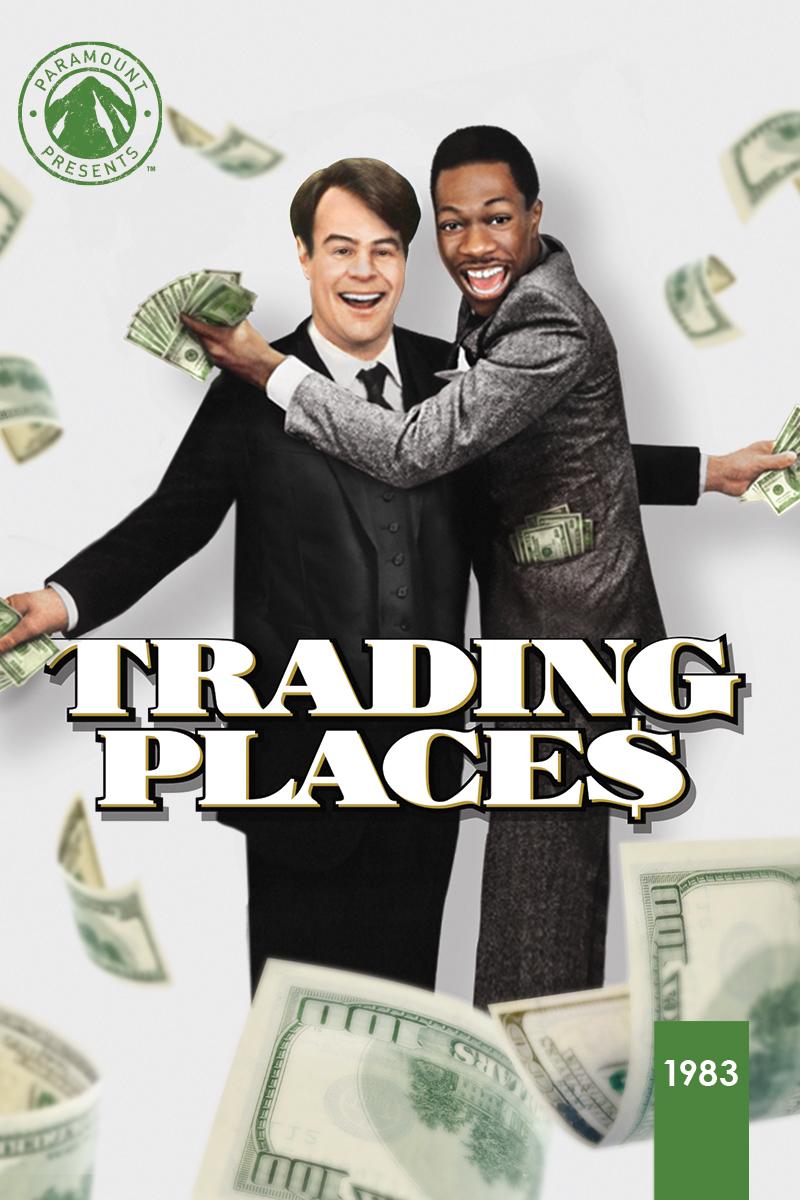
Trading Places poster

Trading Places

116 minutes

Cast

Selected cast credits · Film reference

Dan Aykroyd Louis Winthorpe III
Eddie Murphy Billy Ray Valentine
Ralph Bellamy Randolph Duke
Don Ameche Mortimer Duke
Denholm Elliott Coleman
Paul Gleason Clarence Beeks
Frank Oz Corrupt Cop
Jim Belushi Harvey
Kristin Holby Penelope Witherspoon
Alfred Drake President of Exchange
Bo Diddley Pawnbroker
Al Franken Baggage Handler #1
Tom Davis Baggage Handler #2
Maurice Woods Duke & Duke Employee
Richard D. Fisher, Jr. Duke & Duke Employee
Anthony DiSabatino Duke & Duke Employee
Bonnie Behrend Duke & Duke Employee
Sunnie Merrill Duke & Duke Employee
James Newell Duke & Duke Employee
Mary St. John Duke & Duke Employee
Bonnie Tremena Duke & Duke Employee
David Schwartz Duke & Duke Employee
Tom Degidon Duke Domestic
William Magerman Duke Domestic
Alan Dellay Duke Domestic
Florence Anglin Duke Domestic
Ray D'Amore Duke Domestic
Bobra Suiter Duke Domestic
Herb Peterson Duke Domestic
Sue Dugan Duke Domestic
Walt Gorney Duke Domestic
B. Constance Barry Duke Domestic
P. Jay Sidney Heritage Club Doorman
Avon Long Ezra
Tom Mardirosian Officer Pantuzzi
Charles Brown Officer Reynolds
Tony Sherer Philip
Robert Earl Jones Attendant
Robert E. Lee Cop #1
Peter Hock Cop #2
Clint Smith Doo Rag Lenny
Ron Taylor Big Black Guy
James D. Turner Even Bigger Black Guy
Giancarlo Esposito Cellmate #2
Steve Hofvendahl Cellmate #3
Gwyllum Evans President of Heritage Club
Eddie Jones Cop #3
John McCurry Cop #4
Michelle Mais Hooker #1
Barra Khan Hooker #2
Bill Cobbs Bartender
Joshua Daniel Party Goer
Jacques Sandulescu Creepy Man
W.B. Brydon Bank Manager
Margaret H. Flynn Duke & Duke Receptionist
Kelly Curtis Muffy
Tracey K. Shaffer Constance
Lucianne Buchanan President's Mistress
Jed Gillin Jr. Executive #2
Jimmy Raitt Ophelia's Client
Kate Taylor Duke's Secretary
Philip Bosco Doctor
Bill Boggs Newscaster
Deborah Reagan Harvey's Girlfriend
Don McLeod Gorilla
Stephen Stucker Stationmaster
Richard Hunt Wilson
Paul Austin Trader #1
Jack Davidson Trader #3
Bernie McInerney Trader #4
Maurice Copeland Secretary of Agriculture
Ralph Clanton Official #1
Bryan Clark Official #2
Gary Klar Longshoreman
Afemo Omilami Longshoreman
Donna Palmer Gladys
Barry Dennen Demitri
Murray Bandel Man at Police Station (uncredited)
Benjean Stray Dog (uncredited)
John Black Man Sitting on Couch at Party (uncredited)
John Landis Man with Briefcase (uncredited)
Shirley Levine Bag Lady (uncredited)
Charles Pendelton Cop (uncredited)
Yvonna Russell Girl in Park (uncredited)
Jan Saint Man in Police Station (uncredited)
Arleen Sorkin Woman at Party (uncredited)
Ronald Sylvers Rolls Royce Driver (uncredited)
Marlene Willoughby Woman Passed Out on Couch (uncredited)
Jim Gallagher Duke & Duke Employee

Trading Places | The Rewatchables

Explore episodeClose episode

Half-Assed Internet Research

Box office and contract; screenplay origins; credits; cameos; sailboat; dialogue; song; mugshot; traders; career counts; trading rule; money clip; profanity; restaurant; Italian broadcast

In the discussion (20)
Approx. transcript time · 00:05:48Read transcript
  • The film reportedly stayed in the box-office top ten for 17 weeks.
  • Paramount reportedly rewarded Murphy with a $25 million five-film contract and financing for a production studio.
  • Writer Timothy Harris’s experience with two wealthy, cheap tennis partners reportedly inspired the Duke brothers.
  • Commodity research included the Hunt brothers and Silver Thursday; familiar orange juice and pork bellies helped make the trading story accessible.
  • The Prince and the Pauper is noted as a possible influence rather than a firmly documented adaptation.
  • The budget is corrected from $50 million to $15 million, with $120.6 million gross and fourth place for 1983 reported.
  • The performer playing Penelope is described as a model with only this film and Manhunter credited, later marrying a biology professor and related to Ansel Elgort; these are reported biographical claims.
  • Harris reportedly received competing claims that Russo or Katzenberg originated the idea once the film became successful.
  • Esposito is identified in the jail scene and Falco as the disgusted salmon witness.
  • The ending’s 56-foot sailboat is reported still in the Caribbean, with the Virgin Islands identified.
  • Murphy reportedly changed stereotyped dialogue; Murphy and Landis opposed the studio’s attempt to remove the Kools-on-the-rug line.
  • The quartet song is described as an American Civil War song; its title is rendered “Orelia” in the transcript.
  • Louis’s mugshot number matches Jake Blues’s number in The Blues Brothers.
  • Actual traders were used in the exchange scenes.
  • The veteran actors’99th and 100th film claims prompted Murphy’s joke that the three collectively made 201 films.
  • A 2010 commodities restriction is reported as the Eddie Murphy rule.
  • The money-clip fumble reportedly happened unintentionally.
  • Ameche reportedly agreed to say the final profanity only once because of religious convictions.
  • A Philadelphia Westin restaurant was named Winthorpe and Valentine.
  • The film is reported as an annual highly watched Italian Christmas Eve broadcast.

Most Rewatchable Scene

Trading floor; Curtis’s nude scenes; bar and limousine reveal also strongly considered

In the discussion (18)
Approx. transcript time · 00:11:37Read transcript
  • The opening credits establish Philadelphia, season and atmosphere before the characters.
  • Billy Ray’s supposed miraculous recovery reveals his street hustle and explosive comic presence.
  • The collision with Louis leads to armed police confrontation and a Blues Brothers callback.
  • The Dukes’ offer prompts Billy Ray to consult the chauffeur and test whether the arrangement is a joke.
  • Billy Ray explores the house, calls Coleman his slave and breaks the vase while testing what ownership means.
  • The bar reunion and limousine reveal are strong contenders.
  • The house party turns Billy Ray protective of his possessions, including cigarette damage.
  • The Christmas party through overhearing the bet is nominated, including salmon in the Santa suit.
  • Billy Ray pockets one joint while confiscating the planted drugs.
  • The bathroom conversation and inhaler are favorite details.
  • Louis waking and confronting Billy Ray leads to the experiment explanation.
  • The trading sequence is nominated.
  • The final beach ending is nominated.
  • Billy Ray’s jail stories, broken limousine phone and karate boasting are considered among the funniest comedy scenes.
  • Curtis’s nude scenes are emphatically selected as formative and highly rewatchable.
  • The trading floor is an explicit final choice, praised as a satisfying heist-like conclusion beginning with the financial contributions at the station.
  • The Dukes’ collapse culminates in the demand to reopen trading and indifference to a brother’s illness.
  • Billy Ray proves his value through the kung-fu-grip market reasoning and saves the Dukes money.

Roger Ebert's review

In the discussion (1)
Approx. transcript time · 00:25:39Read transcript
  • Ebert gave 3.5 stars, praising character-based comedy beyond simple racial-prejudice lessons.

What’s Aged the Best?

Murphy; escargot joke; credits and score; bookies comparison; Coleman; Dukes; gorilla reaction; class details; Constance Fry; Penelope; Coming to America callback; trading ending; camera look; profanity

In the discussion (21)
Approx. transcript time · 00:39:20Read transcript
  • Young Murphy is selected.
  • The cheap judge’s escargot joke and toupee remain funny.
  • Opening credits and score are reiterated.
  • Billy Ray describing commodities brokers as bookies neatly captures the business.
  • Coleman’s emotional discomfort makes him a moral indicator despite his complicity with the Dukes.
  • The Dukes’ natural sibling chemistry and professional delivery are praised.
  • The gorilla’s reaction when the characters consider what to do with Beeks is a favorite small joke.
  • Louis silently waiting for Coleman to open the door captures entitlement.
  • Squash and the exclusive Heritage Club establish privileged social life.
  • Penelope’s Muffy nickname and Exeter and Harvard references reinforce class signals.
  • The Constance Fry song is admired, including the oddity of performing it beside its apparent subject.
  • Louis dismissing dessert and leaving it to Coleman is another rich-person detail.
  • The small tips are another class detail.
  • The distinction between heroin and PCP makes the confrontation with Muffy funny.
  • The Dukes’ later appearance in Coming to America provides a satisfying callback.
  • Penelope’s performance is praised as consistently strong.
  • The orange-juice ending succeeds without lengthy explanations of short-selling.
  • Murphy’s direct-to-camera deadpan during the bacon, lettuce and tomato explanation is praised.
  • Beeks abruptly dismissing the payphone woman is a favorite profane moment.
  • The party-serving exchange includes a dismissive “fuck them,” another admired profane moment.
  • Coleman reacting to the woman’s fur and becoming a teammate rather than merely a lifelong servant adds a meaningful arc.

Mount Rushmore for Butlers

Coleman; Alfred; Clue’s butler; Hobson; Jeffrey added; Annie, Alice and Belvedere considered

In the discussion (8)
Approx. transcript time · 00:40:02Read transcript
  • Coleman is included in the proposed butler Mount Rushmore.
  • Alfred is included.
  • Tim Curry’s Clue butler is included.
  • Hobson from Arthur is included.
  • Annie’s unnamed possible butler is floated uncertainly.
  • Jeffrey from The Fresh Prince of Bel-Air is endorsed.
  • Alice from The Brady Bunch raises an eligibility question about maids versus butlers.
  • Mr. Belvedere is added with uncertainty about his caretaker role.

Probably Unanswerable Questions

Investment size; Murphy jail scenes; sympathetic sex-worker characters; smoothies; Beeks’s fate; Ophelia and Coleman

In the discussion (9)
Approx. transcript time · 00:48:35Read transcript
  • How much the heroes invested and whether their island stay represents retirement or vacation remain unresolved; savings may have restored their finances without enormous wealth.
  • This film’s jail scene is preferred to 48 Hrs., though the latter is considered a more iconic character introduction.
  • Curtis’s Ophelia is proposed as the best sympathetic sex-worker character, while Roberts is preferred in response; physical rescue and emotional rescue are compared.
  • Coleman’s drink prompts the joking question of whether he invented smoothies and a proposed expensive namesake drink.
  • The length of Beeks’s voyage to Africa is questioned.
  • Why the gorilla is at the Philadelphia station and what treatment Beeks experiences remain unresolved.
  • The costume going unnoticed and Beeks surviving for a year are questioned.
  • Poor animal care and the trip’s unsanitary conditions are offered as dark explanations for Beeks’s predicament.
  • A suggested Ophelia-Coleman sexual encounter is rejected because she is understood to love Louis.

The Big Kahuna Burger Award for Best Use of Food and Drink

Crêpes Suzette; Santa salmon, grossest

In the discussion (3)
Approx. transcript time · 00:51:11Read transcript
  • Crêpes Suzette are selected as best use, including Coleman discarding the rejected dessert.
  • Santa-suit salmon is identified as the grossest use, with discussion deferred.
  • Salmon pulled from the Santa coat and eaten through the dirty beard is the deliberately repulsive food image.

What’s Aged the Worst?

Blackface; homophobia; racial language, context qualified; lost impact of nudity; E.F. Hutton reference; World Trade Center line; Santa salmon

In the discussion (7)
Approx. transcript time · 00:54:21Read transcript
  • Blackface is the first explicit choice.
  • The film’s pervasive homophobia is identified.
  • Racist language is described as jarring but effective in exposing the Dukes’ worldview, including the charged use of both an older racial term and a slur.
  • The historical impact of Curtis’s nudity is difficult to communicate decades later.
  • The E.F. Hutton silence gag depends on a now-obscure advertisement reference.
  • The World Trade Center kill-or-be-killed line has become dark in retrospect and is reportedly cut from some television versions.
  • The Santa depiction caused childhood distrust; the salmon beard remains revolting.

The Stephen A. Smith Hottest Take Award

Heroes could face trading charges; Chase as Louis; Christmas-movie preference

In the discussion (3)
Approx. transcript time · 01:04:35Read transcript
  • The heroes may also face insider-trading consequences for stealing and exploiting the report, with Beeks and the Dukes’ lawyers potentially exposing them.
  • Chase is imagined as excellent in Aykroyd’s role, though whether he would be better is doubted and his usual comic persona differs.
  • Trading Places is preferred as an underrated Christmas-adjacent film to Home Alone and Die Hard, despite uncertainty over calling any of them Christmas films.

Casting What-Ifs

Pryor and Wilder; Aykroyd pay cut; Curtis casting resistance; Milland to Ameche; Liddy as Beeks; Moranis and Thomas

In the discussion (9)
Approx. transcript time · 01:09:51Read transcript
  • The project was originally developed for Pryor and Wilder.
  • Pryor’s burn injury reportedly prevented his participation, and Paramount backed Murphy.
  • Murphy reportedly resisted working with Wilder because of the established Pryor-Wilder association.
  • The Vietnam-veteran hustle is attributed to the original plan to cast Pryor.
  • Aykroyd reportedly took a major pay cut after studio doubts about his solo appeal.
  • Landis insisted on Curtis despite Paramount’s resistance.
  • Ray Milland reportedly failed a physical, leading to Ameche’s return from a long acting gap.
  • G.Gordon Liddy reportedly declined Beeks because of the gorilla ending.
  • Moranis and Thomas were intended as the baggage handlers before Franken and Davis.

The Joey Pants “That Guy” Award

First arresting officer; Philip Bosco; Eckhouse, Oz, Scent of a Woman actor and Airplane II actor mentioned; Cobbs eligibility unclear

In the discussion (8)
Approx. transcript time · 01:13:26Read transcript
  • The first arresting officer is selected through recognition from Presumed Innocent and Oz; the actor’s name remains unstated.
  • James Eckhouse, known as the 90210 father, is nominated.
  • Frank Oz is nominated.
  • A supporting man recognized from Scent of a Woman’s Thanksgiving scene is nominated without a clear name.
  • Beeks is rejected as too established.
  • Philip Bosco as the doctor receives an explicit final choice.
  • The wisecracking AirplaneII performer is nominated without a spoken name.
  • Bill Cobbs’s eligibility is discussed with an unclear back-and-forth rather than a stable ruling.

Apex Mountain

Hoagie City; 1983 Philadelphia; Philadelphia films, qualified; commodities

In the discussion (11)
Approx. transcript time · 01:18:01Read transcript
  • Murphy’s peak is debated between Beverly Hills Cop and Coming to America rather than this film.
  • Landis receives a tentative yes, qualified as possibly the filming period because of the trial.
  • Aykroyd’s peak is placed at Ghostbusters.
  • Hoagie City receives yes.
  • Philadelphia’s 1983 peak is affirmed, with the nation’s founding as an exception.
  • Landis’s tentative peak is reconsidered against Coming to America, Animal House and the period after The Blues Brothers; no firm final choice emerges.
  • Ameche and Bellamy receive no.
  • Philadelphia films receive a qualified case for this film and the early 1980 s, with RockyIII, Blow Out, Creed and 12 Monkeys offered as comparisons.
  • Eating salmon in a Santa suit is met with a pass.
  • Gleason’s peak is placed at The Breakfast Club.
  • Commodities receive an affirmative choice, with frozen orange-juice trading singled out as a revelation.

Best Race Horse Name from This Movie

Billy Ray Valentine, qualified; unresolved Constance/lake phrase

In the discussion (2)
Approx. transcript time · 01:21:50Read transcript
  • Billy Ray Valentine is praised as a name, with uncertainty about its suitability for a racehorse.
  • A Constance-and-lake phrase is suggested for a filly; the ASR wording is unresolved.

Picking Nits

Louis’s benefits; Dukes’ shared home; salmon; Coleman’s loyalty; crop-report news and forgery; dark handoff; infection risk

In the discussion (10)
Approx. transcript time · 01:22:01Read transcript
  • Louis’s apparent wealth despite his salary is explained by employer-provided house, butler and other benefits that can be withdrawn.
  • The wealthy Dukes sharing a home without visible spouses or families seems odd; thrift, companionship, widower or lifelong-bachelor possibilities are offered.
  • A joking suggestion that the Dukes are lovers draws objections that they are clearly brothers; the billionaire description is also corrected.
  • Separate wings in a family compound and economical storytelling are defenses of the shared residence.
  • Louis’s hunger and intoxication are revisited as the explanation for the salmon.
  • Coleman switching sides is explained by being treated as a person and included in the team.
  • Local television covering delivery of a crop report seems implausible.
  • The method of fabricating the crop report is not shown and must be accepted.
  • The Dukes should verify Beeks’s identity before exchanging money in a dark garage.
  • Ophelia getting into bed with a coughing Louis raises an infection concern, countered by memories of routinely sharing winter illnesses.

Sequel, Prequel, Limited Series, or All-Black Remake

Untouchable; joking Beeks sequels

In the discussion (3)
Approx. transcript time · 01:27:39Read transcript
  • The film is considered untouchable, with strong opposition to a remake.
  • A revenge sequel brings Beeks back to America.
  • A joking alternative has Beeks stay with the gorilla rather than seek revenge.

Is This Movie Better With…?

Wayne Jenkins on Treasury bills and as island butler

In the discussion (1)
Approx. transcript time · 01:28:22Read transcript
  • Wayne Jenkins riffs respond to Ophelia’s Treasury bills and imagine him as the island butler.
In the discussion (3)
Approx. transcript time · 01:29:15Read transcript
  • Murphy is the clear acting choice, with a supporting placement proposed strategically despite recognition that he is a lead.
  • The screenplay is considered, then Murphy’s rewritten dialogue complicates the choice.
  • The reported supporting-actor field includes Jack Nicholson (Terms of Endearment), Charles Durning (To Be or Not to Be), John Lithgow (Terms of Endearment), Sam Shepard (The Right Stuff), and Rip Torn (Cross Creek).

The Andy and Red – Zihuatanejo Award for What Happens the Next Day?

Beach already shown; new firm or arrest; Santa-return joke

In the discussion (3)
Approx. transcript time · 01:34:37Read transcript
  • The beach epilogue already shows the immediate aftermath; starting a firm is suggested as a later step.
  • Arrest for the trading scheme reprises the earlier legal-consequences theory.
  • The rejected Ophelia-Coleman idea returns as a joke that would put Louis back in the Santa suit.

Producer review

Strong film with a message; newer comedies may be funnier

In the discussion (2)
Approx. transcript time · 01:36:30Read transcript
  • The film is liked but may be less funny than Step Brothers while being a better movie because it has a subject and message. — Craig Horlbeck
  • Older comedies such as The Breakfast Club and Parenthood are contrasted with the bit-driven laughs of Anchorman, leaving the quality-versus-funniness distinction unresolved. — Craig Horlbeck

More from the conversation

Simmons, Ryan and Lathan introduce the episode amid Philadelphia basketball discussion.
Approx. transcript time · 00:01:16Read transcript
The 40 th-anniversary timing prompts praise for early 1980 s Philadelphia’s sports and movie prominence, including the long city-montage opening.
Approx. transcript time · 00:02:44Read transcript
Family repeat viewing established Murphy as an almost sacred pop-culture figure alongside Jackson and Prince.
Approx. transcript time · 00:03:53Read transcript
The film completes a run of major Murphy episodes and combines rising-star expectations with Aykroyd and Landis’s comedy reputations.
Approx. transcript time · 00:04:28Read transcript
Murphy’s rise is contrasted with Pryor’s later career and the coming Cosby Show, with SNL supplying a broad audience.
Approx. transcript time · 00:04:58Read transcript
Long theatrical runs and repeat ticket purchases gave stars a different cultural presence than contemporary franchise-driven releases.
Approx. transcript time · 00:05:48Read transcript
Letterman, Murphy, Cruise, Keaton, Broderick, Seinfeld, Stern, Hughes and MTV illustrate a perceived early 1980 s generational transition.
Approx. transcript time · 00:07:50Read transcript
The movie combines an older visual style with confrontational satire of homelessness, greed and capitalism.
Approx. transcript time · 00:09:20Read transcript
Moral judgments concern worldviews rather than permanently good or bad characters; Louis’s changing circumstances demonstrate the point.
Approx. transcript time · 00:09:43Read transcript
The structure moves through Louis’s privilege, downfall, Billy Ray’s ascent and eventual joint revenge.
Approx. transcript time · 00:11:06Read transcript
The beach ending and screwball ensemble connect the film to classic Sturges and Capra comedy, even as the train chaos is less effective now.
Approx. transcript time · 00:11:37Read transcript
The cast’s youth and appearances by Esposito, Franken, Belushi and Eckhouse become striking on later viewing.
Approx. transcript time · 00:12:28Read transcript
Murphy’s expected SNL departure and Aykroyd’s career after Belushi frame the film’s significance.
Approx. transcript time · 00:13:22Read transcript
Aykroyd needed proof of film viability after disappointing projects and Belushi’s death; Trading Places and Ghostbusters supplied it.
Approx. transcript time · 00:13:45Read transcript
The Blues Brothers’ cultural significance may not translate to younger viewers; its star-filled, chaotic style is compared with other hazy 1980 s comedies.
Approx. transcript time · 00:14:16Read transcript
Curtis’s career before this film is discussed through her horror-film roles, including Halloween, The Fog, Prom Night and Terror Train.
Approx. transcript time · 00:15:37Read transcript
A personal childhood-attraction list includes Jamie Lee Curtis and Vanna White, later Kelly Kapowski and Courtney Thorne-Smith. Valerie Malone and Mallory Keaton are queried; Kirstie Alley is discussed through Summer School but not accepted as a current choice.
Approx. transcript time · 00:15:51Read transcript
Shiv Roy is added during the fictional-character attraction discussion, with debate over her personality.
Approx. transcript time · 00:16:23Read transcript
Curtis’s nudity is recalled as unexpected, followed by memories of family viewing rules.
Approx. transcript time · 00:17:30Read transcript
Porky’s, Revenge of the Nerds and Police Academy illustrate the era’s common gratuitous nudity, with the first two judged poor on revisiting.
Approx. transcript time · 00:18:49Read transcript
Landis’s run of Animal House, The Blues Brothers, Trading Places and Coming to America is praised; the Twilight Zone accident is discussed separately as part of his career context.
Approx. transcript time · 00:19:16Read transcript
Murphy was still an excited young performer on this set before later superstardom, according to the production anecdotes.
Approx. transcript time · 00:20:11Read transcript
Repeated Making of Thriller broadcasts made Landis an unusually recognizable director; limited shared media amplified such cultural moments.
Approx. transcript time · 00:20:55Read transcript
The segmented plot introduces Murphy and Curtis relatively late yet gives each scene clear character work.
Approx. transcript time · 00:23:55Read transcript
Even small supporting roles, including the bartender and arresting officers, are praised as precisely cast.
Approx. transcript time · 00:24:45Read transcript
The Mozart-based score and Bernstein’s contribution are praised as central to the film.
Approx. transcript time · 00:25:09Read transcript
The stated 1983 box-office list is Return of the Jedi, Tootsie, Flashdance, Trading Places, WarGames, Octopussy, Staying Alive, Risky Business, Mr. Mom and National Lampoon’s Vacation; SupermanIII and 48 Hrs. extend it to twelve. The latter’s December release explains its carryover.
Approx. transcript time · 00:28:21Read transcript
The Philadelphia opening inspires a hypothetical Baton Rouge montage in March, with local landmarks and weather considerations.
Approx. transcript time · 00:29:24Read transcript
The Rocky statue’s presence connects Philadelphia’s movie identity to its real cityscape.
Approx. transcript time · 00:30:22Read transcript
Curtis’s second nude appearance is staged for the audience while Louis faces away, reinforcing its remembered impact.
Approx. transcript time · 00:37:29Read transcript
Penelope’s abandonment of Louis and relationship with Todd spark disagreement over loyalty and the group’s social hierarchy.
Approx. transcript time · 00:44:58Read transcript
An informal explanation of the futures trade describes selling high and buying back cheaply, with a margin call ruining the Dukes; the mechanics and profit estimates remain podcast explanations rather than independently verified finance facts.
Approx. transcript time · 00:47:17Read transcript
A Richard Dreyfuss interview about casting and diversity rules supplies the context for a proposed blackface category.
Approx. transcript time · 00:53:10Read transcript
The blackface discussion distinguishes lack of mainstream controversy at release from longstanding objections within Black communities; Murphy’s presence and limited childhood awareness may have softened some viewers’ reactions.
Approx. transcript time · 00:54:39Read transcript
The train disguise is considered unnecessary, with many alternative characters available; other comedy and Halloween examples show the practice persisted.
Approx. transcript time · 00:55:50Read transcript
Streaming content warnings now explicitly identify blackface; old strong-sexual-content labels inspire television-viewing recollections.
Approx. transcript time · 00:56:56Read transcript
Portraits of founding figures underline old power, while the island ending imagines a more inclusive generation replacing it.
Approx. transcript time · 00:58:33Read transcript
Home Alone’s holiday vacation, winter gags and reconciliation are defended as Christmas elements, while objections say the plot could work in another season.
Approx. transcript time · 01:08:19Read transcript
Christmas Vacation’s bonus, visiting family, lights and decorating are offered as more central holiday mechanisms, though hypothetical substitutions are debated.
Approx. transcript time · 01:09:15Read transcript
Miracle on 34th Street and Christmas Vacation are offered as films centrally about Christmas.
Approx. transcript time · 01:09:15Read transcript
The Pryor-to-Murphy casting shift made the leads younger and more plausible as people climbing the social ladder.
Approx. transcript time · 01:10:38Read transcript
Running Scared’s tropical finale inspires a possible episode suggestion.
Approx. transcript time · 01:15:14Read transcript
Making-of features let Murphy describe working with veterans whose film histories seemed impossibly long.
Approx. transcript time · 01:16:54Read transcript
Hoagie bread and Philadelphia’s restaurant reputation prompt regional teasing.
Approx. transcript time · 01:19:26Read transcript
The exchange’s handwritten, shouted trading appears chaotic to viewers unfamiliar with its procedures.
Approx. transcript time · 01:21:41Read transcript
Examples of rich men sharing a home include Step Brothers and A Night at the Roxbury, although their absurdity does not resolve the objection.
Approx. transcript time · 01:26:28Read transcript
The remake objection extends to contemporary remakes of White Men Can’t Jump and House Party.
Approx. transcript time · 01:27:39Read transcript
An imagined framing at a workplace meeting reprises Louis’s planted-drug humiliation.
Approx. transcript time · 01:36:14Read transcript
The response agrees that a tighter story distinguishes this film from a hypothetical longer sequence of Murphy bits.
Approx. transcript time · 01:37:33Read transcript
The closing tease announces a future movie with a musical theme, not a tag for this episode.
Approx. transcript time · 01:38:10Read transcript