
‹ All movies

The waterfall jump

The category is set up as the scene you stay for when you catch the movie while flipping channels; one host has five and invites additions, and one participant asks to guess them first.

The guesses: the first-act fight with the huge guy in the gang that ends with one kick, which is on the list, and the third-act attempt to rob the Bolivian bank while getting the Spanish right, which was not on the list but gets added.

"I got vision and the rest of the world wears bifocals"

Nominations: the bifocals line, 'every day you get older, that's a law', called a good senior yearbook quote, 'this is no time for bravery, I'll let you', and Etta's monologue about sewing socks and stitching wounds but refusing to watch him die, a great moment.

The film

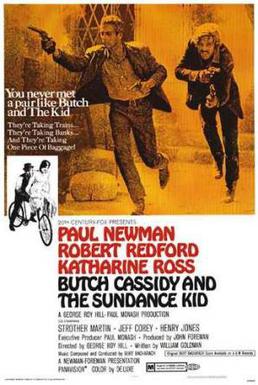
Butch Cassidy and the Sundance Kid (1969)

Directed by George Roy Hill · Western

110 minutes

Cast

Selected cast credits · Film reference

Paul Newman Butch Cassidy
Robert Redford the Sundance Kid
Katharine Ross Etta Place
Strother Martin Percy Garris
Jeff Corey Sheriff Bledsoe
George Furth Woodcock
Ted Cassidy Harvey Logan
Timothy Scott "News" Carver
Charles Dierkop Flat Nose Curry
Henry Jones Bike Salesman
Kenneth Mars Marshal
Jody Gilbert Large Woman on Train
Pancho Córdova Bank Manager
Enrique Lucero Bolivian Guard
Nelson Olmsted Photographer

Everything from the episode

In the order the hosts got to it. Open a row for the discussion.

36:14

Roger Ebert's review

In the discussion (1)
Approx. transcript time · 00:36:14Read transcript
  • Ebert gave the film two and a half of four stars and was not a fan of the last hour, its dialogue or the violent, bloody ending; the hosts think he came around over the years, and recall a 1980s special in which he and Siskel publicly admitted not liking the movie, which they stood by even though it is now a very unpopular opinion.
38:27

Casting What-Ifs

Steve McQueen as Sundance, out over billing; Jack Lemmon and Warren Beatty turned Sundance down; Zanuck's split-print...

Steve McQueen as Sundance, out over billing; Jack Lemmon and Warren Beatty turned Sundance down; Zanuck's split-prints billing idea; Redford a near-unknown; Natalie Wood considered for Etta

In the discussion (8)
Approx. transcript time · 00:38:27Read transcript
  • Redford was not the original Sundance: Jack Lemmon was offered the part, at Goldman's suggestion, and turned it down feeling he had played too many aspects of the character; Warren Beatty turned it down as too similar to Bonnie and Clyde; Steve McQueen was in, and the title was to become The Sundance Kid and Butch Cassidy because McQueen considered himself the bigger star than Newman.
  • The fight over whether McQueen or Newman would be billed first drove McQueen off the movie; asked whether this is true, one participant confirms that kind of nonsense happens all the time, over billing and over parts not taken.
  • Fox president Daryl Zanuck (as transcribed) made the unusual suggestion that half the prints bill Newman first and half McQueen, McQueen refused and left, and they got Redford, a handsome theater actor nobody knew, known if at all for urbane Neil Simon comedy like Barefoot in the Park; he has maybe a hundred words in the movie, becomes a giant star in four expressions, gives a great performance, and played men of few words for the rest of his career, even as Bob Woodward.
  • The long sepia close-up when Redford is first met, held while someone else talks, is one of the all-time close-ups and became a Redford signature, a good editing-room decision; Goldman wrote that Newman's people, not Newman himself, were upset by all the Redford close-ups and worried Redford would steal the movie.
  • Natalie Wood was considered for Etta.
  • Catherine Ross was in The Graduate, the biggest movie of the year before, then in this, the biggest movie of its year, and was in pole position as the good-looking actress of choice, but did not want that power, toned it back, did some stage work and the moment left; Anne Bancroft was only three or four years older than her in The Graduate.
  • Goldman was unsure whether the real Etta was a schoolteacher or a prostitute and, from how pretty and cleanly dressed she was in photos, chose to believe schoolteacher, though the historical record is fuzzy; it would have been unusual for a woman of about 24 to be unmarried.
  • Ally McGraw (as transcribed) of Love Story was the market correction, though Ross, the better actress, could have corrected her back and instead gave up, with Mia Farrow and Ellen Burstyn the other big actresses; research suggests Ross was difficult and disliked making movies; she met Sam Elliott, a card player with a very small role here, did not date him, and married him fifteen years later.
44:06

Most Rewatchable Scene

The waterfall jump

The waterfall jump

In the discussion (8)
Approx. transcript time · 00:44:06Read transcript
  • The category is set up as the scene you stay for when you catch the movie while flipping channels; one host has five and invites additions, and one participant asks to guess them first.
  • The guesses: the first-act fight with the huge guy in the gang that ends with one kick, which is on the list, and the third-act attempt to rob the Bolivian bank while getting the Spanish right, which was not on the list but gets added.
  • The first Redford scene: with no history with the actor, the close-ups and the different 1870s-style color make you wonder what is going on, the film carefully establishes in two minutes that nobody should mess with him though he is not physically huge, and it ends with him firing six bullets around the man without killing him, instant mythology, while Newman knows what is coming and is already flying out of the way.
  • Butch kicking the giant leader in the balls is on the list; Goldman wrote that people objected because a John Wayne hero would not do that, and studio people asked why Sundance was not helping, joking dryly about bets instead; the answer is that Sundance knows exactly what is going to happen and is not worried about Butch at all.
  • The train robbery that introduces the super posse is on the list, though the first train robbery where they blow the car up could be argued; the Woodcock clip is played, the poor man nearly murdered out of loyalty to E.H. Harriman, and the actor is identified as George Firth (as transcribed); the second robbery with the horse posse is called a great seven minutes, with Goldman's book explaining how it was shot.
  • Further nominees: the Bolivian bank scene, the ending, the payroll-up-the-hill scene in Bolivia with the colorful character actor right before he is shot, its sister scene where it comes out that Butch has never shot anyone, the waterfall, and the meeting with Bledsoe where they try to enlist, which one host holds back for another category.
  • It comes down to the train robbery and super posse scene versus the waterfall; the waterfall is called one of the most rewatchable scenes of all time and the clip is played, with the angry, embarrassed 'I can't swim' named a favorite line reading, Newman's reaction praised, and the jump and the men coming in called everything you want from an action scene.
  • Earlier, Goldman is described as holding on to the secret that Sundance could not swim for as long as he could, unable to wait to write the cliff scene; the run to the edge and what they shout as they jump have been ripped off in fifty other movies, Lethal Weapon included.
48:52

What’s Aged the Best?

The widescreen cinematography

The widescreen cinematography

In the discussion (8)
Approx. transcript time · 00:48:52Read transcript
  • Young Redford is a first nomination: Downhill Racer and The Candidate are loved, Downhill Racer came out a week after this film, which studios would never allow today, and Hollywood has spent fifty years trying to manufacture another Young Redford, with Brad Pitt in Thelma and Louise the example that worked; the mysterious handsome guy whom women want and men want to hang out with is the hardest thing to find in an actor.
  • Finding another Redford is harder still because the kinds of movies where he would be discovered are rarely made now, more likely on Netflix than in the seventh installment of a superhero franchise; Redford did appear in a Marvel movie as the Secretary of Defense and turned up in Endgame for about a minute after rumors that The Old Man and the Gun would be his last film, so he is not ashamed of a paycheck.
  • Redford's first three big film roles were written by Neil Simon, William Goldman and James Salter, writers who understood his quiet pullback; Goldman wrote four more Redford movies afterward, and then Redford turned on him with a revisionist history of All the President's Men that was debunked on the internet.
  • In All the President's Men, the stretch where Dustin Hoffman grabs his copy and he finally confronts him is unbelievable Redford; he also produced it, and that film is named his Apex Mountain, with Ordinary People a close second, since in 1976 he was probably the biggest star in the world with the juice to fund his own movie.
  • Widescreen: the film had a crappy run on square TVs through the 70s, 80s and 90s because it is shot super wide, and the super posse sequence is gorgeous on the right TV and transfer where the 1982 broadcast version was cutting and panning; Conrad Hall shooting and Edith Head doing the look are perhaps the best cinematographer and costume designer of their generation on one movie, with George Roy Hill again.
  • The Butch, Etta and Sundance dynamic could have gone wrong in many ways but the chemistry works even though Butch and Etta are not dating, in the bicycle scene and her line about what would have happened if she had met him first; it is believable.
  • The scene where Etta is first met is held for what has aged worst; the love story is between Butch and Sundance, and Etta, though a key figure, recognizes that, which is why it never turns into a weird fight over her, since they are loyal to each other over anyone else.
  • Old-school dynamite hooked up to a safe, something movies no longer show, and the dialogue, where not a word would be changed, are also nominated; the final pick is the widescreen, having lived through thirty years of watching it another way, with agreement plus love for Redford and the Swingle Singers.
55:15

What’s Aged the Worst?

The scene where Sundance makes Etta undress at gunpoint

The scene where Sundance makes Etta undress at gunpoint

In the discussion (4)
Approx. transcript time · 00:55:15Read transcript
  • The scene where Etta is met: they appear to be strangers and Redford makes her undress at gunpoint, which reads like a date rape scene; today the reaction would be that it turns rape into something sexy and a woman's fantasy, and it would never be shot, much less released, though it was half a century ago and nobody is being blamed.
  • The montages are weird and make it feel distinctly a 60s and 70s movie; the New York trip and the ship to Bolivia go on for a while and would be done better now, the one place surgery would be easiest.
  • The opening credits' silent-film device is raised as possibly aging badly, since Goldman's original idea became convoluted; one host goes back and forth, forgets each time that the movie does not start the way he remembers, and still gives it an A for trying something new; starting that way made more sense in 1969, forty years after silent movies, than it would now.
  • Goldman wanted them to watch a movie of their own lives, which does not land because we are not there yet, and the point was that this was not the old, old days; he argued with a studio executive over the bifocals line, saying these men were alive when his grandmother was, in the Edison era; the date rape scene is named the winner, and the film is called as close to perfect as the show may ever do.
1:01:21

The Dion Waiters Award for Best Heat Check Performance

Strother Martin

Strother Martin

In the discussion (1)
Approx. transcript time · 01:01:21Read transcript
  • The candidates are the giant Harvey, who is confirmed not to be Richard Kiel from the Bond movies and may not be a true giant since they shot him from below, and Strother Martin, who gets the award with agreement for going for it in his scene, with the 'you're going to die bloody' line recalled; Strother Martin appears in all three 1969 westerns, True Grit, The Wild Bunch and this one.
1:04:43

Half-Assed Internet Research

Body count of 30; a 1979 prequel with Tom Berenger and William Catt; Catherine Ross clashed with George Roy Hill and ...

Body count of 30; a 1979 prequel with Tom Berenger and William Catt; Catherine Ross clashed with George Roy Hill and later married Conrad Hall; Montezuma's revenge in Mexico except for the stars; Redford did his own train-top stunt; Bob Dylan was asked to sing Raindrops; Redford hated the bicycle interlude; the film motivated David Fincher; Newman and Hill fought over the Bledsoe scene

In the discussion (8)
Approx. transcript time · 01:04:43Read transcript
  • Guessing the body count: the five Bolivian payroll robbers are counted, the army at the end is debated since the frame freezes and only gunfire is heard, and the shootout before it may be covering fire; the answer is 30, more than expected.
  • A 1979 prequel, Butch and Sundance: The Early Days, starred Tom Berenger as Butch and William Catt (as transcribed) of Greatest American Hero as Sundance; Goldman produced but did not write it, and people did not like it.
  • Catherine Ross did not get along with George Roy Hill, saying any day away from him was a good one; she was scolded and banned from the set for a day for operating a camera, which Conrad Hall had allowed, and Hall and Ross married shortly after; she liked the silent bicycle sequence most because the second unit, not Hill, shot it.
  • The Bolivia scenes were shot in Mexico, where everyone got Montezuma's revenge except Redford, Newman and Ross, who drank only soda and beer; Newman called it the most fun he ever had making a film, and he and Redford became legitimately close, which shows on screen in this and The Sting.
  • Redford wanted to do his own stunts and ran along the tops of the train cars himself despite Newman objecting that he did not want to lose a co-star.
  • The filmmakers tried to get Bob Dylan to sing Raindrops Keep Falling on My Head and he declined; one participant sees the attempt as reaching across the century divide to feel contemporary, and 1969 was a nice year to get Dylan; Scorsese's Rolling Thunder documentary is called inspiring in an aside.
  • Redford was honest that he thought the bicycle musical interlude killed the movie the first time he saw it and that the whole sequence was terrible, and the sequence was scotched; one host can picture an early screening feeling that way and beseeching Hill to cut it; now it is classic, perhaps the most iconic scene for broad audiences while fans pick the waterfall, the song was the year's biggest hit and the most parodied, and BJ Thomas's people thought it ruined his career.
  • The film motivated David Fincher to become a director and the guest to become a screenwriter, so without it The Social Network does not happen; the only major Newman and Hill conflict was the Bledsoe scene, which Newman wanted at the end of the chase as the catalyst for Bolivia, and they argued about it daily on set.
1:11:08

Apex Mountain

Paul Newman

Paul Newman

In the discussion (3)
Approx. transcript time · 01:11:08Read transcript
  • Paul Newman is a yes: after this movie, at the end of the decade, he is at the absolute peak of his powers and could do whatever he wanted; agreed.
  • Catherine Ross is not thought to be at her peak here, and certainly not Redford; George Roy Hill is offered as a hedged yes, with his next twenty years of films admired, Funny Farm and The World According to Garp among them, plus his Goldman reunion on The Great Waldo Pepper, an underseen movie.
  • Earlier, Redford's Apex Mountain is placed at All the President's Men in 1976, with Ordinary People a close second.
1:11:26

The Joey Pants “That Guy” Award

George Firth (as transcribed), who plays Woodcock

George Firth (as transcribed), who plays Woodcock

In the discussion (2)
Approx. transcript time · 01:11:26Read transcript
  • The award is named after Joey Pants; Strother Martin is proposed first, a known name in the 60s who now reads as a that guy, then George Firth (as transcribed), who plays Woodcock, is offered instead and judged even better.
  • George Firth is actually a writer who is nonetheless seen acting a lot, with a great that-guy name and face; the joke is that he gets the roles Charles Grodin passes on.
1:12:23

The Ruffalo / Hanna / Rubinek / Partridge Overacting Award

Nobody

Nobody

In the discussion (1)
Approx. transcript time · 01:12:23Read transcript
  • The award is explained by Saul Rubinek in True Romance dialing it up when he realizes he has been betrayed; after scrolling through the movie, nobody is found to have overacted, Sweet Face at the brothel is considered and judged fine, and Cloris Leachman at the brothel is remembered.
1:13:03

Picking Nits

Etta's endgame is unexplored; act two is a long, slow chase; there is no love scene with Catherine Ross

Etta's endgame is unexplored; act two is a long, slow chase; there is no love scene with Catherine Ross

In the discussion (4)
Approx. transcript time · 01:13:03Read transcript
  • The only nitpick for one host is not understanding Etta's endgame, whether she loved Sundance and was the third wheel or had a thing for Butch; it feels slightly unexplored and perhaps ages poorly, though in 1969 it needed no explanation why a woman would follow powerful men around.
  • Act two feels weird and long, basically one chase with very little dialogue and almost nothing else happening, which Goldman wrote about; older movies are paced differently so younger audiences struggle, and a rewatch the night before was surprisingly slow despite how important the events are; the other host had the same note.
  • The retort is to go to hell: he could take the two of them into an editing room, put the reels up and tell them to knock themselves out and take three minutes. — Aaron Sorkin
  • Made today, the studio would want a rattlesnake fight for juice, a superpower for Butch or a spaceship; the mock rape notwithstanding, there is no love scene with Catherine Ross, which a studio would have a problem with.
1:14:45

The Neil McCauley “A Book about Metals” Award for Best Line from the Movie

"I got vision and the rest of the world wears bifocals"; "Every day you get older, that's a law"; "This is no time fo...

"I got vision and the rest of the world wears bifocals"; "Every day you get older, that's a law"; "This is no time for bravery, I'll let you"; "I won't watch you die"; "For a moment I thought we were in trouble"; "I can't swim"; "Next time I say let's go someplace like Bolivia, let's go someplace like Bolivia"

In the discussion (2)
Approx. transcript time · 01:14:45Read transcript
  • Nominations: the bifocals line, 'every day you get older, that's a law', called a good senior yearbook quote, 'this is no time for bravery, I'll let you', and Etta's monologue about sewing socks and stitching wounds but refusing to watch him die, a great moment.
  • The last line of the movie, 'for a moment I thought we were in trouble', is played and called so good; the first line is mentioned too; 'I can't swim' is the most famous line; the 'I think we lost them' exchange and the Bolivia exchange round it out.
1:16:39

Sequel, Prequel, Limited Series, or All-Black Remake

No; ten hours would dilute the movie's moments, though someone will eventually try, probably updated to the present

No; ten hours would dilute the movie's moments, though someone will eventually try, probably updated to the present

In the discussion (2)
Approx. transcript time · 01:16:39Read transcript
  • The instinct would be fury at Netflix remaking it as a ten-episode show, but the next question would be who is doing it, and the right names could suck a viewer in; after fifty years a remake seems allowed, and the pitch is written by Aaron Sorkin and starring Ben Affleck and Matt Damon.
  • The problem would be the movie itself: even with ten hours of material, people would wait for the movie moments and feel them diluted, the same problem as The Godfather, since nobody can disassociate from what is ingrained; someone will find a way, there is no sanctity, Harley Davidson already did it, and it would have to be updated to 2019, perhaps as two hackers.
1:18:30

Probably Unanswerable Questions

Who would play Butch and Sundance if the film were made from scratch today?

Who would play Butch and Sundance if the film were made from scratch today?

In the discussion (3)
Approx. transcript time · 01:18:30Read transcript
  • The one question is who plays these two if the movie never existed and they start from scratch in 2019, though going decade by decade would be more fun; Matt and Ben are not a bad idea, but perhaps a 2009 idea since they are older now, unless aging fits a story about the times changing under their feet.
  • Butch should be older, as Newman was 13 or 14 years older than Redford, so Damon as Butch and Affleck as Sundance would draw them in; Clooney and Pitt are floated, with Pitt able to play either part, though both are mid-50s; one participant wants men who have had a whole life of robbing trains before being chased to South America.
  • Pitt has done Jesse James; Tom Cruise is floated; Denzel and his son would need to be closer in age, with his son recalled as a USC receiver who did a stint with the Rams; Gosling and Leo are paired, Leo more a Sundance but Butch next to Gosling; both parts need someone truly famous; one participant would give anything to have written it; Ethan Hawke is named a great Butch, a chatterbox who talks his way out of anything, and Ryan Reynolds too.
1:20:35

Who Won the Movie?

William Goldman

William Goldman

In the discussion (3)
Approx. transcript time · 01:20:35Read transcript
  • The category is framed as a sport that cannot end in a tie, with no shootouts on the show; one voice first says Redford, anticipating the other will say Goldman, is surprised that a screenwriter is allowed, and concedes of course it is Bill.
  • Goldman wins hands down: he made a ton of money, it set up his career, he became the dean of screenwriters and completely rebottled the buddy movie; $400,000 for a screenplay in 1969 is likened to $100 million now, and he wrote only three drafts over eight years, prompting jokes about how screenwriters count drafts and the finality of typing on a 1969 typewriter.
  • The pick was surprisingly easy with no argument; one host had been going back and forth between Newman and Redford before realizing Goldman won.
Podcast choices
Speaker not identified
William Goldman
Speaker not identified
William Goldman

More from the conversation

The guest chose the film as one of his favorites on its 50th anniversary, written by William Goldman, who died a few months earlier and who took him under his wing out of college and turned him into a screenwriter; he calls it as close to a perfect movie and perfect screenplay as exists.
Approx. transcript time · 00:02:49Read transcript
The film is called watchable with kids who would never guess it is fifty years old and the first postmodern Western, unusual because the heroes run away to Bolivia; Goldman's Adventures in the Screen Trade is recommended to anyone, and the film is called the first modern buddy movie after Hope and Crosby and Martin and Lewis, the template for a thousand buddy action films; it was released September 23, 1969, two days before one host was born.
Approx. transcript time · 00:03:40Read transcript
One host's rewatch threshold begins around 1969, with Rosemary's Baby feeling old and Cool Hand Luke and The Hustler the exceptions, and The Godfather the first huge drama still watchable in 2019; one participant explains test-screening top-two-box scoring and why no movie will ever displace The Godfather; Goldman was offered The Godfather, predicted a hit and passed rather than glamorize mob life, and the Godfather Journal is recommended.
Approx. transcript time · 00:05:00Read transcript
Goldman honed in on Butch in the late 50s and spent eight years finding the screenplay, convinced the relationship between the two men, not the shootouts, was the movie; it was a box office and critical hit and won him the original screenplay Oscar after library research; the real Butch was so charming that a Wyoming judge freed him on a promise not to rob banks in Wyoming, Sundance was an incredible shot, and the overarching theme is change, the last outlaws of their era.
Approx. transcript time · 00:08:17Read transcript
The opening bank line about the beautiful old bank sets up the change theme; Goldman knew two scenes had to be in the movie, the Wyoming judge scene and the final shootout, spent years trying to fit Wyoming in and ultimately cut it as ruining the structure, the book's lesson about cutting your babies.
Approx. transcript time · 00:10:50Read transcript
Cutting happens all the time for the greater good or for length; a typical screenplay is 120 to 130 pages but dialogue-heavy scripts run 150 or 160, The Social Network was 181 pages, Molly's Game about 180, and the first draft of The American President was 345 pages delivered in a shopping bag, with the hundreds of cut pages becoming the first scenes of The West Wing pilot.
Approx. transcript time · 00:12:10Read transcript
Goldman wrote readable screenplays that approximate the theater experience instead of blueprint-like instruction manuals, changing the form for every writer after him; the super posse premise is explained, E.H. Harriman of the Union Pacific tired of payroll robberies, compared to the 2015 Golden State Warriors, with the 'who are those guys' repetition and the posse never shown in close-up, only lanterns thousands of yards away.
Approx. transcript time · 00:14:26Read transcript
George Roy Hill's choices must have seemed lunacy: the Swingle Singers scoring the third act of a Western, pop music never used that way before, Burt Bacharach and Hal David's Raindrops sung by BJ Thomas, who famously thought it would end his career.
Approx. transcript time · 00:16:36Read transcript
The second-train sequence is walked through: after too much dynamite, another train arrives, stops instead of ramming, a tense silence, a tight shot of the smokestack, the boxcar doors slide open and Goldman wrote 'the longest tracking shot in history' as horses jump over the camera; twenty minutes follow with no score or dialogue across Utah and Durango, Colorado locations, with backup horses assumed.
Approx. transcript time · 00:17:31Read transcript
A tangent on War Horse, said to hold the best horse performance ever with Joey played by five or six horses, launches a joke Movie Animal Hall of Fame with Hooch; Turner and Hooch is defended as Tom Hanks and a well-trained dog, and called inspired by Butch Cassidy as affable guy and silent killer; one participant once read the Harley Davidson and the Marlboro Man script, a search-and-replace Butch Cassidy with motorcycles for horses, and Goldman shrugged that it happens.
Approx. transcript time · 00:20:00Read transcript
Adventures in the Screen Trade was the first book to include a screenplay and break down the craft, read twenty times, grad school for the price, the screenwriter's bible and entertaining for anyone; it shaped how Grantland and the Ringer thought about stardom, with 'nobody knows anything' the famous lesson; it ruffled feathers, The Season is its Broadway equivalent with the passage on failed people becoming critics, and one participant wishes he could have had Goldman's back; structure is the big takeaway, and Goldman's regret that the opening scene is too wise-ass is disputed.
Approx. transcript time · 00:22:02Read transcript
As a reference point, Stephen Sondheim thinks I Feel Pretty is a bad song because a young Puerto Rican immigrant would not use an interior rhyme scheme, though once a character is singing those rules go out the window.
Approx. transcript time · 00:25:28Read transcript
A Few Good Men, the first thing he wrote, is like his high school yearbook picture, something he cannot look at despite fond memories and pride in the play and the movie; it is the work of a possibly promising young playwright who needed experience, his starter play and starter movie.
Approx. transcript time · 00:26:10Read transcript
Goldman was drawn by the F. Scott Fitzgerald line that there are no second acts in American lives, since these men lived eight more years in South America, and by Jack Benny, whom audiences enjoyed following anywhere, which became the spine of the film; he had no footprints to walk in, like Larry Gelbart making MASH before anyone had mixed drama and comedy in one scene.
Approx. transcript time · 00:26:43Read transcript
Goldman was paid $400,000, twice what Richard Zanuck was allowed to spend on a script, and chose $450,000 flat over $400,000 plus a piece; in Hollywood there is no net, A Few Good Men cost $41 million, made over half a billion and has shown no profit, and All the President's Men sent Goldman red-ink statements for fourteen years before a $2,200 check and then went back into the red.
Approx. transcript time · 00:28:40Read transcript
The film grossed $100 million as by far the biggest movie of 1969, top 30 or so adjusted for inflation; one participant wonders where it ranks among movies about humans with no powers, creatures or space, and the 1968 to 1972 hits drew a huge share of the population through repeat customers, since there was no DVD, HBO or iPad and the movie was gone after its run.
Approx. transcript time · 00:30:48Read transcript
Goldman wrote in 1973 that Butch would be the reason for his obituary; he died November 16, 2018, and the New York Times obit is read aloud, with irritation at the 'outspoken critic of the movie industry' clause; he was beloved and respected with no comparable figure for screenwriters, and his screenwriter tree runs to double figures including Tony Gilroy, Matt Damon, Ben Affleck and Scott Frank.
Approx. transcript time · 00:32:52Read transcript
The film has 90% on Rotten Tomatoes and won four Oscars, screenplay, cinematography, score and song; Oliver had won Best Picture the year 2001 was not nominated, Midnight Cowboy beat Butch in the year of Easy Rider as the shift went public, yet John Wayne's True Grit Best Actor win was the last gasp of rewarding the old guard; The Wild Bunch, Butch and True Grit are the year's trifecta of westerns, and early reviews were mostly mediocre.
Approx. transcript time · 00:34:27Read transcript
Movies that grew on them after a disappointing first viewing: Rounders, confusing in the theater and a favorite on cable; First Man, understood and loved on the second viewing; and The Big Short, now seen twenty times and called genius.
Approx. transcript time · 00:36:33Read transcript
Newman is set up as one of the three biggest stars of the 60s with Steve McQueen and John Wayne, coming off Cool Hand Luke; Redford was an up-and-comer from Barefoot in the Park who lost The Graduate when Mike Nichols wanted Hoffman over the studio's choice and later reshaped that narrative, and who turned down Rosemary's Baby.
Approx. transcript time · 00:37:28Read transcript
Michael Keaton passed on Forrest Gump, as did Matthew Broderick, the example of what Wesley Morris calls the market correction, where stars at the same level are thinned by survival of the fittest; Keaton and Tom Hanks were dead even for nine years, and Keaton's renaissance since Bergman (as transcribed) is celebrated.
Approx. transcript time · 00:39:32Read transcript
Credit for To Kill a Mockingbird's precision goes to the crew and cast who show up every night, with Jeff Daniels given the ingredients and left to cook; he has worked with Daniels three times, on Mockingbird, Steve Jobs and the Newsroom, and ten more would not be enough; every play is a risk, this one sold out for a long time and hit with critics and the box office, Scott Rudin is happy for now, and it has been the time of his life.
Approx. transcript time · 01:03:04Read transcript
Wrap-up: the guest is thanked and invited back and says he would love to; the BS Podcast returns Monday with Cousin Sal for the line's season 13, followed by the Vudu outro read.
Approx. transcript time · 01:24:05Read transcript

Mentions across The Rewatchables

Recorded movie reference

Pulp Fiction

The Rewatchables · aired July 29, 2024

Best Picture losers: introduced as ten, twelve titles named without ranks