‹ All movies
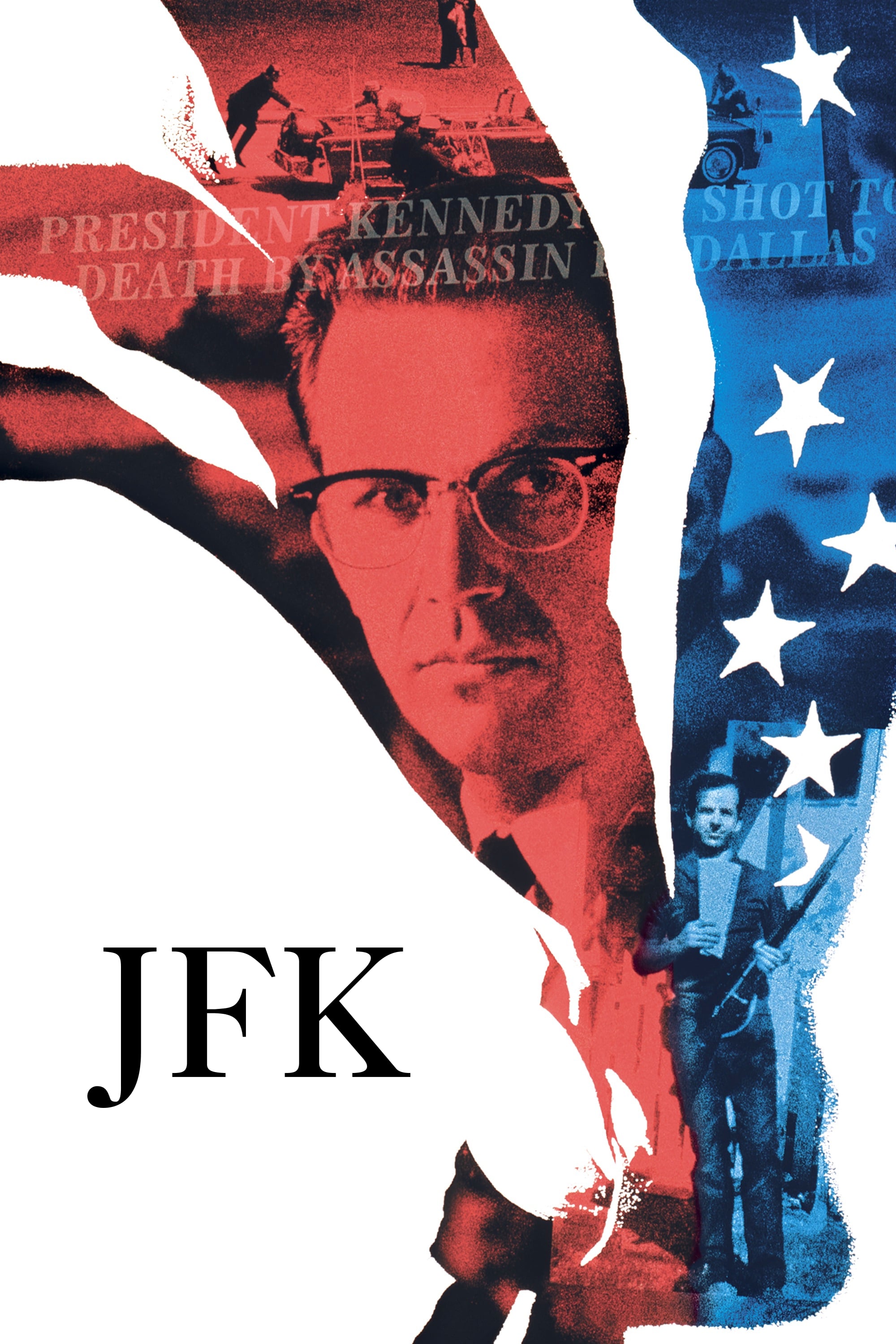
JFK poster

JFK

188 minutes

Cast

Selected cast credits · Film reference

Kevin Costner Jim Garrison
Sissy Spacek Liz Garrison
Tommy Lee Jones Clay Shaw / Clay Bertrand
Gary Oldman Lee Harvey Oswald
Kevin Bacon Willie O'Keefe
Joe Pesci David Ferrie
John Candy Dean Andrews Jr.
Jack Lemmon Jack Martin
Walter Matthau Senator Russell B. Long
Ed Asner Guy Banister
Michael Rooker Bill Broussard
Laurie Metcalf Susie Cox
Jay O. Sanders Lou Ivon
Wayne Knight Numa Bertel
Beata Poźniak Marina Oswald Porter
Brian Doyle-Murray Jack Ruby
Peter Maloney Colonel Finck
Dale Dye General Y
Frank Whaley Imposter Oswald
Jim Garrison Earl Warren

JFK | The Rewatchables

Explore episodeClose episode

Roger Ebert's review

In the discussion (3)
Approx. transcript time · 01:00:04Read transcript
  • Ebert, called the show's guy, is said to have been over the moon, giving the film four stars.
  • A quoted passage says the film's achievement is not answering the mystery of the assassination, which it does not, but marshaling the anger gnawing at the national psyche since 1963.
  • His Great Movies essay on the film is called one of his best pieces; the hosts say he named it the year's best and one of the top ten films of the decade.

Most Rewatchable Scene

Mr. X scene; John Candy scene

In the discussion (16)
Approx. transcript time · 01:01:12Read transcript
  • Costner's 'ashamed to be an American' moment and his New Orleans walk with his investigators, pointing out the FBI, CIA, Secret Service and O&I buildings, are nominated; the editing is praised.
  • The New Orleans scenes make participants want to drink and smoke; New Orleans is called the only place one participant still smokes.
  • John Candy's big scene is quoted at length: the big enchilada, a mouse fighting a gorilla, Kennedy as dead as that crab meat, and 'Daddy-o'; his moving sunglasses are praised.
  • Asked when Candy died, the joking reply is that 'they killed him'.
  • The hosts want to work Candy's 'any idea what you're getting into, Daddy-o' line into NBA conversations, such as Lakers defense and Frank Vogel.
  • Kevin Bacon's prison scene is quoted; he 'hits a four-three from 30 feet', culminating in a crude line one participant can't believe was in the script, likened to Ashley Schaeffer from Eastbound & Down.
  • Pesci's last big scene ('a mystery wrapped in a riddle inside an enigma', 'the shooters don't even know') is called great, though Pesci is said to dial it up too much.
  • Pesci's wig is called out of control, and he never inhales while smoking, compared to Tom Cruise smoking.
  • The first Pesci interrogation and the way Costner comports himself in the Sunday detention scene are singled out as a movie-star sequence noticed in the theater.
  • Setting the film in New Orleans lets the actors play Foghorn Leghorn, and Richardson's frames are packed with layers, such as the flambe in the restaurant scene.
  • For the Mr. X scene, Dale Die (as transcribed) wearing aviator sunglasses indoors is praised, and Garrison appearing as Earl Warren is a moment one participant rewinds to watch.
  • Anecdote: after moving to Los Angeles to work for Grantland, one participant repeatedly made his wife and a friend's wife watch the Mr. X scene on Friday nights to show how the two friends talk; they never enjoyed it.
  • The Mr. X scene is compared to the 35-minute Boogie Nights sequence at Jack Horner's house as a mega-sequence.
  • Two more nominations: Jim explaining the magic bullet theory, iconic once Seinfeld grabbed it, and 'back and to the left' leading to the big monologue.
  • 'X is the answer' is stated over the John Candy scene, while another participant votes for the John Candy scene but says they understand.
  • Also praised: the Clay Shaw interrogation, Jack Lemmon at the horse track, and Ed Asner beating up Lemmon's character at the opening.

What’s Aged the Best?

Gary Oldman as Oswald; Seinfeld spoof; Pesci-Tommy Lee Jones wig battle; Kevin Bacon's career revival; Oliver Stone's Dave cameo; Tommy Lee Jones in gold paint; Dealey Plaza recreation; John Williams score; New Orleans setting; specter of JFK; character actors in tiny roles

In the discussion (15)
Approx. transcript time · 01:12:33Read transcript
  • Offered as number one: Oldman as Oswald is creepy, great, and looks like Oswald.
  • Oldman must have shot much of his material separately with Stone; a 'Gary Oldman cut' as a standalone Oswald movie is wished for.
  • Deleted-scene story: Oldman asked Stone to point the camera at him late at night for an elegiac Oswald monologue; Stone shot him in a casket and planned to end the film with it before making a different call; it can be found on YouTube.
  • The 1992 Seinfeld spoof 'The Boyfriend' features Wayne Knight and Keith Hernandez; Hernandez is praised and then jabbed as possibly a QAnon guy.
  • 'The Boyfriend' is remembered as the episode that showed Seinfeld would be the biggest show, with the spitter bit called lights out.
  • The wig battle between Pesci and Tommy Lee Jones: Tommy Lee wins a 10-8 round.
  • Bacon is said to call the film a turning point that reignited his career, leading to A Few Good Men.
  • Stone's self-deprecating cameo in Dave two years later has aged best for one participant.
  • Tommy Lee in gold paint getting slapped by Pesci in a Dangerous Liaisons outfit is praised as the good version of a wild idea, unlike a cut Nicholson idea in The Departed; Tommy Lee doing it is what makes it great.
  • Objection: the same scene bumps against what's aged worst, the film's attitude about homosexuality, called retrograde and unacceptable; the counterpoint is that it was part of Garrison's case against Shaw and that era's judgment.
  • Stone recreated the assassination in Dealey Plaza, spending $4 million to restore it to 1963 conditions and reroute traffic; Sutherland and Costner memorized their monologues.
  • Debate on whether acting is mostly memory: one participant says no, the camera reveals compelling people like Sutherland and memorizing matters more in theater; it is jokingly settled at 70% memory.
  • John Williams's score and New Orleans as a setting are named.
  • The specter of JFK himself: the speech that opens Stone's documentary, the Caesar-like shot in the X speech and the still photograph of Kennedy.
  • Top character actors appear for less than a scene, including Ron Rifkin with one line, Lolita Davidovich, Brian Doyle-Murray and John Larroquette.

What’s Aged the Worst?

Runtime; Garrison family scenes; 'I should have loved you more' line; Costner's accent; magic bullet theory; Pesci's performance

In the discussion (11)
Approx. transcript time · 01:24:27Read transcript
  • The movie is called too long at three hours and eight minutes; another disagrees, nearly naming three-hour movies as what aged best.
  • Cut the Sissy Spacek scenes: nobody cares about Garrison's family, compared to the domestic scenes in Donnie Brasco where the wife drags the hero away.
  • Liz Garrison's big contribution is telling the housekeeper to get hold of herself; Spacek has no good scene, and she yells at Jim over his JFK nightmares.
  • Counterpoint: the family scenes carry 'daddy never keeps his promises' and the trauma of the American male lied to by the American father; the reply is that the fatherhood style has aged the worst.
  • It should have been an assassination movie; a parenting tangent follows, then the argument that a movie about an obsessive must show the cost of obsession, with agreement that the scenes are badly written and could be cut.
  • Stone is said to have cared about making Garrison a well-rounded role Costner would want; the Kathleen Quinlan role in Apollo 13 works because her husband is in a spaceship.
  • Worst line: Garrison saying 'I should have loved you more' as he and his wife are about to have sex.
  • Tangent: Kay's return scene in The Godfather is called the worst scene of the best movie ever by one participant and defended as perfect by others.
  • Costner's accent goes in and out, better than his Prince of Thieves accent and like Bull Durham in the courtroom; Pesci's is worse; a courtroom line echoes The Untouchables.
  • The hosts say the magic bullet theory has been pretty much debunked over how Connolly was sitting, while Stone's documentary still argues the trajectory; one participant still believes in four bullets.
  • Last: Pesci, liked far less by two participants; conflating homosexuality with the mafia and anti-communist soldiers is called whacked, and one cannot suspend disbelief with Pesci's baggage in the role.
In the discussion (10)
Approx. transcript time · 01:31:04Read transcript
  • Stone is said to have sent the script to Costner, Mel Gibson and Harrison Ford.
  • Gibson is argued as a great, wild-eyed Garrison who would better represent Stone's mind, and who later made Conspiracy Theory; another questions casting an Australian.
  • Harrison Ford doesn't make sense but is a big what-if, with a wish he had more movies like this.
  • Don Johnson tried hard for Garrison and has post-Miami Vice appeal, but doesn't read smart enough to be the district attorney.
  • Jeff Bridges would have been amazing; 'Hank' (as transcribed) might work but may be two years too young and too aw-shucks.
  • Will Patton is suggested as David Ferry; Stone wanted James Woods, but Woods wanted to play Garrison.
  • Frank Whaley was going to be Oswald, and after the part went to Oldman he was made the imposter.
  • Willem DeFoe (as transcribed) and John Malkovich turned down the Ferry role; Malkovich in the red wig would have been mind-boggling.
  • Stone considered Marlon Brando for Mr. X, joked to need SNL monologue-style cue cards.
  • Origin: Stone met Warner Brothers about a Howard Hughes film, but Warren Beatty had the rights, so JFK was the backup pitch; jokes follow about carrying three pitches and a Doug Collins 1972 Olympics pitch.
In the discussion (6)
Approx. transcript time · 01:35:17Read transcript
  • There are about 100 candidates; Wayne Knight is judged ineligible, and J.O. Sanders is in.
  • Michael Rooker is deferred to a later spot.
  • J.O. Sanders plays one of Costner's two cohorts who quits and shows up in the courtroom at the end; he has been in a million things and resembles a True Detective character.
  • Peter Maloney, the medical examiner, is also in The Thing and is recognizable once seen.
  • Oswald's wife, played by the actress who was a Russian doctor on Melrose Place (Dr. Katia Petrovna), is named as Bita Posniak (as transcribed); she is said to have read all 26 volumes of the Warren Report.
  • George C. Scott is floated as a great, angrier X, but Sutherland's bemused X is called perfect.
In the discussion (5)
Approx. transcript time · 01:37:55Read transcript
  • Called one of the most important awards handed out, with three nominees: John Candy, Kevin Bacon and Donald Sutherland.
  • Oldman is in the movie too much to be eligible; Brian Doyle-Murray is proposed and rejected.
  • Bacon and Candy annihilate brief roles, but Sutherland is first called the winner for the 16-minute monologue, then his screen time is said to be about third most.
  • The pick moves to Candy because he did something he never did before or after, while Bacon found a tough swagger and kept doing it, as in A Few Good Men.
  • Candy as Dusty Rhodes in a biopic is imagined on the spot; Candy wins.

Recasting Couch

Denzel Washington as David Ferrie or Mr. X; Sally Field; Madeleine Stowe; Gary Sinise as David Ferrie

In the discussion (5)
Approx. transcript time · 01:39:48Read transcript
  • Since the movie makes things up anyway, Denzel Washington as David Ferry is suggested; Denzel as Mr. X is called insanely great, with doubt about him as Ferry.
  • Recast Sissy Spacek because she is too good an actress for a crummy part, freeing her for a better role.
  • Sally Field is suggested for the part; pushback says Costner and Spacek do not fit together.
  • Madeline Stowe is suggested for 'Renee Rousseau' (character name as transcribed) and called perfect.
  • Gary Sinise would have killed as Ferry; whether Oldman and Sinise ever had a showdown is asked.

Half-Assed Internet Research

Lead researcher; Mr. X source; Garrison cameo; Tommy Lee Jones's gold paint

In the discussion (4)
Approx. transcript time · 01:41:17Read transcript
  • Stone hired a lead researcher, named as Jane Riscone (as transcribed); Stone read two dozen assassination books and the researcher 100 to 200, a range mocked as imprecise.
  • The hosts say Stone's source for X was Colonel Leroy-Fletcher Prouty (as transcribed), who once worked in the Pentagon, but that his stories have a lot of holes.
  • The real Garrison appears in the film as Earl Warren.
  • Tommy Lee Jones deciding to paint himself gold is the favorite research item; another participant had not come across it.

Apex Mountain

Robert Richardson; Oliver Stone; JFK assassination conspiracies; Michael Rooker; Wayne Knight; Zapruder film

In the discussion (11)
Approx. transcript time · 01:42:09Read transcript
  • Costner: no; his peak is still Dances With Wolves, which won all the Oscars and made him the new Warren Beatty, with no argument.
  • Oliver Stone: it might be this, since he got a studio to fund an assassination movie with his made-up theory and made The Doors and JFK in the same year; called a really good case.
  • JFK assassination conspiracies peaked in the early 90s: agreed.
  • Michael Rooker: Henry: Portrait of a Serial Killer is his high point, with Henry and JFK in about a two-year span when it was all happening for him.
  • Henry is recommended as a realistic, disturbing film; one participant recalls seeing it before a game at a theater near BU with seven other men; tangent: Henry and One False Move as a never-sleep-again home double feature.
  • Rooker being the most normal-seeming character shows how crazy the movie is; his LBJ argument scene is called absurd and possibly cut down.
  • Rooker is praised in Cliffhanger and now in the MCU; one participant has met with him.
  • Wayne Knight, no question: Newman at the same time and Jurassic around then.
  • The Zepruder (as transcribed) film as Apex Mountain: yes, with a reference to the Time-Life building.
  • Also joked about: the Cowboys doing well in '91, and a Zupruder (as transcribed) NFT pushed by Gary Vee.
  • Richardson: a filmography spanning Stone's films from Salvador through Nixon, John Sales (as transcribed), Scorsese and Tarantino; at the top of his game here; a jab that he's no Gordon Willis, but flexible with a distinctive blown-out overhead light.

Picking Nits

Skipped

In the discussion (1)
Approx. transcript time · 01:49:44Read transcript
  • Picking Nits is waved off because the entire movie has already been picked apart.

Sequel, Prequel, Limited Series, or All-Black Remake

Yes: a present-day fictional JFK conspiracy series

In the discussion (3)
Approx. transcript time · 01:50:00Read transcript
  • An emphatic yes: there is no other reason for Netflix to exist, five seasons.
  • Doubt that Sarandos and Reed Hastings are brave enough, though Netflix could shut down Dealey Plaza for two months.
  • The preference is a fiction rather than a Garrison series: a present-day event with mafia and CIA plots that starts someone investigating, like The Crown for JFK.

Probably Unanswerable Questions

Did Oliver Stone invent QAnon?; Who killed JFK?

In the discussion (9)
Approx. transcript time · 01:50:43Read transcript
  • Did Stone invent QAnon, popularizing today's conspiracy culture? One argues 9/11 mattered more; another cites post-Vietnam revelations like the LSD experiments.
  • The CIA's documented misdeeds are called not conspiracy theory because the papers are public.
  • Stone tapped into obsessively studying footage (the Pruder film as transcribed, 9/11, January 6) and seeing what you look for; it is clarified that January 6 was a conspiracy, not a conspiracy theory.
  • 9/11 is described as a known conspiracy with witnesses and video that stayed secret while planned, which might refute the idea that a conspiracy would come out.
  • The danger is that disempowered people seek answers where none exist, as Stone worked through trauma via art; Willie O'Keefe is called a white supremacist who would later vote for Trump.
  • Who killed JFK: the first participant asked says 'Oliver Stone', turns to how the film is not about JFK's ideas, admits not knowing, and is ruled out.
  • One answer: the intelligence community, active or ex-CIA.
  • Another answer: the mob and the CIA together, as American Tabloid has it; agreement follows, and the trigger man is said to be dead.
  • The participants agree Oswald was in on it and none thinks he was completely innocent, and the Jack Ruby killing is called bizarre.

What Piece of Memorabilia Would You Want From This Movie?

David Ferrie's wig; John Candy's sunglasses; Dealey Plaza model; Sutherland's fedora

In the discussion (3)
Approx. transcript time · 01:56:09Read transcript
  • David Ferry's wig and John Candy's sunglasses.
  • The Dealey Plaza model from the courtroom, for a living room and a Vanity Fair cover pose.
  • Sutherland's fedora, with a proposed recurring Mr. X bit giving 16 uninterrupted minutes on the podcast.
In the discussion (3)
Approx. transcript time · 01:57:08Read transcript
  • Asked who won the movie, the answer is Oliver Stone, echoed with 'Yeah, Stone'.
  • Another participant has Stone as well and calls the pick boring.
  • Lee Harvey Oswald is offered as the other argument, since the film does everything to take blame away from him.
Podcast choices
Speaker not identified
Oliver Stone
Speaker not identified
Oliver Stone

More from the conversation

The guest (ASR 'Brian Cobbman') is introduced as busy with multiple TV shows and a previous guest for the 'Godfather, too' (as transcribed) episode; the episode is framed as JFK's 30th anniversary.
Approx. transcript time · 00:01:50Read transcript
A trailer cold open plays before the roll call of participants.
Approx. transcript time · 00:02:07Read transcript
JFK is framed as one of the all-time directorial heat checks: Stone's assassination theory, studio funding for a three-hour-plus film, and some 20 strong actors.
Approx. transcript time · 00:02:24Read transcript
Asked why he wanted to do it, the reply calls the movie super important, batshit crazy and full of killer scenes, calls Stone a great screenwriter and director, and calls it his third Vietnam movie.
Approx. transcript time · 00:03:13Read transcript
The film is read as the culmination of Stone's Vietnam wound after Platoon and Born on the Fourth of July: his theory of why it all happened, the country's original sin.
Approx. transcript time · 00:04:07Read transcript
A director in the zeitgeist going all in with the biggest movie star on provocative, even irresponsible storytelling raises what responsibility Stone has to the truth.
Approx. transcript time · 00:04:57Read transcript
True-story films like Argo fudge facts, but here audiences believed it; the hosts say the Bacon character was made up and the Pesci character's natural death was made to seem like murder.
Approx. transcript time · 00:05:48Read transcript
A deleted scene of Jack Ruby being injected with cancer cells is joked about as Apex Mountain; Born on the Fourth of July came before JFK.
Approx. transcript time · 00:06:44Read transcript
Recollection of seeing the film in Florida with a mother who remembered where she was when Kennedy was killed and cried that the official story never felt right.
Approx. transcript time · 00:07:24Read transcript
1980s college conspiracy culture: Posner's single-shooter books, a house called the Lodge with a gravity bong, and an expert friend explaining the grassy knoll.
Approx. transcript time · 00:08:32Read transcript
One participant long obsessed with the case wishes it were more real; the X scene with Donald Sutherland on the military-industrial complex is called the key scene, while the Pesci and Bacon threads are fictional moviemaking.
Approx. transcript time · 00:09:48Read transcript
Stone is said to have called the film a counter-myth and still argues online; the X scenes are called crucial and brilliantly edited.
Approx. transcript time · 00:10:53Read transcript
The film is excused as a cry of pain from a man destroyed by Vietnam at 18; Nixon's Larry Hagman scene is cited as a fourth related film.
Approx. transcript time · 00:11:39Read transcript
Asked whether the film would bother him if it were an obscure miss, the reply is that he really likes it but is frustrated nobody talked the filmmakers out of the stupid stuff.
Approx. transcript time · 00:13:04Read transcript
Two cultural impacts: slow-motion Zapruder footage on a big screen, and mainstream conversation the hosts say led to the assassination records act a year later and the Seinfeld episode.
Approx. transcript time · 00:13:33Read transcript
The Zapruder film is called the shark from Jaws of this movie; the audience reacts like the courtroom extras to 'back and to the left'.
Approx. transcript time · 00:14:52Read transcript
Researching the podcast becomes a rabbit hole of takes and refutations; DeLillo's Libra and Ellroy's American Tabloid also use the assassination, with DeLillo's 'fiction rescues history from its confusions'.
Approx. transcript time · 00:15:42Read transcript
Debate over whether Stone claims 'this did happen' or makes a movie about Jim Garrison's theory; the captioned line 'daddy never keeps his promises' is read as the film's theme.
Approx. transcript time · 00:16:33Read transcript
The 1991 release felt like a Game 7 and delivered; John Candy's single scene and Jack Lemmon and Walter Matthau in separate scenes are highlights.
Approx. transcript time · 00:17:52Read transcript
Released today the internet would eat it alive; seen at about age 11 it bred distrust of the government; an earlier Kennedy film, Interview with the Assassin, with Neil Berger is mentioned.
Approx. transcript time · 00:18:54Read transcript
X's opening dialogue is read aloud (black ops, coups, getting the Dalai Lama out) and likened to Zelig, the Predator pre-action scene and Trautman in First Blood.
Approx. transcript time · 00:20:06Read transcript
'If Alex Jones had Paul Thomas Anderson's cinematic talent'; a fever dream kept attached to the earth by Costner.
Approx. transcript time · 00:21:26Read transcript
Stone gets great brief performances, reigniting Bacon; a case for him as the best caster of his generation (Wall Street, Platoon, The Doors, Any Given Sunday).
Approx. transcript time · 00:21:44Read transcript
Stone's quoted 25th-anniversary remarks that the film was a hot potato that changed perceptions of him; his earlier work including Midnight Express, Scarface, Seizure, The Hand and Conan; JFK is called a thriller.
Approx. transcript time · 00:22:39Read transcript
Hypothetical: a mostly factual James Dolan/Knicks movie with an invented Isaiah Thomas character as an analogy for frustration with JFK's inventions.
Approx. transcript time · 00:24:43Read transcript
As a filmmaker, compositing and dramatizing to serve the truth is not bothersome; Thirteen Days (Roger Donaldson, written by David Self) is praised as better every year.
Approx. transcript time · 00:25:56Read transcript
Two more conspiracy-minded participants admit to being more bothered; Garrison's version, Stone's version and Stone's own behavior are separated, and the text is called a heavyweight champion.
Approx. transcript time · 00:27:39Read transcript
Research tidbit: James Woods wanted to play Garrison with a family-sacrifice angle, called an all-time bad take; the story is Alice in Wonderland.
Approx. transcript time · 00:28:28Read transcript
A narrative film must aspire to more than facts; the hosts say Norman Mailer followed Stone's trail in a 1995 book and ended certain Oswald acted alone.
Approx. transcript time · 00:28:56Read transcript
One participant always believed it was the mob; Stone's Garrison dismisses the mob in a few lines because it would not explain Vietnam.
Approx. transcript time · 00:30:56Read transcript
Conspiracy theorist or recovering: the answer is recovering; the X speech's cellularized, deniable idea is a favorite; a fourth bullet is asserted.
Approx. transcript time · 00:32:55Read transcript
Grassy knoll photograph discussion; the autopsy and hospital events are called the truest part of the movie and the most compelling part of Stone's new documentary.
Approx. transcript time · 00:34:12Read transcript
Two things the hosts call inexplicable: Oswald defecting and returning without penalty, and Jack Ruby, described as a mob associate, killing him on live TV amid security.
Approx. transcript time · 00:35:23Read transcript
One participant says power moves quietly and asks whether a very small group of powerful people could have made decisions unknown to most others involved; the answer is 'of course'.
Approx. transcript time · 00:38:13Read transcript
Mr. X's 'why' speech prompts listing three groups with motives: the mafia, the Russia/Cuba side, and the CIA.
Approx. transcript time · 00:39:10Read transcript
A participant says military figures were frustrated with Kennedy's Cuban missile crisis deal; another doubts a government conspiracy could stay quiet, calling the CIA of the era incompetent and citing the Castro beard plot.
Approx. transcript time · 00:40:11Read transcript
One participant argues such events more likely evolve through improvisation than a puppet-master plan, citing the Jack Ruby killing; Libra and American Tabloid are recommended.
Approx. transcript time · 00:41:52Read transcript
The hosts say early Zapruder witnesses reported the limo stopped and many witnesses were discounted; X's claims land because they are delivered with confidence.
Approx. transcript time · 00:43:51Read transcript
A dinner guest's stepfather is said to have been on the Secret Service advance detail in Dallas; the identity is withheld.
Approx. transcript time · 00:44:57Read transcript
Costner's run from The Untouchables to The Bodyguard gave the film credibility; his closing speech is called one of his best moments.
Approx. transcript time · 00:45:50Read transcript
Costner likely wanted to work with Stone, who could promise every good actor; debate over whether Costner worked with bold filmmakers.
Approx. transcript time · 00:46:38Read transcript
The hosts say the film was shown to Congress and led to the 1992 disclosure act promising release by 2017, still delayed, with about 12% of documents unreleased.
Approx. transcript time · 00:48:40Read transcript
A guess that remaining documents hide bad CIA activity of the era; a mock refusal to comment; Hoover called a sociopath; Ellroy recommended.
Approx. transcript time · 00:49:25Read transcript
Stone's version summarized: New Orleans at the heart, Bannister and Ferry, Clay Shaw as money man, and a coup to install LBJ.
Approx. transcript time · 00:49:54Read transcript
Garrison's case in the film rests on three witnesses: David Ferry, Bacon's Willie O'Keefe (possibly based on Perry Russo) and Sutherland's X, called made up.
Approx. transcript time · 00:50:49Read transcript
Edward J. Epstein's Atlantic piece on Garrison's trial is cited; comparisons to The Trial of the Chicago 7 and Fog of War.
Approx. transcript time · 00:51:30Read transcript
Hot take that LBJ was involved or knew; Errol Morris's Rumsfeld film and Umbrella Man short are recommended.
Approx. transcript time · 00:53:13Read transcript
Who benefited: LBJ, the military complex, the CIA and the mafia are named; The Irishman's JFK implication discussed.
Approx. transcript time · 00:55:49Read transcript
Controversy fueled promotion; Stone's annotated screenplay book; the supporting cast; John Williams's score; Robert Richardson's cinematography and pioneering editing.
Approx. transcript time · 00:56:42Read transcript
Before the categories, Robert Richardson is called 'an Apex Mountain candidate for me for this'; he is taken up in the Apex Mountain segment later ('Brian mentioned Richardson').
Approx. transcript time · 00:57:59Read transcript
Oscars: lost Best Picture to The Silence of the Lambs; Tommy Lee Jones's supporting nomination; Sutherland preferred; debate over Pesci.
Approx. transcript time · 00:58:08Read transcript
Stated $40 million budget, $205 million gross, eight nominations with wins for cinematography and editing.
Approx. transcript time · 00:59:48Read transcript
After the Ebert review is quoted, the hosts say Walter Cronkite called Ebert, furious that he loved the movie, and lectured him that it was not factual, and that this is the lead of Ebert's review.
Approx. transcript time · 01:00:38Read transcript
Tangent during Most Rewatchable Scene on New Orleans films: Angel Heart, and Heaven's Prisoners, called the most underrated New Orleans movie, which one participant has never seen.
Approx. transcript time · 01:07:57Read transcript
During What's aged the best, Tommy Lee Jones in gold paint is jokingly called 'definitely Apex Mountain for the New Orleans anti-communist homosexual underground'; it is not revisited in the Apex Mountain segment.
Approx. transcript time · 01:16:06Read transcript
During What's aged the best, 'Apex Mountain for Brian Doyle Murray' is flagged as saved for that category; he is not raised in the Apex Mountain segment.
Approx. transcript time · 01:22:16Read transcript
Cable-channel tangent (Heist Channel, New Orleans channel) and Lisa Bonet.
Approx. transcript time · 01:22:31Read transcript
Tarantino-Stone feud over Natural Born Killers; Stone and Spike Lee at NYU under Scorsese; the Chasing the Light biography; jacket ribbing.
Approx. transcript time · 01:47:41Read transcript
Is this Stone's best movie: this and Wall Street are the most rewatchable, with Platoon third; U-Turn defended.
Approx. transcript time · 01:57:33Read transcript
Closing: the guest is thanked, the podcast credits producer Craig Horlebeck (ASR), and Saturday Night Fever is announced next.
Approx. transcript time · 01:58:11Read transcript