
‹ All movies

The opening scene, Mike McD losing his 30 grand to Teddy KGB

Five nominees are read: the opening scene where Mike McD loses his shirt ('I don't think you have the spades'), and Mike McD's poker comeback, whose clip is played; 'let's play some fucking cards' plus the guitar riff gets a host fired up to gamble, like the Vegas moment in Swingers.

An aside: the comeback is a bit of a cheat, because the two hosts played cards on the same night earlier this summer and real poker is slow and awful, everyone is Joey Knish and no one is Mike McD, whereas the movie makes it feel like a jet engine down the tarmac; one host's favorite thing in life is driving to Vegas and sitting silently at a poker table for eight hours.

"Hanging around hanging around kids got alligator blood"

A rip-through of quotes: 'Welcome to Chesterfield South'; 'Rule number one, throw in your cards when you know you can't win. Fold the hand', good life advice and a senior yearbook quote; and 'you can't lose what you don't put in the middle, but you can't win much either', another yearbook quote.

The film

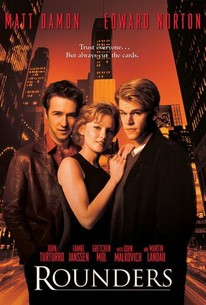
Rounders (1998)

Directed by John Dahl · Drama / Crime

120 minutes

Cast

Selected cast credits · Film reference

Matt Damon Mike McDermott
Edward Norton Lester 'Worm' Murphy
John Turturro Joey Knish
John Malkovich Teddy KGB
Martin Landau Abe Petrovsky
Josh Mostel Zagosh
Lenny Clarke Savino
Tom Aldredge Judge Marinacci
Michael Lombard District Attorney Shields
Lenny Clarke Savino
Chris Messina Higgins
Goran Višnjić Maurice
David Zayas Trooper Osborne
Johnny Chan himself
Bill Camp Eisenberg
Josh Pais Weitz
Adam LeFevre Sean Frye

Everything from the episode

In the order the hosts got to it. Open a row for the discussion.

11:35

Roger Ebert's review

In the discussion (1)
Approx. transcript time · 00:11:35Read transcript
  • While going through the weird, lukewarm 1998 reviews, one host recalls that Roger Ebert liked the movie, 3 out of 4; the other greets it with 'nice, my guy' and ribs Roger that it is about time he had a good opinion.
20:07

Most Rewatchable Scene

The opening scene, Mike McD losing his 30 grand to Teddy KGB; Mike McD and Worm arriving at the emptied apartment and...

The opening scene, Mike McD losing his 30 grand to Teddy KGB; Mike McD and Worm arriving at the emptied apartment and leaving to 'play some fucking cards'

In the discussion (9)
Approx. transcript time · 00:20:07Read transcript
  • Five nominees are read: the opening scene where Mike McD loses his shirt ('I don't think you have the spades'), and Mike McD's poker comeback, whose clip is played; 'let's play some fucking cards' plus the guitar riff gets a host fired up to gamble, like the Vegas moment in Swingers.
  • An aside: the comeback is a bit of a cheat, because the two hosts played cards on the same night earlier this summer and real poker is slow and awful, everyone is Joey Knish and no one is Mike McD, whereas the movie makes it feel like a jet engine down the tarmac; one host's favorite thing in life is driving to Vegas and sitting silently at a poker table for eight hours.
  • The remaining nominees: the Johnny Chan scene, Chan being one of the movie's big winners, with the Russian lady's intimate familiarity with World Series of Poker hands and the Chan versus Seidel 'look at the patience' hand; Mike and Worm trying to win everything back ('I've gone on runs like this before'); and the final Mike McD versus Teddy KGB showdown.
  • Runner-up nomination: the judges' game, Mike McD putting every judge in the room on a hand so that Judge Marinacci offers a clerkship on the strength of one read; every movie like this needs a moment showing how smart the lead is. — Sean Fennessey
  • The other runner-up is the trip to Binghamton and the card game with the police officers, corrected to municipal workers: the scariest scene but one of the best made, the shot of Mike and Worm getting beaten after Norton's mechanic work is caught, real tension in a movie where the stakes are otherwise hard to gauge.
  • The opening scene is picked as the most rewatchable: a testament to how the film draws you in, the soundtrack, Mike McD rolling in with 30 grand, taking three stacks of high society and explaining the game's nuances; voiceover is a no-no that the host hates, but here it works for the first ten minutes.
  • A quibble about the opening hand: Mike McD holds ace-nine, KGB holds aces, the board runs ace nine eight, then another nine gives both a full house, and a rag comes on the river; KGB is so sure he has won that he shows his aces, drops them and walks away, yet Mike could have held pocket nines for four of a kind, something the host has never heard anyone discuss.
  • The quibble is told to save it for picking nits; the counter is that KGB read Mike's devastated face and needed to see nothing else, which the questioner half accepts while still wanting to see the cards.
  • The other favorite is when Gretchen Mull (as transcribed) moves out: not the moving but Mike McD and Worm arriving at the emptied apartment, Ed Norton's 'women are the rake' speech, Mike's wheels turning to 'fuck it, let's go, let's play some fucking cards', and the music, almost a sports-movie scene.
25:53

What’s Aged the Best?

The 'spot the sucker' opening line; the Billions DNA; the Mike McD face; the throwaway poker lingo; Damon and Norton ...

The 'spot the sucker' opening line; the Billions DNA; the Mike McD face; the throwaway poker lingo; Damon and Norton at fun points of their careers; the look and the New York setting; Russians as villains; Teddy KGB's accent; the World Series of Poker ending

In the discussion (14)
Approx. transcript time · 00:25:53Read transcript
  • The first line, 'if you can't spot the sucker in your first half hour at the table then you are the sucker', may not be the greatest opening line in movie history but is one of the most memorable; the hosts want to see that list, which must exist on the internet, and float it as a vacation column.
  • There is Billions DNA in the film: watching Rounders is like watching Tracy McGrady on the Raptors, and the pop culture throwaways such as Buckner going into Shea became signatures of Billions, which also brought in Malkovich in season three.
  • The face Mike McD makes after losing the 30K is one of the best acting moments of Damon's career: the face everyone makes when destroyed in poker or blackjack, the life sinking out of your body; the sports-fan equivalent is the Marco Bellinelli corner three or the Case Keenum pass.
  • Having a big hand cracked while deluded with euphoria is called the most crushing unimportant thing that can happen in life; all the throwaway poker lines have aged beautifully and one host understands the lingo partly because of this movie.
  • Damon and Norton at fun points in their careers: Norton arrives with Primal Fiction (as transcribed), American History X, one of the most interesting performances of the last 25 years, then Rounders and Fight Club; 25th Hour mixes that guy with Worm; also Everyone Says I Love You, a terrible Woody Allen musical, and The People vs. Larry Flint, which has not aged well.
  • The Larry Flint writers, Larry Krasuski and Scott Alexander (as transcribed), also wrote the OJ Ryan Murphy show and Ed Wood and set the template for the clever, controversial biopic, like Man in the Moon, a style that now lives on TV in 13-episode runs.
  • The late-nineties talent cluster: in a fantasy draft Leo, Damon and Norton are the top three or in the top five, with Brad Pitt, Affleck gravitating to popcorn movies, feeder films like School Ties and Dazed and Confused, and Vince Vaughn; weirdly no black actors went to the stratosphere, Halle Berry aside.
  • Clooney, Matthew Perry twenty years ago, Wahlberg after Boogie Nights, Will Smith and Jim Carrey round out one of the best clusters, all 35 and under, compared with the Godfather generation around Brando; these people get credit as movie stars rather than actors, in the era when the Entertainment Weekly cover mattered and Carrey got $20 million a movie.
  • Norton took a left turn after the mid-nineties string: directing Keeping the Faith, which Juliette Littman likes, The Score with De Niro, Death to Smoochie, then 25th Hour, probably his best of the 2000s, and The Illusionist; he never had the Pacino or Gene Hackman career one host wanted, though he may still.
  • Worm is a character unique to Norton, out of the John Cazale 1970s: the lovable scumbag you root for without knowing why, with a little Fredo in him.
  • The movie looks surprisingly cool and undated for 1998 and is a good New York movie that still looks like the New York the hosts remember; the Chesterfield is based on a club called the Mayfair, and one host once played in a private room like it, the film's room being a slightly nicer red leather version of his, with that seedy but exciting feeling.
  • Russians as villains has aged the best: in 1998 the Cold War had ended eight years earlier and Russia was in free fall, but twenty years on Roman, Maurice, Teddy KGB and the underground network are far more believable villains.
  • Forgotten from aged best: Teddy KGB's accent, ridiculous in 1998 and loved in 2018 largely from familiarity; in the theater it was the movie's biggest flaw, a completely unnatural choice in a natural film, but twenty years later it works, is distinct, fun to imitate and almost a parody of bad Russian accents.
  • The ending of Mike McD heading to Vegas and the World Series of Poker makes far more sense now, since within five years that became the dream of basically everyone who played; it could have been aged best too.
35:49

What’s Aged the Worst?

Gretchen Maul's (as transcribed) wet-blanket girlfriend Joe and her performance; the judges' instant hand-reading sce...

Gretchen Maul's (as transcribed) wet-blanket girlfriend Joe and her performance; the judges' instant hand-reading scene; Mike McD not hooking up with Famke Janssen's character

In the discussion (11)
Approx. transcript time · 00:35:49Read transcript
  • Gretchen Mala (as transcribed) plays the stereotypical wet-blanket girlfriend, a staple of 80s and 90s sports movies for undermining the hero: a girlfriend or wife who does not believe in what he is doing.
  • A Mount Rushmore of wet-blanket girlfriends: Adrian Balboa in Rocky IV, who quits on Rocky and shows up belatedly in Russia, leaving one host still in go-fuck-yourself-Adrian mode; Myra Fleener in Hoosiers, the number one, subject of an old ESPN magazine column, with no idea why Gene Hackman liked her.
  • A theory: many men do not know how to write female characters, so they pour their own relationship anxieties into a figure who is holding the hero back, which is why so many movies have a woman you cannot place; the last Rushmore member is Ned Braden's wife in Slapshot (as transcribed), a tough hang who even throws it at Paul Newman.
  • The defense from Koppelman and Levine, given in a back-and-forth with one host: Damon's girlfriend was originally in only three scenes, and a law-school best friend named Atkinson, a counterpoint to Worm, was in the script until the studio made them merge Joe and Atkinson and boost Joe, leaving her inessential and simply in Worm's way.
  • Not a great performance either, though she rallied in the 2000s; she is flat-out bad and unlikable here, around the time of the Vanity Fair cover anointing her the next ingenue when she had made little more than Donnie Brasco, and hers is the only stretch where the movie loses its rhythm.
  • The judges' card scene, which both like, has aged worst: Mike McD standing for eight to fourteen seconds and reading everyone's hand is not believable, even if Koppelman and Levine claim to have seen it happen; the clip is played; such reads take hours of study.
  • The judges' game is not Texas Hold'em, perhaps a seven-card stud variant with many cards showing, which makes the reads more plausible, and the judges' cards are never shown, so he might have missed some; it sets him up as a savant, a reach one host is fine with.
  • Martin Lando's (as transcribed) character is described as a cross between a law professor, Confucius, the fairy godmother and Red Arbeck (as transcribed); not a great character but essential, and the bar scene where he pours gin and tells the yeshiva story is loved; movies like this need an old guy, as Charlie Pierce was for Grantland.
  • Mike McD not hooking up with Famke Jansen (as transcribed) is called the biggest flaw of the movie and maybe of a host's life, raised with Koppelman and Levine multiple times: his girlfriend has moved out, he is home alone watching an old World Series of Poker, she comes over about Worm's tab and makes a hard pass, and he says now is not the time, which is called inexplicable and indefensible.
  • Her character is the manic poker dream girl, after the manic pixie dream girl of Penny Lane and the Zooey Deschanel movies: beautiful, a Bond girl three years earlier, works at the Chesterfield and recounts World Series hands; the case against is that he loves Joe, is trying to go straight, and Petra represents the old version of him.
  • On rewatch the hosts think the two should simply have gotten together; Koppelman and Levine admit it is their biggest mistake, prompting a joke about adding a scene for the 25th anniversary; for one host it is the what's aged the worst, and the explanation offered does not convince him.
43:49

Casting What-Ifs

Neve Campbell turned down the role of Joe

Neve Campbell turned down the role of Joe

In the discussion (2)
Approx. transcript time · 00:43:49Read transcript
  • The only item: Neve Campbell turned down Joe; the film seems to have been locked in on Damon and Norton throughout, with little almost-happened history.
  • Both hosts think the movie would have worked better with Neve Campbell: a better actress at a nice point in her career, Party Five (as transcribed) still running and post-Scream, inherently sympathetic, which Joe needs so you believe she is trying to get Mike McD to go straight.
44:19

The Dion Waiters Award for Best Heat Check Performance

John Malkovich as Teddy KGB

John Malkovich as Teddy KGB

In the discussion (5)
Approx. transcript time · 00:44:19Read transcript
  • The category is loaded for this movie: John Malkovich as Teddy KGB, Famke Jansen (as transcribed), John Turturro as Knish, Martin Landau with only three scenes who has to be mentioned, and the actor who played Grandma (as transcribed), Michael Rispoli, saved for the Joey Pants Award.
  • Both agree there is only one answer, 'pay this man his fucking money', KGB: he is in the opening and closing scenes, maybe three in all, and his NBA box score is 12 minutes with 35 points, 10 rebounds and seven blocked shots.
  • Famke Jansen (as transcribed) gets a shout-out and a case that she should have been Joe with another Russian character invented; Knish should not be overlooked either, with some of the greatest lines, representing lifetime grinders, based on a real man named Joel Bagels (as transcribed) whom Koppelman and Levine wrote about in 2014, whose real-life line was 'women are the rake'.
  • The sauna confrontation where Knish refuses Mike McD the money is loved and the clip is played: two grand buys a day, Knish will not chase cards or pipe dreams of winning the World Series on ESPN because he owes rent, alimony and child support and his kids eat, offering calls and a place to stay instead.
  • Knish is almost not a heat check because he is in too many scenes, whereas Malkovich is in two or two and a half, the ultimate Deion Weirder (as transcribed) and a fucking heat check.
47:22

The Joey Pants “That Guy” Award

Michael Rispoli, who plays Grandma (as transcribed); a shout-out to Lenny Clark

Michael Rispoli, who plays Grandma (as transcribed); a shout-out to Lenny Clark

In the discussion (2)
Approx. transcript time · 00:47:22Read transcript
  • Many that-guys fill the random poker scenes; a shout-out goes to Lenny Clark, now recognizable but back then known only in Boston, who has a couple of lines in one poker scene.
  • Michael Raspoli (as transcribed), who plays Grandma (as transcribed): a host in the 99th percentile for this stuff did not know his name until looking it up, and the key fact is that he lost the Tony Soprano bake-off to James Gandolfini, then played Jackie April (as transcribed) as a consolation prize; an amazing what-if that likely changed his life, and he is a good actor.
48:53

Half-Assed Internet Research

Joe was in only three scenes in the original draft; the law school scenes were shot at Rutgers; Malkovich built his a...

Joe was in only three scenes in the original draft; the law school scenes were shot at Rutgers; Malkovich built his accent from a Russian woman reading his lines; the original script had Mike move on Phil Hellmuth, not Johnny Chan; the closing Counting Crows song is on no album; Damon and Norton played the 1998 World Series of Poker main event, where Doyle Brunson's aces knocked out Damon's kings; the book in the opening is Brunson's Super System

In the discussion (7)
Approx. transcript time · 00:48:53Read transcript
  • Joe was in only three scenes in the original draft; all law school scenes were filmed at Rutgers, though one host assumed John Jay, as the film calls it something like City Law School; Malkovich got his accent by having a Russian woman read his lines and mimicking her, which prompts the question of whether it is convincing.
  • In the original script Mike McDermott was to make his move on Phil Hellmuth in the Atlantic City big-money game rather than Johnny Chan; relief is voiced that it was changed; Hellmuth is discussed as polarizing, Skip Bayless crossed with poker, one of the great figures in sports history whose existence makes the game more interesting, still stirring drama at this year's World Series, and also as annoying.
  • Johnny Chan is one of the biggest winners of the movie, top four for Who Won the Movie: he won the World Series of Poker twice when nobody cared, has the perfect poker name, and stands alone like the Muhammad Ali of boxing because of this film; made ten years later the spot goes to Phil Ivey.
  • Eric Seidel, who loses the famous hand to Chan, is one of the greatest players ever and still makes a fortune in cash games, but looks like a yokel in the movie and must hate it.
  • The Counting Crows song at the end, 'Baby, I'm a Big Star Now', is on no album and hard to find, though one host locates it on Spotify under Saturday Nights and Sunday Mornings; it is called one of their best twenty songs, with a double meaning, and a host wants Adam Duritz on his podcast as the band nears 25 years.
  • Matt Damon and Edward Norton played the $10,000 Texas Hold'em championship at the 1998 World Series of Poker in Vegas, where Damon's pocket kings were knocked out by Doyle Brunson's pocket aces; Brunson is the Bill Russell of poker and has the 10-2 hand named after him.
  • In the opening shots Mike McD pulls money out of a copy of Doyle Brunson's Super System, a book one host devoured at 18, dated as strategy but a cool way in; having something named after you means you did something well, and Brunson won the World Series with 10-2, not a favorite hand.
54:29

Apex Mountain

Johnny Chan

Johnny Chan

In the discussion (5)
Approx. transcript time · 00:54:29Read transcript
  • Matt Damon is a no because the movie was not a hit; his real apex is probably the first movie of his franchise that made a shitload of money (the transcript has 'that first born movie'), unless it was covered in the Good Will Hunting episode; Ed Norton is a no, with Fight Club his apex given his body of work, though he was on his way up; Gretchen Maul (as transcribed) is definitely a no, with The Notorious Betty Page (as transcribed) her comeback.
  • Johnny Chan is put forward as a 100 percent yes; the other reacts 'No way!' and the proposer repeats 100 percent yes, since Chan won two World Series of Poker in a row, this was effectively his third title, and he is immortalized pulling the greatest poker move, waiting out his man; the hosts wonder whether it is the same wheel hand Mike uses to beat Teddy KGB.
  • John Turturro is a no: this and Jesus in The Big Lebowski the same year are a great one-two, but Barton Fink is probably his apex, even though one host is not a Coen Brothers guy.
  • For Malkovich, Dangerous Liaisons is argued as his apex, coming off Killing Fields, with an underrated over-the-top performance opposite Glenn Close; then the other realizes it must be Being John Malkovich, since they named a movie after him, which is conceded as the cherry on the sundae.
  • For Koppelman and Levine, Billions is their apex mountain right now; their dream is Kevin Durant telling them at a party that he loves their show.
57:39

Is This Movie Better With…?

Steve Buscemi

Steve Buscemi

In the discussion (2)
Approx. transcript time · 00:57:39Read transcript
  • The easy quick answer is Buscemi, but Michael K. Williams should not be slept on: there is not a lot of diversity in the movie and he could have been dropped into any poker scene, or played Grandma (as transcribed), or even Worm, which leads to the idea of Black Rounders.
  • Black Rounders, a Ringer Films presentation, would be incredible, with Williams as Worm, though he is probably too old, so it goes back to the drawing board; both settle on Buscemi, who fits at the Taj table or the Chesterfield as a New York guy.
58:33

The Ruffalo / Hanna / Rubinek / Partridge Overacting Award

The Grandma (as transcribed) scenes; John Malkovich's Teddy KGB

The Grandma (as transcribed) scenes; John Malkovich's Teddy KGB

In the discussion (2)
Approx. transcript time · 00:58:33Read transcript
  • The Grandma (as transcribed) scenes are rough and hard to read: the pit bull abuse, which a dog lover dislikes, is a quick way to make the audience hate him, but it tips into evil, and if he is evil why does he not just kill Worm; what he actually did to the dog is unclear because the camera cuts away.
  • Asked for another overactor, a host wonders whether Teddy KGB could win both the overacting and the heat-check awards: the 'splash the pot' clip is played and called a bit of a reach, trying too hard; Malkovich is captivating and everything he says gets a laugh, but there should be menace, and instead he is an oddball, shut-in, Oreo-eating quasi-Russian with a weird exaggerated accent that is fun without necessarily being good.
1:01:22

Picking Nits

Mike McD taunting Teddy KGB after taking his money; the Oreo tell going unnoticed for 20 hours; Teddy's tell being so...

Mike McD taunting Teddy KGB after taking his money; the Oreo tell going unnoticed for 20 hours; Teddy's tell being so basic; Mike telling Teddy he knows the tell and showing his laid-down hand; Worm not smoking; Petrovsky's 10 grand loan; how 10 grand becomes 60; KGB's fold in the opening hand; Grandma's (as transcribed) arrangement with Teddy; Worm not playing

In the discussion (12)
Approx. transcript time · 01:01:22Read transcript
  • 'You feeling satisfied now, Teddy, because I can go on busting you up all night' is said after taking 60K off a man who may head the Russian mafia; Mike McD would be killed immediately and never leave the Chesterfield for taunting the warlord whose hand he just stole; a heat check in itself.
  • Two questions about the Oreo tell, a controversial moment: Mike McD reads every judge's hand in 14 seconds yet plays Teddy for 20 hours without the tell clicking, which has no defense and is the biggest flaw; and Teddy, cleaning out basements for years, has the most basic tell imaginable, eating the cookie only when he likes his hand.
  • In a less sophisticated poker movie, like Casino Royale where everyone has five kings, the tell would not stand out, but this film is so nuanced about table tics at the Taj that one glaring tell in the villain nags; still, it was made for audiences who do not know poker, and one host did not notice it until his fourth viewing while the other caught it at once.
  • Why does Mike tell Teddy he knows the tell? One host long considered it a problem, since with the tell he could take the money in ten hands, like Belichick telling the other coach what he has figured out; the counter, credited as what the writers intended, is that it is a mind game that rattles KGB so his aggressive game falls apart.
  • Showing a hand when laying it down is a real strategic question; whenever someone does that at a Vegas table the host thinks he is an idiot without security in his game, unless it is after ten hours to prove he actually laid one down; the 'laying this down, Teddy, top two pair' line is great.
  • How is Worm not a smoker, the most likely smoker of any movie character? Research saved for here: Ed Norton is anti-smoking and did not want Worm to smoke; it also fits the plot that he plays for cigarettes in prison without smoking himself; still called the biggest reach in the movie.
  • Mike McD's law professor lending him 10 grand to set up the finale, at the cost of another yeshiva story, draws a joke that the host would rather rob a liquor store than sit through it; the defense is an admittedly bullshitty theory of an underdog bond between Irish and Jewish people, with Italians thrown in, which makes the Petrovsky storyline make sense.
  • Both like the old guy Petrovsky; Martin Landau's return as Bob Evans on a creatively dormant Entourage had a splash of Petrovsky in it, and Crimes and Misdemeanors, a favorite of both, is called incredible though unlikely to get an episode before season 19.
  • How does Mike McD go from 10 grand to 60 against Teddy rather than 40? Koppelman and Levine told one host that Teddy reloads, visible in the chip changes, and that they fought for reload scenes but could only go so far into poker minutiae before it got boring; it is still weird that Teddy rebuys into his own game instead of calling it a day at 40K.
  • Raised early and told it belongs in picking nits: KGB folding and walking away in the opening hand without seeing whether Mike McD had four nines; the reply is that he read Mike's face.
  • Grandma (as transcribed) is a weird character whose arrangement with Teddy KGB is unclear; how the money works at the end is confusing, since Grandma got paid yet is upset, and the juice on Worm's debt, suddenly 15K, seems arbitrary with the numbers shifting; parked for nitpicks.
  • Forgotten in nitpicking: why Worm, clearly good at poker, does not play with Mike to double their chances; the answer is that Mike does not trust him, and his instincts prove right when Worm sits down at the cop game and cheats.
1:09:51

The Neil McCauley “A Book about Metals” Award for Best Line from the Movie

"Hanging around hanging around kids got alligator blood"

"Hanging around hanging around kids got alligator blood"

In the discussion (5)
Approx. transcript time · 01:09:51Read transcript
  • A rip-through of quotes: 'Welcome to Chesterfield South'; 'Rule number one, throw in your cards when you know you can't win. Fold the hand', good life advice and a senior yearbook quote; and 'you can't lose what you don't put in the middle, but you can't win much either', another yearbook quote.
  • Says he used the don't-put-it-in-the-middle line on John Skipper while fighting for more Grantland headcount, when they only had 51; the other host jokes he got sucked out by pocket aces on that one. — Bill Simmons
  • 'And in my club, I will splash the pot whenever the fuck I please' is great, though the host cannot do the Teddy KGB voice, and pot splashing could arguably have been an aged-best entry; '15 grand in five days. I could do that' and 'I've gone on runs like that before' are loved for the confidence.
  • Also nominated: 'if you're too careful your whole life can become a fucking grind', another yearbook quote; 'You keep grinding out that rent money, Joe. It's noble work you're doing', a great cut-down; 'You're a new man and you won't be pushed around' from Teddy; 'Call me if you need a lawyer. I will. And I will'; and 'You're right, Teddy. That ace didn't help me'.
  • The best quote is 'hanging around, hanging around, kids got alligator blood', used by one host many times and agreed to be the line that has lingered; it transfers to football, like the Pats down 10 to Baltimore in the playoffs, and 'hanging around' is still said to this day.
1:12:21

Probably Unanswerable Questions

Was Knish the smartest of them and the hero? Where does Johnny Chan's cameo rank among sports cameos? Is this the bes...

Was Knish the smartest of them and the hero? Where does Johnny Chan's cameo rank among sports cameos? Is this the best gambling movie ever made? Does 'women are the rake' hold up? Where did Worm go after Binghamton? Did Joe give Petrovsky the 10 grand? What was the perfect release year? Could Damon and Norton have switched parts?

In the discussion (9)
Approx. transcript time · 01:12:21Read transcript
  • Was Knish the smartest of all these people and the hero? He owned his own business, grinded out the rent money, was smart enough not to lend Mike McD 10 grand he would never see again, stayed away from Worm, and gives the Turkish bath speech that it is about making a living, not the World Series; he seems to live okay with his truck business despite alimony and child support.
  • The ending at the World Series of Poker, which nobody watched then because you could not see the cards, became everyone's dream within five years; Positively Fifth Street by James McManus, about the World Series and Binion's, is recommended as one of the great crime and sports books, and Grantland tried to hire him.
  • Where does Johnny Chan's cameo rank among sports-related cameos? The bar is Hulk Hogan in Rocky III; also Kareem in Airplane, Xavier McDaniel in Singles, Larry Bird in Blue Chips, though Koozie (as transcribed) with the left-handed free throws is the real Blue Chips flex and is acting rather than a cameo, and Bob Watson and Cesar Cedeno in the Bad News Bears sequel; Chan is up there even though he only mouths words.
  • Is this the best gambling movie ever made? It is a host's favorite poker movie but not favorite gambling movie, which is Robert Altman's California Split with George Segal and Elliot Gould, about how befriending a gambler is bad for you; Koppelman and Levine are surely California Split guys, but as poker movies go Rounders is head and shoulders above everything.
  • Where do we stand on 'in the poker game of life, women are the rake'? Iconic twenty years ago, it now reads as misogynist in the woke era, but the hosts still like it: it is Worm's line, this is a movie about card-playing, prison-dwelling dirtbags and that is how they talk, not a movie about the president or the Navy.
  • Where did Worm go after Binghamton? In a 2013 Grantland mailbag Koppelman and Levine answered that he meant 'highway time' but needed road money, found a Bronx backroom game far from KGB's territory, and was chased across town by the man he had fleeced for cigarettes in the prison hearts game, a scene they shot, edited, screened and cut; they imagine he later scammed his way through the Moneymaker online boom, where Rounders 2 would pick up.
  • Are we sure Joe gave Petrovsky the 10 grand? Why would she, and how would he know; and why did Petrovsky lend it in the first place to a bad student with a gambling problem, since nobody would give 10 grand to an untrusted, failing Ringer employee; Joe's look through the window pane suggests they will go another round, but nothing is certain.
  • What year would have been perfect for release? It would have to be about two weeks before Moneymaker so the movie was still in theaters during the rush of interest, but Damon and Norton would be too old by then; a year later, after Fight Club and Ripley, is floated, yet both like how it played out and doubt a later release would have led to this podcast.
  • An early question saved from this category: could Damon and Norton have switched parts? Norton 100 percent, since at the time he seemed the new Marlon Brando and the most important actor in a decade; Damon no, and Norton as the embodiment of filth and dishonesty is probably the more irreplaceable of the two.
1:28:16

Who Won the Movie?

John Malkovich; Matt Damon; Koppelman and Levine (as transcribed)

John Malkovich; Matt Damon; Koppelman and Levine (as transcribed)

In the discussion (4)
Approx. transcript time · 01:28:16Read transcript
  • The first pick is Malkovich, to the other's surprise: his character is the most memorable and most quoted, still the phrasing used at tables today; this is not Damon's or Norton's biggest movie, not what John Dahl is best remembered for, Famke Jansen (as transcribed) was about to be in a superhero franchise and Turturro has bigger films, but for men of a couple of generations this is where Malkovich went for it.
  • The counter-pick is Damon: an old-school Tom Cruise role that just needs a star, since Mike McD is a mediocre law student with the wrong friend who likes poker and yet makes you care; Affleck, Leo, Brad Pitt and Clooney would not pull it off, with Norton ironically the only other choice.
  • The reply is that Damon was going to be fine regardless and a movie-star part is inherently blank, never too far or too good; another candidate is Koppelman and Levine, since few TV or movie writers are known to normal people, Steve Zalian (as transcribed) aside, and even Succession's Jesse Armstrong or Veep's David Mandel lack public profile.
  • Koppelman and Levine positioned themselves well in the guys' pop culture world of the late nineties and probably won, since they have thriving careers and made something people love; Damon loses initially but retroactively the Good Will Hunting, Ripley, Rounders run is an all-timer, and the best rewatchables are movies where the major players are in their sweet spot, as Damon and Norton were.
Podcast choices
Speaker not identified
John Malkovich
Speaker not identified
Matt Damon

More from the conversation

The episode marks the 20th anniversary of Rounders, which has belatedly become one of the best sports movies: a nineties slow burn that could come and go, be missed, and then gain a run because it was rewatchable.
Approx. transcript time · 00:01:46Read transcript
One host is credited with helping build the movie's cult: a Curious Guy column with Brian Koppelman and David Levine (as transcribed) around 2006, and before that handing out Rounders quotes as NBA awards on Page Two in spring 2002, when his editors were puzzled because he had done bigger movies like Top Gun.
Approx. transcript time · 00:02:07Read transcript
One host first saw it on a date with his wife and liked but did not love it, missing the poker (the 60,000 swing, the Oreo tell); it became super rewatchable through an illegal Charlestown cable box from a man named Big Al that ran it constantly on a pay-per-view channel.
Approx. transcript time · 00:02:54Read transcript
The other host missed it in theaters during his Ed Norton obsession, just before college, where like many East Coast students he got into poker as the World Series of Poker crept onto ESPN, pre-Moneymaker; the movie rewards the rewatch because you get something new each time, since it throws you into the lingo without hand-holding.
Approx. transcript time · 00:04:03Read transcript
Poker was rare in movies before this and the hands were absurd, as in The Cincinnati Kid and the four-of-a-kind finale of Maverick, an underrated William Goldman movie; Rounders paid real attention to the specificity and dialogue of the game, even if parts are fantastical.
Approx. transcript time · 00:05:24Read transcript
The movie turned one host from a twice-a-year Vegas blackjack player into someone driving to Foxwoods at night to play poker, to his girlfriend's suspicion; Koppelman and Levine told him the belated boom came from both Moneymaker and the hole-card camera that made televised poker watchable.
Approx. transcript time · 00:07:02Read transcript
Despite Damon fresh off a monster hit, Norton's run, John Dahl, Gretchen Mol's buzz, an all-time supporting cast, an October release and the Miramax machine, the film flopped and was pulled after three weeks, something the writers are said to be still bitter about even though it belatedly made a lot of money on DVD; it is bigger to poker than Hoosiers could be to basketball, a stake in the ground for players who quote it constantly.
Approx. transcript time · 00:07:53Read transcript
The slow-burn pattern is compared with Swingers, Dazed and Confused and John Wick, and the hosts say movies people have a relationship with, rather than agreed classics like Jaws, make the best Rewatchables episodes.
Approx. transcript time · 00:10:41Read transcript
Reception recited: only 65 on Rotten Tomatoes, David Anson of Newsweek murdered it, Peter Travers and Variety were lukewarm; this sat in Damon's great run of Good Will Hunting, Rounders and The Talented Mr. Ripley, all Miramax films handpicked by Harvey Weinstein.
Approx. transcript time · 00:11:35Read transcript
A theory of early Matt Damon: he kept being cast as a liar in Good Will Hunting, Rounders, Courage Under Fire, Ripley and even School Ties, because his baby-faced likability makes a scummy undercurrent effective, something he later shed in films like The Martian; The Rainmaker is the one where he felt off.
Approx. transcript time · 00:12:28Read transcript
Nobody else could be Mike McD: Leo in his early career lacked the innocence and always had the Cheshire Cat grin; Koppelman and Levine pursued John Dahl for the film's noir element; one host wrote that the movie made him play casino poker against people missing teeth, a grim scene.
Approx. transcript time · 00:14:08Read transcript
A host has seen the movie in the hundreds, at least 30 to 40 times start to finish, and lists six entry points for channel-flicking; a bold claim is also made that it might be the speaker's favorite movie of the last 20 years, not the best but the one that makes them happiest, calm and excited at once.
Approx. transcript time · 00:15:52Read transcript
The Page Two column drew a flood of 'I fucking love that movie' mail; Koppelman and Levine later made Tilt for ESPN, which one host argued belonged on HBO, and nobody has tried a Rounders TV show since; the little nuances, such as the Chesterfield regulars reconvening at the Taj as 'Chesterfield South', are the favorite details.
Approx. transcript time · 00:17:20Read transcript
A 2006 Rounders 2 pitch is read aloud: Mike McD a two-time World Series runner-up living at the Palms with a stake in the Kings and a Heather Graham girlfriend, Worm's brother Gerbil played by Ben Affleck, the Russian mob, Famke Janssen's character drugging him and wiring $3 million to Teddy KGB, Gretchen Mol as a dancer fired over the Petrovsky affair, another Petrovsky loan, and a Damon-Affleck final table where Damon lets Affleck win.
Approx. transcript time · 01:17:41Read transcript
The pitch is applauded as an insane imaginary movie; today the hosts think Rounders 2 is really Billions season seven or eight, with Damon returning as a billionaire poker-site founder who starts a hedge fund to take Bobby Axe's lunch money, and they note a missed sequel window around 2006-07 when poker was big on TV but Damon was too famous.
Approx. transcript time · 01:23:18Read transcript
The realistic sequel would be Mike McD as the old-school player challenged by aggressive 19-year-olds from online poker, drawn from one host's 2005 poker-cruise reporting where such kids annihilated him; Mike presumably rose into the Phil Ivey and Daniel Negreanu class, and it could be a great Vegas movie that Ringer Films should make.
Approx. transcript time · 01:25:10Read transcript
A crossover idea, like Salami from The White Shadow turning up on St. Elsewhere, is noted as already done with Teddy KGB in Billions; moving Mike McD into Billions is proposed, while Worm cannot because Worm is dead.
Approx. transcript time · 01:27:30Read transcript