
Film credit
Johnny Chan
Also referred to as Johnny Chin
Stats
- Episodes featuring their films
- 2
- Movies in this archive
- 1
Rewatchables episodes featuring Johnny Chan’s films
Mentioned in discussions
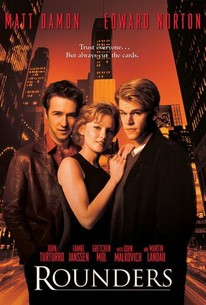

Sequel, Prequel, Limited Series, or All-Black Remake
Worm prequels; Worm as villain; Judges Night Out; Gerbil and Jo’s son
In the discussion (4)
- Worm in jail or young Mike/Worm fixing high-school basketball are wanted; a Little Worm title is pitched.
- Van’s reported rejected pitch makes Worm the new KGB figure and climaxes with Mike against him. A Russian accent and taunting title are jokes. — Van Lathan
- Judges Night Out would frame a legal case with a brief poker game at each end, borrowing Law and Order structure.
- Another sequel makes Mike a champion and returns Worm after 20 years; Affleck as brother Gerbil, Johnny Chan and Joe’s internet-playing son populate a final table. Petrovsky as the father is a joke. — Bill Simmons

In the discussion (1)
- The playing-yourself award explicitly returns to Johnny Chan; it repeats the early 109 selection, not a new person or winner ballot. — Bill Simmons

What’s Aged the Best?
Opening and closing lines; narration; modest stakes; Russian mob; poker clubs; jail-release possessions; Johnny Chan; bad beats; World Series goal
In the discussion (7)
- The opening maxim and Worm’s final you’ll-thank-me line are liked; his last 25 minutes absence surprises. Voiceover elegantly explains poker without stripping jargon, despite one host’s general narration objection and a Forrest Gump joke.
- The 15 thousand stakes and 10 thousand loan limit make danger feel grounded in real people’s money. — Chris Ryan
- A speaker recalls this as their introduction to the Russian mob on screen, followed by Eastern Promises, Training Day and John Wick; another objects that the mob already existed. This is personal cultural memory, not a historical first-film claim. — Van Lathan
- The closed poker-club world and receiving possessions when released from jail are nostalgic pleasures; a never-ending montage and imagined returned belongings are jokes.
- The early ESPN quote-awards column unexpectedly revealed fan enthusiasm before social media. Johnny Chan’s memorable real name and consecutive championships are source reports, with a Street Fighter 2 comparison. — Bill Simmons
- The Buckner-at-Shea line is admired; its authorship is debated between Damon and the writers. Mike’s hometown is guessed from his plain cap, with Connecticut/Jersey/Rhode Island alternatives and no settled fact. Remembering bad beats more vividly than wins is endorsed.
- Bad-beat memory gets sports-loss analogies; the grip exchange is admired. Mike’s World Series goal makes more sense in 2024, and Landau’s later Entourage character is imagined as a Petrovsky sequel, with Ed Wood Academy Award mentioned. — Bill Simmons
In the discussion (1)
- Johnny Chan’s self-portrayal in the flashback explicitly receives the playing-yourself award. — Bill Simmons

Most Rewatchable Scene
Rolled-up aces speech; Mike defeats Teddy KGB
In the discussion (12)
- Teddy crushing Mike opens the choices. A writer is credited with inventing three stacks of high society, replacing three big dimes, and spreading it into real casino language.
- Mike’s full-house shove fails to consider Teddy’s aces; the hosts blame overconfidence after bluffing Johnny Chan. Equinox basketball success versus trying out for the Lakers is an analogy, and his defeated face/Kinnish telling him to leave are praised.
- Reading the judges’ hands impresses the audience. The writers reportedly saw a similar real feat; seven-card stud makes it easier, and televised hand-reading is cited. Worrying too much about others’ cards remains a possible Mike flaw; one speaker simply finds it cool.
- The mansion game restores Mike and Worm’s rhythm and sharp dialogue. Worm engineers Mike’s lateness and repeatedly wins forgiveness, showing that Mike himself is his mark.
- The girlfriend’s departure and rolled-up-aces speech lead to the excited decision to play cards. Worm’s fist pump and the James Gang song make the scene elite.
- Chesterfield South, its nature-channel banter and rent-money insult are praised as a credible closed poker world; the real Mayfair is the reported model.
- The municipal-worker game is a candidate. Mike’s face registers disaster when Worm arrives; leaving immediately seems obvious, but the remaining four-thousand target explains taking the risk. A Wild On viewing excuse is hypothetical.
- Mike recounting the Johnny Chan bluff and the flashback are chosen. Turturro is praised despite only an estimated four or five scenes. — Bill Simmons
- The final Teddy confrontation is a sustained run of taunts, cookie tell and the winning straight. His turning away to soccer and theatrical lines are relished; the suggestion he fixed the match is a joke, and Borat is a character/impression comparison.
- Worm alone with Roman and Maurice and the hot-dog sequence receive an extra nomination for Norton’s virtuosity and the Sputnik insult. — Chris Ryan
- The judge’s yeshiva story is an extra choice for thematic importance despite apparent repetition. Petra’s visit is suggested then explicitly deferred to aged-best discussion.
- Two adjacent choices favor the rolled-up-aces speech; Van and Chris explicitly favor the final defeat of KGB. These are scene preferences, not movie-winner ballots. — Bill Simmons
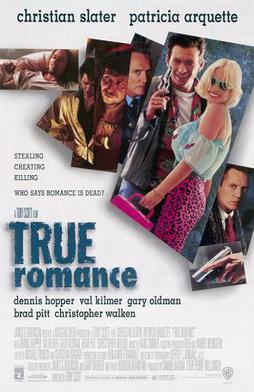

In the discussion (3)
- The choices: Christian Slater, Patricia Arquette, Tony Scott, Quentin Tarantino, Sonny Chiba, Floyd or Saul Rubinek; Sonny Chiba is the Johnny Chan of the movie, a big winner who did not really do anything; since it was not a hit, it has to be Tarantino, who was minted and became someone to watch for the next twenty years, giving him sustainability after Reservoir Dogs.
- Slater is underrated on this pod: by this film he was Christian Slater in every movie, the Jack Nicholson impersonation that had been exciting in Heathers was now held against him; he is a good actor and believable in the part even though a case can be made the movie is about a schizophrenic, wish fulfillment in his head, a dream woman, a classic bag-of-money scenario, note-perfect gangsters and everyone liking a loser from a comic book store.
- Tarantino wins it because it proved Reservoir Dogs was not just a weird indie fluke, established a narrative, led to Pulp Fiction and is belatedly great, the most personal of his films with Clarence as his proxy; Tony Scott was another's runner-up, since the movie needed him and the Gandolfini scene in the wrong hands would go badly, and Tarantino directing it in 1993 would have shot it closer to the ear-cutting scene in Reservoir Dogs; he was famously not on set, and started Pulp Fiction about three months after this came out.
Podcast choices
- Speaker not identified
- Quentin Tarantino

Probably Unanswerable Questions
Was Knish the smartest of them and the hero? Where does Johnny Chan's cameo rank among sports cameos? Is this the best gambling movie ever made? Does 'women are the rake' hold up? Where did Worm go after Binghamton? Did Joe give Petrovsky the 10 grand? What was the perfect release year? Could Damon and Norton have switched parts?
In the discussion (9)
- Was Knish the smartest of all these people and the hero? He owned his own business, grinded out the rent money, was smart enough not to lend Mike McD 10 grand he would never see again, stayed away from Worm, and gives the Turkish bath speech that it is about making a living, not the World Series; he seems to live okay with his truck business despite alimony and child support.
- The ending at the World Series of Poker, which nobody watched then because you could not see the cards, became everyone's dream within five years; Positively Fifth Street by James McManus, about the World Series and Binion's, is recommended as one of the great crime and sports books, and Grantland tried to hire him.
- Where does Johnny Chan's cameo rank among sports-related cameos? The bar is Hulk Hogan in Rocky III; also Kareem in Airplane, Xavier McDaniel in Singles, Larry Bird in Blue Chips, though Koozie (as transcribed) with the left-handed free throws is the real Blue Chips flex and is acting rather than a cameo, and Bob Watson and Cesar Cedeno in the Bad News Bears sequel; Chan is up there even though he only mouths words.
- Is this the best gambling movie ever made? It is a host's favorite poker movie but not favorite gambling movie, which is Robert Altman's California Split with George Segal and Elliot Gould, about how befriending a gambler is bad for you; Koppelman and Levine are surely California Split guys, but as poker movies go Rounders is head and shoulders above everything.
- Where do we stand on 'in the poker game of life, women are the rake'? Iconic twenty years ago, it now reads as misogynist in the woke era, but the hosts still like it: it is Worm's line, this is a movie about card-playing, prison-dwelling dirtbags and that is how they talk, not a movie about the president or the Navy.
- Where did Worm go after Binghamton? In a 2013 Grantland mailbag Koppelman and Levine answered that he meant 'highway time' but needed road money, found a Bronx backroom game far from KGB's territory, and was chased across town by the man he had fleeced for cigarettes in the prison hearts game, a scene they shot, edited, screened and cut; they imagine he later scammed his way through the Moneymaker online boom, where Rounders 2 would pick up.
- Are we sure Joe gave Petrovsky the 10 grand? Why would she, and how would he know; and why did Petrovsky lend it in the first place to a bad student with a gambling problem, since nobody would give 10 grand to an untrusted, failing Ringer employee; Joe's look through the window pane suggests they will go another round, but nothing is certain.
- What year would have been perfect for release? It would have to be about two weeks before Moneymaker so the movie was still in theaters during the rush of interest, but Damon and Norton would be too old by then; a year later, after Fight Club and Ripley, is floated, yet both like how it played out and doubt a later release would have led to this podcast.
- An early question saved from this category: could Damon and Norton have switched parts? Norton 100 percent, since at the time he seemed the new Marlon Brando and the most important actor in a decade; Damon no, and Norton as the embodiment of filth and dishonesty is probably the more irreplaceable of the two.

In the discussion (5)
- Matt Damon is a no because the movie was not a hit; his real apex is probably the first movie of his franchise that made a shitload of money (the transcript has 'that first born movie'), unless it was covered in the Good Will Hunting episode; Ed Norton is a no, with Fight Club his apex given his body of work, though he was on his way up; Gretchen Maul (as transcribed) is definitely a no, with The Notorious Betty Page (as transcribed) her comeback.
- Johnny Chan is put forward as a 100 percent yes; the other reacts 'No way!' and the proposer repeats 100 percent yes, since Chan won two World Series of Poker in a row, this was effectively his third title, and he is immortalized pulling the greatest poker move, waiting out his man; the hosts wonder whether it is the same wheel hand Mike uses to beat Teddy KGB.
- John Turturro is a no: this and Jesus in The Big Lebowski the same year are a great one-two, but Barton Fink is probably his apex, even though one host is not a Coen Brothers guy.
- For Malkovich, Dangerous Liaisons is argued as his apex, coming off Killing Fields, with an underrated over-the-top performance opposite Glenn Close; then the other realizes it must be Being John Malkovich, since they named a movie after him, which is conceded as the cherry on the sundae.
- For Koppelman and Levine, Billions is their apex mountain right now; their dream is Kevin Durant telling them at a party that he loves their show.
Half-Assed Internet Research
Joe was in only three scenes in the original draft; the law school scenes were shot at Rutgers; Malkovich built his accent from a Russian woman reading his lines; the original script had Mike move on Phil Hellmuth, not Johnny Chan; the closing Counting Crows song is on no album; Damon and Norton played the 1998 World Series of Poker main event, where Doyle Brunson's aces knocked out Damon's kings; the book in the opening is Brunson's Super System
In the discussion (7)
- Joe was in only three scenes in the original draft; all law school scenes were filmed at Rutgers, though one host assumed John Jay, as the film calls it something like City Law School; Malkovich got his accent by having a Russian woman read his lines and mimicking her, which prompts the question of whether it is convincing.
- In the original script Mike McDermott was to make his move on Phil Hellmuth in the Atlantic City big-money game rather than Johnny Chan; relief is voiced that it was changed; Hellmuth is discussed as polarizing, Skip Bayless crossed with poker, one of the great figures in sports history whose existence makes the game more interesting, still stirring drama at this year's World Series, and also as annoying.
- Johnny Chan is one of the biggest winners of the movie, top four for Who Won the Movie: he won the World Series of Poker twice when nobody cared, has the perfect poker name, and stands alone like the Muhammad Ali of boxing because of this film; made ten years later the spot goes to Phil Ivey.
- Eric Seidel, who loses the famous hand to Chan, is one of the greatest players ever and still makes a fortune in cash games, but looks like a yokel in the movie and must hate it.
- The Counting Crows song at the end, 'Baby, I'm a Big Star Now', is on no album and hard to find, though one host locates it on Spotify under Saturday Nights and Sunday Mornings; it is called one of their best twenty songs, with a double meaning, and a host wants Adam Duritz on his podcast as the band nears 25 years.
- Matt Damon and Edward Norton played the $10,000 Texas Hold'em championship at the 1998 World Series of Poker in Vegas, where Damon's pocket kings were knocked out by Doyle Brunson's pocket aces; Brunson is the Bill Russell of poker and has the 10-2 hand named after him.
- In the opening shots Mike McD pulls money out of a copy of Doyle Brunson's Super System, a book one host devoured at 18, dated as strategy but a cool way in; having something named after you means you did something well, and Brunson won the World Series with 10-2, not a favorite hand.
Most Rewatchable Scene
The opening scene, Mike McD losing his 30 grand to Teddy KGB; Mike McD and Worm arriving at the emptied apartment and leaving to 'play some fucking cards'
In the discussion (9)
- Five nominees are read: the opening scene where Mike McD loses his shirt ('I don't think you have the spades'), and Mike McD's poker comeback, whose clip is played; 'let's play some fucking cards' plus the guitar riff gets a host fired up to gamble, like the Vegas moment in Swingers.
- An aside: the comeback is a bit of a cheat, because the two hosts played cards on the same night earlier this summer and real poker is slow and awful, everyone is Joey Knish and no one is Mike McD, whereas the movie makes it feel like a jet engine down the tarmac; one host's favorite thing in life is driving to Vegas and sitting silently at a poker table for eight hours.
- The remaining nominees: the Johnny Chan scene, Chan being one of the movie's big winners, with the Russian lady's intimate familiarity with World Series of Poker hands and the Chan versus Seidel 'look at the patience' hand; Mike and Worm trying to win everything back ('I've gone on runs like this before'); and the final Mike McD versus Teddy KGB showdown.
- Runner-up nomination: the judges' game, Mike McD putting every judge in the room on a hand so that Judge Marinacci offers a clerkship on the strength of one read; every movie like this needs a moment showing how smart the lead is. — Sean Fennessey
- The other runner-up is the trip to Binghamton and the card game with the police officers, corrected to municipal workers: the scariest scene but one of the best made, the shot of Mike and Worm getting beaten after Norton's mechanic work is caught, real tension in a movie where the stakes are otherwise hard to gauge.
- The opening scene is picked as the most rewatchable: a testament to how the film draws you in, the soundtrack, Mike McD rolling in with 30 grand, taking three stacks of high society and explaining the game's nuances; voiceover is a no-no that the host hates, but here it works for the first ten minutes.
- A quibble about the opening hand: Mike McD holds ace-nine, KGB holds aces, the board runs ace nine eight, then another nine gives both a full house, and a rag comes on the river; KGB is so sure he has won that he shows his aces, drops them and walks away, yet Mike could have held pocket nines for four of a kind, something the host has never heard anyone discuss.
- The quibble is told to save it for picking nits; the counter is that KGB read Mike's devastated face and needed to see nothing else, which the questioner half accepts while still wanting to see the cards.
- The other favorite is when Gretchen Mull (as transcribed) moves out: not the moving but Mike McD and Worm arriving at the emptied apartment, Ed Norton's 'women are the rake' speech, Mike's wheels turning to 'fuck it, let's go, let's play some fucking cards', and the music, almost a sports-movie scene.