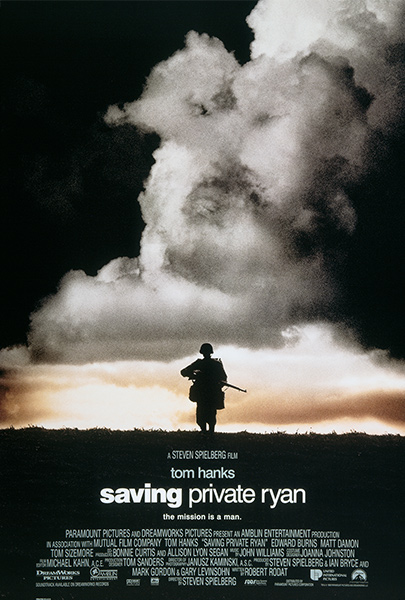
Burns is disputed: She’s the One is preferred as his moment of opportunity, while Ryan is defended as a larger role in a major film; the absence of subsequent momentum is held against Ryan.
The broader World War II movie Apex question remains debated, with Stalag 17, From Here to Eternity, Where Eagles Dare, The Guns of Navarone, The Great Escape, Von Ryan’s Express, and Castle Keep among the alternatives.
Filmed combat receives an explicit affirmative Apex assessment and agreement. — Sean Fennessey
Kaminski receives an affirmative Apex assessment. — Bill Simmons
The transition from young to old Ryan is proposed for morphing, but its dissolve is distinguished from Terminator 2’s effects and Mystique in Days of Future Past is preferred by another speaker. — Bill Simmons
Pepper receives a yes, with 25th Hour offered as another personal preference. — Bill Simmons
Picking up one’s own arm and the expression FUBAR are raised without a settled affirmative selection; the claim that this film invented FUBAR is explicitly rejected. — Bill Simmons
Taking gum out of another person’s mouth is offered as an Apex, followed by disgust and discussion of the different rules for spouses or children.
Ebert’s rating is stated as four stars; no denominator is spoken. — Bill Simmons
Ebert’s review is paraphrased as praising the expression of complex ideas about war through images and action, with Upham serving as an audience surrogate. — Bill Simmons
The review itself is criticized as weak relative to the film and Ebert’s usual work; Stephen Hunter’s Spielberg’s Hell is offered as a stronger response. The three-and-a-half-star remark is speculation about Ebert’s feelings, not his reported rating. — Sean Fennessey
The cinematography is described as using altered lenses, film technique, and desaturation to produce a gray, muddy, visceral image. — Sean Fennessey
Spielberg is recalled as arriving without a shot list, shooting largely handheld and sometimes operating the camera himself, despite the huge number of extras and complicated effects resets. — Chris Ryan
The discussion names eleven Oscar nominations and enumerates wins for directing, cinematography, sound, editing, and sound-effects editing; the transcript renders the intervening win count unclearly. — Sean Fennessey
Brokeback Mountain and La La Land are identified as the two other films matching the described combination of precursor wins and a directing Oscar without Best Picture. — Sean Fennessey
Robert Rodat is credited with building the screenplay from an anecdote he read, with Mark Gordon producing. — Bill Simmons
The stated budget is $70 million and worldwide gross $485 million, placing it second for 1998; its cost is contrasted with The Gray Man and expensive television.
It is described as the third R-rated film to reach $200 million domestically, after Terminator 2 and Beverly Hills Cop. — Bill Simmons
Diesel’s account that Spielberg saw his filmmaking and created the role for him is discussed with explicit skepticism about the strongest version of the story. — Bill Simmons
The actors are said to have helped shape their parts, with Goldberg’s involvement in Mellish raised as an example. — Chris Ryan
The widely repeated account of Sizemore being drug-tested daily and threatened with replacement even at the end of filming is discussed; the threat to reshoot is doubted.
Goldman’s criticism is read from his essays on the five Best Picture nominees collected in The Big Picture; the publication attribution is corrected tentatively from New York to Premiere.
Darabont is credited with uncredited rewrites and creating the Bible-quoting sniper, whose dialogue is praised. — Bill Simmons
The story is traced to a D-Day book Rodat’s wife gave him and an account of a family whose surviving son was removed from Normandy; the transcript’s book date and family spelling are unclear. — Bill Simmons
The actors reportedly attended a ten-day boot camp while Damon trained separately to encourage resentment toward him. — Bill Simmons
The Omaha Beach sequence is said to have been filmed in Ireland for $12 million with 1,500 extras.
The movie’s body count is stated as 255 after guesses of 10,000, 500, and 192. — Bill Simmons
An alleged Spielberg ban on admitting late arrivals is discussed but rejected as implausible to enforce.
The historical account behind the Lincoln–Bixby letter is questioned; the sons’ outcomes are given inconsistently rather than treated as a verified tally. — Chris Ryan
Oliver Stone’s criticism of the film as promoting the good-war idea is called self-serving and overly restrictive about who can make war films. — Bill Simmons
The objection leads to a debate about whether exciting combat and heroic sacrifice undermine an anti-war message, including comparisons with Platoon; Ryan is defended as celebrating sacrifice without making war attractive.
Earn this is questioned as unclear, difficult to hear, and less profound than intended; make this matter is proposed as an alternative, while another view finds the original acceptable. — Bill Simmons
The older Ryan asking his wife whether he led a good life is strongly criticized as an overexplicit, sentimental ending to a film otherwise effective at showing rather than explaining. — Bill Simmons
Removing the prologue and epilogue entirely is proposed, with the counterargument that their sentimentality helped the film’s popularity; a narrower suggestion keeps the grave visit but removes the wife’s reassurance.
The invited producer response calls the line cheesy but argues that the moment, perhaps with different wording, needed to remain.
The cemetery scene is faulted for writing and acting, while the underlying idea that a survivor would reflect on whether he lived well is defended as reasonable.
Ryan’s son taking photographs during the cemetery walk is called irritating, with the wife’s reaction noticed. — Chris Ryan
One speaker questions his own reduced enthusiasm for Ryan compared with other Spielberg favorites despite its importance and the injustice of its Oscar loss; the painful opening and visible flaws are contrasted with Jaws, Raiders, and Close Encounters. — Sean Fennessey
Title; personal tokens; pencil callback; Hanks; young cast; returning German; Farina and Danson; older Ryan; cinematography; squad archetypes; barn story
The title receives an enthusiastic ten-out-of-ten assessment; Horvath speaking the title adds to its appeal for one speaker.
Horvath’s title speech is criticized as corny and stapled into the film, but defended through its resemblance to Sizemore’s bank-is-worth-the-risk speech in Heat. — Bill Simmons
Horvath collecting dirt from different countries is praised as a small character detail. — Chris Ryan
Mellish crying after receiving the Hitler Youth knife is praised as another meaningful personal token. — Chris Ryan
The pencil is praised as a recurring detail, from Miller responding to Upham’s typewriter question to the later need to write a note for a deaf soldier. — Chris Ryan
The spared German returning works as an action-movie device despite Goldman’s objection; his return is defended as plausible because he rejoins other Germans rather than appearing alone.
Farina and Danson’s unexpected appearances are enthusiastically praised, with Farina receiving the stronger joking exclamation-point rating. — Bill Simmons
The older Ryan is praised for looking like an aged Damon, and the image’s later use as an aging meme is noted.
Ryan’s attentive family at the cemetery is admired and contrasted jokingly with how the speakers’ own children might behave. — Bill Simmons
Kaminski’s cinematography is praised for lens-coating changes, shutter timing, and bleach-bypass treatment.
Saving Ryan’s Privates is nominated as an especially funny porn-parody title, without a claim to having seen it. — Bill Simmons
Watching Burns’s scenes while joking that he is in one of his own romantic dramas is described as a recurring pleasure.
The squad’s archetypes are praised as a strong lineup: Brooklyn guy, Italian guy, Jewish guy, religious guy, writer, medic, sergeant, and captain.
Ryan’s crude story is now appreciated more because its awkwardness and Miller’s patient reaction show the gap between a young soldier and an experienced teacher. — Chris Ryan
The film is credited with establishing the cloudy, foggy visual style of the later Spielberg–Kaminski partnership, contrasted with Amistad. — Sean Fennessey
The California setting remains imprecise: Elliott points near Tahoe, while the visual geography mixes the valley and redwoods. — Mallory Rubin
The backyard cornfield appears from one angle but not others, making its existence puzzling despite its effectiveness. — Mallory Rubin
The plant-like description prompts joking questions about E.T. as a Beyond Burger and whether he could be eaten. — Bill Simmons
Hypothetical disasters include a raccoon attack, bicycle crush, herpes, medical dissection, contacting invading aliens, alcohol poisoning and a DUI.
The many keys’ functions are unknown; house, storage, car and trunk are possibilities, and keeping them over a hazmat suit seems especially odd. — Mallory Rubin
Whether the school continued having children chloroform live frogs after the escape remains unanswered.
Sally’s identity and relationship to the absent father are unknown; a performer transcribed as Dana Wheeler-Nickleson is proposed as a type, with the appearance of the imagined character disputed. — Mallory Rubin
The father’s departure is reconsidered as a young couple falling out of love; the hosts connect it with Spielberg later learning a more complicated account of his own parents’ split. — Sean Fennessey
E.T.’s Halloween reaction to Mary prompts a joking attraction question; Keys’s behavior raises a more plausible future date with her. — Mallory Rubin
Elliott accepting the invitation to space divides the panel: some would go as children, others stay with family, with future sports and entertainment making departure less appealing.
Elliott’s next decade is imagined either as chasing an unrepeatable high through drugs or creating magical stories for others; Michael’s future is pessimistically imagined too.
Ralph Macchio reportedly nearly played another child, Tyler; Thomas rescued his audition by thinking about his dead dog and moving Spielberg to tears. — Bill Simmons
Feldman’s part reportedly disappeared in rewrites. Shelley Long being offered Mary is an unconfirmed internet report, with Night Shift and Cheers making the alternative outcome seem fine. — Bill Simmons
Ford’s cut principal appearance reportedly concealed his face, but a recognizable Star Wars actor could still distract in this world.
E.T.’s apparent death, especially the overhead river image, remains painfully distressing; the earlier resurrection reference offers hope. — Mallory Rubin
Growing older shifts identification toward Mary’s safety concerns and the scientists’ lost discovery, reducing childhood’s unquestioning wonder. — Bill Simmons
Mars declining M&M’s placement and the now-obscure Asteroids-score reference have aged poorly. — Bill Simmons
The surprise that the child became adult star Barrymore has disappeared; this is merely something that aged rather than a moral criticism. — Bill Simmons
The hosts discuss an unresolved plagiarism allegation involving Ray’s 1967 Alien script, Scorsese’s apparent support and Spielberg’s denial; independent similar ideas remain plausible. — Bill Simmons
Bad E.T. voice impressions are a downside to the memorable vocal style. — Bill Simmons
The rushed 1982 holiday video game is called among the worst and blamed in contemporary accounts for the 1983 industry crash. — Bill Simmons
The hosts recount unsold cartridges buried in a New Mexico landfill and a 2014 excavation, illustrating the video game failure.
Sayles’s unmade Night Skies is a regretted lost project despite elements surviving in E.T.; his Piranha work reportedly led to Spielberg hiring him.
Williams’s score makes viewers emotionally believe in the puppet, restores childhood wonder and gives the ending its force. — Chris Ryan
Spielberg reportedly edited the final chase to Williams’s music, reversing the usual film-first scoring process and showing unusual trust. — Sean Fennessey
The almost wholly score-driven soundtrack and Williams’s many iconic themes put him at the peak of his profession; Gordon Willis is offered as a comparable technical master.
Favorite images include forest flashlights, steam above the kitchen sink as Elliott looks skyward, and the wide shed shot when the ball rolls out. — Chris Ryan
The unsettling dolly zoom over the housing development is a favorite, compared with later Goodfellas camera work. — Chris Ryan
The ambiguous early 1980 sCalifornia setting works without a precise location, with a near-Tahoe intention recalled. — Bill Simmons
Barrymore’s continuing adult success and Spielberg’s chronological shoot, letting the children genuinely say goodbye at the end, have aged well. — Bill Simmons
The child-eye-level shots and C. Thomas Howell are enjoyed, with a wish for another recognizable child actor in the group. — Bill Simmons
The physical E.T. effects still work despite their age; the living, blinking creature had to meet an audience already familiar with Yoda. — Bill Simmons
Keeping the original science-fiction story standalone instead of making its planned sequel preserved its legacy; Spielberg’s existing Indiana Jones franchise may have helped him resist.
The yearlong theatrical run and stronger eighth Friday illustrate extraordinary staying power. The moon silhouette and phone-home line are called top-ten icons, with the moon shot proposed as the most iconic ever. — Sean Fennessey
Imitating E.T.’s voice has aged both best and worst because impressions vary greatly. — Bill Simmons
The provocative take calls losing picture and director the best thing for Spielberg because it renewed his ambition, despite already having an extraordinary run.
The child ensemble is proposed as a possible Apex, with Stand by Me as a competing benchmark. — Bill Simmons
Spielberg receives an affirmative choice for the Raiders/E.T./Poltergeist period, while 1993 and multiple career peaks remain plausible alternatives.
Every child actor except Barrymore is assigned this peak; her later rom-com years, Fever Pitch,50 First Dates and The Wedding Singer are alternatives. — Bill Simmons
Wallace receives an affirmative choice amid a strong run; discussion corrects assumptions about her age to 34.
Aliens broadly are rejected in favor of Alien, but friendly aliens receive a yes.
Children’s movies are disputed: E.T. may be a favorite, but Toy Story’s industry influence and Star Wars compete.
Cute little-girl performers brings Barrymore versus Shirley Temple; semi-degenerate California children prompts Repo Man, and stealth divorce movies is proposed without a settled answer.
The penis-breath insult and Speak & Spell receive affirmative choices, with the insult’s post-film popularity recalled. — Bill Simmons
Merchandising is rejected in favor of Star Wars; Grogu and the connected Star Wars/E.T. period complicate the friendly-alien discussion.
Reese’s Pieces earns a qualified product-placement Apex for feeling organic; Coke, Coors and V 8 illustrate additional brands.