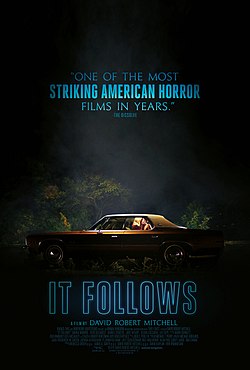
One night with the It Follows girl is worth it; better than Obsession, Hereditary and Weapons; it would make $180 million today; Maika Monroe holds the Scream Queen belt; the sequel should be a comedy
Rolling the dice for a one-nighter with the It Follows girl: at every point from age 18 to 27 the answer would have been fuck it, worth the demon STD.
It goes straight into the doctrine of bet on yourself, counting on scoring again in the next couple of nights; there is no time limit to pass it along.
Changing the Catherine Trammell would you throw your life away award to the would you have sex with the It Follows girl award, or the Bill Simmons I would award, is floated.
Another take: this movie is better than Obsession, Hereditary and Weapons, the elevated horror of the last 15 years, because it has a lot on its mind and peels back more every time, down to her broken hand holding Paul's at the end.
Piggybacking, if it came out right now with a big studio it would make $180 million, at least 100, and it is very similar to Obsession.
Part of what people respond to with horror is newness and surprise, so for the sequel no trailer is wanted, just the title and one second.
The sequel's title is argued as They Follow or They Follows, and Paul is not in it.
Micah Monroe (as transcribed) still has the Scream Queen belt, with competition from Jessica Roth (as transcribed) and Samara Weaving, after Jamie Lee in the 80s, Neve Campbell in the 90s and Naomi Watts in the aughts for Ring, Ring 2, the Funny Games remake and Mulholland Drive.
Funny Games is not a rewatchable because it's not a fun hang, and the dad, Tim Roth, is a zero out of ten on the protect my family scale.
The last take is that the sequel should change genres into a straight comedy, just Paul trying to get laid as people come towards him, made by the This Is the End crew.
The Wolf, Gimp, Walken, Roth, Plummer, Arquette, Stoltz, Maynard, Zed and cab driver are considered; Roth and Plummer are excluded for too much screen time. — Bill Simmons
Debate narrows to Walken and Keitel, with Stoltz defended and the Gimp playfully rejected.
One response initially chooses the Wolf, but Walken’s four-and-a-half-minute impact better fits the award; the final responses settle on Walken, including Craig’s explicit choice. — Bill Simmons
The original notebook already wanted Keitel, Walken, Roth and Plummer; Fishburne was Jules before Jackson, with Murphy another listed possibility rather than a confirmed offer. — Bill Simmons
Murphy’s move toward family films makes accepting this material uncertain, although it might have been a valuable career choice. — Bill Simmons
Madsen committed to Wyatt Earp instead of Vincent, and later Vega-brothers speculation linked his Reservoir Dogs character with Vincent.
Miramax reportedly resisted Travolta and pushed Day-Lewis; the panel imagines his unusual contemporary-hitman interpretation while strongly preferring the actual casting.
Dillon reportedly asked for a day before accepting Butch, during which Willis became available; the lost role might have changed Dillon’s trajectory despite later successes. — Bill Simmons
A competing Dillon story says he wanted an onscreen boxing match rather than merely asking for time to decide. — Chris Ryan
Max Julien and Sid Haig reportedly declined Marsellus; Jackson was another backup while Fishburne remained the intended Jules. — Bill Simmons
Cusack and possibly Oldman were considered for Lance, followed by Tarantino and then Stoltz; Buscemi’s unavailability led Tarantino to Jimmie, a preferable outcome to replacing Stoltz. — Bill Simmons
Decades of imitations, especially in the mid-1990 s, are selected for aged worst. — Bill Simmons
Racial slurs, especially Jimmie’s dialogue, are considered increasingly jarring. The discussion distinguishes their uses without resolving the justification for Jimmie’s language. — Chris Ryan
Tarantino’s racial slurs are defended as his perception of how criminal characters would speak, while the language remains uncomfortable and his claimed familiarity with Black communities is discussed. — Sean Fennessey
Butch’s chair-escape slow motion looks dated and uniquely artificial within the film. — Chris Ryan
Characters are careless about forensic evidence: Butch merely wipes a gun, and the apartment killings leave a conspicuous bloodbath and early-morning gunshots. — Chris Ryan
Los Angeles diners are disappearing, and robbing diners for cash-filled wallets seems less plausible now. — Chris Ryan
Buscemi’s tiny Buddy Holly part feels wasteful; he reportedly lacked time to play Jimmie.
Roth’s predicted next-great-star trajectory is questioned despite strong work in this film, Reservoir Dogs and Rob Roy. — Bill Simmons
Marvin’s visible dummy in the trunk is criticized. — Bill Simmons
Bullet holes visible before the divine-intervention shots are criticized. — Bill Simmons
Smoking while drinking a milkshake is considered an unpleasant combination. — Bill Simmons
Craving a cheeseburger after heavy cocaine use is questioned. — Bill Simmons
Older pop-culture references may no longer register.
The cab’s rear projection is defended as a deliberate old-movie homage.
Tarantino’s acting is defended in retrospect, especially opposite Keitel over linens; his angry tone toward Jules is the specific stretch considered unsuccessful. — Sean Fennessey
A point is started about the gentleman who played Random Task. — Chris Ryan
That actor is called a complicated figure, to be covered later. — Bill Simmons
An actress named on air as Ali Larder is proposed as the lead fembot; the fembots needed one future star, and Helen Mirren is jokingly suggested. — Bill Simmons
The Irish henchman (the Lucky Charms guy) should be replaced by a young host then working at Newbury Comics; Bono is joked about, and edgy British method actors such as Gary Oldman or Tim Roth are proposed.
Bruce Dern was not the first choice; the hosts say the first choice was Bert Reynolds, who died during rehearsals. Reactions to Dern are mixed; one view is that Reynolds would have been a better touch because he was almost a Rick Dalton, while Dern was always the bad guy in westerns. — Bill Simmons
Tim Roth and James Marsden were cut from the film; Marsden played Bert Reynolds in a deleted scene and is said not to look or sound like him.
Tarantino is the no-brainer: nobody ever launched a career so aggressively, he was compared to Orson Welles as a debut shot out of a cannon, and unlike Welles, whose next movie was Magnificent Ambersons, he topped it with Pulp Fiction.
Agreement comes surprisingly easily; the runner-up would be Roth for his performance, which prompts the missed nitpick about his accent.
The Caruso call is praised, one host claims to have won the pod and a who-won-the-pod category is suggested, and the guests are thanked before the closing Vudu read.
A case is made for a ten-episode Netflix remake: twenty-seven years later the movie is dated, seven guys could each get a Lost-style backstory episode, and done straight it would be a show about Roth building up to being a cop and then infiltrating the gang.
Nobody wants any new Reservoir Dogs content; the case was only played out.
Eating breakfast together before a heist; the female driver pulling a gun on two carjackers; how Keitel gets two shots off in the three-way shootout; Tim Roth's accent
They would not eat breakfast before a bank heist, already covered; the female driver pulling a gun on two scary carjackers is questioned, though guns and carjacking were an early-nineties thing, especially in L.A., and it makes less sense against two men than one.
How Keitel gets two shots off in the three-way shootout has bothered one host for twenty-seven years; the explanation is a vanishing quarter second in which Mr. White, already shot, turns and shoots Nice Guy Eddie, since being shot does not drop you instantly and the story needs them all to die; the curved bullet joke follows.
Earlier, during the opening scene, the crew being seen together in public in uniform before the heist was flagged for nitpicks.
Roth's accent, meant for nitpicks, goes up and down, sounding Dutch or Rhode Island; his character's surname Neuendijk (as transcribed) might excuse Minnesota, but it is a British guy doing an L.A. accent that does not add up, better in the commode scene than elsewhere.
Lawrence Tierney cannot win because he is a bad actor rather than an overactor; it has to be Chris Penn, bad for about ninety seconds after he shoots the cop, spit flying and eyes bulging, trying too hard like he is taking a shit, though he is really great overall; Sean Penn or James Woods are imagined in the scene.
Another nominee is the last thirty seconds of Keitel, climbing on Roth almost romantically after their father-son bond; they bet on the Brewers.
Madsen is a yes: a case could be made and nobody argues against this being his Apex Mountain; Chris Penn is floated as a possible case.
Tim Roth is not a yes here; Pulp Fiction is his peak, and he is not thought that great in this movie.
Chris Penn's peak is somewhere between this and Shortcuts, maybe At Close Range, though people would point to Footloose; one host loves him in this movie and no decision is made.