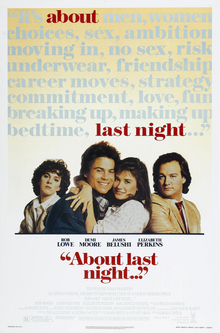
For Rob Lowe, this movie is rejected because of the 1980s hair; older appearances in The West Wing or Parks and Recreation are preferred. — Bill Simmons
For Demi Moore, G.I. Jane, The Substance, and Indecent Proposal are proposed. — Mallory Rubin
Indecent Proposal receives the strongest support. — Bill Simmons
Fictional rock bands are compared, with Stillwater winning over Crucial Taunt and alternatives including Spinal Tap, Wyld Stallyns, School of Rock, Steel Dragon, the Pinheads and Citizen Dick. — Bill Simmons
The Myers–Carvey relationship remains intriguing, and Farley’s first-film cameo makes even listing cities funny. — Bill Simmons
The No Stairway gag endured despite home-video replacement notes; rights costs reportedly caused the substitution, later restored for Blu-ray and streaming. — Bill Simmons
Carrere’s singing, comedic timing and subtitle scene are praised; her later career seemed smaller than her talent deserved. — Bill Simmons
Carrere also keeps the cast from being entirely white; the newer viewer finds her far more distinctive here than in True Lies.
The soundtrack bridges hair metal and emerging grunge, including Temple of the Dog, and makes the film more enjoyable than Singles for one viewer. — Kyle Brandt
Older Queen, Sabbath, Clapton and Hendrix coexist with newer music and Carrere’s covers; Crucial Taunt is a convincing club band. — Bill Simmons
Dutch door action remains funny, with uncertainty whether Myers invented the phrase; Lowe’s literally anticipates Parks and Recreation. — Bill Simmons
Alice Cooper’s scholarly Milwaukee explanation is admired, with a report that his dialogue was unexpectedly added on set. — Bill Simmons
Holding a backstage pass conspicuously is remembered as an enduring behavior from the movie. — Kyle Brandt
Hi, I’m in Delaware remains a lasting joke, and the branded-content sequence still works. — Kyle Brandt
Street hockey adds the game-on/car refrain, Blackhawks jerseys and Stacey’s collision; the Bee Gees line remains apt. — Bill Simmons
Carvey’s actual drumming is admired. — Bill Simmons
Claudia Schiffer remains attractive, with a debate about younger viewers recognizing her through Love Actually. — Bill Simmons
Carrere’s band is passionate and entertaining even on its weaker ballad, compared with Lita Ford and Hole. — Kyle Brandt
No way/way, That’s what she said and the hand-job line still work. — Bill Simmons
Robert Patrick’s Terminator 2 cameo remains effective because the original film is iconic. — Bill Simmons
The Oscar clip, extreme close-up, water on the face and gratuitous-sex-scene jokes remain funny. — Bill Simmons
Jay Roach is affirmed for Apex, with the film's success launching a substantial comedy career and later political films and television work. — Sean Fennessey
Mike Myers is emphatically affirmed for Apex based on his post-film power, and Verne Troyer is affirmed without hesitation. — Bill Simmons
Heather Graham is affirmed for Apex, with the film's commercial scale, Bowfinger and magazine prominence outweighing Boogie Nights' prestige. — Bill Simmons
Dr. Evil impressions are proposed for Apex rather than assuming audiences recognized Lorne Michaels; the revived VW Beetle gets only a maybe, and mailbags are rejected. — Sean Fennessey
Random-song soundtracks receive an affirmative Apex response; Lenny Kravitz is tentatively proposed through American Woman and its Graham video. — Sean Fennessey
Rob Lowe's comic reinvention, resilience and concurrent West Wing role prompt a late Apex reconsideration, but his 1980 s leading-man period is preferred for greater power. — Bill Simmons
Jim Carrey reportedly passed on Dr. Evil in the original film, prompting a question about why Carvey was not approached and speculation about the pair's relationship. — Bill Simmons
Colin Quinn reportedly turned down Scott Evil in the original film; the missed opportunity is noted alongside the earlier Carrey story. — Bill Simmons
Rob Lowe reportedly obtained the young Number Two role after doing a Robert Wagner impression while golfing with Myers; knowing Wagner through dating his daughter is offered as background. — Bill Simmons
The opening credits and between-scene face-making transitions are praised for maintaining pace and coherence between sketches. — Bill Simmons
Mojo is praised as an enduring concept and the colorful, larger-budget production design is admired, including the canister's convincing appearance. — Bill Simmons
Dr. Evil's combination of Blofeld and a Lorne Michaels impression is praised; Dana Carvey's claim to the impression and the resulting estrangement are discussed, distinguishing comic invention from Myers's ability to build a film around a character. — Bill Simmons
Dr. Evil's unexplained oversized nipples are an aged-best choice. — Bill Simmons
The sex-scene lead-up with Frau Farbissina is considered weak, but the awkward coffee encounter afterward is praised and suggested as another rewatchable scene. — Sean Fennessey
Mustafa calling up from below after his injury is praised as a successful repeated gag from the first film. — Bill Simmons
Mini-Me humping the laser and his hostile farewell card to Scott are aged-best choices. — Bill Simmons
I shall call him Mini-Me is praised as a reusable line, alongside the Mini-Me fight. — Bill Simmons
Final aged-best choices split between the unapologetic connected-sketch structure and the Mini-Me–Scott feud; Dr. Evil's nipples are explicitly rejected by the structure voter. — Sean Fennessey
Lowe and Wagner are proposed as aged-best choices, interrupted by an explicitly speculative and then qualified accusation about Natalie Wood's death; the speakers acknowledge they do not know what happened. — Bill Simmons