‹ All movies
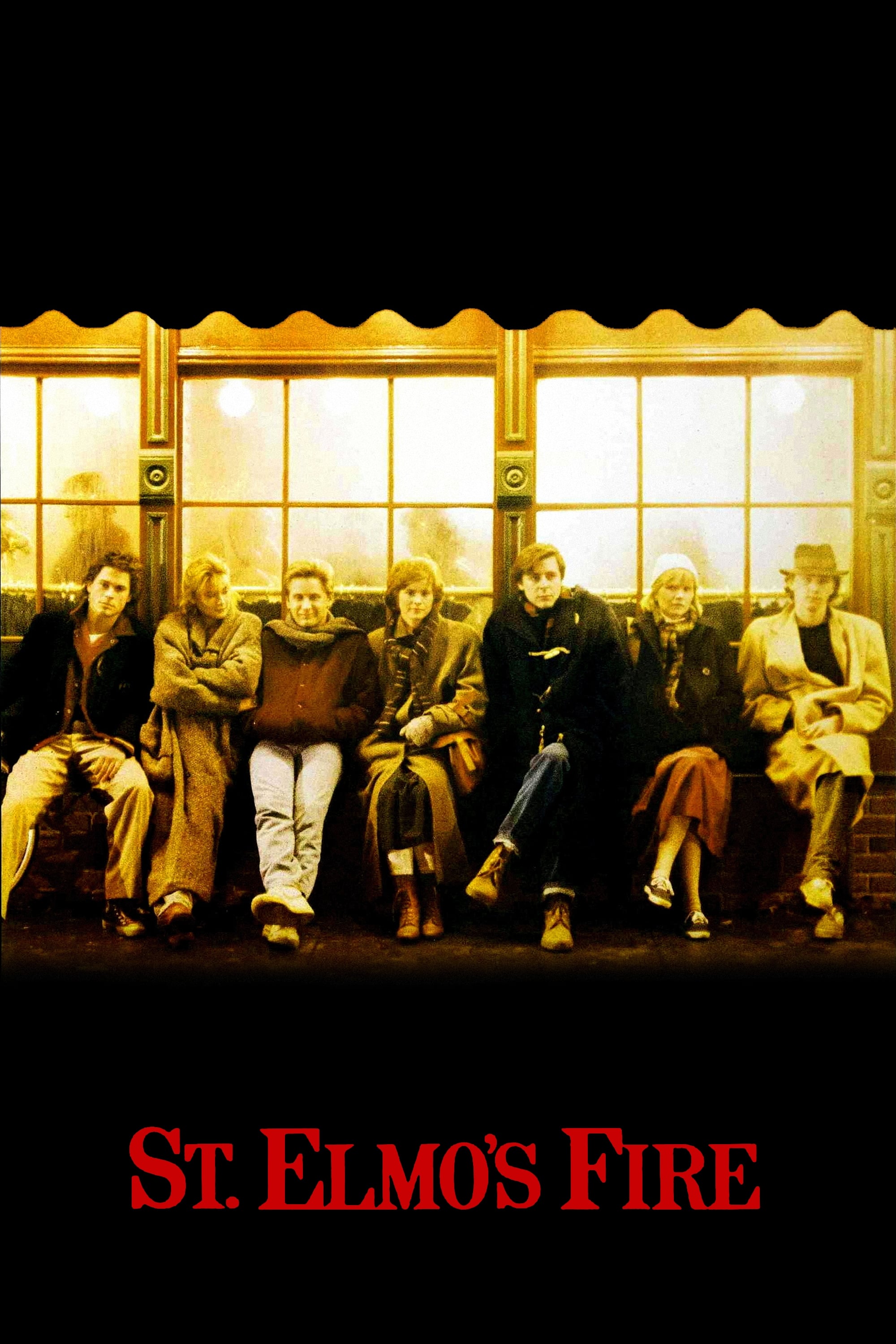
St. Elmo's Fire poster

St. Elmo's Fire

108 minutes

Cast

Selected cast credits · Film reference

Emilio Estevez Kirby Keager
Rob Lowe William "Billy" Hicks
Andrew McCarthy Kevin Dolenz
Demi Moore Julianna "Jules" Van Patten
Judd Nelson Alec Newberry
Ally Sheedy Leslie Hunter
Mare Winningham Wendy Beamish
Martin Balsam Mr. Beamish
Andie MacDowell Dale Biberman
Joyce Van Patten Mrs. Beamish
Jenny Wright Felicia Hicks
Blake Clark Wally
Matthew Laurance Ron Dellasandro
Anna Maria Horsford Naomi, a prostitute who picks up men near Kevin and Kirby's apartment
James Carrington Guy, Dale's boyfriend
Whip Hubley Felicia's Date

St. Elmo's Fire | The Rewatchables

Explore episodeClose episode

Producer credits not yet identified.

Most Rewatchable Scene

Billy's saxophone scene

In the discussion (13)
Approx. transcript time · 00:31:54Read transcript
  • The opening credits are listed first for the theme music.
  • The first St. Elmo's bar scene is listed for its cheesy 80s music and everyone in their habitat, including Judd Nelson dunking Rob Lowe in the water.
  • The short first Jeep scene is listed for the iconic exchange about the three-year Georgetown Young Democrats chief working for a Republican: "Moving up, Kerbo."
  • The scene of Billy on the roof at the Mare Winningham character's house (transcribed 'Mayor Winningham') is listed.
  • Kirby's party at Kim's house and Jules and Billy in the car, ending with "You break my heart. Then again, you break everyone's heart," are listed; the car line is called devastating.
  • Leslie moving out of Alec's apartment and dividing the records ("No Springsteen is leaving this house") is listed, with Nelson described as completely out of control.
  • The vote is Billy's big sax scene, with "no other question".
  • Also liked: the Kevin and Leslie hookup confession ("Am I part of your props?") and Kevin and Kirby's apartment talk when Billy shows up needing a place to crash; but there is really no competition with Billy Hicks and the New Breed on Halloween night.
  • The band's song seems to have only the lyric "One love", leaving the band standing around during Billy's long solo.
  • Whether Billy is a serious musician is unclear; he fronts Billy Hicks and the New Breed but at Georgetown seemed mostly to father children and play rugby.
  • Schumacher's The Lost Boys also has a long sax-solo scene; Clarence Clemons (transcribed 'Clemens') and Eddie and the Cruisers are floated as the influence, and nobody ever picked a bar for its sax player.
  • The "Let's rock" clap-along after the solo brings joy, and Billy's estranged wife arriving with a very 80s date leads to a fight outside the bar, called a great five minutes.
  • Jules's fire-escape rescue and Alec hanging Kevin over the fire escape are added as scenes that probably belonged in this category.
In the discussion (6)
Approx. transcript time · 00:40:39Read transcript
  • Billy's estranged wife's date, 'Hollywood from Top Gun' (transcribed 'Whit Hewley'), is flagged as the Joey Pants pick in his first role.
  • The category is called "a field of one": Hubley (transcribed 'Whit Hubeley').
  • Other nominees: the prostitute character's actress (transcribed 'Maria Westford'), recognized from The Shield and Friday.
  • Matthew Laurance (transcribed 'Matthew Lawrence') as Ron is nominated, with his Eddie and the Cruisers role and his run as Mel Silver on 90210 recalled.
  • Ron is written as a stereotype holding a strawberry daiquiri midday.
  • Confirmed: "So you're going with Hubley. Absolutely, man."

What’s Aged the Best?

Opening credits; theme music; David Foster soundtrack; the Andrew McCarthy impersonation it inspired; the title; Jules; the apartments; the record-splitting breakup; Billy's tie-wearing

In the discussion (12)
Approx. transcript time · 00:41:14Read transcript
  • The opening credits and music are repeated; the hosts say the soundtrack was David Foster's first, and that he later made a fortune and appeared on Real Housewives of Beverly Hills.
  • The hosts say Foster co-wrote the St. Elmo's Fire song with John Parr, and agree it was the number-one song in America.
  • The movie, the bar and the song are all called St. Elmo's Fire, and nobody in the film acknowledges it.
  • A comic's Andrew McCarthy impersonation (transcribed 'Jay Moore') was lifted from this movie and still gets a laugh.
  • The title is great; the hosts say Columbia hated it and sent a 35-page memo, with Sparks and The Real World as alternatives.
  • Billy's St. Elmo's Fire speech to Jules works the title in and is read aloud, but it is mocked as beyond Billy's seven brain cells and, per the hosts, Rob Lowe has called it embarrassing.
  • Jules is one of the best 80s characters; everybody either was a Jules or knew one, and one host was always all in on Jules in his 20s.
  • Jules's career-plan speech turns out to be a real career plan; in a sequel she might co-host The View or run a family reality empire like Jenner.
  • All the apartments have aged the best, including Alec and Leslie's loft with its marathon image.
  • Dividing records in the breakup was accurate for a time when people owned about 20 records, like a fantasy draft.
  • Billy Hicks's loose tie-wearing is a controversial pick said to be ready for a comeback; the other host agrees.
  • Billy's wet-look hair is called both aged best and aged worst.
In the discussion (4)
Approx. transcript time · 00:48:11Read transcript
  • The spin-off is introduced because the exchanges are among what has aged best.
  • Exchanges read: the not-fabulous/irresponsible pair, "I think I'm in touch with that emotion", "Kevin, it is tomorrow", "forever got a lot shorter", and the obsolete-marriage and sexual-revolution exchange.
  • Favorites: one pick is still "Moving up, Curbo"; the other is the forever-got-shorter line, which was used in a song by a band (transcribed 'Brett Braid').
  • A Jules line about feeling old at 22 is also mentioned; the exchanges are agreed to be good.

What’s Aged the Worst?

Wendy's wardrobe and weight plot; Kirby's stalking of Dale; Dale's understanding boyfriend; the glamorous apartments; time spent on Wendy's family

In the discussion (11)
Approx. transcript time · 00:49:33Read transcript
  • Wendy is dressed like a 1950s librarian, and making her weight a plot point is odd.
  • Billy's attraction to Wendy is inexplicable given his wife and bar habits; she is called miscast.
  • Andrew McCarthy is called miscast, with unintentional comedy through the roof; the other host likes him in the film.
  • The actor's smoking as Kevin looks learned the day before filming, and Kevin is compared to Troy in Reality Bites, though Troy's friendships make more sense.
  • Nobody notices Kevin is in love with Leslie, and Alec's cheating seems constant.
  • The Dale and Kirby plot has aged far worse than anything involving Kevin.
  • Kirby is a stalker: the rain-soaked black-tie arrival likened to Buffalo Bill, sniffing the pillow, and leaving his own party to drive three hours to the ski house.
  • Kirby has no other plot beyond law school, the DUI help, switching jobs and returning to law school; he takes bar orders as if nothing happened.
  • Dale's understanding boyfriend at the ski house, who even starts Kirby's car, is ridiculous.
  • The apartments are too glamorous for 22-year-olds; Schumacher is quoted saying youth movies deserved stars, clothes, sets and cars, and that glamour was very much his concept.
  • Too much time goes to Wendy's family with Martin Balsam instead of Jules; in a 10-episode version viewers would skip the Wendy episode.
In the discussion (5)
Approx. transcript time · 00:52:29Read transcript
  • Stepping in early, one host says Robert Downey Jr. (transcribed 'Danny Jr.') as Kevin would make it a better movie; the other says he likes Andrew McCarthy. The name is spoken as 'Robert Downey as Kevin is the sweet spot' at 148.
  • For the Wendy part, an era-specific, better-looking brunette is sought: Daphne Zuniga (transcribed 'Daphne Zaniga'), contrasting with Demi Moore; the reply is "I like that."
  • Justine Bateman is raised and rejected as too famous given her 1985 show.
  • Helen Slater is proposed as Leslie and Linda Fiorentino, coming off Vision Quest, as Jules; the response is "That's pretty good."
  • Downey Jr. (transcribed 'Danny Jr.') is again called a win in that role (name as spoken at 148).

Casting What-Ifs

Anthony Edwards; Lea Thompson; Emilio Estevez as Billy; C. Thomas Howell as Kirby; Robert Downey Jr. as Billy; Charlie Sheen; Jenny Wright as Jules

In the discussion (11)
Approx. transcript time · 00:56:22Read transcript
  • The hosts say hundreds were interviewed, with Anthony Edwards and Lea Thompson (transcribed 'Leah Thompson') coming close.
  • The hosts say Schumacher had to push for the three Breakfast Club actors, and that Emilio wanted to play Billy (called a potential disaster) before settling for Kirby.
  • The hosts say C. Thomas Howell (transcribed 'See Thomas Howe') auditioned for Kirby but was too young, and that Rob Lowe was only 20 when cast as Billy.
  • The hosts say Robert Downey Jr. was considered for Billy before Lowe won it after three auditions; one host loves Lowe as Billy and still sees Downey as Kevin as the sweet spot.
  • Emilio's Kirby is like his Breakfast Club character five years later, yet he had one of the better careers with Young Guns, his own films and Stakeout.
  • Charlie Sheen is called a bit too young and reportedly skipped his audition; one host says he could have played Alec, as he basically does in Wall Street.
  • The hosts say Demi Moore was cast after Schumacher saw her storm out of a John Hughes audition on the Columbia lot; she was on General Hospital, which one host watched.
  • The hosts say that when Moore went to rehab, moving Jenny Wright into the role of Jules was discussed.
  • Madonna stories are uncertain; Madonna as Jules is a good runner-up, but Moore was perfect, and Madonna may not have managed the Jeep scene, possibly Moore's best acting.
  • Mid-80s ensembles seem to have had about 40 actors going up for the same eight parts.
  • Linda Hamilton was rumored for a role, maybe Jules or the Ally Sheedy part.
In the discussion (4)
Approx. transcript time · 01:02:35Read transcript
  • Felicia's date from Top Gun is mentioned again; Anna Maria Horsford (transcribed 'Horstford') is nominated for her "lots of people come to me for love" line.
  • Other nominees: Wendy's mom, the naked man at the hospital, and Andie MacDowell, who looks great in four or five scenes and launched her career.
  • The other host agrees on the prostitute character: "I'm with you. I think it's the hooker."
  • A 14 or 15 seed is Senator Bancroft's guy (transcribed 'Tommy Hodges') smoking a pipe at the bar.

Half-Assed Internet Research

Universal back-lot bar street; the Tombs as the model bar; cast partying; Georgetown filming refusal; shower-door accident; Lowe learning sax; McCarthy feeling apart

In the discussion (8)
Approx. transcript time · 01:05:06Read transcript
  • Per the hosts' research, the bar's street was on the Universal back lot, near the Back to the Future clock tower.
  • Per the hosts, the bar was based on the Tombs (transcribed 'Tumes'), a Georgetown hangout one host visited in the early 90s, which looked similar.
  • The hosts say the five partied a lot, and that Estevez and Moore got engaged and made Wisdom, which he directed and which bombed.
  • The hosts say Georgetown would not permit filming, so the production used the University of Maryland; per Gora's book, a priest answered Schumacher's Exorcist jab by saying God wins in The Exorcist.
  • Per the hosts' research, Lowe had Lakers courtside tickets and a new Porsche.
  • Per the hosts' research, the shower door breaking in the Sheedy-McCarthy scene was an accident; per McCarthy in the book, Schumacher's crude outburst made Sheedy cry, which would be a bigger deal in 2020.
  • The hosts say Lowe learned the sax, though some moments show he is not playing.
  • McCarthy is quoted from the book saying he always felt apart from the group; he is judged a bad hang, and Judd Nelson is preferred.

Apex Mountain

Judd Nelson; Ally Sheedy; John Parr; Jeep CJ7; Georgetown

In the discussion (9)
Approx. transcript time · 01:09:07Read transcript
  • Rob Lowe: his peak is About Last Night the following year.
  • Judd Nelson: yes, coming off Breakfast Club; the peak went down, but yes.
  • Andrew McCarthy: his peak is Weekend at Bernie's or Mannequin.
  • Demi Moore: no way; her own apex was not A Few Good Men, G.I. Jane is floated, and signing the record Striptease contract is probably it.
  • Ally Sheedy: yes.
  • Emilio: no; probably Young Guns or Stakeout.
  • John Parr: yes.
  • The CJ7 the friends drive around Georgetown to pick everybody up: yes, an incredible car.
  • Georgetown is called a big one, citing this movie and, per the hosts, Patrick Ewing winning the title this year.

Probably Unanswerable Questions

Georgetown basketball's view of the movie; what happened to each character; freezing to death in a D.C. apartment; whether Kevin is gay in a 2020 version

In the discussion (10)
Approx. transcript time · 01:10:36Read transcript
  • Would Patrick Ewing like this movie? No. Has John Thompson seen it? No way.
  • The film should have referenced Georgetown basketball, such as Reggie Williams or David Wingate; Kirby should have had an Ewing poster.
  • A Perfect Storm follow-up: a friend emailed that the film says it is October, so Celtics games should have been on.
  • Kevin probably preferred his Woody Allen poster; he is a one seed with Troy among movie characters one host would not hang out with.
  • Kevin's writing career: a Pop Tarts front-page column, a Mitch Albom-style career (transcribed 'Mitch album'), or Spin in the late 80s; one verdict is that it failed because he is too much of a loser.
  • Alec becomes a senator and resigns in a scandal; the Ally Sheedy character's fate is unknown (transcribed 'Alice Sheedy'); Billy is dead.
  • Jules called her shot and hosts a show; Kirby has a bad ending, perhaps as Nationals GM.
  • Wendy is of no interest; Hubley joins the Navy and becomes a pilot.
  • Can you freeze to death in a Washington, D.C. apartment? No.
  • In a 2020 TV version, is Kevin gay? The other host says the Leslie love triangle must stay as the story's hinge.

Picking Nits

Jules losing every possession; the party-night timeline; Billy's quick bail before the bar

In the discussion (5)
Approx. transcript time · 01:11:41Read transcript
  • How do you lose all your possessions to a cocaine problem? The bank repossessing credit-card purchases is debated.
  • The Billy Idol poster looked like an art installation; whether it could go up at home is debated.
  • On the night of Kirby's party, Kirby's drive, Billy and Jules's drive, Kevin and Leslie's night with the broken shower door, and Alec's morning arrival do not add up.
  • At the start, Billy gets a DUI and is bailed out before the bar that night, raising the question of a 40-minute bail.
  • The party night becomes one of the longest in movie history, about 14 hours, with Kirby driving three and a half hours, possibly to the Poconos.

The Neil McCauley “A Book about Metals” Award for Best Line from the Movie

"There are several quintessential moments in a man's life, losing his virginity, getting married, becoming a father, and having the right girl smile at you"; "You break my heart. Then again, you break everyone's heart"; "Never trust a woman who says she isn't angry"; "It ain't a party until something gets broken"; "I enjoy being afraid of Russia"

In the discussion (4)
Approx. transcript time · 01:15:19Read transcript
  • The quintessential-moments-in-a-man's-life line is offered; asked if he agrees, the other host says no and jokes about beating Tom Brady for a Super Bowl.
  • "Never trust a woman who says she isn't angry" and "It ain't a party until something gets broken" are added; "You break my heart" is called the iconic quote.
  • One host recalls his own 2001 Page 2 column about Terry Glenn, built around Billy Hicks as the kind of athlete destined to break your heart.
  • Kevin's line about enjoying being afraid of Russia is added as a take that has lasted.
In the discussion (4)
Approx. transcript time · 01:16:20Read transcript
  • Absolutely, though today's graduates may be less raucous.
  • One host says Topher Grace (transcribed 'Tophore Grace') tried to make it as a TV show around 2009.
  • A Cobra Kai style modernization is pitched, perhaps with Jules's son at Georgetown.
  • A flipped Dale Biberman version is rejected; Dale locked down a great guy.
In the discussion (5)
Approx. transcript time · 01:20:37Read transcript
  • Answers offered as jokes: the backing band the New Breed (ruled ineligible) and New York City getting prime Billy Hicks years.
  • Billy moving to New York in 1985 to clean up is hilarious, and is compared to Beautiful Girls.
  • Two finalists: Judd Nelson is enjoyable in every scene, but it is Rob Lowe or Demi Moore, with Moore's star-making performance feeling like a real person.
  • Asked if a tie is a cop-out, the reply is that they have tied before; Demi Moore and Rob Lowe are named co-winners, with About Last Night as a payoff.
  • Lowe had the best role of his career at 20, the right age for the part.
Podcast choices
Speaker not identified
Demi Moore
Speaker not identified
Rob Lowe

More from the conversation

After the introduction, 0-1 is film trailer and dialogue audio, not host speech.
Approx. transcript time · 00:00:00Read transcript
The hosts mark 35 years since the film, call it the movie that launched the Brat Pack phenomenon, and say it has aged badly in some ways and well in others.
Approx. transcript time · 00:01:01Read transcript
Hollywood rarely makes low-concept after-college friend movies; this one is a flawed portrait of lives without an event-driven plot.
Approx. transcript time · 00:01:01Read transcript
Comparable films named: Reality Bites, a planned Kicking and Screaming, The Big Chill (with surprise William Hurt went un-nominated) and Indian Summer as a failed try.
Approx. transcript time · 00:02:44Read transcript
Seven is the right ensemble size, as in The Big Chill; Billy's wife makes this about seven and a half.
Approx. transcript time · 00:03:21Read transcript
Unlike reunion movies, the characters' plots run independently, so the film plays like a compressed TV season.
Approx. transcript time · 00:03:42Read transcript
Themes: the post-college rude awakening, mattering less after college, and a friend group that won't last; a new generation sits at their bar table at the end.
Approx. transcript time · 00:05:07Read transcript
The film captures a pre-texting era when friends made plans by phone, so a friendship period ended severely.
Approx. transcript time · 00:06:37Read transcript
The Big Chill is called the best reunion film; its late heart-to-heart is described and an episode is promised.
Approx. transcript time · 00:07:40Read transcript
One host recalls a Boston house of college friends in the music scene and how abruptly that ended.
Approx. transcript time · 00:08:52Read transcript
Reasons it endured: it captures a friend group in two hours, and the Brat Pack moment of overlapping casts.
Approx. transcript time · 00:09:55Read transcript
A Rob Lowe podcast conversation about the film is promised for the end of the episode.
Approx. transcript time · 00:10:50Read transcript
The hosts describe cocaine-era partying and say the cast deflated after this peak, with Rob Lowe and Demi Moore enduring.
Approx. transcript time · 00:10:50Read transcript
The hosts recount David Blum's New York magazine Brat Pack piece: he went out with Estevez, the actors got too comfortable, and the piece was damaging.
Approx. transcript time · 00:12:35Read transcript
Citing co-writer Carl Kurlander's (transcribed 'Carl Carlander') Deadline reflection, a host says Kurlander found the piece unfair to that moment, with Moore sober after rehab.
Approx. transcript time · 00:14:12Read transcript
Better work would have let them overcome the backlash; Ally Sheedy's 1980-85 run is listed, and Rob Lowe and Demi Moore looked like the biggest future careers.
Approx. transcript time · 00:14:55Read transcript
The Brat Pack article is proposed as the most famous Hollywood article of the 80s; the label became common parlance, compared to 70s New Hollywood.
Approx. transcript time · 00:16:18Read transcript
Third reason it endured: the theme, called one of the five greatest movie theme songs, used in mid-80s NBA Celtics promos.
Approx. transcript time · 00:18:20Read transcript
Fourth reason: cable; it was on constantly and easy to drop into.
Approx. transcript time · 00:19:14Read transcript
80s pop culture made kids want to be older, while later pop culture let kids stay their age; one host wished to be older and says his 15-year-old daughter enjoys her age.
Approx. transcript time · 00:19:47Read transcript
The episode is being done partly because Joel Schumacher just died; Sean and Amanda discussed him on The Big Picture the week before.
Approx. transcript time · 00:23:03Read transcript
Schumacher favored the glamorous version of ideas; the apartments are unrealistic for 22-year-olds.
Approx. transcript time · 00:23:20Read transcript
The director's filmography is walked through, from The Incredible Shrinking Woman and D.C. Cab through Flatliners, Falling Down, Batman Forever, A Time to Kill, 8mm and Phone Booth.
Approx. transcript time · 00:25:22Read transcript
A running bit: one host has tried for two years to get the other to do an 8mm episode.
Approx. transcript time · 00:26:49Read transcript
Research credited to Susannah Gora's (transcribed 'Susanna Gora') book You Couldn't Ignore Me If You Tried; Schumacher told her the film is about every group pledging to stay together.
Approx. transcript time · 00:27:22Read transcript
Per the book, the director noticed Georgetown graduates while making D.C. Cab; the costumes show each character trying on an adult persona.
Approx. transcript time · 00:28:05Read transcript
The hosts say Schumacher wrote it with assistant Kurlander, it was announced in 1984 as a 'little Big Chill', and it made almost $38 million on a $10 million budget.
Approx. transcript time · 00:29:00Read transcript
Right-out-of-college bars: one host never had one and names Boston bars and a Port Chester favorite with shuffleboard.
Approx. transcript time · 00:32:43Read transcript
Research says five cast members were tight while McCarthy was an outsider in New York and Winningham had a kid.
Approx. transcript time · 00:34:10Read transcript
Side bits: a promised Legend of Billie Jean episode, and jokes that it created the internet and Pump Up the Volume created podcasting.
Approx. transcript time · 01:04:25Read transcript
One host would take the Jeep if he could have anything from the movie (not announced as a memorabilia category).
Approx. transcript time · 01:13:18Read transcript
Archival interview clip introduced as Lowe (229): the guest pays tribute to Schumacher, says the studio wanted him for the Judd Nelson part, and says he won Billy by bringing a six-pack to the meeting.
Approx. transcript time · 01:22:06Read transcript
Sign-off: Legend of Billie Jean and Pump Up the Volume planned for summer; Swingers next on Wednesday, on HBO Max, with a Grantland oral history mentioned.
Approx. transcript time · 01:22:21Read transcript
In the clip, the NBA use of the theme, the D.C. setting and the then-new post-college premise are recalled.
Approx. transcript time · 01:25:00Read transcript
In the clip, the guest says the film is partly hate-watched for being so 80s but is about lasting things.
Approx. transcript time · 01:26:06Read transcript
The guest says he modeled the sax scene on Clarence Clemons (transcribed 'Clemens'), down to the strap.
Approx. transcript time · 01:26:22Read transcript
The guest calls the Brat Pack and Outsiders casts his fraternity, including Tom Cruise.
Approx. transcript time · 01:27:07Read transcript
The guest calls the Brat Pack piece ultimately good though it hurt them with critics; others in the group hated it.
Approx. transcript time · 01:28:17Read transcript
In the clip, 80s cocaine culture is discussed: Belushi's death, the guest's comparison to wine culture after 30 years sober, and Len Bias's death as a turning point.
Approx. transcript time · 01:30:28Read transcript
The guest says drugs were sold on film sets and the young Outsiders cast was handed beer.
Approx. transcript time · 01:32:22Read transcript
In the clip, the film is called one of five movies to explain the 80s, and Kirby's stalking would not work today.
Approx. transcript time · 01:33:26Read transcript