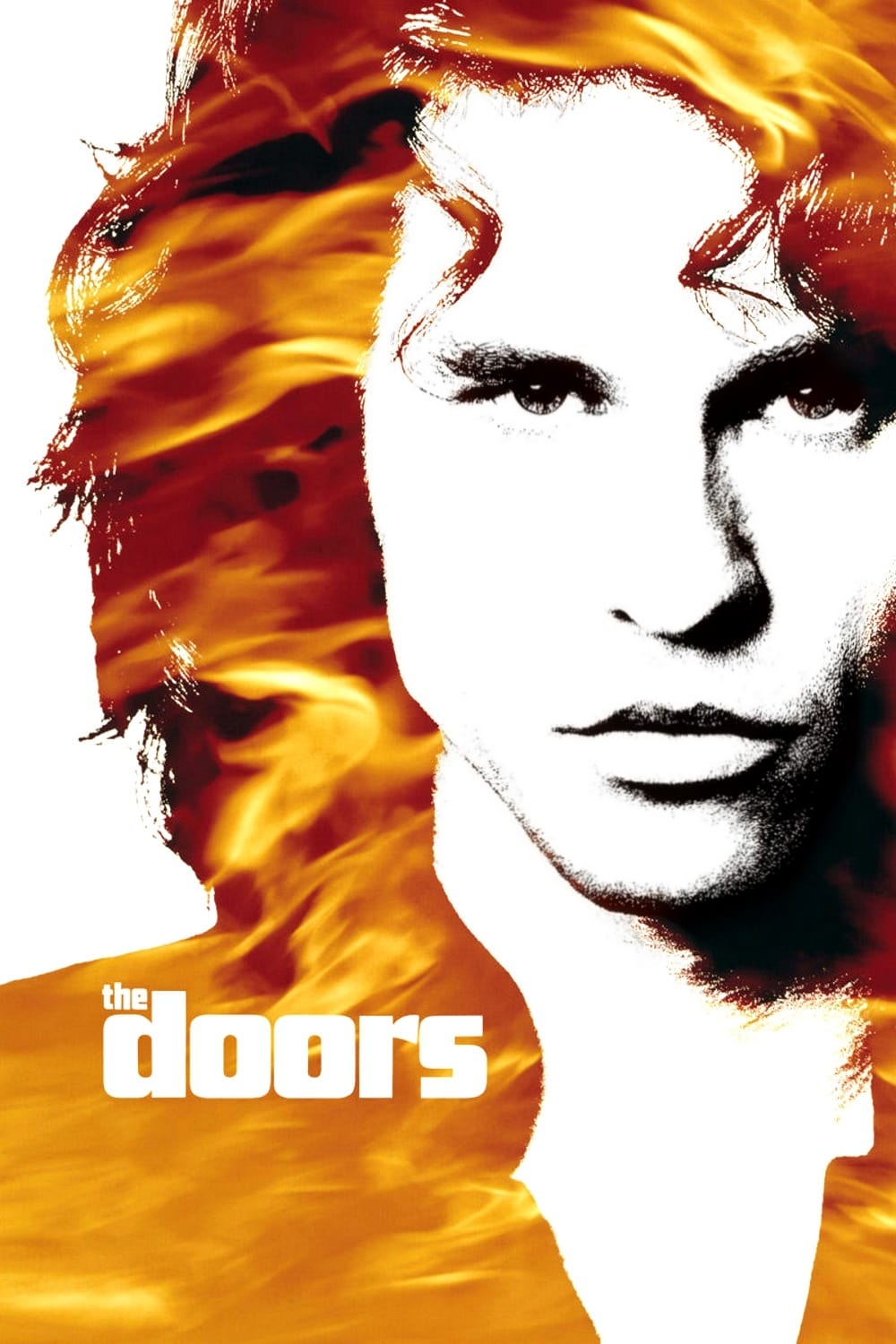
The band opposed the film and wanted to be in it, like Queen with its movie; the Courson family wanted Pam portrayed as an angel.
A memo told someone not to make eye contact with Val Kilmer during filming.
A participant who profiled Kilmer around 2005-06 interviewed Stone, who said Kilmer's biggest issue was wearing the same black leather pants every day.
Stone invented or took liberties with the closet fire, Thanksgiving and Morrison's anger over Light My Fire.
A 1991 Manzarek quote says the film was about "Jimbo Morrison, the drunk," not the sensitive poet and funny guy he knew.
The reporter was a composite character, not a real person.
The desert scenes were shot in the East Mojave Preserve, drawing a fine; Billy Idol's role shrank after his motorcycle accident, so he is seated or framed around it.
The bar Morrison frequents is Barney's Beanery in West Hollywood, where he pisses in the film.
Stone offered Jim Morrison to Ian Aspery (as spoken) of the Cult, who turned it down and later toured with the Doors in the early 2000s; his voice, like Eddie Vedder's, was compared to Morrison's.
An unverified report that Bono wanted the role; Michael Hutchins (as spoken) could have been good, while Bono doing it seems strange.
Michael Madsen auditioned for Morrison and was moved to Tom Baker, initially Billy Idol's role, losing 40 pounds.
Billy Idol's motorcycle accident also cost him the T-1000; without it he might be huge, joked into Lincoln or an HBO prestige series.
The casting director said Patricia Arquette auditioned well for Pam and should have gotten it; an unknown would have been better.
Kyle McLaughlin (as spoken) was Stone's first choice for the Charlie Sheen role in Platoon.
Light My Fire rehearsal through the everything's-taking-off montage and Ed Sullivan; the early fan-mania scene; the Miami sequence from backstage to performance
The opening is liked but left out; the film-school scene is enjoyed; the first scene with Jim and Ray on the beach is picked, from "great fucking lyrics" to "people want to fight or fuck," setting up the 60s in three sentences, called a great four minutes.
Kilmer is not singing well yet on the beach, and later works out a raspier drunk-Jim voice.
The beach is identified as Venice.
The likely pick is the first band rehearsal where Light My Fire comes together in about two minutes.
A good detail is Morrison walking through the rough chord changes; the speed seems crazy, but it shows how a band turns one member's rough version into a song.
The organ intro gets worked out during a five-minute break; the path-to-a-hit device is loved here and in That Thing You Do and the NWA movie.
The first live performance of The End at the Whiskey is incredible and hilarious, along with the short scene where he will not face the crowd and then turns around.
The crowd at that show is unrealistically attractive compared with real rock shows like a Poison concert.
Stone captures the band's early mania in a news-camera style; on the plane each member states name and occupation (Manzarek, Densmore as percussionist, Krieger), the girlfriend is introduced as an ornament and Morrison just says "Jim," which drew theater laughter.
It is hard to recall what he knew about the Doors at 19, including whether he read No One Here Gets Out Alive before or after the movie.
The everything's-taking-off montage and the character reset are loved, compared with a favorite Boogie Nights deleted scene; it leads into Ed Sullivan.
The New Haven 1968 concert used 4,000 extras over five days, which seemed new for a concert scene; the announcer sounds like Mike Francesa; The Blues Brothers' concert was probably about 1,000 people, and films like the first two Rockies cheated with extras.
The Thanksgiving dinner where Pam meets Patricia over a duck is very funny, with the knife and the quoted confrontation.
The Thanksgiving scene and the closet-fire scene are both made up; odd details like the burnt duck make it seem real, a Stone trick also used in JFK, and the invented closet fire effectively casts Morrison as a murderer.
The scene reflects a type of man who invites both women to extend his power over them; the real Pam and Patricia were reportedly cordial.
Pam's family was involved in the movie and there is a rumor she bought the heroin; in the scene she only wants him to wait on the acid, so she was not advocating sobriety.
Drunk Jim recording Touch Me might be the single best scene, followed by his outburst over the Light My Fire commercial ($75,000; Feliciano had sold 2 million).
The short plane scene with Madsen before Miami ("what are you going to do for act three") and Morrison asking for heroin on the plane are liked.
In Miami, drunk Jim insults everyone, then police and the Native American figure appear and he glides through the crowd; called one of the coolest two-minute scenes of the era and the film's peak.
The real Miami concert audio is on YouTube, but the Kilmer version is called better.
The Miami backstage stretch is a favorite: everyone voicing their feelings, peyote with Krieger, and a journalist dictating that The Soft Parade was disappointing while Densmore listens.
Kevin Dillon's "we took drugs to expand our minds, not to escape" is something no drug user says; Stone co-wrote with Randall Johnson (as spoken).
Stone oddly emphasizes Morrison's impotence (coke, blood); the Wiccan blood marriage could be cut from a two-hour-20-minute movie.
Stone handles the transgressive background (Ed Sullivan, decency laws, Manson) in a minute or two while lingering on rants, Wiccan ceremonies, shamanism and the desert.
The Ed Sullivan scene is dramatized: the Stones visibly protested their lyric change, but in the actual Doors performance they just play the song and he does not change the lyric; the scene contrasts wholesome acts with the band.
A short book about the band by Grill Marcus (as spoken) is cited: people were not shocked by The End at the Whiskey; the lyrics signaled a different way to live, which the movie does not convey except in the on-the-nose beach scene.
The last scene of the band together, which first seemed like heaven, is enjoyed.
Favorite rewatchable scene: Light My Fire all the way through the everything's-taking-off montage and Ed Sullivan.
Favorite scene is the "first time they're present" (as transcribed), for the mania, with a woman kissing him and the girlfriend hitting him with a purse; the live performances run a bit long. — Chuck Klosterman
Picks the whole Miami sequence, from backstage to the performance. — Chris Ryan