
‹ All movies

Ving Rhames's 'I would have taken a bullet for you' farewell

Six nominees are offered, starting with the scene when Dave becomes Mitchell's stand-in, is taught the part, runs into the guy and then goes out and does God Bless America; it has the right dramatic tone and is really fun.

Second is the montage when President Mitchell is feeling better, with the 'I once caught a fish this big' moment, the early-nineties shows like the McGoughlin group (as transcribed) and real senators weighing in, nicely edited and finishing with the first pitch at the Orioles game at Camden Yards, probably shot right before a real game started; third is Dave fixing the budget in four minutes, one of a host's favorite scenes in movie history.

"Why can't you die from a stroke like everyone else?"

Nominated lines: 'why can't you die from a stroke like everyone else?', 'you're a flea, you're a blip', the exchange 'I'm going to kill him / you can't kill a president / he's not a president, he's an ordinary person, I could kill an ordinary person, I could kill a hundred ordinary people', and then the speech.

The film

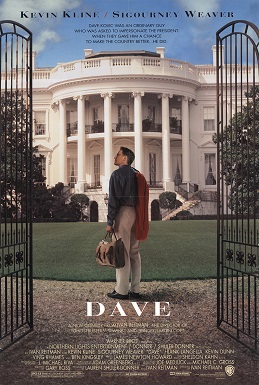
Dave (1993)

Directed by Ivan Reitman · Drama

110 minutes

Cast

Selected cast credits · Film reference

Kevin Kline Dave Kovic/President William Harrison Mitchell
Sigourney Weaver Ellen Mitchell
Frank Langella Bob Alexander
Kevin Dunn Alan Reed
Ving Rhames Duane Stevenson
Ben Kingsley Vice President Gary Nance
Charles Grodin Murray Blum
Faith Prince Alice
Laura Linney Randi
Tom Dugan Jerry
Stephen Root Don Durenberger
Ralph Manza White House Barber
Bonnie Hunt White House Tour Guide
Anna Deavere Smith Mrs. Travis
Charles Hallahan Policeman
Stefan Gierasch House Majority Leader

Everything from the episode

In the order the hosts got to it. Open a row for the discussion.

14:23

Roger Ebert's review

In the discussion (2)
Approx. transcript time · 00:14:23Read transcript
  • Roger Ebert came through with three and a half stars, writing that this movie is more proof that it isn't what you do, it's how you do it, and that Ivan Reitman's direction and Gary Ross's screenplay use intelligence and warm-hearted sentiment to make wonderful light-hearted entertainment.
  • A host jokes that the it-isn't-what-you-do axiom could apply to Ebert's entire career as discussed on this show, that the archives don't lie, and that it isn't about two stars but what's inside the two stars.
20:31

Most Rewatchable Scene

Ving Rhames's 'I would have taken a bullet for you' farewell; the traffic stop where Dave and the First Lady sing 'To...

Ving Rhames's 'I would have taken a bullet for you' farewell; the traffic stop where Dave and the First Lady sing 'Tomorrow'

In the discussion (9)
Approx. transcript time · 00:20:31Read transcript
  • Six nominees are offered, starting with the scene when Dave becomes Mitchell's stand-in, is taught the part, runs into the guy and then goes out and does God Bless America; it has the right dramatic tone and is really fun.
  • Second is the montage when President Mitchell is feeling better, with the 'I once caught a fish this big' moment, the early-nineties shows like the McGoughlin group (as transcribed) and real senators weighing in, nicely edited and finishing with the first pitch at the Orioles game at Camden Yards, probably shot right before a real game started; third is Dave fixing the budget in four minutes, one of a host's favorite scenes in movie history.
  • Fourth is Dave firing Bob and giving the speech about his new jobs initiative, which is called a little flimsy and, for the record, a pitch for socialism; fifth is his last speech and the stroke, with the party where everybody leaves, an amazing five minutes.
  • The 'I would have taken a bullet for you' farewell is made its own scene and is one host's most rewatchable, getting this host every time: two guys reaching that Shawshank beach-hug place, with Ving Ramsey (as transcribed) going from not even eating the sandwich Dave made him to saying he would have taken a bullet; a second voice notes once again listening to the guys talk about men not expressing their emotions.
  • Another nominee is when Dave and Sigourney Weaver are pulled over by the cops, Dave does the club med routine and they sing Tomorrow; her voice is bad on purpose, the cop flashing the flashlight in Kevin Kline's eyes and the 'I'm okay' keep-singing beat have perfect comedic timing, and a host who basically hates live singing picks it as a favorite scene and sticks with it over the montage despite the arms-up moment on the mound.
  • The children's homeless shelter visit, Dave sitting down to talk to the little kid and telling the press 'guys, not now', is a nominee but not a pick; it is hokey yet works, you have to be a great actor to keep it from seeming schmaltzy, and Robin Williams would have botched it with handkerchiefs everywhere; a host goes with 'I would have taken a bullet for you', or the four-minute budget fix if the farewell is not considered a scene.
  • The budget scene is walked through: delinquent defense contracts saving 23 million a month, the need to reach 650 million to save the homeless, the 47 million car marketing campaign to make people feel better about a car they already bought, and the carry-over-the-two 656 finish; the clip of 'I don't want to tell some eight-year-old kid that he's got to sleep in the street' is played, and the cabinet ends up shaking his hand saying 'Mr. President, well done, sir'.
  • Asked whether balancing the budget could really be this easy if the pork were stripped out of every bill in Congress, the answer is yes but that it sounds like every person on talk radio and you only pick your own causes; cutting money to help the homeless is agreed to be a good thing, there is doubt whether a real campaign to make people feel better about their cars ever existed, and a host whose husband recently got a new car has been performing that service for free, at 47 million emotional dollars.
  • During the research block, the scene where Dave and the First Lady pose as presidential impersonators, added late in the shoot, is named by a host as their most rewatchable scene.
29:48

What’s Aged the Best?

The 1993 cameos (Oliver Stone, Tip O'Neill, Jay Leno, Arnold Schwarzenegger, Ben Stein, Paul Simon); the jobs speech;...

The 1993 cameos (Oliver Stone, Tip O'Neill, Jay Leno, Arnold Schwarzenegger, Ben Stein, Paul Simon); the jobs speech; the soundtrack; Bob Alexander; the Kevin Kline and Sigourney Weaver wedding photo; the Kline and Ving Rhames scenes; the realistic DC driving; Kevin Kline's performance

In the discussion (7)
Approx. transcript time · 00:29:48Read transcript
  • The cameos are tremendous and feel very 1993: Oliver Stone, Tip O'Neill, Jay Leno, Arnold Schwarzenegger, the McGluffin Group (as transcribed), early Camden Yards two years in, Ben Stein and Paul Simon, not the politician; the only missing piece would be a fake SNL sketch with Phil Hartman doing Kevin Kline, and the movie feels trapped in that year.
  • The 'if you've ever seen the look on someone's face when they get a job' riff still gets a host; the soundtrack and music are happy and perfect yet completely of a moment, like the score in The Firm, the kind of score nobody writes anymore and which feels stolen for other movies and trailers.
  • Bob Alexander is a phenomenal bit and an iconic character to be discussed later, and the Kevin Kline and Sigourney Weaver wedding photo next to the bed is basically their Ice Storm photo before they made The Ice Storm, sideburns included, foreshadowing a movie the hosts all love.
  • The Kevin Kline and Ving Rhames scenes: Rhames, who later plays Marcellus and the Kiss of Death guy and all these crazy characters, is a straight presence here, and the exchange about his sweaters making his neck look too thick and whether to get a sweater vest is a sweet friendship.
  • DC itself: the film is said to be one of the only movies that realistically portrays what it's like to drive around Washington, unlike the virtually impossible routes most DC movies take, something the show points out about New York in nitpicks, though it helps that they don't go that many places.
  • Kevin Kline's performance counts too: he walks a fine tonal line in this that not many people could pull off, basically its own brand of comedy we haven't seen much of.
  • The cameos are one host's final answer, with the Oliver Stone one singled out as excellent and so funny, and the movie gets out of it quickly so the joke isn't beaten into the ground.
34:21

What’s Aged the Worst?

The first 25 minutes; Charles Grodin's hair; Jay Leno's cameo

The first 25 minutes; Charles Grodin's hair; Jay Leno's cameo

In the discussion (3)
Approx. transcript time · 00:34:21Read transcript
  • The movie gets better as it goes: the first 25 minutes aren't bad but are probably the weakest part, and from the moment Mitchell goes down it takes off; a host realized how many times they had caught it already in progress on HBO, so the beginning, with him coming in on the pig at the car dealership and a Steven Root cameo, was unfamiliar, a premium-cable experience from a bygone era.
  • Chuck Grodin's wig or whatever is going on with his hair, a fuller head than at any point of his career, is called out by a host with an admitted obsession with actors who suddenly have full heads of hair, McConaughey's big flowing locks included; another host, who had Dave on VHS and knows no other Charles Grodin, finds it normal.
  • Jay Leno pops into the movie with the 'too many happy meals' punchline about President Mitchell and is just bad; 26 years ago Leno was not funny, even though he was amazing in the 80s, and the whole spiel about his Letterman-era legend is saved for Craig later.
36:21

Casting What-Ifs

Arnold Schwarzenegger batted around when Warner Brothers wanted a box-office star; Warren Beatty and Kevin Costner co...

Arnold Schwarzenegger batted around when Warner Brothers wanted a box-office star; Warren Beatty and Kevin Costner considered, with Beatty bringing Dave to Ivan Reitman; Robin Williams considered; Kevin Kline almost turned it down as too close to his A Fish Called Wanda character

In the discussion (3)
Approx. transcript time · 00:36:21Read transcript
  • Warner Brothers wanted a box office star and Arnold Schwarzenegger was batted around at one point, which is weird for a variety of reasons, though a host jokes he could have pulled off the Laura Linney cheating scenes; both Warren Beatty and Kevin Costner were considered, and Beatty took it seriously enough that after deciding not to do it he brought Dave to Ivan Reitman, which is how Reitman got the movie.
  • Costner is interesting but one voice doesn't think it works; he had the most power of his career right around then and basically plays Bob Alexander in 13 Days (as transcribed), so he has some interest in the executive branch; Kevin Kline almost turned it down because he thought the character was too close to his Fish Called Wanda character, which none of the hosts can see.
  • Casting what-ifs are blown early: this was almost a Robin Williams movie, which is 90% likely a disaster and 10% likely a reined-in Dead Poets Society performance; Kevin Kline being such a good and subtle actor keeps the ridiculous premise from becoming a circus show of clown ideas, whereas Williams's big expressive face riding that pig would make you ask what ridiculous movie this is, and how could two people look like Robin Williams.
36:21

The Dion Waiters Award for Best Heat Check Performance

Bonnie Hunt

Bonnie Hunt

In the discussion (2)
Approx. transcript time · 00:36:21Read transcript
  • This was tough: Grodin is in it, Ving Rhames is mentioned even though he's not really a heat check, and the initial choice is Oliver Stone, in the movie for 20 seconds and making about seven threes.
  • Bonnie Hunt is nominated for the 'we're walking, we're walking, and we're stopping' White House tour bit introducing Bob Alexander and the 42 presidents and their wives; the scene is really funny, she is pretty good, and the award is given to Bonnie Hunt.
38:19

Half-Assed Internet Research

The Oval Office set was reused more than 25 times; Bill Clinton gave Gary Ross an autographed script and a photo with...

The Oval Office set was reused more than 25 times; Bill Clinton gave Gary Ross an autographed script and a photo with a Dave mug; Barack Obama told Kevin Kline he loves Dave; a musical opened in 2018; Nelson Rockefeller's 1979 death with his assistant; Woodrow Wilson's 1919 stroke and his wife running the presidency; the impersonator scene was added late in the shoot; Ivan Reitman's wife and son Jason play Vice President Nance's family

In the discussion (8)
Approx. transcript time · 00:38:19Read transcript
  • The film's Oval Office set was reused more than 25 times, including for The Pelican Brief, Hot Shots Part Deux and Absolute Power in the 90s, which makes sense since everyone has seen a million pictures of the Oval Office; a nerdy aside notes the residence here is like no other White House residence on film, with a president's bedroom totally different from the identical Sorkin bedroom in The American President and The West Wing, this one quite large and full of red velvet with the bed really far from the other furniture; Hot Shots Part Deux will never get a Rewatchables.
  • Bill Clinton surely approved of a film that gives hope and optimism to the presidency: he gave Ross a framed autographed script calling it a funny, often accurate lampooning of politics, plus a picture of himself holding a Dave mug, though a host adds you can't really trust Clinton saying he likes something.
  • Barack Obama once told Kline he loves Dave and watches it when depressed because it makes the job look fun and easy; the hosts debate whether the line about the current president rooting for Mitchell was Obama's or Kline's, a punctuation issue, and find it weird for Obama, who did that job for eight years, to care what a movie says about it.
  • A musical based on the movie opened in 2018, and President Mitchell's stroke apparently really happened: Nelson Rockefeller, the former vice president and New York governor, died in 1979 at 70 during an encounter with his 22-year-old assistant, though the hosts think he probably wasn't in office at the time and nobody found a Rockefeller lookalike to bring out in front of the people of New York.
  • Woodrow Wilson, two years into his second term in 1919, had a stroke that left him semi-paralyzed, partially blind and mentally incapacitated, and since the 25th Amendment had not been ratified his wife took the presidency for the last two years; a century later it is still not known how bad it was, and a host feels like being in history class with Dr. Bill.
  • The Wilson story is pitched as the greatest hundred-years-ago Hulu series, the First Lady in 1919 taking things over, with a joke about ending the pod to open Final Draft.
  • The scene where Dave and the First Lady are presidential impersonators was added late in the shoot because Reitman didn't buy that those two would click and felt they needed something leading to that scene; the hosts agree you can't go from 'I hate you' to 'you're a stranger' to 'hey'.
  • Ivan Reitman's wife and son play the wife and son of Vice President Nance as he is sworn in at the end; the son is Jason Reitman, who became a famous director, so look for him in the Nance scene.
45:51

Apex Mountain

No affirmative selection

No affirmative selection

In the discussion (5)
Approx. transcript time · 00:45:51Read transcript
  • Kevin Kline is debated: apex is meant to be objective, when he had the most power or success, so A Fish Called Wanda is possible but he arguably has more power coming off this; another host puts it at Grand Canyon, five years after the Oscar and not so far removed from it; one host votes yes for Kline and tells the other two they vote no.
  • Grand Canyon tangent: a movie about somebody who made a wrong turn leaving a Laker game, which is a host's life every day driving home on the 101 and plays on every fear of a detour leaving the Staples Center.
  • Frank Langella, one host's actorly god, has been a lot of different guys: a hit Dracula in the 70s, the star of Mel Brooks' first movie The Twelve Chairs, really good on the Showtime show Kidding, and his falling for Whoopi Goldberg is in the running for weirdest celebrity couple of the last 30 years, with Eddie called a great movie.
  • A host goes yes for Langella as his signature performance because he dials it up, having asked Ivan Reitman whether to scale back and been told to go for it, bulging his eyes at the window like a maniac while Dave balances the budget; another agrees it's his most fun performance but doubts it's his apex, and the group settles that Dracula was probably his apex.
  • Nobody else in the movie qualifies: Sigourney had peaked, and Kevin Dunn is a maybe who is coming up next.
48:38

The Joey Pants “That Guy” Award

Kevin Dunn

Kevin Dunn

In the discussion (2)
Approx. transcript time · 00:48:38Read transcript
  • Kevin Dunn: a host never knew his name until researching the movie, knowing him only as that guy from Dave and from Mad Love with Drew Barrymore and Chris O'Donnell.
  • Dunn has been in a lot of stuff: Mississippi Burning, Hot Shots, 1492, Chaplin, Beethoven's 2nd, Little Big League, Nixon, Chain Reaction, Picture Perfect, Godzilla, Stir of Echoes, Snake Eyes, I Heart Huckabees, a bunch of Transformers movies, Warrior, and five years being really funny on Veep; he is hall-of-fame that guy, the award could be called the Kevin Dunn award, and there were no other candidates.
49:08

The Ruffalo / Hanna / Rubinek / Partridge Overacting Award

Frank Langella

Frank Langella

In the discussion (2)
Approx. transcript time · 00:49:08Read transcript
  • It comes down to Grodin or Langella: Langella really dials it up a couple of times, while nobody knows what Grodin is going for and it is called one of his worst performances despite a host loving Charles Grodin; he is really stressed out and meant to be the audience stand-in and the skepticism in the movie, and his 'get out of here as fast as you can' after the budget scene is one host's single favorite line reading, since that is how most people would react.
  • The bratwurst-with-mustard food order before balancing the budget is enjoyed, and Frank Langella (transcribed as 'Franklin Jell') is picked for 'he's not a president, he's an ordinary person, I can kill an ordinary person'; he's going for it with a great rhythm, bringing his own spin as a theater actor.
51:07

Picking Nits

A body double hired just to cover the president's affair; whether body doubles have ever really happened; Dave's temp...

A body double hired just to cover the president's affair; whether body doubles have ever really happened; Dave's temp agency during the five months; the confusing fall-to-fall timeline; the stroke never leaking; the hush payouts are far too low; the balcony security risk; the president and First Lady getting back into the White House; the everyone-gets-a-job program; why Bob didn't just let the VP take over; the First Lady turning around too quickly

In the discussion (10)
Approx. transcript time · 00:51:07Read transcript
  • A counterpoint argues there is no hole, the movie is perfect and the second best ever made; nit number one is that they found a body double so the president could carry on with a staffer when he could have done that anyway, since he comes in and out of her office multiple times.
  • On body doubles generally: a host thinks it has definitely happened in American history, before the internet or even the cable news era, recalling the Melania body double theory; others accept it may have happened for a diversion when someone was sick but never to this extent, and even Nixon's distinctive face would be hard to replicate.
  • What happened to Dave's temp agency during the five months he was president? Faith Prince was crushing it on the phones, and he had called to say he met a Polynesian gal and was going to Hawaii to get married, with 'she was amnesian' one of the stickiest lines in the movie; a host asks at what point anyone would wonder if they disappeared from the Ringer for five months, with a joke that Chris Connelly replaced Dave at the agency.
  • The timeline is confusing: it is fall when the movie starts and fall when it ends, yet the closing voiceover says the real president was in a coma for five months before he passed away, left intentionally ambiguous; and a lot of people knew about Mitchell's stroke coma, yet it never leaked and there were no rumors.
  • The payouts are extremely low, 50K, 50K, 100K and one doctor asking to head the CDC, as learned in the Alan and Bob Alexander conversation; the president having a stroke on top of his secretary would be a 5 million dollar National Enquirer scoop and the biggest story in the history of American politics, so you always need to ask for more.
  • Dave wandering the balcony as President Mitchell, looking out at the monuments, seems like a security concern with a sniper a mile away in some hotel; another host counters that roof and air rights around the White House are locked down and that on the factual television show Scandal the Truman Balcony is used constantly; the nit is waved off as not the biggest concern in a movie where a lookalike becomes president, and listeners are told to email.
  • The president and First Lady leave the White House and are simply let back in at the front gate, which is more unrealistic than leaving, since the guard can't know it's really them, and it certainly isn't him; bad security.
  • President Mitchell's jobs program, everyone who wants one gets a job, the Oprah plan with a direct comparison to FTR (as transcribed), is probably the most unrealistic part, since a real president saying that would be destroyed; the press laughs and is then won over by the 'look on somebody's face the day they finally get a job' speech, which is played, but Dave runs a temp agency and nobody sings from the rafters about a temp job, though the speech is moving and good acting.
  • Why wouldn't Bob just let the VP take over and bulldoze him? Because the boy scout might not keep him on as chief of staff; the random-temp-agency-stooge plan isn't really thought out, Bob just sees an opportunity after an unforeseen stroke, it's a bad plan, and Vice President Nance is a good and decent public servant who wouldn't suffer a devious fool like Bob Alexander in his administration.
  • Parked for nitpicks during the research block: the Sigourney Weaver character still turns around pretty quickly, one sandwich and she wants to keep the coup going, though a host defends it as falling for the sweet, decent version of the person you first loved who looks exactly like him; the real objection is less the attraction than her signing on to the illegal operation and pushing major legislation, while others point to the balanced budget, Ted Bundy's death-row romance, the shower, and how weird it would be to see a spouse of 30 years suddenly do a magic trick.
59:03

The Neil McCauley “A Book about Metals” Award for Best Line from the Movie

"Why can't you die from a stroke like everyone else?"; "You're a flea. You're a blip."; "I could kill an ordinary per...

"Why can't you die from a stroke like everyone else?"; "You're a flea. You're a blip."; "I could kill an ordinary person. I could kill a hundred ordinary people."

In the discussion (3)
Approx. transcript time · 00:59:03Read transcript
  • Nominated lines: 'why can't you die from a stroke like everyone else?', 'you're a flea, you're a blip', the exchange 'I'm going to kill him / you can't kill a president / he's not a president, he's an ordinary person, I could kill an ordinary person, I could kill a hundred ordinary people', and then the speech.
  • 'You're a flea, you're a blip' is loved for being so insulting, and the clip runs through 'you're nobody', 'I'm not nobody', 'you're lint' and 'you're a freak'; a host tells Sean never to say that to anyone.
  • Replies that he says it to the staff every morning, looking everyone directly in the eye and telling Craig he is lint. — Sean Fennessey
59:33

Sequel, Prequel, Limited Series, or All-Black Remake

Yes, a 10-episode Netflix series

Yes, a 10-episode Netflix series

In the discussion (4)
Approx. transcript time · 00:59:33Read transcript
  • Posed as a new category, could this be remade as a 10-episode Netflix series: one host is 1,000% yes and would be in on the series, but the question is how similar a 2019-20 version would be, an optimistic comedy or the story of a coup and a cover-up.
  • Now you would make it as Trump replaced by a body double who becomes a much better president, which could be pretty interesting, though that might inadvertently humanize him and his policies; the underlying issue with the movie, if you think too hard, is the idea that all you need is a nice guy and the country will be fine, which one host still believes.
  • The Frank Capra comparison is defended: the movie is about ideas, about using public office for good and decency once ego, money, vanity and sex are disentangled, the kind of show Aaron Sorkin tried to make with The West Wing as a true believer whose dad went to school on the GI Bill; but Sorkin's president is a Nobel-winning economist accused of being an elitist, and the implication here that anyone can be president hits the wrong way today and may already have led down rocky paths, though Dave would disagree.
  • Polled yes or no: one host says no, having answered no virtually every time on this category because we got Dave the movie and a series would just be very different and a bummer; another says it can be done and is ready for another president series in general, making it two in favor against one.
1:03:10

Probably Unanswerable Questions

Who would divorce Dave? Would Dave ever come clean that he had been president for five months? What did the First Lad...

Who would divorce Dave? Would Dave ever come clean that he had been president for five months? What did the First Lady's reaction to Dave in the shower mean?

In the discussion (3)
Approx. transcript time · 01:03:10Read transcript
  • Dave was divorced in this movie: who would divorce such a good guy and why did the marriage fall apart? Theories: he is a magic-trick-spewing charlatan who forces his friend to hire people to sustain his business, flighty and impressionable about stumbling into the arrangement, and based on his Oklahoma rendition he may sing too much at home; is Dave a great hang or a tough hang after three years?
  • Would Dave, running for office later, ever come clean that he was actually the president for five months? Should he? No, he would be arrested, maybe not for treason but impersonating a government official is a crime and this is literally a coup d'etat, so even though Dave did a great job, don't go around admitting it.
  • The shower scene: based on the First Lady's reaction, was Dave more or less healthy than President Mitchell? A host has been preparing this since the episode was announced; the reaction is coy and unclear, the common male reaction to the movie is that she should have recognized the difference, but after not seeing each other naked in a long time that is hard; the lean is that she was genuinely impressed, with shower conditions an X factor.
1:06:08

Who Won the Movie?

Kevin Kline

Kevin Kline

In the discussion (3)
Approx. transcript time · 01:06:08Read transcript
  • Kevin Klaid (as transcribed) is the instant answer, with 'can't believe this is a podcast' and 'that was easy', followed by agreement and a shout-out to Ving Rhames.
  • A stealth case is made for Ivan Reitman, since this kind of movie is really hard to do with the right tone and could go wrong in so many ways; it may be his last great movie, after a resume of Stripes, Meatballs, Ghostbusters, Twins and Kindergarten Cop, with Junior in 94, Six Days and Seven Nights and Evolution less impressive, his style specific to a time period and this the last confluence of those events.
  • Reitman's two interesting movies this decade, No Strings Attached and Draft Day, would probably have been huge hits in 1986 or 1988; No Strings Attached, written by Liz Merriweather (as transcribed) of New Girl under a cruder original script title, is judged better than Friends with Benefits, features Kevin Kline, and the hosts admit they all like it; you're in safe hands with Ivan Reitman, who has never made a bad movie.
Podcast choices
Speaker not identified
Kevin Kline
Speaker not identified
Kevin Kline

More from the conversation

The episode marks the film's 25th anniversary in May; it is jokingly ranked with The Godfather 2 as the best movie of all time, and praised as satisfying, simple, happy and innocent, from what feels like a different time or country, tapping the same innocence Clinton tapped into, back when people believed in the office as an institution, as with The American President and The West Wing, which stings in the Trump era.
Approx. transcript time · 00:00:45Read transcript
The movie is impressively old-fashioned, like a Frank Capra movie, and the show's favorite phrase applies: they really don't make movies like this anymore, especially earnest light comedy that isn't slapsticky or meta; it also has ideas and is a rich text of its era, and a host who had it and The American President on VHS learned politics from them, as did a whole generation of liberal thinkers once you add The West Wing.
Approx. transcript time · 00:01:54Read transcript
A host's list of the best movie presidents: Kevin Kline as Dave, Michael Douglas in The American President, Jeff Bridges in The Contender, Bill Pullman in Independence Day, Jack Warden in Being There and Harrison Ford in Air Force One; Morgan Freeman in Deep Impact is out because the movie is bad, Peter Sellers in Dr. Strangelove is rejected, and Jack Nicholson in Mars Attacks is one everyone thinks they liked at the time.
Approx. transcript time · 00:03:04Read transcript
Kevin Kline appreciation: a big takeaway of every rewatch is how likable he is, in The Big Chill, this and even the flawed Grand Canyon; he mixes a little Tom Hanks, the better pieces of Robin Williams and some Costner, can turn on 20% Robin Williams for the pig or the traffic stop yet be earnest, a romantic lead and a convincing villain as the evil Bill Mitchell; nicknamed Kevin DeKline for turning down so many movies, he skips the Marvel checks for the theater, like The Seagull on Broadway.
Approx. transcript time · 00:05:12Read transcript
Kline seems a happily married actor who met Phoebe Cates and settled down while she basically stopped acting despite being one of the best-looking actors of the 80s; he was recognized early, winning an Oscar for a comedy, A Fish Called Wanda, at about 35, which is the one distinction between him and Glenn Close and gave him capital to recede from the frame; the hosts debate whether this is his best part over The Big Chill, whose plot is recounted as ridiculous yet effortlessly sold, note Silverado and his Kasdan era, and wonder whether he could lead a Death Wish.
Approx. transcript time · 00:07:14Read transcript
A 25th anniversary story: Kline is constantly stopped on the street by people who love the film, some just calling him Dave, and during a W. Bush motorcade on Fifth Avenue someone told him 'I wish it was you, why didn't you run?'; the movie cut through and makes politics seem easy, possibly because it has wisdom.
Approx. transcript time · 00:09:53Read transcript
Production facts recited: Ivan Reitman's 79-93 run of Meatballs, Stripes, Ghostbusters, Legal Eagles, Twins, Ghostbusters 2, Kindergarten Cop and Dave has no outs; the cast includes Kline, Sigourney Weaver, Ben Kingsley, Frank Langella, Ving Rhames in the middle of his 92-98 IMDb run, Laura Linney and Charles Grodin; Gary Ross wrote the Oscar-nominated script while working on the Michael Dukakis campaign, having written Big and Mr. Baseball; Reitman is quoted as deliberately putting a Capra-style innocence into the film and calling today's world far more cynical.
Approx. transcript time · 00:10:38Read transcript
Context: 1993 was pre-internet, yet earlier political movies such as Advise and Consent, The Best Man and Fail Safe were cynical, and post-Watergate DC films were suspense thrillers; the Gulf War and a happier couple of years led to the Clinton election, and Dave's effervescence is credited to Reitman's comedy years rather than a Dukakis staffer's sourness; the hosts also think it accurately shows a handful of people making decisions, compare it to the unitary executive in Vice, and to the current White House.
Approx. transcript time · 00:12:23Read transcript
Rotten Tomatoes 95%, 63 million dollars at the box office; Ben Kingsley's 1993 of Dave, Schindler's List and Searching for Bobby Fischer is a murderer's row of sliders.
Approx. transcript time · 00:14:23Read transcript
If made today it would be a TV show, maybe an ABC sitcom after The Bachelor, or total slapstick or satire; Bill Mitchell feels clearly based on George H.W. Bush, a bureaucrat from a blank era of politics after Reagan's checked-out final years, and a prick-behind-closed-doors president replaced by a double would feel out of place in today's extremist conversation.
Approx. transcript time · 00:15:15Read transcript
The sham marriage theme: the president and First Lady have contempt for each other, with her 'why can't you die from a stroke like everybody else' and his line of patriotic secretaries; this is pre-Lewinsky but after Paula Jones and Gary Hart, with LBJ's tunnels mentioned, and the hosts recall 1992 as the first time the public debated a president's marriage, contrasting the Nixons, the Reagans, Camelot and Trump and Melania.
Approx. transcript time · 00:16:44Read transcript
The 1993 Best Actor field of Tom Hanks, Daniel Day-Lewis, Laurence Fishburne, Anthony Hopkins and Liam Neeson explains why Kline wasn't nominated, with Hopkins the weak link; a host likes Ving Rhames' performance more than most and didn't check supporting actor.
Approx. transcript time · 00:19:43Read transcript
Plot recap for anyone who hasn't seen it (it's on HBO Go and Amazon Prime): evil President Mitchell, who barely talks to his wife and has a two-person cabinet, has a stroke while with his secretary Laura Linney; Dave, who runs a temp agency and had been his stand-in, is kept on because the vice president is seen as a buffoon and chief of staff Bob Alexander, Frank Langella as a Machiavellian Dick Cheney figure, wants to keep controlling the office; the hosts sort out that Cheney was Ford's chief of staff and Bush's Secretary of Defense.
Approx. transcript time · 00:21:02Read transcript
Who plays Dave today? Richard Gere is rejected as boring; the hosts note Dave is meant to be about ten years younger than Mitchell; Affleck is debated, hilarious on Kevin Smith commentaries but perhaps not trustworthy or funny enough in character; Jon Hamm is agreed on, with the admission that they land on Jon Hamm for about half the roles they recast.
Approx. transcript time · 00:32:51Read transcript
A tangent on Ashton Kutcher movies: a host liked A Lot Like Love with Amanda Peet and the Chicago scene, and says they saw it on a date right before meeting their current wife, prompting jokes about ruining a marriage on the podcast until the movie turns out to be Boys and Girls with Freddie Prinze and Jason Biggs from 1998; Loser with Jason Biggs has aged badly despite a great soundtrack, and American Pie's 20th anniversary is teased as a possible episode.
Approx. transcript time · 01:09:22Read transcript
Wrap-up: next week is Reality Bites; Four Weddings and a Funeral has been bumped for Fletch, prompting a threatened solo sit-in episode, a confession of never being a Hugh Grant guy, and a deal in the style of The American President to do it if a co-host can be found, possibly outside Ringer circles; the show signs off thanking Amanda and Sean by name.
Approx. transcript time · 01:11:32Read transcript