
‹ All movies
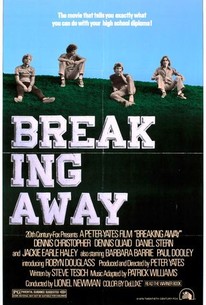
Breaking Away poster

Breaking Away

100 minutes

Cast

Selected cast credits · Film reference

Dennis Christopher Dave Stoller
Daniel Stern Cyril
Barbara Barrie Evelyn Stoller
Paul Dooley Ray Stoller
Robyn Douglass Katherine
Amy Wright Nancy
Peter Maloney Doctor
John Ashton Mike’s brother
Lisa Shure French girl
P.J. Soles Suzy
David K. Blase 500 race announcer
William S. Armstrong 500 race official
Howard S. Wilcox 500 race official
J. F. Briere Mr. York
Carlos Sintes Italian rider
Eddy Van Guyse Italian rider

Breaking Away | The Rewatchables

Explore episodeClose episode

Producer credits not yet identified.

Most Rewatchable Scene

The Little 500 finale

In the discussion (8)
Approx. transcript time · 00:15:10Read transcript
  • The father-son hug and the mother’s emotional reaction form the strongest dramatic scene.
  • Cyril looking for someone to hug after the victory adds loneliness to the expected sports-movie celebration.
  • The opening quarry sequence establishes the setting and all four personalities almost immediately, including the uncertainty of being nineteen and Dave’s Italian obsession.
  • Mike’s feigned drowning and speech about aging while college athletes are continually replaced make him a tragic figure.
  • Dave drafting the Cinzano truck creates an expectation of disaster but becomes a pleasant encounter ending in a speeding ticket for the driver.
  • Mike racing the college antagonist in the pool is another nominated scene.
  • The Italian riders’ unsportsmanlike behavior destroys Dave’s idealization; the aftermath with his father and crying mother is especially moving.
  • The Little 500 is the emphatic final choice: the friends take turns after Dave’s injury, Mike pushes through his despair, and Dave returns for a continuous wide shot of the thrilling last two laps.


Top Ten List

Seventies sports pyramid; 1979 domestic box-office list (twelve named)

In the discussion (5)
Approx. transcript time · 00:18:25Read transcript
  • The final seventies sports-movie pyramid places Rocky first; The Longest Yard and Breaking Away second and third; Slap Shot, The Bad News Bears and Rollerball on the next tier; and The Jericho Mile, Rocky II, North Dallas Forty and The Bad News Bears in Breaking Training on the last tier.
  • Downhill Racer was initially tenth but is removed when its 1969 release is pointed out; Breaking Training replaces it.
  • Fast Break, One on One, The Fish That Saved Pittsburgh and The Bingo Long Traveling All-Stars and Motor Kings receive honorable mentions; Fat City is additionally recommended, while Inside Moves is excluded as 1980.
  • Slap Shot receives a personal favorite vote, and another preference would move The Jericho Mile higher; the top seven are considered more established than the lower spots.
  • A list introduced as the 1979 domestic top ten names twelve: Superman, The Amityville Horror, Rocky II, Star Trek: The Motion Picture, Alien, Apocalypse Now, 10, The Jerk, Moonraker, Meatballs, Escape from Alcatraz and Manhattan. The speaker explicitly corrects the count to twelve.

Roger Ebert's review

In the discussion (2)
Approx. transcript time · 00:26:04Read transcript
  • Roger Ebert awarded four stars, praising the film’s sunny humor, intelligence and emotional uplift.
  • The review laments the film’s limited theaters compared with Bloodline and calls rare films of this quality cinematic miracles.

What’s Aged the Best?

College towns; Indiana sports; cycling movies; Rod; Robyn Douglass; Mercedes; Amy Wright; John Ashton; Barbara Barrie; P.J. Soles; Cutters nickname

In the discussion (11)
Approx. transcript time · 00:39:31Read transcript
  • College towns remain excellent film settings, with townie-student tension and familiar streets, bars and pizza places.
  • Indiana sports in 1979 hold up especially well, coinciding with Larry Bird’s college season.
  • Cycling movies are more cinematic than running movies because crashes and interference create additional possibilities.
  • Rod’s pink polo, blue convertible, swimming and handsome college-villain persona remain excellent, as does Bochner’s later Die Hard connection.
  • Robyn Douglass is praised among a crowded field of seventies stars and for The Lonely Guy.
  • Rod’s blue Mercedes and the reverse-driving shot are admired, alongside simpler seventies downtown streets.
  • Amy Wright’s run through The Deer Hunter, The Amityville Horror, Breaking Away and Inside Moves demonstrates her character-actor strengths.
  • John Ashton as Mike’s brother efficiently conveys their relationship when threatening to take the car away.
  • Barbara Barrie is an outstanding screen mother with her own sexual life and a moving passport scene.
  • P.J. Soles’s busy six-year run and appeal are praised, alongside the reported marriage to Quaid and lost Princess Leia role.
  • Changing the local nickname from Stoners or Stonies to Cutters avoids drug confusion and produces a memorable name.

The Stephen A. Smith Hottest Take Award

1979 Indiana peak; parents understanding their son; Yates’s America; Quaid–Costner career swap

In the discussion (4)
Approx. transcript time · 00:41:23Read transcript
  • The hottest take calls 1979 Indiana’s Apex: Knight recruiting Thomas, Bird, Gretzky and Messier’s WHA connection, Breaking Away, Michael Jackson’s Off the Wall, Mattingly’s draft, the Indy 500, Jane Pauley and Letterman.
  • The film is fundamentally about parents finally understanding their son before he leaves, rather than about sports.
  • Yates is said to understand America better than most American directors, with his city portraits and this film’s documentary-like final stretch.
  • A counterfactual argues Quaid could have had Costner’s career if their roles and timing were exchanged, with No Way Out, American Flyers, Bull Durham, JFK and Yellowstone offered as plausible fits.

The Great Shot Gordo Award for Most Cinematic Shot

The final two laps’ continuous wide shot

In the discussion (2)
Approx. transcript time · 00:48:36Read transcript
  • The continuous wide shot of the final two laps is preferred for technical achievement; the quarry wide shot is another strong choice.
  • The pump entering Dave’s wheel and breaking it is another exciting visual moment.

The Butch’s Girlfriend Award for the Weakest Link in the Film

Moocher’s relationship subplot, tentatively; the father’s business strategy

In the discussion (2)
Approx. transcript time · 00:51:17Read transcript
  • Moocher’s weightlifting and secret-marriage subplot is the tentative weak link, qualified by the film’s leanness and lack of an obvious cut.
  • The father’s repeated lemon-selling strategy seems unsustainable in a small town, although poor used-car protections at the time offer a defense.

Picking Nits

Rod’s final turn; Katherine’s credulity; swimming injury; sportsmanship; race setup; Italian visit; juvenile-actor nomination; heat; pregnancy

In the discussion (10)
Approx. transcript time · 00:51:40Read transcript
  • Rod loses by leaving the inside open on the final lap, a frustrating choke that contrasts with his athletic confidence.
  • Katherine’s attraction to Dave and failure to question his poor accent, absence from classes and lack of homework are doubted, with willing suspension of disbelief offered in defense.
  • Mike hitting his head while swimming seems unlikely for such an athlete and should have left him concussed.
  • Rod applauding the Cutters is implausibly gracious; he would more likely protest the taped pedal, recalling Karate Kid’s similarly abrupt sportsmanship.
  • The rapid transition from bowling-alley brawl to the university president proposing a bicycle race is odd.
  • The Italian team’s reason for visiting Indiana is unclear, although a national tour or the town’s cycling culture might explain it.
  • Christopher’s nomination as a juvenile actor despite being twenty-eight is an external nitpick.
  • Katherine would probably stop speaking to Dave after the deception, though his elaborate interest could conceivably appeal to her.
  • The portrayal underplays potentially oppressive Indiana heat and humidity, although the race’s spring timing complicates the objection.
  • The mother becoming pregnant so readily seems unusual given Barrie’s age, reported here as forty-six during filming.

What’s Aged the Worst?

Swimming in jeans; Haley’s lost casting impact; scooter; cycling; Italian deception; serenading; cigarettes; TV adaptation; broadcast window; concealed age; idle time

In the discussion (11)
Approx. transcript time · 00:53:50Read transcript
  • Mike swimming in jeans is emphatically disliked.
  • Haley’s casting has lost the contemporary impact of bringing Kelly Leak into another film; he was then the biggest star of the cast.
  • Katherine’s oversized scooter looks bizarre.
  • Recreational campus cycling is questioned in the scooter era, prompting strong complaints about Los Angeles cyclists and narrow roads.
  • Dave’s Italian persona might prompt parental concern today, but it is defended as a young man’s attempt to reinvent himself without leaving home.
  • Serenading outside a dorm and falsely posing as Italian across multiple dates seem much less acceptable today.
  • Mike continually displaying cigarettes without smoking them is frustrating despite the character explanation.
  • The 1980–81 TV adaptation is criticized, with Shaun Cassidy leading and Barrie, Haley and Ashton returning; Barrie’s move directly from an Oscar nomination is unusual.
  • NBC reportedly paid $5 million for a May 1980 broadcast, outbidding HBO; the once-short theatrical-to-TV window contrasts with modern release patterns.
  • Christopher allegedly claimed a 1955 birth year rather than 1950, illustrating the pre-IMDb ability to conceal age.
  • The friends’ abundant idle time feels remote today, when they might spend their days playing video games.

Casting What-Ifs

No actor alternatives located; Bob Fosse as director, uncertain

In the discussion (1)
Approx. transcript time · 01:11:57Read transcript
  • No actor casting alternatives are located; a reported Bob Fosse interest in the earlier Eagle of Nap Town script is discussed skeptically as a director what-if.

Recasting Couch

No replacement

In the discussion (1)
Approx. transcript time · 01:13:15Read transcript
  • No replacement is proposed because the film is considered well cast.

Half-Assed Internet Research

Little 500; quarry access; Tesich’s cycling inspiration; locations; slap takes; race extras

In the discussion (6)
Approx. transcript time · 01:14:03Read transcript
  • The Little 500 still takes place annually at Indiana University.
  • Access to the quarry is reportedly heavily restricted because of its danger; exaggerated traps are a joke.
  • Tesich was reportedly an alternate on the 1962 Phi Kappa Psi team; a teammate who rode 139 of 200 laps and won inspired the main character.
  • The used-car lot is gone and the pizza location is reported to have become Opie Taylor’s.
  • Katherine’s slap reportedly required six takes.
  • The race sought 20,000 extras but attracted 3,000, requiring compressed crowd staging.

Apex Mountain

Dennis Christopher; cycling movies; irritable Italians; Masi Gran Criterium; scarce Blu-rays; villains named Rod

In the discussion (11)
Approx. transcript time · 01:15:52Read transcript
  • Dennis Christopher is unequivocally at Apex despite a later career that did not match the initial stardom expectations.
  • Dennis Quaid is rejected; Robyn Douglass is a probable yes, qualified by praise for The Lonely Guy.
  • Jackie Earle Haley is rejected in favor of Kelly Leak, with Little Children and Watchmen also mentioned.
  • Cycling movies receive agreement, ahead of American Flyers; Quicksilver and other films are considered while discussing a possible cycling month.
  • Used cars and Daniel Stern are rejected, with Stern’s Home Alone, City Slickers and The Wonder Years period preferred.
  • Irritable Italians and the 1978 Masi Gran Criterium bicycle receive affirmative selections.
  • Peter Yates is initially rejected for Bullitt, then reconsidered because of this film’s Oscar success and unknown cast; no settled final answer emerges.
  • Hart Bochner is rejected in favor of Die Hard, with his directing of PCU also praised.
  • Indiana movies divide opinion between this and Hoosiers, with a tentative preference for Hoosiers.
  • Hard-to-find Blu-rays receive an affirmative nomination, illustrated by the expensive out-of-print Twilight Time release.
  • Villains named Rod receive an affirmative late Apex nomination.
In the discussion (1)
Approx. transcript time · 01:22:32Read transcript
  • Hanks is the clear choice, imagined as Dave or Cyril; Cruise might play Mike but could not convincingly do Dave.

Is This Movie Better With…?

Italian Wayne Jenkins; the Hanson Brothers

In the discussion (2)
Approx. transcript time · 01:30:24Read transcript
  • Italian-speaking Wayne Jenkins is the comic better-with performance, sending Dave back to the quarry.
  • The Hanson Brothers are an alternative cycling team, starting fights and demanding attention to Dave’s song.

Just One Oscar

Screenplay

In the discussion (1)
Approx. transcript time · 01:31:47Read transcript
  • The screenplay is the clear one-Oscar choice, matching the actual award.

Probably Unanswerable Questions

Tolerance for the Italian act; Mike’s football ability and eligibility; Little 500 reward and tuition

In the discussion (3)
Approx. transcript time · 01:32:05Read transcript
  • How long would a parent tolerate the Italian act? About five days is suggested, while friends might let it continue because the romance works.
  • Could Mike later become an older college quarterback, and was he genuinely good at football? A Necessary Roughness-style sequel is imagined, with confidence loss offered as the obstacle.
  • Is the Little 500 reward only a trophy, and might Dave receive tuition assistance? The effort seems to merit money.

The Andy and Red – Zihuatanejo Award for What Happens the Next Day?

Mike becomes a cop; Moocher has children; Dave graduates and prospers

The panel is imagining how this might look in the future.

In the discussion (2)
Approx. transcript time · 01:35:57Read transcript
  • Mike is expected to become a cop like his brother; Moocher’s possible move to Chicago is raised, with four children predicted.
  • Dave is expected to get a degree, become an engineer and do well; his much younger sibling’s future prompts discussion of parents mellowing with age.
In the discussion (5)
Approx. transcript time · 01:37:56Read transcript
  • Steve Tesich is the first winner choice because of the Academy Award.
  • Quaid is considered through the category’s career-benefit definition but explicitly rejected; Indiana is proposed for the film’s portrait of the state.
  • Peter Yates is the settled choice for a film that strengthens his place among major directors; Bullitt and Breaking Away are described as his enduring signature works.
  • Indiana receives renewed support as the subject of a love letter, and Barbara Barrie is proposed for the performance and long subsequent career.
  • The final recap establishes a three-way split: Peter Yates, Barbara Barrie and the state of Indiana. Tesich’s earlier nomination is not retained as a final choice.
Podcast choices
Speaker not identified
Indiana

More from the conversation

The theme month remains deliberately unresolved: seventies films, seventies sports, sports movies and Paul Dooley are all possible connections to the preceding Slap Shot episode.
Approx. transcript time · 00:02:37Read transcript
Four-person ensembles make appealing youth stories because contrasting personalities create shifting alliances; Breaking Away joins Boyz n the Hood, Stand by Me, The Hangover, Heathers and Mean Girls as examples.
Approx. transcript time · 00:03:38Read transcript
Diner is distinguished as six leads and American Pie as five; Kicking and Screaming is considered a possible quartet.
Approx. transcript time · 00:04:24Read transcript
Personal friendship groups illustrate the foursome idea, including a thoughtful and eccentric wildcard compared with Daniel Stern’s character.
Approx. transcript time · 00:04:56Read transcript
The friends function as a team before the plot makes them one, while their desire to stay together conflicts with jobs, college and leaving town.
Approx. transcript time · 00:05:44Read transcript
Pregame shows, golf and dinner also work particularly well with four people; the Beatles illustrate unequal influence within a quartet.
Approx. transcript time · 00:06:32Read transcript
More modestly budgeted quartet movies should be made, although The Hangover has occupied that territory.
Approx. transcript time · 00:07:26Read transcript
The proposed welterweight-movie championship describes small films with outsized importance: Breaking Away, Diner, She’s Gotta Have It, Sex Lies and Videotape, Before Sunrise, You Can Count on Me, Memento, In the Bedroom, Lost in Translation, Little Miss Sunshine, Fruitvale and Moonlight.
Approx. transcript time · 00:07:42Read transcript
Past Lives provides a comparison for this sincere character piece; Dazed and Confused and Swingers became larger successes later, whereas Breaking Away expanded in theaters immediately.
Approx. transcript time · 00:08:30Read transcript
The reported $2.3 million budget and $20 million gross demonstrate unusual success without stars; the bicycle-race underdog premise still sounds appealing.
Approx. transcript time · 00:09:14Read transcript
An experienced director can elevate a modest sports or youth premise, with Rocky and Dead Poets Society offered as comparisons for Yates’s involvement.
Approx. transcript time · 00:09:54Read transcript
Yates’s varied filmography includes Bullitt, The Friends of Eddie Coyle, Mother Jugs and Speed, The Deep, Eyewitness, Suspect, The Hot Rock and Krull.
Approx. transcript time · 00:10:19Read transcript
Tarantino’s Cinema Speculation is praised for explaining McQueen’s minimalist star presence in Bullitt; Gosling in Drive and The Place Beyond the Pines and Pitt in Once Upon a Time in Hollywood provide modern comparisons.
Approx. transcript time · 00:11:15Read transcript
A recalled Chris Pine interview quotes Costner’s advice to carry a movie’s emotional weight on one’s face; Newman’s Slap Shot expressions provide another example.
Approx. transcript time · 00:12:35Read transcript
Yates creates palpable places, from Eddie Coyle’s Boston and Bullitt’s Bay Area to The Deep and humid Bloomington; the compact film remains emotionally complex without slowing down.
Approx. transcript time · 00:13:32Read transcript
On an adult rewatch, the parents’ substantial role stands out more than the cycling and young friends.
Approx. transcript time · 00:15:10Read transcript
An informal list of great sports scripts includes Breaking Away, Jerry Maguire, Rocky, Bull Durham and The Way Back, with Moneyball and Creed added.
Approx. transcript time · 00:16:29Read transcript
Rocky’s cultural impact and imitation justify the top pyramid position despite slower pacing today; The Longest Yard is called the first great modern sports film.
Approx. transcript time · 00:18:25Read transcript
Rollerball’s ideas about corporations and players suggest a modern LeBron remake.
Approx. transcript time · 00:19:26Read transcript
Mac Davis’s quarterback in North Dallas Forty is praised as acting but doubted physically; Bingo Long, Brian’s Song and Bang the Drum Slowly feel conspicuously old in style and pace.
Approx. transcript time · 00:21:25Read transcript
Quaid’s character understands he has already peaked, while the other friends have more open futures; centering Dave instead of the obvious athletic lead is a distinctive choice.
Approx. transcript time · 00:22:16Read transcript
Casting relatively unknown young actors avoids star-image baggage; Quaid’s later fame can distort the retrospective sense of who leads the film.
Approx. transcript time · 00:23:57Read transcript
The film won original screenplay and received picture, director, score and supporting-actress nominations, but Kramer vs. Kramer dominated the awards.
Approx. transcript time · 00:25:12Read transcript
Steve Tesich’s concentrated writing run includes Breaking Away, Four Friends, Eyewitness, The World According to Garp and American Flyers; the film reportedly combined two scripts.
Approx. transcript time · 00:25:27Read transcript
Ebert’s criticism of Fast Times and horror is revisited as part of broader concern about changing movie culture.
Approx. transcript time · 00:26:04Read transcript
The low-budget theatrical success is contrasted with a hypothetical modern release swallowed by a streaming catalog.
Approx. transcript time · 00:27:29Read transcript
The 1979 box office mixed adult dramas with emerging franchise attractions; Kramer vs. Kramer earned much of its money in 1980.
Approx. transcript time · 00:28:39Read transcript
The Amityville Horror divides enthusiasm, while The Warriors, Breaking Away, The Fish That Saved Pittsburgh and The Great Santini broaden the year’s movie discussion.
Approx. transcript time · 00:29:21Read transcript
A Robert Duvall basketball comparison prompts disagreement over his stature, Network performance and the need for a career Hall of Fame episode.
Approx. transcript time · 00:30:04Read transcript
Childhood knowledge of college life came partly from films; familiar local campuses looked very different from the college city shown here.
Approx. transcript time · 00:40:08Read transcript
Chariots of Fire, Out of Africa and Gandhi prompt a proposed redo of eighties Oscars, criticized for rewarding perceived prestige.
Approx. transcript time · 00:43:11Read transcript
The town’s warmth inspires a comparison with Midwestern personalities and an imagined swim-coach and drama-teacher career.
Approx. transcript time · 00:45:34Read transcript
Attractive pizza matters in film food scenes; Can’t Buy Me Love and Along Came Polly are positive comparisons, and Bloomington’s slice earns modest approval.
Approx. transcript time · 00:49:38Read transcript
The mother’s early dialogue suggests cycling helped Dave overcome childhood health problems, a detail newly noticed on rewatch.
Approx. transcript time · 00:58:06Read transcript
Lance Armstrong’s legacy is raised as another possible blow to cycling’s image.
Approx. transcript time · 00:58:41Read transcript
Broadcasting soon after Oscar attention could capitalize on the film’s nominations; network movie premieres are compared with modern streamer debuts.
Approx. transcript time · 01:01:05Read transcript
Fade to Black divides opinion: one childhood theater experience soured Christopher’s appeal, while another view considers it a compelling strange follow-up.
Approx. transcript time · 01:02:24Read transcript
Fade to Black’s film-buff killer premise and character makeup are praised; an uncertain actress-name recollection alleges Chris Pine’s mother was pregnant with him during filming.
Approx. transcript time · 01:02:53Read transcript
The friends’ free time prompts nostalgia for aimless walks, baseball cards and freedom from responsibilities, plus speculation that more marijuana might be expected.
Approx. transcript time · 01:03:53Read transcript
Quaid’s severe weight loss for Wyatt Earp is discussed as a health crisis that altered his trajectory; The Big Easy, Great Balls of Fire and Flesh and Bone receive praise.
Approx. transcript time · 01:09:13Read transcript
Quaid is proposed as a first-ballot sports-movie actor: Everybody’s All-American, Breaking Away, Tough Enough, Any Given Sunday and The Rookie are the five favorites, followed by The Long Game, American Underdog and Soul Surfer as further credits.
Approx. transcript time · 01:10:04Read transcript
Quaid’s Any Given Sunday quarterback is compared with Dan Fouts, Matt Ryan and late-career Troy Aikman types.
Approx. transcript time · 01:11:01Read transcript
Fosse’s possible interest is contextualized as an attempt to escape musical expectations after Lenny, near All That Jazz and before Star 80.
Approx. transcript time · 01:12:13Read transcript
The father revisiting the stone factory prompts memories of former workplaces and a proposed bookstore live podcast.
Approx. transcript time · 01:14:28Read transcript
A Fade to Black interview suggests Christopher had strong ideas about rewriting his character, leading to speculation that early success may have enlarged his demands.
Approx. transcript time · 01:16:24Read transcript
An Indiana serial-killer tangent gives way to memories of Super Bowl 46, the Hoosiers gym, a speeding-ticket escape and a Grantland job interview.
Approx. transcript time · 01:19:05Read transcript
Bill Hader’s Lorne Michaels and BTK impression is recalled; Dave’s Italian voice is compared with Vinny Vedecci.
Approx. transcript time · 01:20:27Read transcript
Physical-media scarcity prompts discussion of Disney’s Fox catalog, The Heartbreak Kid rights and the newly released Abyss disc.
Approx. transcript time · 01:21:16Read transcript
The Abyss divides interest in a rewatch, and its alternate-cut history is recalled uncertainly.
Approx. transcript time · 01:22:19Read transcript
The Rolling Stones’ late-career touring success prompts Beatles and athletic-longevity comparisons.
Approx. transcript time · 01:23:49Read transcript
A tangent about dated names leads to appreciation of The Brady Bunch’s structure and family viewing.
Approx. transcript time · 01:28:08Read transcript
The all-Black casting question prompts discussion of scarce Black film roles between blaxploitation and the late-eighties resurgence.
Approx. transcript time · 01:29:57Read transcript
Searching for another Yates double feature leads to discussion of Eleni, Year of the Comet and the difficulty of making successful wine movies after Sideways.
Approx. transcript time · 01:34:36Read transcript
John Mellencamp’s emerging career is added to the Indiana cultural context.
Approx. transcript time · 01:38:14Read transcript
A Barbara Bosson comparison leads to a Stephen Bochco career tangent and proposed Watch episode.
Approx. transcript time · 01:40:10Read transcript
The Bochco tangent includes Cop Rock, Murder One and the importance of NYPD Blue’s first season.
Approx. transcript time · 01:40:51Read transcript
The next theme remains unresolved between sports and seventies sports; the hosts defend Breaking Away as worthy of the announced bangers run.
Approx. transcript time · 01:41:37Read transcript
The Big Picture’s balance of new-film coverage and nostalgic drafts becomes a playful argument about responsibility for movie culture.
Approx. transcript time · 01:43:05Read transcript
Strike effects and current television releases frame a discussion of entertainment supply.
Approx. transcript time · 01:44:12Read transcript
Long runtimes deter viewing; Breaking Away and Fast Times are praised for concision, while The Iron Claw and John Wick 4 prompt disagreements over length.
Approx. transcript time · 01:44:53Read transcript
2019 is remembered as a strong movie year before COVID; budget economics, diminished social interaction and online discourse are proposed explanations for current problems.
Approx. transcript time · 01:46:44Read transcript
Cell phones solve many classic plot problems and may deter filmmakers from contemporary settings, but Hit Man offers an inventive counterexample.
Approx. transcript time · 01:48:02Read transcript
Go is praised for two-thirds of its story but not chosen for coverage; Empire Records also divides opinion. Their communication gaps may seem increasingly alien to later generations.
Approx. transcript time · 01:49:25Read transcript
Pulp Fiction’s watch problem illustrates the cell-phone issue, followed by concern that films neglect contemporary life.
Approx. transcript time · 01:50:30Read transcript
Snack Shack inspires a proposed coming-of-age-summer theme and recommendations of Adventureland and One Crazy Summer, though a child rejects the first recommendation based on its actors.
Approx. transcript time · 01:51:08Read transcript