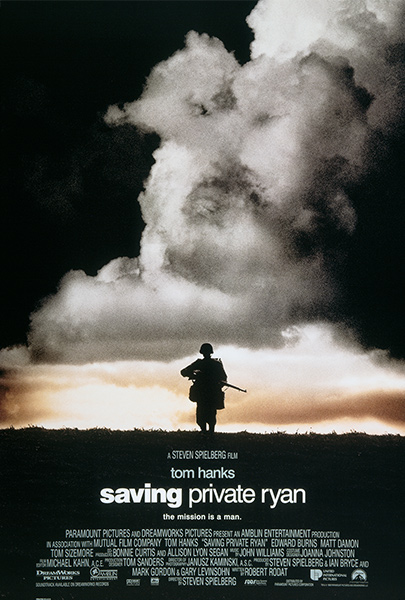
Spielberg is the explicit winner, followed by a separate Steve response; Ribisi and Hanks are then mentioned as following choices rather than clear additional first-place ballots. — Chris Ryan
Sizemore is an initial thought, Hanks receives a strong choice based on the latest viewing, and Spielberg is selected for the unique ability to make the film; awarding both Hanks and Spielberg is wished for despite the one-Oscar constraint.
Burns is disputed: She’s the One is preferred as his moment of opportunity, while Ryan is defended as a larger role in a major film; the absence of subsequent momentum is held against Ryan.
The broader World War II movie Apex question remains debated, with Stalag 17, From Here to Eternity, Where Eagles Dare, The Guns of Navarone, The Great Escape, Von Ryan’s Express, and Castle Keep among the alternatives.
Filmed combat receives an explicit affirmative Apex assessment and agreement. — Sean Fennessey
Kaminski receives an affirmative Apex assessment. — Bill Simmons
The transition from young to old Ryan is proposed for morphing, but its dissolve is distinguished from Terminator 2’s effects and Mystique in Days of Future Past is preferred by another speaker. — Bill Simmons
Pepper receives a yes, with 25th Hour offered as another personal preference. — Bill Simmons
Picking up one’s own arm and the expression FUBAR are raised without a settled affirmative selection; the claim that this film invented FUBAR is explicitly rejected. — Bill Simmons
Taking gum out of another person’s mouth is offered as an Apex, followed by disgust and discussion of the different rules for spouses or children.
The mother framed in the doorway as the car approaches, followed by her collapse onto the porch, is a selected cinematic image. — Chris Ryan
The men walking across the field and heads appearing over the hill are offered as other striking compositions. — Chris Ryan
The wide shot of the men on the steps listening to the record player, apart from Hanks and Damon, is praised as poster-like. — Chris Ryan
A soldier surviving a shot that hits his helmet, removing it, and then being shot in the head is singled out as a brutal visual moment. — Sean Fennessey
The intricate handheld battle shots are praised for coordinating several moving actions within one shot. — Sean Fennessey
The tank crossing the opening in the final battle visually shows that the planned defense must change without explanatory dialogue. — Sean Fennessey
The underwater imagery during the landing is praised, including the realization that soldiers can be shot underwater. — Bill Simmons
Phoenix is also proposed for Wade, prompting joking reshuffles of Ribisi and Davies; Reiben is characterized as the film’s best straightforward movie-star part.
The original 1998 casting is retained; for a modern Miller, Clooney is considered too old and Reynolds too youthful-looking. — Bill Simmons
Reilly is rejected as too old and Driver is doubted despite his military service because he lacks the desired reassuring Hanks quality; Dave Franco is briefly floated. — Bill Simmons
DiCaprio and Gyllenhaal are discussed, with Gyllenhaal considered too handsome and nervy; Ledger is mourned as someone who could have filled this type of role. — Bill Simmons
Harrison Ford and Mel Gibson are recalled as rumored alternatives for Miller; Gibson’s Australian identity makes him harder to picture.
Ford is considered plausible and naturally suited to Miller’s guarded command style, but likely to give a grouchier performance. — Sean Fennessey
Ford is doubted as an equivalent for Hanks in the teacher speech because Hanks supplies unusual empathy and handles extended speeches naturally. — Bill Simmons
Michael Bay is said to have declined an approach to direct; Pearl Harbor is used to imagine the likely result. — Bill Simmons
Ford and Gibson are repeated as Miller alternatives; another proposed actor’s name is unclear in the transcript and the claim is explicitly doubted. — Bill Simmons
Norton is said to have declined Private Ryan because of American History X. — Bill Simmons
Garth Brooks is said to have briefly been considered for the sniper. — Bill Simmons
Thornton is discussed as a possible Horvath who did not want to film the water scenes; the claim is treated as plausible rather than established.
Madsen is said to have been offered Horvath and recommended Sizemore, but the account is explicitly doubted. — Bill Simmons
Schweiger is said to have declined the prisoner role to avoid typecasting; his inability to seem goofy is discussed.
Title; personal tokens; pencil callback; Hanks; young cast; returning German; Farina and Danson; older Ryan; cinematography; squad archetypes; barn story
The title receives an enthusiastic ten-out-of-ten assessment; Horvath speaking the title adds to its appeal for one speaker.
Horvath’s title speech is criticized as corny and stapled into the film, but defended through its resemblance to Sizemore’s bank-is-worth-the-risk speech in Heat. — Bill Simmons
Horvath collecting dirt from different countries is praised as a small character detail. — Chris Ryan
Mellish crying after receiving the Hitler Youth knife is praised as another meaningful personal token. — Chris Ryan
The pencil is praised as a recurring detail, from Miller responding to Upham’s typewriter question to the later need to write a note for a deaf soldier. — Chris Ryan
The spared German returning works as an action-movie device despite Goldman’s objection; his return is defended as plausible because he rejoins other Germans rather than appearing alone.
Farina and Danson’s unexpected appearances are enthusiastically praised, with Farina receiving the stronger joking exclamation-point rating. — Bill Simmons
The older Ryan is praised for looking like an aged Damon, and the image’s later use as an aging meme is noted.
Ryan’s attentive family at the cemetery is admired and contrasted jokingly with how the speakers’ own children might behave. — Bill Simmons
Kaminski’s cinematography is praised for lens-coating changes, shutter timing, and bleach-bypass treatment.
Saving Ryan’s Privates is nominated as an especially funny porn-parody title, without a claim to having seen it. — Bill Simmons
Watching Burns’s scenes while joking that he is in one of his own romantic dramas is described as a recurring pleasure.
The squad’s archetypes are praised as a strong lineup: Brooklyn guy, Italian guy, Jewish guy, religious guy, writer, medic, sergeant, and captain.
Ryan’s crude story is now appreciated more because its awkwardness and Miller’s patient reaction show the gap between a young soldier and an experienced teacher. — Chris Ryan
The film is credited with establishing the cloudy, foggy visual style of the later Spielberg–Kaminski partnership, contrasted with Amistad. — Sean Fennessey
The opening beach sequence is recalled as physically overwhelming in a theater, creating a wish for an intermission and a need for the slower material afterward. — Bill Simmons
The notification of Mrs. Ryan, including the long drive and music, creates an emotional change after the beach; the sentimentality is questioned while its emotional force is acknowledged. — Chris Ryan
Blood hitting the camera lens during the landing is remembered as an especially shocking detail. — Chris Ryan
The Omaha Beach sequence makes the geography and movement toward the bunkers legible while making survival seem nearly impossible. — Bill Simmons
A soldier retrieving his own arm is singled out from the beach landing. — Bill Simmons
The reveal that a dragged body is only a torso is another striking landing detail. — Bill Simmons
Miller’s revelation that he is a teacher, breaking up the Burns–Sizemore confrontation, is called the key to Hanks’s performance. — Bill Simmons
Omaha Beach is treated as one continuous most-rewatchable scene. — Bill Simmons
Miller using a little mirror to locate the firing position and bringing over Pepper’s sniper to turn the situation around is singled out. — Bill Simmons
Caparzo’s death leads into a surprise armed standoff when the wall collapses, briefly resembling a Tarantino confrontation. — Bill Simmons
The quiet church conversation is praised for letting the audience know the soldiers, especially Wade’s story about pretending to sleep when his mother came home.
Wade’s death is singled out for Ribisi’s suddenly pale face, his realization about his liver, his request to raise his legs, and the others giving him morphine. — Bill Simmons
Horvath’s confrontation with Reiben and Miller’s explanation of his mission and desire to get home are praised as a great five-minute sequence. — Craig Horlbeck
The final battle is nominated for the tension built around the approaching tank. — Bill Simmons
The sniper’s last stand in the tower, ending as he sees the tank aim at him, is singled out. — Bill Simmons
Mellish’s fight with the German soldier is described as uniquely vicious and disturbing, including the killer’s whispered urging to stop struggling. — Bill Simmons
Upham’s collapse during the final battle prompts an angry response, while another speaker notes that the film is designed to create that reaction.
Horvath and a German throwing their helmets at each other is singled out before Horvath’s death. — Bill Simmons
The final battle is preferred for rewatching because its geography is laid out in advance, its adventure structure is clearer, and the audience is invested in the characters. — Chris Ryan
Defending the bridge at Ramelle is the explicit final selection, with the brief sniper duel and identification of the shooter in the bell tower offered as another especially replayable sequence. — Sean Fennessey
Anne Ramsay reportedly broke her nose, while other cast members sustained bruises, damaged skin, broken fingers, and a broken foot during baseball work. — Bill Simmons
Wrigley Field, League Stadium in Huntingburg, and Evansville supplied the tryout, home, and championship locations. — Bill Simmons
Madonna's song was excluded from the soundtrack for contractual reasons, and Lori Petty described the period uniform as difficult to play in. — Bill Simmons
Several cast members reportedly shared a house, socialized together, and received wine from Francis Ford Coppola. — Bill Simmons
Petty reportedly hit the home run herself, ran the bases repeatedly, and became sick after the final take. — Bill Simmons
The real league began under Philip Wrigley as softball; the film's switch to baseball is endorsed. — Bill Simmons
Jimmy Dugan is described as drawing principally from Jimmie Foxx, with Hack Wilson also mentioned. — Mallory Rubin
A stunt double performed the split catch, Penny Marshall created the urination effect, and Tom Hanks gained weight for the role. — Bill Simmons
Madonna was moved from third base to the outfield because she struggled with ground balls. — Bill Simmons