‹ All movies

DiCaprio’s first great lead performance

Sean Fennessey: The first-great-DiCaprio-performance hot take argues that this film depends more fully on him than Titanic or Romeo + Juliet; This Boy's Life is offered as an earlier exception.

Bill Simmons: Hanks's greatest-actor claim is questioned through weak accents, while his extraordinary movie-star run, popularity and success are defended; Cruise and Denzel are personal alternatives.

Check forgery over violent crime (challenged)

The proposed life lesson favoring check forgery over violent crime is challenged as a mere preference and not victimless; claims about bank insurance are mocked rather than established financial advice.

The film

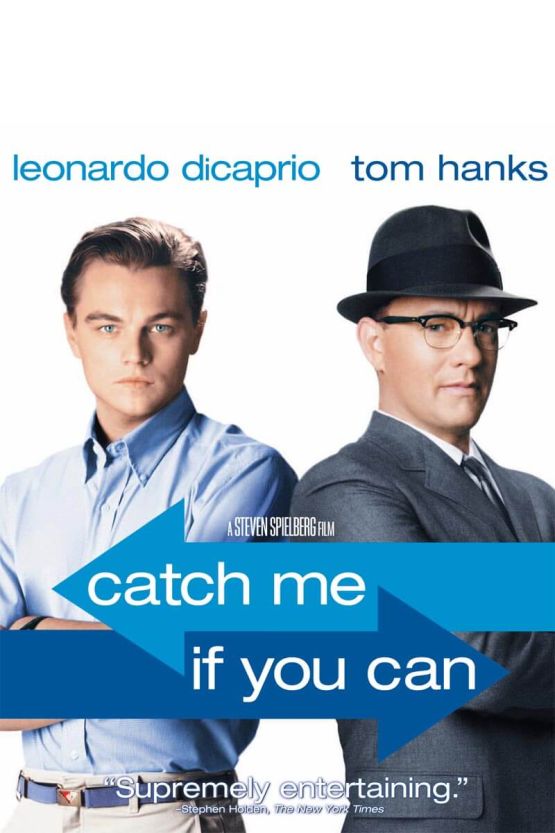
Catch Me If You Can (2002)

Directed by Steven Spielberg · Comedy

140 minutes

Cast

Selected cast credits · Film reference

Leonardo DiCaprio Frank Abagnale Jr.
Tom Hanks Carl Hanratty
Christopher Walken Frank Abagnale Sr.
Martin Sheen Roger Strong
Nathalie Baye Paula Abagnale
Amy Adams Brenda Strong
James Brolin Jack Barnes
Steve Eastin Paul Morgan
Chris Ellis Special Agent Wilkins
John Finn Assistant Director Marsh
Jennifer Garner Cheryl Ann
Nancy Lenehan Carol Strong
Ellen Pompeo Marci
Guy Thauvette Warden Garren
Matthew Kimbrough Loan officer
Frank W. Abagnale French policeman

Everything from the episode

In the order the hosts got to it. Open a row for the discussion.

33:54

Roger Ebert's review

In the discussion (2)
Approx. transcript time · 00:33:54Read transcript
  • The podcast reports a 52 million budget,352 million labeled international,164 million domestic and eleventh place for the year; scopes remain the transcript's unverified wording. — Bill Simmons
  • Ebert gives three stars, with no scale stated, praising effortless watchability and DiCaprio's breezy charm rather than calling it major Spielberg. — Bill Simmons
35:30

Most Rewatchable Scene

Hollywood hotel; stewardess recruitment and airport escape

Hollywood hotel; stewardess recruitment and airport escape

In the discussion (13)
Approx. transcript time · 00:35:30Read transcript
  • Frank's substitute-teacher impersonation is a scene candidate that launches the story with conviction.
  • Becoming a Pan Am pilot, obtaining the uniform and experiencing his first flight in the cockpit form an extended scene candidate; Pompeo's presence adds to the fantasy.
  • Frank presenting his father with a new Cadillac is the next scene nomination.
  • Walken balances his recognizable mannerisms with warm, dishonest, increasingly defeated fatherhood; the award speech, dancing and aging are praised.
  • The short failed bank-loan visit, with Frank posing as chauffeur, is admired without being formally nominated; Frank succeeds at escaping problems his father cannot.
  • The Hollywood hotel escape is a major scene candidate, especially the wallet reveal, discarded labels, invented agent identity and hotel setting.
  • The Garner encounter is liked because Frank cannot be conned, but it is also considered a strange interlude. — Chris Ryan
  • A raunchy deleted Jaws scene and alternate Deep Throat title are explicitly joking inventions, not production facts or an actual-film nomination. — Chris Ryan
  • Garner's Alias-era appeal and the film's brief appearances by future stars Banks, Pompeo, Adams and Garner are noted.
  • Frank's conversation with Martin Sheen as the father of the woman he loves is another admired scene. — Bill Simmons
  • The engagement-party raid and bedroom confession are nominated, with cash-filled suitcases and Brenda struggling to understand Frank's collapsing identities.
  • The eight-stewardess airport diversion, Frank's possible final return and exploding check-printer imagery are praised.
  • The Hollywood hotel is one final scene choice; the complete stewardess recruitment and airport escape is the other.
44:03

What’s Aged the Best?

Father-son casting; period houses and mothers; surveillance recognition; television; airline glamour; cons; ensemble;...

Father-son casting; period houses and mothers; surveillance recognition; television; airline glamour; cons; ensemble; credits

In the discussion (12)
Approx. transcript time · 00:44:03Read transcript
  • Walken and the father-son casting are aged-best choices; the mother's new home is identified as the Father of the Bride house. — Sean Fennessey
  • A joke imagines collectively buying houses connected to the show, including Boogie Nights and a Danny Trejo property, as a podcast real-estate cluster. — Bill Simmons
  • Discreetly sexual mothers in period movies are an enjoyed trope, with Forrest Gump and The Ice Storm as examples; The Ice Storm receives explicit affection. — Bill Simmons
  • Frank recognizing airport surveillance before being caught is an aged-best pleasure. — Bill Simmons
  • To Tell the Truth is enjoyed as period television and identified as one of the story elements that really occurred. — Bill Simmons
  • The two-mice speech is considered memorably odd and possibly bad rather than straightforwardly praised. — Bill Simmons
  • The glamour of 1960s pilots and flight attendants is an aged-best choice, compared with Almost Famous and the Pan Am television series. — Bill Simmons
  • Enjoying a con man while hoping he escapes, and the Sheen–DiCaprio pairing before The Departed, are aged-best choices. — Bill Simmons
  • DiCaprio's 2002 moment just before his sustained adult-star run is an aged-best choice. — Bill Simmons
  • The cast's four future major actresses are praised; Adams nearly steals the film according to one speaker, anticipating disagreement. — Sean Fennessey
  • Con-man process details, including model-plane decals, routing numbers and check manipulation, are aged-best pleasures. — Chris Ryan
  • The animated credits are praised and explicitly corrected as Saul Bass-inspired rather than created by Bass.
49:15

The Slow Ride / Kid Cudi – Pursuit of Happiness Award for Best Needle Drop

Williams’s original saxophone score; three song alternatives

Williams’s original saxophone score; three song alternatives

In the discussion (4)
Approx. transcript time · 00:49:15Read transcript
  • The Christmas Song is a needle-drop choice. — Bill Simmons
  • Come Fly With Me is another needle-drop choice. — Chris Ryan
  • You Really Got Me is another needle-drop choice, praised despite being an obvious musical cue. — Sean Fennessey
  • The discussion ultimately favors Williams's original saxophone score. — Chris Ryan
49:55

The Big Kahuna Burger Award for Best Use of Food and Drink

Airplane éclair

Airplane éclair

In the discussion (1)
Approx. transcript time · 00:49:55Read transcript
  • The airplane éclair wins food and drink; its appeal prompts memories of elaborate earlier airline catering.
50:29

The Den of Thieves Benihana Award for Scene-Stealing Location

French arrest setting; TWA building; Waldorf-Astoria exterior

French arrest setting; TWA building; Waldorf-Astoria exterior

In the discussion (1)
Approx. transcript time · 00:50:29Read transcript
  • The French arrest setting wins scene-stealing location for one speaker, with the TWA building at JFK and Waldorf-Astoria exterior as alternatives. — Bill Simmons
50:29

The Great Shot Gordo Award for Most Cinematic Shot

French arrest setting; first Christmas Eve phone call

French arrest setting; first Christmas Eve phone call

In the discussion (2)
Approx. transcript time · 00:50:29Read transcript
  • The French arrest setting is also one cinematic-shot choice. — Bill Simmons
  • Hanks's first Christmas Eve call is another shot choice, contrasting cold blue-gray surroundings with a warm lamp to express how much the case means to him. — Chris Ryan
51:41

The Butch’s Girlfriend Award for the Weakest Link in the Film

Hanks’s accent and broad comedy

Hanks’s accent and broad comedy

In the discussion (1)
Approx. transcript time · 00:51:41Read transcript
  • Hanks's accent and broad comic behavior are the weak link; a possible Dragnet homage explains but does not necessarily justify the performance.
53:06

The Vincent Chase Award: Are We Sure This Character Is Actually Good at Their Job?

Carl Hanratty

Carl Hanratty

In the discussion (1)
Approx. transcript time · 00:53:06Read transcript
  • Carl's competence is questioned because he takes years to catch Frank and receives little respect from his bosses. — Bill Simmons
53:19

What’s Aged the Worst?

Missing stewardess-escape aftermath; checks; deteriorating motels

Missing stewardess-escape aftermath; checks; deteriorating motels

In the discussion (3)
Approx. transcript time · 00:53:19Read transcript
  • A missing scene showing the aftermath of the stewardess escape is an aged-worst complaint. — Bill Simmons
  • Writing personal checks and the weak verification that enabled fraud feel dated; checking-account and bounced-check memories illustrate the change. — Chris Ryan
  • The deterioration of Los Angeles motels, including the Tropicana and a True Romance location, is an aged-worst discussion. — Chris Ryan
55:58

The Ron Burgundy Flute Award for the Best Time for a Pee Break

Extended ending; Brenda’s family scenes (disputed)

Extended ending; Brenda’s family scenes (disputed)

In the discussion (4)
Approx. transcript time · 00:55:58Read transcript
  • Bathroom-break choices focus on the extended ending, with alternative stopping points at the arrest or Frank walking away in pilot uniform before an epilogue.
  • Excess time with Brenda's family leads into disagreement about Adams's value and awards reputation; the debate is explicitly contentious.
  • Adams's Brenda is attacked as exaggerated and incoherent, while defenders describe a sheltered candy striper and explain Frank's attraction as an attempt to regain a happy family and identify with another bullied person.
  • Hathaway is favorably compared with Adams; The Fighter, American Hustle, Arrival, The Master and Junebug support a defense of Adams, while the criticism focuses on her perceived highest level and six Oscar nominations.
1:00:24

Recasting Couch

Scarlett Johansson as Brenda (rejected)

Scarlett Johansson as Brenda (rejected)

In the discussion (1)
Approx. transcript time · 01:00:24Read transcript
  • 2003 Scarlett Johansson is proposed for Brenda and rejected as too sexy; the family singalong's creepiness and deliberately underwritten projection surface are debated.
1:01:15

Is There a Better Title for This Movie?

Catch Me If You Can

Catch Me If You Can

In the discussion (1)
Approx. transcript time · 01:01:15Read transcript
1:01:36

The Neil McCauley “A Book about Metals” Award for Best Line from the Movie

People only know what you tell them; Sometimes it’s easier living the lie

People only know what you tell them; Sometimes it’s easier living the lie

In the discussion (1)
Approx. transcript time · 01:01:36Read transcript
  • People only know what you tell them and Sometimes it's easier living the lie are quote choices, with the former receiving further approval. — Bill Simmons
1:03:23

The Stephen A. Smith Hottest Take Award

DiCaprio’s first great lead performance; Hanks’s greatest-actor credentials disputed

DiCaprio’s first great lead performance; Hanks’s greatest-actor credentials disputed

In the discussion (22)
Approx. transcript time · 01:03:23Read transcript
  • The first-great-DiCaprio-performance hot take argues that this film depends more fully on him than Titanic or Romeo + Juliet; This Boy's Life is offered as an earlier exception. — Sean Fennessey
  • Hanks's greatest-actor claim is questioned through weak accents, while his extraordinary movie-star run, popularity and success are defended; Cruise and Denzel are personal alternatives. — Bill Simmons
  • Accent objections name Elvis, Charlie Wilson's War, The Post, Captain Phillips, The Terminal and Cloud Atlas, with disagreement over Captain Phillips. — Bill Simmons
  • Carl's composite identity makes the accent unnecessary; the performance is placed low in Hanks's career despite affection for his presence. — Bill Simmons
  • Hanks's two Oscars and serious films are weighed against Cruise's cultural force and comeback; Forrest Gump's standing draws disagreement. — Sean Fennessey
  • Hanks's likability and storytelling are distinguished from greatest-actor status; Cruise's potential in Big or Cast Away is debated, while Greyhound illustrates a sturdy role Hanks handles well. — Sean Fennessey
  • Cruise's consistent charismatic action lane is contrasted with Hanks's risky character work; hypothetical swaps include Philadelphia, Forrest Gump, Big, Mission: Impossible, Days of Thunder, Edge of Tomorrow, Minority Report, Taken, Eyes Wide Shut and A Few Good Men, with disagreement over equivalence.
  • Hanks is defended as the more accomplished actor while Cruise's longevity and Denzel's comparable stature complicate the comparison. — Bill Simmons
  • Hanks's post-Catch Me filmography is enumerated: The Ladykillers, The Terminal, The Polar Express, The Da Vinci Code, Charlie Wilson's War, Angels & Demons, Larry Crowne, Extremely Loud & Incredibly Close, Cloud Atlas, Captain Phillips, Saving Mr. Banks, Bridge of Spies, A Hologram for the King, Sully, Inferno, The Circle, The Post, Greyhound, A Beautiful Day in the Neighborhood, News of the World, Finch and Elvis. Cloud Atlas and the later dad-film run draw qualified defense. — Sean Fennessey
  • A Man Called Otto is acknowledged as a hit and praised by a family member, while another speaker calls it only okay and a close Scandinavian remake. — Sean Fennessey
  • Cruise's commercially bigger career is distinguished from Hanks's better career; comparing their 1988–2001 peaks prompts suggested Oscars for Hanks in Cast Away and Cruise in Jerry Maguire and Magnolia.
  • Denzel's paycheck films, including The Equalizer, Déjà Vu and The Taking of Pelham 123, are considered more entertaining; Hanks's self-imposed Jimmy Stewart image may constrain his roles.
  • Cruise losing for Magnolia to Caine in The Cider House Rules and for Jerry Maguire to Rush in Shine is challenged; Jude Law's Ripley performance is admired but placed below Cruise's Magnolia work. — Bill Simmons
  • Hanks's consecutive Philadelphia and Forrest Gump Oscars strengthen his case; Denzel's Glory and Training Day wins are recalled with Malcolm X considered another deserved award. — Sean Fennessey
  • Cruise's 2005-onward filmography is enumerated: War of the Worlds, Mission: Impossible III, Lions for Lambs, Tropic Thunder, Valkyrie, Knight and Day, Ghost Protocol, Rock of Ages, Jack Reacher, Oblivion, Edge of Tomorrow, Rogue Nation, Never Go Back, The Mummy, American Made, Fallout and Maverick; several weak films temper the franchise-success defense. — Bill Simmons
  • Hanks's willingness to experiment is defended against Cruise's safe action lane, while Cruise's ongoing audience appeal and perceived rescue of theatrical movies are counterarguments; longevity versus peak quality is compared with basketball greatness. — Bill Simmons
  • Cruise's 1990s-to-Minority Report run is compared with Hanks's peak, with The Others explicitly corrected as only an executive-producing credit; Toy Story is considered a decisive Hanks asset. — Chris Ryan
  • Cruise's film library is the preferred desert-island entertainment choice for one speaker, while De Niro is called the best actor of that speaker's lifetime; Daniel Day-Lewis's great performances are distinguished from rewatchability. — Bill Simmons
  • Weak later films and Hanks's lack of a Michael Mann collaboration enter the debate; both stars may be trapped by personas, but Cruise's stunts are considered more entertaining than Hanks's accents. — Bill Simmons
  • The proposed top tier includes Cruise, Hanks and Denzel, before Harrison Ford's placement is debated. — Bill Simmons
  • Ford's capacity for morally compromised sexuality is contrasted with Cruise's usual innocence; Hanks is urged to try a direct villain role without hiding behind makeup and accents. — Bill Simmons
  • The industry's shift away from movie stars is offered as context for older stars' weaker later work; DiCaprio's future is compared with Nicholson's transition, including disagreement over Wolf and Hoffa. — Sean Fennessey
1:15:56

Casting What-Ifs

Gandolfini as Carl; Depp or Hoffman as Frank; Harris and Sevigny; alternative directors

Gandolfini as Carl; Depp or Hoffman as Frank; Harris and Sevigny; alternative directors

In the discussion (8)
Approx. transcript time · 01:15:56Read transcript
  • James Gandolfini, reportedly once locked in as Hanratty, is preferred to Hanks; production delays and Sopranos scheduling lost the casting window. — Chris Ryan
  • Fincher reportedly departed the project for Panic Room. — Bill Simmons
  • Verbinski was reportedly attached with Ed Harris as the father and Chloë Sevigny as Brenda. — Bill Simmons
  • Verbinski reportedly left after Gangs of New York ran long.
  • Cameron Crowe reportedly considered directing; the panel imagines a different but potentially workable film.
  • Gandolfini's menace, fractured vulnerability and believable exhaustion would improve Carl; regret over this lost role and The Night Of accompanies praise for Killing Them Softly, The Mexican and Crimson Tide. — Chris Ryan
  • Spielberg reportedly considered Depp as Frank, with uncertainty about the report; the panel imagines a dashing performance unlike much of Depp's stranger work. — Bill Simmons
  • Hoffman's brief involvement in early development is doubted as casting, though fast-talking con artistry could fit; the real Frank's reportedly older appearance is discussed with a caveat about disputed history.
1:19:27

The Ruffalo / Hanna / Rubinek / Partridge Overacting Award

Amy Adams

Amy Adams

In the discussion (1)
Approx. transcript time · 01:19:27Read transcript
1:19:27

The Teddy KGB Award for the Actor in a Completely Different Movie

Amy Adams

Amy Adams

In the discussion (1)
Approx. transcript time · 01:19:27Read transcript
  • Amy Adams receives the actor-doing-their-own-thing choice from a critic of her Brenda performance. — Bill Simmons
1:20:00

The Joey Pants “That Guy” Award

Nathalie Baye

Nathalie Baye

In the discussion (1)
Approx. transcript time · 01:20:00Read transcript
  • Nathalie Baye as Frank's mother is the that-guy choice; her offer to settle his debt is particularly enjoyed.
1:20:28

The Dion Waiters Award for Best Heat Check Performance

Elizabeth Banks; Nathalie Baye; James Brolin

Elizabeth Banks; Nathalie Baye; James Brolin

In the discussion (4)
Approx. transcript time · 01:20:28Read transcript
1:21:48

Recasting Couch

Chalamet as Frank; DiCaprio or Sterling K. Brown as Carl

Chalamet as Frank; DiCaprio or Sterling K. Brown as Carl

In the discussion (1)
Approx. transcript time · 01:21:48Read transcript
1:22:35

Half-Assed Internet Research

Development; invented father-son meetings; Shea; cameo; locations; visual research

Development; invented father-son meetings; Shea; cameo; locations; visual research

In the discussion (6)
Approx. transcript time · 01:22:35Read transcript
  • Lear and Yorkin reportedly acquired the rights in 1980 after seeing Frank on television; the project passed through several studios before DreamWorks and Spielberg. — Bill Simmons
  • Spielberg reportedly invented the continuing father-son meetings because the real Frank never saw his father again after leaving home. — Bill Simmons
  • Joseph Shea is named as the FBI agent most like Hanratty who did not want his identity used. — Bill Simmons
  • Frank Abagnale reportedly cameos as the arresting French officer. — Bill Simmons
  • The production reportedly used 157 locations, with California doubling for cities such as Atlanta and Miami and Ontario Airport standing in for Miami. — Chris Ryan
  • Kaminski reportedly watched High School and Salesman for visual research; the attribution to the Maysles and the exact influence are discussed without independently verifying that attribution. — Chris Ryan
1:24:26

Apex Mountain

No definite affirmative choice

No definite affirmative choice

In the discussion (10)
Approx. transcript time · 01:24:26Read transcript
  • Spielberg, DiCaprio and Hanks are rejected for Apex here. — Bill Simmons
  • Titanic's enormous freedom and leverage make it DiCaprio's accepted peak, despite a Django preference. — Bill Simmons
  • The Father of the Bride house retains its peak in Father of the Bride. — Bill Simmons
  • Con-man movies peak with The Sting rather than Catch Me. — Bill Simmons
  • Walken is rejected for Apex here; The Deer Hunter, more-cowbell fame and the 1993–94 SNL/True Romance/Pulp Fiction period are alternatives, with Annie Hall also a favorite performance. — Bill Simmons
  • Walken's Pulp Fiction and True Romance scenes continue the favorite-performance discussion. — Bill Simmons
  • Joe Garagiola's peak is placed at playing or broadcasting a World Series rather than here. — Chris Ryan
  • Pan Am receives tentative favorable Apex discussion but no firm resolution. — Bill Simmons
  • Goldfinger is preferred as the Aston Martin's peak. — Bill Simmons
  • The Aston Martin reportedly came from a Huntington Station dealership and a private owner because the specific car was difficult to find; its very high value is discussed as a reported estimate. — Bill Simmons
1:27:22

Best Race Horse Name from This Movie

Catch Me If You Can

Catch Me If You Can

In the discussion (1)
Approx. transcript time · 01:27:22Read transcript
1:27:49

Picking Nits

Wallet delay; abrupt geography; medical skills; age; modern verifiability

Wallet delay; abrupt geography; medical skills; age; modern verifiability

In the discussion (4)
Approx. transcript time · 01:27:49Read transcript
  • Carl waiting to examine Frank's wallet in the hotel is an implausible delay attributed jokingly to DiCaprio's persuasive presence.
  • Frank's sudden Atlanta-to-New-Orleans transition and Carl reaching France despite denied travel permission feel choppy and insufficiently explained. — Sean Fennessey
  • Medical impersonation should require more than television knowledge, and Frank looks implausibly young to have completed both legal and medical training; the authority of uniforms is offered as a partial explanation.
  • Modern easily checked résumé lies seem less innocently plausible than old cons; a hypothetical false Grantland application illustrates the difference, explicitly contrasted with the actual blogging background. — Chris Ryan
1:39:10

Sequel, Prequel, Limited Series, or All-Black Remake

One or two prestige-TV seasons

One or two prestige-TV seasons

In the discussion (1)
Approx. transcript time · 01:39:10Read transcript
  • One or two seasons of prestige television is the preferred remake format. — Bill Simmons
1:39:10

Is This Movie Better With…?

Kathryn Hahn as Brenda; Wayne Jenkins as pilot or Carl

Kathryn Hahn as Brenda; Wayne Jenkins as pilot or Carl

In the discussion (2)
Approx. transcript time · 01:39:10Read transcript
  • One or two seasons of prestige television is the preferred remake format. — Bill Simmons
  • Kathryn Hahn replacing Adams and Wayne Jenkins as the first pilot are better-with choices, while another speaker imagines Jenkins as Hanks at the French arrest.
1:40:29

Just One Oscar

Leonardo DiCaprio

Leonardo DiCaprio

In the discussion (1)
Approx. transcript time · 01:40:29Read transcript
1:40:43

Probably Unanswerable Questions

Bar exam; airplane-toilet escape; piloting; check forgery; accent

Bar exam; airplane-toilet escape; piloting; check forgery; accent

In the discussion (2)
Approx. transcript time · 01:40:43Read transcript
  • The bar-exam story and airplane-toilet escape are questioned, with the latter reportedly disproved by research; whether Frank ever piloted a plane also prompts inquiry. — Bill Simmons
  • The apparent ease of check forgery raises the question of why more people did it, answered partly by the stigma of being caught; Hanks's accent remains unexplained.
1:41:33

Best Double Feature

The Fabelmans; Gangs of New York; The Aviator
In the discussion (3)
Approx. transcript time · 01:41:33Read transcript
1:42:15

The Andy and Red – Zihuatanejo Award for What Happens the Next Day?

Check-security career; later debunking

Check-security career; later debunking

In the discussion (1)
Approx. transcript time · 01:42:15Read transcript
  • The next-day answer repeats Frank's check-security career and later debunking, without independently endorsing the historical claims. — Bill Simmons
1:42:15

What Piece of Memorabilia Would You Want From This Movie?

Aston Martin; sunglasses; fake cash; Bond suit; pilot uniform

Aston Martin; sunglasses; fake cash; Bond suit; pilot uniform

In the discussion (1)
Approx. transcript time · 01:42:15Read transcript
  • The Aston Martin is the preferred memorabilia; Miami sunglasses, a suitcase of fake cash, the James Bond suit and a pilot uniform are alternatives.
1:42:55

The Coach Finstock Award for Best Life Lesson

Check forgery over violent crime (challenged)

Check forgery over violent crime (challenged)

In the discussion (3)
Approx. transcript time · 01:42:55Read transcript
  • The proposed life lesson favoring check forgery over violent crime is challenged as a mere preference and not victimless; claims about bank insurance are mocked rather than established financial advice.
  • A hypothetical bank-robbery team discussion chooses driving or addressing the customers, while recalling an earlier Heat-related conversation. — Bill Simmons
  • Hypothetical robbery-mask choices include James Harden, Nikola Jokić, Sam Hauser and a smaller Lone Ranger-style mask, with practical objections and colored-contact jokes. — Bill Simmons
1:45:16

Who Won the Movie?

Leonardo DiCaprio

Leonardo DiCaprio

In the discussion (1)
Approx. transcript time · 01:45:16Read transcript
  • An explicit collective statement says all think DiCaprio won the movie, followed by assent; no separately identifiable individual ballot statements are supplied. — Bill Simmons
Podcast choices

More from the conversation

The late-2002 release calendar names an unspecified Harry Potter film, Die Another Day, Adaptation, Analyze That, About Schmidt, Drumline, Maid in Manhattan, Star Trek: Nemesis, The Lord of the Rings: The Two Towers, 25th Hour, Antwone Fisher, Gangs of New York, Two Weeks Notice, Catch Me If You Can, The Hours, Chicago and The Pianist. Twin Towers is immediately corrected to The Two Towers.
Approx. transcript time · 00:02:28Read transcript
Gangs of New York and Catch Me If You Can arriving five days apart is considered an odd scheduling clash that may have hurt both; Catch Me's reputation improved gradually.
Approx. transcript time · 00:03:41Read transcript
The light surface and darker undercurrents of Catch Me launch discussion of DiCaprio's sustained strategy of working with major directors, even when an individual film is weaker.
Approx. transcript time · 00:05:14Read transcript
Initial excitement favored Gangs of New York, but its flaws and Diaz's performance contrast with admiration for Day-Lewis and DiCaprio's maturity in Catch Me.
Approx. transcript time · 00:06:51Read transcript
DiCaprio's transition from youthful heartthrob to adult star and avoidance of superhero franchises are praised; audiences root for his criminal despite recognizing wrongdoing.
Approx. transcript time · 00:08:03Read transcript
Period pieces offer actors attractive design and distance from present-day controversy, while modern surveillance would quickly undermine this particular con story.
Approx. transcript time · 00:08:56Read transcript
Early DiCaprio fandom choices include The Beach, This Boy's Life, The Basketball Diaries and Growing Pains; the Basketball Diaries answer explicitly revises the initial Beach choice.
Approx. transcript time · 00:10:24Read transcript
A season-tickets podcast about early celebrity fandom is jokingly proposed, with Noah Centineo and Black Adam discussed.
Approx. transcript time · 00:11:32Read transcript
A Growing Pains scene involving DiCaprio's birth mother is recalled as unusually accomplished acting for a sitcom.
Approx. transcript time · 00:12:03Read transcript
DiCaprio's filmography is enumerated from The Beach through Catch Me, Gangs, The Aviator, The Departed, Blood Diamond, Body of Lies, Revolutionary Road, Shutter Island, Inception, J. Edgar, Django, Gatsby, Wolf, Revenant, Hollywood, Don't Look Up and Killers of the Flower Moon; a Paul Thomas Anderson collaboration is explicitly unconfirmed.
Approx. transcript time · 00:12:22Read transcript
DiCaprio's willingness to play supporting roles is praised; his rewatchability is debated through Wolf, The Departed, Inception and Once Upon a Time in Hollywood.
Approx. transcript time · 00:13:07Read transcript
Hollywood's extra closing time after the violence divides the panel; its wistful alternative-history ending is defended.
Approx. transcript time · 00:14:01Read transcript
DiCaprio changes his physical behavior subtly between Frank's youthful self and his invented adult identities, especially Barry Allen.
Approx. transcript time · 00:14:31Read transcript
DiCaprio is viewed as emblematic of a fading movie-star system; joking action-franchise possibilities contrast with admiration for his privacy and mysterious in-person presence.
Approx. transcript time · 00:15:16Read transcript
His director-led career strategy is compared with Nicholson, Gosling, Chalamet and Daniel Kaluuya; Chalamet is an obvious modern Frank candidate.
Approx. transcript time · 00:18:03Read transcript
A desire to see DiCaprio in more physical mission-style action meets the counterexample of Inception and a stated dislike of dream/alternate-reality premises.
Approx. transcript time · 00:19:17Read transcript
Hanks's role begins discussion of his move away from the dominant 1992–2000 period toward supporting parts, makeup and accents; his reported box-office streak is compared with Cruise's longer streak.
Approx. transcript time · 00:19:52Read transcript
Inflation-adjusted receipts, ticket sales and cultural durability are distinguished, using The Godfather, Titanic, Gone with the Wind, E.T., The Robe and Forrest Gump as examples.
Approx. transcript time · 00:21:16Read transcript
Hanks's character-actor turn is compared with Spielberg's 2001–2005 run; Carl is considered a relatively thin composite role with a strange accent despite Hanks's recent major successes.
Approx. transcript time · 00:22:26Read transcript
Hanks's invented composite character is used to question why he needs an unusual accent instead of his own voice.
Approx. transcript time · 00:23:49Read transcript
The lead-actor nominees are enumerated as Brody, Cage, Caine, Day-Lewis and Nicholson; DiCaprio's omission and Polanski's celebrated directing win are questioned.
Approx. transcript time · 00:26:10Read transcript
Walken's believable father-son relationship, including birthday pancakes and a checkbook, gives Frank's scams a psychological motive: impressing his father while avoiding his collapse.
Approx. transcript time · 00:26:49Read transcript
Spielberg's family psychology and period setting connect the film with The Fabelmans, while its crime energy recalls Scorsese; A.I. and Minority Report illustrate Spielberg experimenting with other directorial styles.
Approx. transcript time · 00:28:27Read transcript
Kaminski, Kahn, Williams and Spielberg's regular production team are praised; a making-of toast welcomes DiCaprio into this longstanding filmmaking family.
Approx. transcript time · 00:29:57Read transcript
The film's trusting pre-surveillance world is interpreted through post-9/11 travel, alongside The Terminal, Minority Report, Munich and War of the Worlds as indirect responses to contemporary fears.
Approx. transcript time · 00:31:09Read transcript
The autobiography's factual claims are questioned without rejecting the movie; misleading true-story marketing is distinguished from artistic enjoyment, with A Beautiful Mind and The Hurricane as comparisons.
Approx. transcript time · 00:32:21Read transcript
The initially unimpressive Williams score grows effective in context, compared with Dave Grusin's uneasy music for The Firm.
Approx. transcript time · 00:33:33Read transcript
The episodic second act is especially enjoyable; Hanratty reportedly provided structural glue as a pursuer and second father, but the panel would also enjoy a con-per-episode prestige series.
Approx. transcript time · 00:34:28Read transcript
Pompeo's appeal and later television career prompt an aside about Frank's necklace pickup trick.
Approx. transcript time · 01:19:43Read transcript
A YouTube compilation of Wayne Jenkins impressions is praised; the missed Whiplash opportunity is recalled.
Approx. transcript time · 01:40:07Read transcript
The hosts say they are alone in the studio and do not know who produced the recording; no full non-ad producer identity is credited. The Wayne Jenkins compilation creator is identified at the end.
Approx. transcript time · 01:45:27Read transcript

Mentions across The Rewatchables

Recorded movie reference

Titanic

The Rewatchables · aired September 28, 2017

Catch Me If You Can is listed in the sourced research for this episode. The precise discussion has not been linked yet.