
‹ All movies

The Sicilian scene between Hopper and Walken

Five candidate scenes are set out: Clarence going back to Drexel, Hopper versus Walken, which might be the most famous scene of both careers, Gandolfini versus Alabama, the coke sale at the Beverly Ambassador when Slater shows up wired and talks Vietnam movies and Coming Home in a Body Bag, and the big three-way shootout, Tarantino's second three-way shootout in two movies.

Bill Simmons: A recap for anyone who has not seen the film in a while: Clarence falls in love with the woman his boss hires for him and they get married.

"If there's one thing this last week has taught me, it's better to have a gun and not need it than to need a gun and not have it"

Nominations: 'don't condescend me man', Drexel's crude line comparing himself to a woman's body, 'he must have thought it was white boy day', the gun line, 'she tastes like a peach'; the gun line is liked as a senior yearbook line for the high school students out there, and it is replayed with Clarence telling Richard that Lee Donowitz is not a pimp, credited to Clarence Worley, 1993.

The film

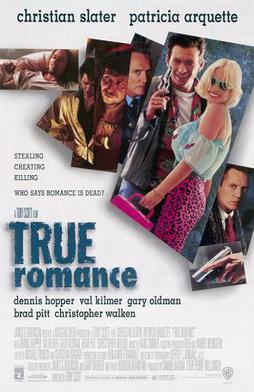
True Romance (1993)

Directed by Tony Scott · Drama

118 minutes

Cast

Selected cast credits · Film reference

Christian Slater Clarence Worley
Patricia Arquette Alabama Whitman
Dennis Hopper Clifford Worley
Val Kilmer Elvis
Gary Oldman Drexl Spivey
Brad Pitt Floyd, Dick's roommate
Christopher Walken Vincenzo Coccotti
Bronson Pinchot Elliot Blitzer
Samuel L. Jackson Don "Big Don"
Michael Rapaport Dick Ritchie
Saul Rubinek Lee Donowitz
Conchata Ferrell Mary Louise Ravencroft
Victor Argo Lenny
Paul Bates Marty
Chris Penn Detective Nicky Dimes
Tom Sizemore Detective Cody Nicholson
Gregory Sporleder burger stand customer
Frank Adonis Frankie
Michael Beach Detective Wurlitzer
Laurence Mason Floyd "D"
Ed Lauter Captain Quiggle (uncredited)

Everything from the episode

In the order the hosts got to it. Open a row for the discussion.

26:50

Most Rewatchable Scene

The Sicilian scene between Hopper and Walken

The Sicilian scene between Hopper and Walken

In the discussion (9)
Approx. transcript time · 00:26:50Read transcript
  • Five candidate scenes are set out: Clarence going back to Drexel, Hopper versus Walken, which might be the most famous scene of both careers, Gandolfini versus Alabama, the coke sale at the Beverly Ambassador when Slater shows up wired and talks Vietnam movies and Coming Home in a Body Bag, and the big three-way shootout, Tarantino's second three-way shootout in two movies.
  • A recap for anyone who has not seen the film in a while: Clarence falls in love with the woman his boss hires for him and they get married. — Bill Simmons
  • The recap is corrected: she is a call girl, not a hooker, there's a difference, she says; Clarence decides he has to emancipate her from the pimp, Drexel Spivey, played by Gary Oldman, which leads to a shootout, and he takes the wrong suitcase, full of cocaine, so they end up on the run.
  • One pick is Clarence versus Drexel as one of the great five minutes of the nineties; another insists it has to be the Sicilian story, Tarantino's favorite scene he has ever written, three-dimensional chess; a clip plays and a third goes with it 100 percent.
  • Christopher Walken playing a Sicilian is a ludicrous choice, the least Italian person imaginable, and he pulls it off; Hopper is at a fascinating career moment, having survived the nine stages of fame, a trailblazing filmmaker, an Academy Award nominated actor, villains and heroes, Shooter and Frank in Blue Velvet; a text the night before called him warm and powerful here.
  • Hopper's relationship with Clarence is set up in about three minutes; in the scene the gangsters surround the two men in a circle, it is the middle of the day but lit like three in the morning with a spotlight on them, and the dialogue is two guys telling crazy Tarantino stories, the antichrist and vendetta lines; the Drexel proposer is talked into it.
  • Drexel is one of a host's favorite characters: Gary Oldman was already famous from Dracula and talked about as a next great actor, yet audiences 25 years ago could not tell it was him under the hat and the affected Black vernacular; a clip of the negotiation speech plays.
  • Tony Scott and Oldman disagreed about where Drexel came from: Scott's version is that Oldman called in the middle of the night to say Drexel was his drug dealer; Oldman's version is that he had no drug dealer and was emulating kids he heard outside his trailer; Scott later had a big heat check of crazy interviews, clearly disliked Christian Slater and took credit for a lot.
  • Drexel is a complete Tarantino original, every word entertaining; shot flat the way Reservoir Dogs was shot in a warehouse, without the music, the swinging light and the Chinese food, the scene might not work at all, which is where Tony Scott makes this something different in the Tarantino canon and why it is called the best Tony Scott scene; the techno track is by an artist named Nymphomaniac, and Slater seems intimidated before answering all of Drexel's questions.
33:33

What’s Aged the Best?

The way the film looks; the dialogue; Gandolfini

The way the film looks; the dialogue; Gandolfini

In the discussion (10)
Approx. transcript time · 00:33:33Read transcript
  • Young Gandolfini: he is basically auditioning for Tony Soprano, and this and his Get Shorty role (transcribed 'bare') are the two poles of that character, sweet, charming, evil, menacing and violent; the film was one of the first DVDs a host bought, so he was always the guy from this movie.
  • Floyd, who gives the directions down Beachwood to the Beverly Ambassador, was an A++ in the nineties and the DVD era, a spirit animal for anyone getting baked at two in the morning; the whole idea of Pineapple Express came from Judd Apatow and company loving Floyd and asking what would have happened if he chased the Italians.
  • Unlike Tom Cruise in Tropic Thunder working to go viral, Pitt just lies on the couch with a couple of improv lines; the Floyd stuff is largely improvised, as are Hopper's eggplant and Walken's cantaloupe lines; Floyd is the most important character because he gets everyone together for the shootout, and 'don't condescend me' is a favorite line.
  • Brad Pitt has an alternate path as one of the great character actors, fifteen non-essential but memorable parts up through Burn After Reading, but he was so handsome he had to be a leading man; Seven is a character he put thought into before material started being created for him; the Tarantino relationship continues through Inglourious Bastards and the coming Once Upon a Time in Hollywood.
  • Dennis Hopper is so likable that even the Speed villain was hard to root against; the Clarence-Clifford scene is economical writing, 'you're just like your mother', three years apart, a recovering alcoholic who only has a Seven Up, telling you why Clarence would throw it all away; two lines are lifted, 'you're just like your mother' from Hopper's own line in Rumblefish and the beer line from The Last Picture Show.
  • Pre-internet, movie quotes and pulling from the past mattered more; a host's column threw in movie lines because that is how he and his friends connected, and Twitter gifs have given it a renaissance.
  • Sizemore and Penn together are the twelve-episode Fox cop show we never got; the hosts saw a Reitman live read at the Ace Hotel with Slater and Arquette, the Duplass brothers as the cops, J.K. Simmons as the estranged father, Kevin Pollack as Walken's part, Jon Favreau as Gandolfini's, Keegan-Michael Key and Paul Scheer as Drexel and Elliot Blitzer, May Whitman in several parts and Jason Segel as Floyd.
  • Coming Home in a Body Bag is funny right on the heels of forty Vietnam movies; Saul Rubinek's Lee Donowitz as Joel Silver, Bronson Pinchot as his assistant, Boris the bodyguard who hates cops, and Dick Ritchie constantly asking whether the producer knows he is an actor; Donowitz is one of a host's favorite movie characters, saved for the Dion Waiters argument.
  • The Hans Zimmer score is distinct and gives the movie levity; according to a host it is based on a composition from the 1500s by Carl Orff that Terrence Malick used in Badlands, which Zimmer redoes as an homage, and Arquette's opening voiceover mimics the Badlands voiceover; the film pulls the best parts of other things.
  • Asked for a single best out of all of it, one goes with the way it looks, the peak of Tony Scott's neon vision of urban America; another is still responding to the dialogue, over the top and offensive on purpose because it is pulp; a third says Gandolfini, like watching Michael Jordan at North Carolina.
43:39

What’s Aged the Worst?

Tony Scott's 'persuader': slapping Patricia Arquette before her heavy scenes

Tony Scott's 'persuader': slapping Patricia Arquette before her heavy scenes

In the discussion (9)
Approx. transcript time · 00:43:39Read transcript
  • Smoking in movie theaters and at the payphone is the first offering; for the most part the film could come out right now, but Gandolfini beating Patricia Arquette for ten minutes probably would not, and Drexel probably could not be done today.
  • Whether the Sicilian speech could be done today: Tarantino is still doing that stuff and people get bent out of shape in 2018's outrage society, a cycle that will repeat with Once Upon a Time in Hollywood; he grew up around Black friends and feels he has access to that experience, always has Sam Jackson in his movies, and Jackson is quoted every time saying Quentin is not a racist.
  • The Sicilian speech was based on a story a Black friend told Tarantino, put in a white guy's mouth to be more offensive; it also fits a true-to-life lonely guy who reads history books; the hosts worry we are losing the ability to distinguish creator from creation, and that characters with reprehensible values are still worthwhile to watch.
  • Tarantino comes from a tradition of pulp crime about gritty, bad people; nobody in this film is good, Clarence and Alabama included; a host who is a white man has never been the target of the material; the eggplant speech is put down but has not aged badly, the country has changed; Hopper's character knows he is going to die and needles Walken's with the worst thing he can think of, which movies should still be able to do.
  • The Gandolfini-Arquette scene is defended as something that could still happen in 2018: everybody is bad so the behavior has to be over the top, she is the hero, she wins the scene and kills him after surviving the pounding, no different from Uma Thurman in Kill Bill, and it is not read as a domestic violence scene.
  • The scene gives the film tremendous gravity and ends the fantasy: Alabama is a pinup dream with an invented name, the Cadillac and the snap drive to the desert are a dream, and this is the consequence; it happens away from Clarence, who has been seeing Elvis in the bathroom, and shows who these men really are, changing the stakes.
  • Gandolfini sets it up almost like a masochist, letting her get a shot at him and stab him, almost flirting before he hits her, then the speech about the first time you kill somebody shows he is a psycho she has to defeat; the one thing that might get legislated is that Tony Scott shoots the violence beautifully, slow motion through the shower, the mirror, art-film touches, which could be read as glamorization.
  • It is basically three scenes cut together, a lot of time watching her get beaten before she kills him in thirty seconds; today it would be reversed, him knocking her around for thirty seconds and her beating him for three minutes; it smashes into Bronson Pinchot's arrest right after, caught in a car with a woman and his cocaine spilled, and it is the most important scene because afterward anything is possible and the two leads really could be killed.
  • The actual answer is the anecdote that Tony Scott used what he called a 'persuader', occasionally slapping Arquette before shooting to get her where she needed to be emotionally, until she approached him asking for it before heavy scenes, which he joked was the English School of Directing; indefensible and weird, from the Maxim oral history, a 1957 story rather than a 1993 one, likened to sixties and seventies directors brawling with actors like Charlton Heston and the Belushi SNL sketch about it.
57:21

The Joey Pants “That Guy” Award

Saul Rubinek

Saul Rubinek

In the discussion (2)
Approx. transcript time · 00:57:21Read transcript
  • Two candidates: Ed Lauder (as transcribed), Eddie Albert's sidekick quarterback in The Longest Yard, the head coach in Youngblood, in a hundred sports movies, the bald lieutenant type of the seventies and eighties and the lieutenant here; and Saul Rubinek, whose name people do not know though they know him from things, with the 'I treated you like a son' tirade quoted; he is not Mandy Patankin (as transcribed), he is a that guy, and he wins.
  • This is the iconic Saul Rubinek performance to end all his performances, so it goes in Joey Pants while he stays eligible for Dion Waiters; two more are thrown out, Victor Argo as one of Walken's men and Conchata Farrell (as transcribed) as the casting agent at Michael Rappaport's audition, with the 'thanks so much, Mr. Ritchie' brush-off.
1:00:29

The Dion Waiters Award for Best Heat Check Performance

Saul Rubinek

Saul Rubinek

In the discussion (11)
Approx. transcript time · 01:00:29Read transcript
  • There are individually probably five Dion Waiters winners, like an Oscar category where every nominee could win; Val Kilmer cannot crack the top five and sits sixth; his Elvis is fine, and his 1993 of The Real McCoy, Tombstone with the all-time Doc Holliday, and this is incredible; a Doors episode is offered to Chris Iron (as transcribed) whenever he is ready.
  • The field: Gary Oldman's Drexel, the white pimp who thinks he is black; Brad Pitt's Floyd, so great it spawned Pineapple Express; Christopher Walken pulling off a Sicilian; Gandolfini as the most evil hitman; Hopper counts with only two scenes; and a surprise entry, Saul Rubinek; Pinchot is left out for having too big a part, and Kilmer (as transcribed: 'Kim') and Rappaport are in too many scenes.
  • A Pinchot tangent: he got the script finishing Perfect Strangers, was Serge in both Beverly Hills Cop films, the roller coaster scene was shot over two days with the cast throwing up or sedated, and his run from Risky Business through Perfect Strangers to this is not bad; he became a punching bag unfairly, like Andrew McCarthy, light comic actors who could star in 1989 but not 1999; the elevator scene with Sizemore and Penn bluffing Elliot is great.
  • A Walken question: his only two Tarantino scenes are the watch speech in Pulp Fiction and this one, which is nuts; a Pulp Fiction episode would spend thirty minutes on the watch speech.
  • Rubinek is shouted out for a Joel Silver impersonation at the height of Joel Silver on cocaine, doing the most with the least while Oldman, Gandolfini and Pitt had a lot to work with in their parts, smoking and driving on the PCH asking Elliot why he is calling on a Sunday.
  • Cannot really decide for the first time; it is something between Pitt, Rubinek or Walken, and Oldman is loved too. — Chris Ryan
  • Oldman is in three scenes and out of control and might have the line of the movie with white boy day; one host has Saul Rubinek in a walk because he has never done anything else, which is where another wanted to go; all the other characters' actors went on to Oscars and Emmys, while Rubinek's highlight reel starts here.
  • Rubinek did not know he was doing Joel Silver; the character is written as just a producer and Tony Scott, who hated Silver, made him Silver, so Scott gets a lot of credit for molding the performance; it probably hurt Rubinek's career.
  • Rubinek is the eleventh man who should not be able to score twenty points in seven minutes, the definition of the award; favorite moments are the taunt about knowing Elliot's name, the Body Bags 2 taste line and the 357,000 dollars someone is stealing; he was 20 to 1 heading in with Oldman applauding in the stands, Twitter expected Floyd or Drexel, but watched closely Rubinek is the correct winner.
  • Earlier the cast is called the best Dion Waiters field the show has had, better than Heat, with Sam Jackson, Val Kilmer, Gary Oldman and Saul Rubinek in five-minutes-or-less performances; it is self-aware, actors knowing they have six pages and lighting them on fire, which Craig the producer, seeing it for the first time, noticed.
  • During aged best, the Lee Donowitz discussion is saved for a fascinating Dion Waiters argument.
1:12:56

Apex Mountain

Saul Rubinek

Saul Rubinek

In the discussion (7)
Approx. transcript time · 01:12:56Read transcript
  • Obvious non-candidates like Brad Pitt are taken out; Rubinek is a slam dunk, never more of an Apex Mountain candidate, a theater actor in On Golden Pond doing his best work, also good in the cable movie And the Band Played On and an all-time Law & Order guy with some forty episodes; big winner of this podcast.
  • Christian Slater: a yes from one host that the others contest, going Heathers instead, then calling that too early and picking Pump Up the Volume because he invented podcasting, which is granted as a good point; nobody picked Broken Arrow or Hard Rain, and Broken Arrow was Travolta's real comeback when the wheels came off.
  • Patricia Arquette: Boyhood is floated because she won the Oscar for it, then withdrawn; personally and subjectively this is her film, but career-wise it has to be the Oscar; the category is defined as when they were at the peak of their powers with the most options and respect, and she was pretty unknown here with a rough seven or eight years after, so it is not this.
  • Tony Scott is an unequivocal yes for one host, over Man on Fire, because his commercial hits had faded, people doubted him, and this led to Crimson Tide, his career never in better shape than between the two; the others contest that yes, countering that it was a flop, that Crimson Tide is his apex, and that he made Top Gun, one of the biggest hits of all time, which launched Tom Cruise.
  • The counter is that in the mid-eighties Top Gun was not received as a Tony Scott movie, the narrative was Tom Cruise as the biggest star in the world, whereas with True Romance Scott was part of the narrative; the Top Gun case is acknowledged, and a favorite Tony Scott movie is conceded not to be the same as apex; the category is elusive like the MVP award; the film is also the most critically acclaimed of his, at 92 percent.
  • Bronson Pinchot: Beverly Hills Cop, a massive hit that made him a breakout star, with the espresso with a twist of lemon; Sizemore: Heat, since 'the action is the juice' is the definition of Apex Mountain; Chris Penn: Reservoir Dogs, Nice Guy Eddie, agreed.
  • Walken: hell no, he is The Deer Hunter; an early-nineties case is made, hosting SNL in fall 1992 with Trivial Psychic and Stock Talk, this film in 1993, Pulp in 1994, a Walken-sance with everyone in on him and Jay Moore (as transcribed) doing the impression, plus King of New York, Wayne's World 2 the same year and Things to Do in Denver, but the Russian roulette in The Deer Hunter has to be his apex.
1:19:03

Is This Movie Better With…?

Michael K. Williams

Michael K. Williams

In the discussion (1)
Approx. transcript time · 01:19:03Read transcript
  • All three would fit; the definitive choice is Michael K. Williams, who could easily have had the Sam Jackson part or fit any Drexel scene, and another agrees; Buscemi as Dick Ritchie or Elliot Blitzer is considered but he looks a little old even in 1993, since Dick is meant to be going out against the DiCaprio and Wahlberg generation, and Buscemi is more of a Coen Brothers guy.
1:20:05

The Ruffalo / Hanna / Rubinek / Partridge Overacting Award

Boris and Monty, the bodyguards

Boris and Monty, the bodyguards

In the discussion (2)
Approx. transcript time · 01:20:05Read transcript
  • There is only one choice, the bodyguards, called Bruno and Boris and then corrected to Boris and Monty, going for it the whole time with about three lines including hating cops; Rubinek might win this one too, which would be three awards.
  • Rubinek could almost replace Ruffalo as the award's namesake, with 'I treated you like a son and you stabbed me in the heart' as the new 'they knew'; after 57 episodes it is jokingly declared the Saul Rubinek award, to be quoted on a rom-com episode with Amanda; the bodyguards are congratulated since it cannot go to Rubinek if the award is named after him.
1:29:11

Who Won the Movie?

Quentin Tarantino

Quentin Tarantino

In the discussion (3)
Approx. transcript time · 01:29:11Read transcript
  • The choices: Christian Slater, Patricia Arquette, Tony Scott, Quentin Tarantino, Sonny Chiba, Floyd or Saul Rubinek; Sonny Chiba is the Johnny Chan of the movie, a big winner who did not really do anything; since it was not a hit, it has to be Tarantino, who was minted and became someone to watch for the next twenty years, giving him sustainability after Reservoir Dogs.
  • Slater is underrated on this pod: by this film he was Christian Slater in every movie, the Jack Nicholson impersonation that had been exciting in Heathers was now held against him; he is a good actor and believable in the part even though a case can be made the movie is about a schizophrenic, wish fulfillment in his head, a dream woman, a classic bag-of-money scenario, note-perfect gangsters and everyone liking a loser from a comic book store.
  • Tarantino wins it because it proved Reservoir Dogs was not just a weird indie fluke, established a narrative, led to Pulp Fiction and is belatedly great, the most personal of his films with Clarence as his proxy; Tony Scott was another's runner-up, since the movie needed him and the Gandolfini scene in the wrong hands would go badly, and Tarantino directing it in 1993 would have shot it closer to the ear-cutting scene in Reservoir Dogs; he was famously not on set, and started Pulp Fiction about three months after this came out.
Podcast choices
Speaker not identified
Quentin Tarantino