
‹ All movies

Ray meeting Terrence Mann in Boston

First nominee: Ray meets Shoeless Joe, is this heaven, no it's Iowa; a quick Liotta imitation; this was a year before Goodfellas, when he was a critic's darling after Something Wild; he still has never seen the movie and thought the script was dumb.

Liotta plays Joe Jackson like a sensitive, dew-eyed guy from 1989 rather than a period Black Sox type, which is perfect because he seems like a ghost who doesn't know he is one; a Chantix commercial with him in the cornfield and a second-half-of-Goodfellas Henry Hill emerging from the corn are joked about.

"You see, that's the sort of crap people are always trying to lay on me"

A lot of candidates: Ray never having done a crazy thing until he heard the voice, you build it, he will come, that's the sort of crap people are always trying to lay on me, it's not my fault you wouldn't play catch with your father, hey, Dad, you want to have a catch, and the this is Terrence Mann, Easter Bunny exchange, which is really funny.

The film

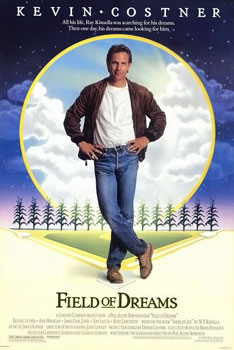
Field of Dreams (1989)

Directed by Phil Alden Robinson · Drama

106 minutes

Cast

Selected cast credits · Film reference

Kevin Costner Ray Kinsella
Amy Madigan Annie Kinsella
James Earl Jones Terence Mann
Ray Liotta Shoeless Joe Jackson
Burt Lancaster Dr. Archibald "Moonlight" Graham Frank Whaley as young Archibald Graham

Everything from the episode

In the order the hosts got to it. Open a row for the discussion.

19:18

Roger Ebert's review

In the discussion (1)
Approx. transcript time · 00:19:18Read transcript
  • Ebert gave the film four stars, a very positive review; one host was proud of Rog.
27:58

Most Rewatchable Scene

Ray meeting Terrence Mann in Boston; Moonlight Graham crossing the line to save Karen; the James Earl Jones speech

Ray meeting Terrence Mann in Boston; Moonlight Graham crossing the line to save Karen; the James Earl Jones speech

In the discussion (17)
Approx. transcript time · 00:27:58Read transcript
  • First nominee: Ray meets Shoeless Joe, is this heaven, no it's Iowa; a quick Liotta imitation; this was a year before Goodfellas, when he was a critic's darling after Something Wild; he still has never seen the movie and thought the script was dumb.
  • Liotta plays Joe Jackson like a sensitive, dew-eyed guy from 1989 rather than a period Black Sox type, which is perfect because he seems like a ghost who doesn't know he is one; a Chantix commercial with him in the cornfield and a second-half-of-Goodfellas Henry Hill emerging from the corn are joked about.
  • Second nominee: Ray goes to Cambridge in his Volkswagen van and meets Terrence Mann; the finger-or-gun exchange is played, the door slamming is really funny, and Mann flips fast once Ray brings up John Kinsella (transcribed 'John Consala'); great suspenders and belt.
  • The two hosts who have spent time in Boston are asked whether there really are that many Jewish people there, since the street looks like half of Brooklyn with Hebrew letters on windows; the Boston exteriors were apparently filmed in Dubuque with after-the-fact wide shots, though they obviously shot at Fenway.
  • Third nominee: after Fenway, Mann pretends he didn't see the scoreboard, drops Ray off, then is standing in the street; the Moonlight Graham, you saw it exchange is recited, New York Giants 1922, one game, never batted, Chisholm, Minnesota; that part is amazing.
  • Fourth nominee: the nighttime scrimmage with Archie, the first time Frank Whaley walks out, ghosts playing at 9:30 with Amy Madigan turning the lights on, the most baseball in the movie, a four-minute sequence.
  • A host doubts they could hit fly balls to a ghost who showed up in the backyard; the counter is that Ray had been prepping, taking BP every day; the one caveat is that Costner wears Timberlands the entire movie rather than Chucks or running shoes.
  • The James Earl Jones speech and the actual ending round out six nominees; the Beulah and Annie scene is rejected as padding rewatchable stats; Moonlight's sacrifice, Karen falling and being saved, is counted as its own scene separate from the catch with dad.
  • The opening catch-up montage is really good where it goes wrong in so many movies, and a secretly great choice is that the voice comes in the first scene with no thirty-minute build-up of farm life; Amy Madigan is quirky enough to buy it, unlike one host's wife, and she asks whether it's acid.
  • Ray meeting Moonlight for the first time and walking back to his office is poetry, resonant though removed from the climax; the rack focus to The Godfather on the marquee; the magic realism works seamlessly and the story is about life rather than baseball or fantasy.
  • Burt Lancaster's last movie, and the part was supposed to be, or at least offered to, Jimmy Stewart, blurted early and rebuked for stepping on half-assed internet research. — Chris Ryan
  • Ray simply accepting that it's 1972 is not ridiculous at all, which is why it is more a fantasy movie than a baseball movie.
  • One pick is when Ray goes to Boston: great chemistry, the reclusive countercultural icon surrounded by tapes and books who wants to be left alone, the locks on his doors; the last thirty minutes can only be watched once a decade, like dialing it up on YouTube to cry it out.
  • Seeing Terrence Mann for the first time has become a favorite, a well-written, well-acted five minutes, with a wish for four hours of deleted van small talk; the 1989-era library research for the old interview mentioning Ebbets Field is loved, as is Mann's heartbreak at not remembering and the you're from the 60s line.
  • Another pick is Moonlight crossing the line to save Karen and Ray's oh my God, you can't go back, the first thing that comes to mind about the movie, more than the catch; it is the emotional gut punch where every theme and tension, hope, purpose, sacrifice, is realized in one second.
  • A sneaky good scene is picking up Frank Whaley hitchhiking, the I need good karma line and his day-job baseball towns, looking like he's in Stand By Me; a host promises to ruin that scene later.
  • A further pick is when he sees Terrence Mann for the first time, and then really the pick is the James Earl Jones speech, with all the ghosts stopping to watch; baseball's a part of us, Ray.
41:19

What’s Aged the Best?

James Horner's score; Shoeless Joe's 'I would have played for nothing'; late-80s Fenway Park; the Kinsella house; Ray...

James Horner's score; Shoeless Joe's 'I would have played for nothing'; late-80s Fenway Park; the Kinsella house; Ray's chemistry with the White Sox ghosts; Gabby Hoffman as Karen; the Terrence Mann character; the Annie and Ray relationship; the van scenes; Busfield walking across the field; Costner's hair and jeans; the disgruntled writer as plot point; the themes of hope and purpose

In the discussion (16)
Approx. transcript time · 00:41:19Read transcript
  • James Horner's score, unequivocally, arguably who won the movie: stolen over and over by sporting events, documentaries and trailers across thirty years, it plays five seconds and you need to excuse yourself; heard in surround sound for the first time it feels like a stadium; it has to double and triple the emotional climax in the last twenty minutes, like Shawshank's iconic score.
  • Shoeless Joe's I would have played for nothing, against today's spoiled players like Bryce Harper getting cash and checks.
  • Late-80s Fenway Park, a personal thing: the caterer, two dogs and two beers for seven bucks, few movies filmed there, the Morgan Magic 88 team with Ellis Burks and Mike Greenwell before the A's kicked their ass.
  • The Kinsella house is a top seven or eight movie house, still standing as it was, worth a fortune if moved to LA; the White Sox ghosts busting Ray's balls during the call to dinner show his chemistry with them, and it would be amazing if he plowed the field and told the cheaters to go back to hell.
  • Gabby Hoffman as the daughter is all-time adorable, in a cutest-daughters final with the Remember the Titans girl, with Macaulay Culkin's bee movie ruled out as a non-sports film; a host's own daughter at six was their favorite human ever and their own field of dreams would be going back to that age; Karen's precociousness is winning.
  • Terrence Mann is James Baldwin meets J.D. Salinger; the book used Salinger and the film changed it for fear of a lawsuit; the recited bio, voice of the 60s, marched with MLK, cover of Newsweek, coined make love not war; asked whether we ever had a writer like this, the answer is no, though Baldwin and Norman Mailer were around back then doing that kind of writing; the whole movie could have been Costner and James Earl Jones in the van.
  • The Annie and Ray relationship: a great, supportive, believable marriage with real history, down to her sleeping in one of his old t-shirts.
  • The son of a bitch died before I could take it back scene is gut-wrenching, Joe Jackson's a criminal being the meanest thing you could say to your dad; the van exchange about the falling out and it's not my fault you wouldn't play catch with your father; all their scenes are high level, high PER.
  • Busfield walking across the field and interrupting without knowing the ghosts are there, the pitch just missing him and the batter swinging through, timed with no visible special effects.
  • Costner's hair and everything about him, worth bottling; the tightness of the jeans, which they don't make like that anymore.
  • Disgruntled writer as plot point has aged well: the recluse found at a pivot point between influencing everyone and being influenced, the aura pulsating over every conversation about him, a stand-in for baseball and tradition in American life; more broadly the themes of the movie.
  • The retort that the themes could equally have aged the worst is greeted as a holy shit take and parked for the next category, with a promise to explain why fathers and sons aren't as interesting as you think.
  • Asked for a pick, the answer is Annie and Ray, first misspoken as Amy and Ray. — Chris Ryan
  • Another pick is the blend of magic realism with hope and purpose as a driving force in a life, which Bill is expected to try to dissuade.
  • Late 80s Fenway Park, a selfish pick for just one person. — Bill Simmons
  • The show missed its chance to get a Ray Liotta walking off the field yelling Karen.
50:28

What’s Aged the Worst?

Baseball as the one constant in the James Earl Jones speech; the slow first twenty minutes; the Christmas-sweater tim...

Baseball as the one constant in the James Earl Jones speech; the slow first twenty minutes; the Christmas-sweater time jump; Costner drinking from a coffee mug while driving; no concussion protocol for Karen; the cover of Newsweek as proof of relevance

In the discussion (7)
Approx. transcript time · 00:50:28Read transcript
  • Baseball itself: the speech's premise that the country ebbs and flows while baseball is the one constant no longer holds, with an apology to Mal; the picker clarifies they are not saying baseball aged badly, only that the 1989 point, once totally true, has been undone by everything that has happened in baseball.
  • Counter: the country is in turmoil now as in the late 60s, sports are a rhetorical minefield yet still elementally loved and shared, what the Red Sox did for one host the Cubs, Eagles and Ravens did for others; a shout out to 'maize' (as transcribed), who would have been on if he hadn't quit four years ago.
  • Most time with baseball now is spent on what's wrong with it and how to fix it, with a counter-struggle of still liking it; in 1989 there was no struggle; the Field of Dreams way of thinking peaked with Sosa and Maguire (as transcribed) and was destroyed when that proved horseshit; Lupica's Summer of 98 book is now a comedy; the conversation is largely numbers.
  • Reply: the message is not the purity of the game but how the game unlocks something in your life; it's a part of our past is still true; investing in something as a portal to something else is eternal; both sides agree they are both right.
  • The 80s already had gross Astrodome stadiums, Pete Rose and cocaine, and Terrence Mann wouldn't have been allowed to play in the majors, a stain the film doesn't acknowledge; yet baseball's space, a rural game held in cities, never changes, which is why the Iowa cornfield setting is so inspired; the cinematography, the smell of a glove and the feel of grass have aged well.
  • The first twenty minutes are a little slow and could lose three minutes; the Christmas sweater time jump always gets a laugh, and what about field maintenance after winter; Costner driving while drinking from a coffee mug seems old, though a thermos is classic.
  • Two small ones: no concussion protocol when Karen falls from the top of the bleachers, nobody checks her head and neck, and a six-year-old would cry for ten minutes rather than recover instantly; and citing the cover of Newsweek as definitive proof of relevance makes members of the media a little sad.
58:23

Casting What-Ifs

Tom Hanks reportedly offered Ray Kinsella; Costner not originally considered after Bull Durham; Jimmy Stewart the ori...

Tom Hanks reportedly offered Ray Kinsella; Costner not originally considered after Bull Durham; Jimmy Stewart the original choice for Moonlight Graham; Burt Lancaster turned it down until a friend changed his mind

In the discussion (4)
Approx. transcript time · 00:58:23Read transcript
  • The internet claims Tom Hanks was offered Ray Kinsella and turned it down, though nobody knows if it happened and a host will ask him if he's ever on a podcast; Costner wasn't considered because they thought he wouldn't follow Bull Durham, then got interested thinking it would be this generation's It's a Wonderful Life, which it probably is.
  • There are strands of Jimmy Stewart, especially Harvey; late-80s Hollywood, often Castle Rock, made throwbacks to Capra like City Slickers and Big, and Robin Williams tried to make that movie four times, What Dreams May Come being the worst version of this one.
  • Jimmy Stewart was ironically the original choice for Moonlight Graham and turned it down; Burt Lancaster turned it down too, then a baseball-fan friend told him he had to do it.
  • Earlier, during the scene nominees: Lancaster's last movie, and the part was supposed to be or offered to Jimmy Stewart. — Chris Ryan
59:15

The Dion Waiters Award for Best Heat Check Performance

Gabby Hoffman (Karen)

Gabby Hoffman (Karen)

In the discussion (4)
Approx. transcript time · 00:59:15Read transcript
  • The field is tight: James Earl Jones is not eligible, Frank Whaley is liked but not a heat-check performance, Busfield is doing the most with the same Ray, you gotta sell the farm, why didn't you tell me routine.
  • Art LaFleur as Chick Gandil (transcribed 'Chick Gandal'), the first baseman, is liked, with his you get a cigarette lines; all the White Sox guys are great.
  • The Busfield character prompts a memory of parents paying the bills at the kitchen table and then fighting; Busfield is initially given the Waiters Award.
  • Gabby Hoffman is raised, every moment a heat check, she's great; a host's daughter at six was as great as her and yelled at goalies at Kings games, so Karen would have been a heckler; the award switches to Karen with an apology to Busfield (transcribed 'Westfield').
1:00:55

The Joey Pants “That Guy” Award

Art LaFleur

Art LaFleur

In the discussion (2)
Approx. transcript time · 01:00:55Read transcript
  • The Joey Pants Award goes to Art LaFleur because nobody knows who that guy is.
  • Earlier, LaFleur's Chick Gandil (transcribed 'Chick Gandal'), the first baseman, was picked out as a favorite among the White Sox.
1:01:29

Half-Assed Internet Research

Original title Shoeless Joe, book working title Dreamfield, changed after test audiences; the voice's identity unknow...

Original title Shoeless Joe, book working title Dreamfield, changed after test audiences; the voice's identity unknown, rumored Ed Harris; Damon and Affleck as Fenway extras; filming sped up for Costner's Revenge; the corn outgrew Costner; the Lansing and Ameskamp farms, 65,000 annual visitors, sold in 2011 for about $5.4 million; 1,500 volunteers' headlights in the final shot; Moonlight Graham's real game was June 1905; the line-drive reaction was genuine; James Earl Jones hates baseball; deleted scenes; George W. Bush's favorite film; AFI quote number 39; W.P. Kinsella bored on set; Ray Kinsella named for Salinger characters; Don Buford and USC coaches as advisers

In the discussion (6)
Approx. transcript time · 01:01:29Read transcript
  • Behind on time, the research is zipped through: the original title was Shoeless Joe, the book's working title Dreamfield, and test audiences thought Shoeless Joe was about a homeless person; nobody knows who the voice was, the rumor is Ed Harris, one host is in the Liotta camp, but Liotta hasn't even seen the movie.
  • Matt Damon and Ben Affleck were legendarily extras at Fenway; filming began in 88 and was sped up because Costner had to shoot Revenge; the corn grew taller than Costner so they put boxes out for him to stand on.
  • Scenes were shot on Don Lansing's property and the baseball scenes on neighbor Al Amiskamp (as transcribed), who replanted corn while Lansing kept the field as a tourist destination without charging admission, only souvenirs; 65,000 visitors a year by the 20th anniversary; sold in 2011 for a believed $5.4 million, so Don Lansing's checkbook won.
  • The final shot used 1,500 volunteers flashing high beams; the real Moonlight Graham played one game in June 1905, not 1922; Shoeless Joe and Ty Cobb really were friends; the line drive knocking over the bag of balls was real and unplanned, Costner's reaction genuine and in character; James Earl Jones hates baseball yet did this and The Sandlot; deleted scenes include Ray's hearing test, buying equipment, getting lost on the way to Fenway, and watching batting practice with Terrence.
  • George W. Bush named it his favorite film; if you build it, he will come was voted the number 39 movie quote by AFI; W.P. Kinsella was on set a lot and found it incredibly boring, though his daughter had a romance with Ray Liotta.
  • Ray Kinsella is not named for the author but for two Salinger characters, Richard Kinsella in Catcher in the Rye and a Ray Kinsella in a 1941 story; Don Buford, the Oriole and father of Damon, coached the actors, and USC coaches were brought in to advise.
1:07:56

Apex Mountain

Kevin Costner; Timothy Busfield; Amy Madigan; Iowa

Kevin Costner; Timothy Busfield; Amy Madigan; Iowa

In the discussion (7)
Approx. transcript time · 01:07:56Read transcript
  • Costner is a yes for this movie rather than Dances with Wolves, since this sets up Dances with Wolves and made him the biggest star; a case for the Apex Mountain Supreme Court; he is cooler in Bull Durham, and 88 and 89 are treated as a pair, plus No Way Out, which deserves its own episode; he was able to direct Dances with Wolves only because of the roll he was on as the most bankable actor, and Robin Hood is placed after Dances with Wolves.
  • He was never more likable across America, everybody was in on Kevin Costner, whereas Dances with Wolves drew a fuck that guy backlash and Goodfellas-should-have-won complaints; this movie has no backlash.
  • James Earl Jones: not enough is known of his career, Darth Vader or Othello, but this feels like his longest-lasting performance, so no answer is given; Timothy Busfield was in thirtysomething and directed a lot of Sorkin, but no question this is his.
  • Amy Madigan, yes, for sure; Gabby Hoffman, no.
  • Iowa: late-80s Iowa, Kirk Ferentz, Steve Alford, its role in the presidential process, but it's hard to top literally standing in for heaven; 100 percent yes.
  • Baseball might have been at its apex: the end of the great baseball movie decade cresting with this, the 86 World Series, the Twins, before the earthquake series, steroids not yet involved though Consico and McGuire (as transcribed) looked like Pacific Rim, cocaine cleaned up, integration achieved; the thought trails off into I don't know.
  • Shoeless Joe as a sympathetic figure: Eight Men Out and this came back to back, and most people's knowledge of the Black Sox comes from these two movies; the Eight Men Out book is a staple that lays out how unfair some of it was; he's a tragic figure; Craig is asked whether his generation reads books.
1:13:14

The Ruffalo / Hanna / Rubinek / Partridge Overacting Award

Beulah, the woman at the PTA meeting

Beulah, the woman at the PTA meeting

In the discussion (1)
Approx. transcript time · 01:13:14Read transcript
  • The overacting award goes to the woman at the PTA meeting, dubbed Eva Braun, Beulah, who is over the top, punching the air and sliding into lockers, though it works; it is explicitly not Amy Madigan, whose notes are held for nitpicks; Meg Ryan is floated as the only other possible casting for Amy Madigan's part, and Chris is teased for being sweet on Amy Madigan.
1:13:14

Picking Nits

Annie is impossibly understanding; the movie needs a sex scene; Ray Liotta bats righty as the lefty Shoeless Joe; the...

Annie is impossibly understanding; the movie needs a sex scene; Ray Liotta bats righty as the lefty Shoeless Joe; the Fenway scoreboard reads 10:30 in the third inning; no black players before 1947; the two-acre field at $2,200 an acre; professional lights beside splintery bleachers; Mark vanishes for a glass of water; Mark isn't thrown off the property; Ray doesn't recognize his father in the scrimmage; Dwyer Brown's catching; Annie wouldn't wait when Karen falls; Karen could be carried onto the field; Archie already existed off the field; the cornfield's ground rules; only one book-burner is opposed; Shoeless Joe's no-errors defense

In the discussion (19)
Approx. transcript time · 01:13:14Read transcript
  • Notes on Amy Madigan are held for nitpicks; the first written down is whether anyone's wife has ever been this understanding in the history of mankind: she objects to Boston but not to mowing the cornfield; only the people who marry serial killers in prison compare; it's the 60s.
  • The movie needs a sex scene to understand what fuels Annie's blind devotion; Terrence Mann's response to Ray is you're seeing a whole team of psychiatrists, while Annie's is follow your bliss, moving and aspirational but also ridiculous, probably an extension of the hippie ethos.
  • Annie's Fenway big green wall vision is when she really buys in, versus her initial don't go, we're underwater doubt; by the Christmas montage of Ray staring at the field in a snowstorm every relative would want him in a mental hospital; and once Joe Jackson shows up, why not replant the corn instead of hosting a 162-game season.
  • Ray Liotta batted righty while Shoeless Joe was a lefty, everybody's biggest nitpick for thirty years and indefensible since they could have flipped the shot and cheated the background; come on, Phil Alden-Robertson (as transcribed), bad job.
  • The Fenway scoreboard reads 10:30 p.m. in the third inning with no rain delay, obviously shot after a game; it has bothered one host for thirty years.
  • The movie gives second chances to Ray and his dad, Moonlight Graham (joked as Grom, the gelato), Terrence Mann, Shoeless Joe and the Black Sox, yet ignores every black player before 1947; instead of the cheating White Sox, Satchel Paige, Cool Papa Bell or Josh Gibson, and Terrence Mann would surely have raised it in the van; Robinson called it his greatest regret; it is the biggest flaw in the movie.
  • Mark's do you know how much this land is worth is undercut by Ray's $2,200 an acre: a baseball field is about two acres, so he isn't losing much on a farm of hundreds of acres; the counter is that he built and maintains a triple-A field with expensive electricity.
  • Why have the lights at all, where does a regular person get professional lighting, and why is the construction so perfect and precise while the bleachers are splintery unvarnished planks with smashed-in nails that aren't safe for a child; the lights do give an ethereal vibe and the film addresses how lights changed the game.
  • Busfield's Mark finally sees the ghosts after Karen is saved, Annie sends him inside for water, and he is never seen again; the counter is that interrupting the reunion with we can charge $20 a car would be in character; the opposite nitpick is that he should be kicked off the premises for nearly killing the child.
  • The editing is shady when Mark grabs and shakes Karen, and a parent would fight anyone who touched their six-year-old; Ray never recognizes his dad during the scrimmage despite catcher's gear and three hours in the stands.
  • Dwyer Brown's childlike catching has an explanation from research: the catch had to be shot in a ten-minute magic hour with an 85-year-old rock-hard catcher's mitt he feared dropping, so apologies to him, though his throwing wasn't loved; it wasn't as bad as the kid at the end of The Natural.
  • Karen falling off the bleachers eating the hot dog has holes: Annie would run to call the paramedics and no mom on the planet stops because her husband has an idea, since a mother whose child is hurt becomes superhuman.
  • Why not carry Karen five feet onto the field so Moonlight needn't cross; the counter is that young Moonlight hasn't been through medical school, answered that he is a timeless ghost who has lived his life and knows the grand design; Ray doesn't yet know Graham can't cross back.
  • Archie already existed outside the field as a hitchhiker, and the implication that Terrence Mann will come back with a long-form piece on heaven raises why Moonlight can't return; none of them can come off the field; Archie is on a different timeline and had to be brought there; he left the field and became a drummer for the Doors.
  • One host is devastated the other doesn't like a scene seen 700 times; the fair questions raise whether you need to understand the rules of the magic to like the movie; it's magic and faith, believing what you can't see, so you opt in, which is why Mark seeing the ghosts at the end is disliked, since he never opened himself up.
  • Smaller nits: the park's ground rules, what a ground-rule double in the cornfield is, an outfielder vanishing into heaven shagging a fly, where all the baseballs go, Janet's void; if Terrence Mann could walk into the corn, why wouldn't Ray try; maybe the spirits have to bring you, and it's about what you are pursuing.
  • The town hall over salacious literature is moral panic, but only the one woman is actually opposed and nobody in the room supports her; the counter is that it's about how hysterical people get together; that scene could be aged-best because it's what the internet is like now.
  • A sequel vision: Mark comes back out after his cold drink and lectures the ghosts about walks, shifts and swing planes, disparages Shoeless Joe for not getting on base, and brings his friend Bill James with notes.
  • Shoeless Joe's no-errors stat is cited as proof he didn't throw the series, but outfielders rarely commit errors in one series and it would have to be an obvious overthrow; the Rothstein gambling contingent, Boardwalk Empire; the segment ends with Mark asked how his glass of water is.
1:30:49

The Neil McCauley “A Book about Metals” Award for Best Line from the Movie

"You see, that's the sort of crap people are always trying to lay on me"; "It's not my fault you wouldn't play catch ...

"You see, that's the sort of crap people are always trying to lay on me"; "It's not my fault you wouldn't play catch with your father"; "Hey, Dad, you want to have a catch?"; "Oh, people will come, Ray"; "is this heaven it's Iowa"; "well then i guess i'm real"; "we just don't recognize life's most significant moments while they're happening"; "Officially, my major was English, but really it was the 60s"

In the discussion (8)
Approx. transcript time · 01:30:49Read transcript
  • A lot of candidates: Ray never having done a crazy thing until he heard the voice, you build it, he will come, that's the sort of crap people are always trying to lay on me, it's not my fault you wouldn't play catch with your father, hey, Dad, you want to have a catch, and the this is Terrence Mann, Easter Bunny exchange, which is really funny.
  • The people will come, Ray speech is performed in full and one voice says it has to go to that now, recalling a joke about planning the Ringer as podcasts mixed with text.
  • Is this heaven, it's Iowa made one host sob; the Shoeless Joe and Karen exchange, are you a ghost, you look real to me, well then I guess I'm real, is quietly a mission statement for the movie and for life, the most important idea in the world to one host.
  • A Harry Potter parallel: Dumbledore telling Harry that happening inside your head doesn't mean it isn't real explains why people invest in stories, teams and Game of Thrones; people love this movie because they put themselves in Ray's position and wish they believed in something without a payoff; movies articulate longing, and closure with your dad experienced secondhand can feel safer than the real thing, with a Game of Thrones 1280s joke.
  • Moonlight's it was coming this close to your dreams and then watching them brush past you like a stranger in a crowd and we just don't recognize life's most significant moments while they're happening, I didn't realize that that was the only day, are gutting; the dream is ultimately human connection and fulfillment, not one at-bat; most rom-coms is a joke.
  • The movie asks you to see the totality of its characters: Moonlight saved lives rather than being haunted, Mann didn't want to be that thing anymore, and Ray gets to see his dad beyond the man who rejected his counterculture; it is underrated on perspective and the lingering consequences of decisions.
  • The comedy lines: oh Lord, you're supposed to build a football field now; officially my major was English, but really it was the 60s; and Ray answering what do you want by pointing at the three men with arms crossed; the hosts have to move on.
  • Later, favorite voice lines: ease his pain, go the distance, and the iconic if you build it he will come, often misquoted as they will come; one host likes ease his pain most as the best thought experiment; a joke about a Trump tweet calling Ray Kinsella a loser bringing back cheaters.
1:38:33

Sequel, Prequel, Limited Series, or All-Black Remake

No

No

In the discussion (3)
Approx. transcript time · 01:38:33Read transcript
  • Could this be remade as a ten-episode Netflix show: absolutely not, nobody would touch it, though it would be an interesting show.
  • Field of Dreams 2 in the post-steroids era writes itself: Bonds and McGuire (as transcribed) return 48 years from now with normal-sized necks and 7.5 hats; or Ray pursues bringing the Negro Leaguers back to play; maybe it's a cartoon.
  • A joke remake: a son who left at 17 calling Larry Bird a loser builds his father a basketball court in the cornfield; you'd make it a basketball movie set in a city.
1:38:47

Probably Unanswerable Questions

Did Terrence Mann come back from heaven, or was he dead all along? Does Ray ever feel guilty about charging $20 a car...

Did Terrence Mann come back from heaven, or was he dead all along? Does Ray ever feel guilty about charging $20 a car? Where do the visitors park and use the bathroom? When does the government notice the traffic? How did they talk the umpires into coming back? Who is the voice? Why could Archie exist off the field but not leave it? Can only good people see the ghosts?

In the discussion (5)
Approx. transcript time · 01:38:47Read transcript
  • Did Terrence Mann ever come back from heaven; a popular internet theory says he was dead the whole time, which is why he can enter the corn, countered by the Red Sox game, the newspaper article about him missing and his father's call; the hosts think he comes back, announcing heaven is real with the 1919 Black Sox and no Negro League players.
  • Does Ray ever feel bad about commodifying his emotional breakthrough by charging everyone 20 bucks; no, not in the least; the business plan is questioned, where the cars park, plow more corn, where they go to the bathroom, though hippies used to walking to Woodstock won't mind.
  • Did anyone get suspicious of a long line of traffic in Iowa, at what point does the government or the X Files get involved; how did they talk the umpires into coming back when being yelled at by Chick Gandil isn't fun, unless they sensed pitch framing coming.
  • Who is the voice, already covered; if Archie could live outside the diamond, why couldn't he leave it; whether only the good people can see the ghosts, answered that it's about open-mindedness and spiritual awakening rather than a judgment on morality.
  • During the nitpicks, the implication that Terrence Mann will come back prompts the question of whether he is dead, parked for unanswerable questions.
1:44:37

Who Won the Movie?

Kevin Costner

Kevin Costner

In the discussion (2)
Approx. transcript time · 01:44:37Read transcript
  • Costner is named at once, with Iowa floated as an alternative; only Costner could have done this, not Tom Hanks, since the wet eyes and the way he looks over a twilight cornfield are not replicable and you believe he is from there.
  • The key Ray scene is his interaction with the old farmers, which makes the premise believable and shows him absorbed into that community; great hair, and he knows how to wear the Berkeley t-shirt.
Podcast choices
Speaker not identified
Kevin Costner
Speaker not identified
Kevin Costner

More from the conversation

Chris Ryan and Mallory Rubin (transcribed 'Malia Rubin') are introduced, one guest is expected to cry and should have brought tissues, and the movie is thirty years old; Costner's Field of Dreams hair, fluffy on top and long in back, was Chris's answer to which movie hairdo he'd take, and he seems to wear his Bull Durham clothes, down to the pool-hall shirt and pleated khakis.
Approx. transcript time · 00:02:13Read transcript
Costner was white hot from 85 to 89, Silverado, American Flyers, The Untouchables, No Way Out, Bull Durham, Field of Dreams, Revenge, Dances with Wolves; he is the most believable baseball-player actor ever, ahead of Snipes, Redford and Charlie Sheen (who threw 85 in Major League, covered on last week's episode), having tried to walk on at Cal State Fullerton; his peak was only five or six years, with Waterworld the end, Tin Cup a comeback, and he never did a Tarantino or Ridley Scott revamp, preferring Hatfields and McCoys, westerns and A Perfect World.
Approx. transcript time · 00:03:15Read transcript
The first note written down was Ray's tight jeans; Costner is a personal favorite, Bull Durham one of two favorite movies of all time and Crash Davis an important figure in life and heart, and Kevin Costner is an extremely handsome man who knows how to handle a bat.
Approx. transcript time · 00:07:09Read transcript
Costner could be the Berkeley hippie and corn-fed middle America and a New York City boy at once, so every aspect of Americana lives in one persona; his Grantland holiday party appearance almost caused a riot among married women; this and Bull Durham are charisma movies, and they don't make movies like this anymore, which would now be a family movie with a clear moral.
Approx. transcript time · 00:07:44Read transcript
Who else could have played Ray in the last 35 years: Brad Pitt, probably in Moneyball mode; Tom Hanks, though maybe not the baseball; Jeff Bridges; Costner's range ran from the Michael Douglas Wall Street type to the cornfield, with his easy charisma and a flabbergasted half-laugh Denzel doesn't do; the current generation has no Costner or Hanks, not Chris Evans or Chris Pratt, with Harrison Ford and Luke Wilson jokes.
Approx. transcript time · 00:09:50Read transcript
1989 capped a great baseball decade apart from the cocaine scandal; the 1981 strike was the worst summer of one host's life; steroids hadn't arrived and there was real innocence, so rewatching now, after baseball has let people down for 25 years, makes the James Earl Jones speech a crazy thing to watch.
Approx. transcript time · 00:12:57Read transcript
The reply is that the Black Sox premise already asks what happens when heroes betray you and you believe anyway, and how a loved one's judgment and regret shape a life; what's eternal is the relationship between a fan and whatever they choose to care about; Terrence Mann's speeches sound like how people talked about Tiger on Sunday, so we're still susceptible.
Approx. transcript time · 00:14:13Read transcript
Roger Angell (transcribed 'Roger Angel') tangent: this was his decade, writing with innocence and ties between generations; reading him and the host in the late 90s taught one guest you were allowed to write about baseball like that, down to a spider web on a press box wall as the lede; meeting him in Cambridge in 93 or 94 was the most one host ever fanboyed; he's still writing at 99 and covered the Women's March.
Approx. transcript time · 00:15:41Read transcript
Adapted from W.P. Kinsella's Shoeless Joe; Phil Alden Robinson tried to make it from 1981 and it may not have been made without a star; three Oscar nominations including Best Picture against Driving Miss Daisy, Born on the Fourth of July, My Left Foot and Dead Poets Society, Driving Miss Daisy's win a travesty; the best actor and supporting actor fields are run through and one host would have snuck James Earl Jones into the supporting actor field.
Approx. transcript time · 00:17:45Read transcript
Premiere Magazine named it one of the 20 most overrated movies in the mid-2000s, and anniversary coverage asks whether it's just corny, now first-page Google territory; the cadence of the language isn't how people talk, certainly about baseball; Charlie Pierce hated it in the early 2000s arguments while loving Bull Durham.
Approx. transcript time · 00:19:37Read transcript
The sports-movie Rushmore of The Natural, Hoosiers and Field of Dreams; the last decade's false choice between Crash Davis and Ray Kinsella is ridiculous; every baseball movie is a slice of fandom, and this one centers the internal, baseball as a language spoken across generations even as the talk turns to contracts and statistics; Mann's giant baseball encyclopedia would now be an iPad.
Approx. transcript time · 00:20:54Read transcript
This is less a baseball movie than a life movie, where Bull Durham is a borderline rom-com, Major League pure baseball and The Natural hero worship; one host saw it in college with his friend Jim Morris, the last twenty minutes are unassailable and the theater sat silent through the credits; it is fixed in time, about boomer kids rejecting fathers who came back from World War II, basically every Bruce Springsteen concert.
Approx. transcript time · 00:22:52Read transcript
It is a daughter-and-dad movie too because of Karen, anchored in the 60s yet timeless and genderless so anyone can cast themselves as Ray, Annie, John or the players; baseball is one of the most important things in her relationship with her dad and how she fell in love with sports and storytelling, through the Orioles, Earl Weaver's three-run homer and Memorial Stadium; the movie is two people pushed apart and brought back together.
Approx. transcript time · 00:25:36Read transcript
Luminary promo: the show is spinning off a fifteen-episode Rewatchables 1999 launching with American Pie, the most uncomfortable ninety minutes of Chris's life, which needed Mallory; Luminary Premium and the pre-sale offer are read.
Approx. transcript time · 01:05:52Read transcript
Continuing a tradition from The Natural episode, newspaper headlines the movie should have shown are read: a local farmer plowing his cornfield to build a field for the living dead, a poltergeist portal, a crazed farmer harassing Boston's Jewish community, a kidnapped author forced to watch a Red Sox game, a child's ten-foot fall and hot dog; what the Trump tweet and the 538 headline would be.
Approx. transcript time · 01:42:40Read transcript
Grown-up Karen is imagined living in LA, writing a bad book, trying to act, doing TED Talks about fathers destroying farms, hosting a ghost-hunt show or producing Paranormal Activity; the catch scene moves quickly to the catch because both men are in a fugue state, and whether Costner needed to say I'm sorry.
Approx. transcript time · 01:45:23Read transcript
Sign-off at the two-hour mark: Rewatchables 1999 on Luminary starts next week, the next Rewatchables is Mean Girls, plugs for The Watch, Binge Mode and the Talk the Thrones Twitter show with five episodes left.
Approx. transcript time · 01:46:54Read transcript