
‹ All movies

The Langley heist

Nominees run through the Prague sequence as a whole (a 32-minute opening act that even fades to black after Tom Cruise jumps through the Aquarium and escapes from Kittredge), Ethan and Max's negotiation, the Langley heist, and the Phelps versus Hunt coffee scene where Hunt sees what Phelps has done while Phelps lies to him, the scene that confused a generation of filmgoers.

One host admits not understanding the coffee scene until rewatching it yesterday after roughly 20 viewings; the Langley break-in is called the most iconic, incredibly staged, ripped off numerous times, and the precedent for Tom Cruise attempting something that seems impossible, even though Wu takes it to another level.

"You've never seen me very upset"

Nominees: 'do you read me, the list is in the open', already flagged; Kittredge's line that dying slowly in America can be a very expensive proposition, guessed to be Robert Towne or David Koepp; 'you've never seen me very upset'; 'relax Luther, it's much worse than you think'; and Kittredge wanting Don Lowe (as transcribed) manning a radar tower in Alaska by the end of the day, just mail him his clothes.

The film

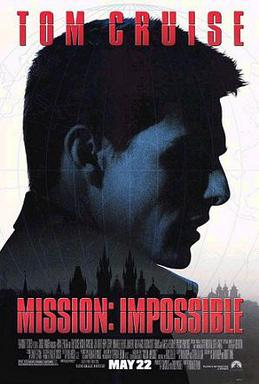
Mission: Impossible (1996)

Directed by Brian De Palma · Drama

110 minutes

Cast

Selected cast credits · Film reference

Tom Cruise Ethan Hunt : A young IMF agent
Jon Voight Jim Phelps : The leader of Ethan's IMF team and his mentor
Emmanuelle Béart Claire Phelps: Jim's wife and a member of his IMF team, specializing in getaway transportation
Henry Czerny Eugene Kittridge: The director of the IMF
Jean Reno Franz Krieger: A disavowed IMF agent and skilled pilot recruited by Ethan to assist him
Ving Rhames Luther Stickell : A disavowed IMF agent and skilled computer hacker recruited by Ethan to assist him
Vanessa Redgrave Max: An illegal arms dealer
Kristin Scott Thomas Sarah Davies: An IMF agent and undercover infiltration expert on Phelps's IMF team
Ingeborga Dapkūnaitė Hannah Williams: An IMF agent and surveillance expert on Phelps's IMF team
Emilio Estevez (uncredited) Jack Harmon: An IMF agent and security system specialist on Phelps's IMF team
Rolf Saxon William Donloe: A CIA analyst at Langley
Marcel Iureș Alexander Golitsyn: An IMF agent posing as a rogue agent to lure out a mole in Prague

Everything from the episode

In the order the hosts got to it. Open a row for the discussion.

21:16

Most Rewatchable Scene

The Langley heist

The Langley heist

In the discussion (6)
Approx. transcript time · 00:21:16Read transcript
  • Nominees run through the Prague sequence as a whole (a 32-minute opening act that even fades to black after Tom Cruise jumps through the Aquarium and escapes from Kittredge), Ethan and Max's negotiation, the Langley heist, and the Phelps versus Hunt coffee scene where Hunt sees what Phelps has done while Phelps lies to him, the scene that confused a generation of filmgoers.
  • One host admits not understanding the coffee scene until rewatching it yesterday after roughly 20 viewings; the Langley break-in is called the most iconic, incredibly staged, ripped off numerous times, and the precedent for Tom Cruise attempting something that seems impossible, even though Wu takes it to another level.
  • The scene one host rewound four times is Ethan on the horn with Kittredge after the team is killed, shouting that his team is dead, that they knew we were coming, that the disc is gone and the list is in the open; the clip is played, and Cruise is said to go Ruffalo before Ruffalo and to resemble Bill Paxton in Aliens.
  • The Kittredge call is a bookend to the Aquarium restaurant scene: before it Cruise is loud and brash, cracking jokes while Jon Voight's Phelps lays out the plan, and in the restaurant he turns cerebral, seeing the other team, the waiters and the lovers on the river bank; the Langley heist is then named the pick, iconic and almost all in silence, with the tension of Don Lowe (as transcribed) about to come back, and compared to the silent drilling heist in Rafifi (as transcribed), the host's favorite heist movie.
  • Further Langley favorites: the digital sound meter, the rat in the air duct likened to the final shot of The Departed, the Top Copy (as transcribed) reference to the same filmmaker Jules Dassen (as transcribed), the trope of explaining the heist on the train before doing it with Jean Reno, Ving Rhames and Emmanuel Bayard (as transcribed), Cruise's Cheshire Cat grin saying it is even worse than you think, and the first encounter with the idea of an air-gapped computer; Langley is confirmed as the most rewatchable scene.
  • Asked for memories earlier, the Langley drop of Cruise hanging is named the iconic image inside the movie, one the later Mission Impossible films call back to every time, and the film is called De Palma's last great movie. — Sean Fennessey
26:15

What’s Aged the Best?

De Palma's visual style

De Palma's visual style

In the discussion (5)
Approx. transcript time · 00:26:15Read transcript
  • The movie is in a race against time as digital life changes; it was weirdly prescient about wireless streaming video, while things like Netscape no longer make sense; the first nominees are the Hitchcockian vibe of drawing on 1950s and 1960s Hitchcock for an espionage movie, especially in the Prague sequence, the cat-and-mouse format of the set pieces built on ducking into rooms, masks, disguises and hanging from places rather than buildings falling, and Cruise's performance.
  • Casting great actors in supporting roles is argued to hold up: Voight at the right stage of his career to be Phelps, a character from the television series; Manuel Bear (as transcribed), an actress few American filmgoers had seen; Jean Reno coming off Leon the Professional with his dickishness; Ving Rhames, who becomes the only other connecting figure in the series along with Monaghan; Kristen Scott Thomas, Vanessa Redgrave, Emilio Estevez and Henry Zerny (as transcribed), later of Sharp Objects, all lived in and knowing what movie they are in.
  • The Prague sequence is bittersweet because two or three movies of the Estevez, Kristen Scott Thomas and Cruise team would be welcome; it is set up like Alien with people who know each other, down to the wife's coffee and the barn in Kiev, and the scene where Cruise and Kristen Scott Thomas make out while tracking the arms dealer shows legitimately good chemistry, if less than Cruise's with Vanessa Redgrave; killing off those movie stars 35 minutes in is called a Hitchcockian twist like Janet Leigh in Psycho.
  • Estevez's line about lasagna while showing Cruise the chewing gum explosive is a favorite; red light green light and 'you've never seen me very upset' show Robert Towne style dialogue sprinkled throughout, and the hosts assign roles: Koepp the genius of action plotting, Zalian (as transcribed) the dramatic storyteller, Towne the king of memorable lines, with Tom Cruise movie starring on top.
  • De Palma's visual flair under control is the final nominee: the deep-focus shot where Don Lowe (as transcribed) is dressed down by Henry Zirny's (as transcribed) CIA character before being sent to Siberia, a charismatic look unlike same-looking modern blockbusters, stylish and fun where a Villeneuve film never makes you laugh; De Palma's playful visual style is named the pick.
31:53

Casting What-Ifs

Juliette Binoche turned down Claire; Peter Graves and Martin Landau turned down roles after reading the script; Demi ...

Juliette Binoche turned down Claire; Peter Graves and Martin Landau turned down roles after reading the script; Demi Moore floated as Claire

In the discussion (4)
Approx. transcript time · 00:31:53Read transcript
  • There are not many casting what-ifs because the movie was put together by Cruise and Wagner; Juliette Binoche turned down Claire because she did not want to be known for blockbusters, which worked out for her, and it would have been a funny coincidence with Kristen Scott Thomas in two well-seen 1996 movies in the year of The English Patient.
  • Peter Graves and Martin Landau from the original series turned down roles after reading the script; Graves did not care for Jim Phelps being the villain and Landau thought it got away from what made the show good, though the hosts wonder whether the roles were smaller than they wanted and joke about Landau feeling himself after his 1994 Oscar.
  • Since Claire did not have to be European, Demi Moore is floated as a reunion with Cruise after A Few Good Men; sex scenes between Claire and Ethan were written and cut, a kiss appears in the trailer that is not in the film, and despite the grabbing and handsiness and an implied night together there is not much chemistry.
  • 1996 was the year of Striptease for Demi Moore, so it would have been a left turn; Claire is called an underwritten part and one of the weakest aspects, a Russian doll for Jim's motivations in a Hitchcockian way; Susan Sarandon is also mentioned, but the objection is that Moore is too visceral and signals a fight scene is coming, whereas Claire's sphinx-like quality serves the narrative, so maybe Emmanuel Bayer (as transcribed) is right for it after all.
35:14

The Dion Waiters Award for Best Heat Check Performance

Vanessa Redgrave

Vanessa Redgrave

In the discussion (7)
Approx. transcript time · 00:35:14Read transcript
  • The award is defined as supporting character actors who make the most of their time; Vanessa Redgrave, born in 1937 and about 59 or 60, one of the great actresses of the 20th century, plays an arms dealer named Max who communicates via Usenet group, and is argued to have more sexual chemistry with Cruise than anyone in his movies except Kelly McGillis.
  • Redgrave looks at him like he is a steak, chews over every line, calls him dear boy, seems to have been taking nitrous hits, and smiles like a shark when he comes in; the shroud scene is recalled, with Ethan hooded in a knit hat and warned he will wear the shroud indefinitely if Max does not like what he has to say, and the clip of her asking who he is and his demand for $150,000 is played.
  • Whether it is a flaw or a nitpick, the villains' goals in the whole series are elusive: this film has Phelps and Max, and what they have going on, beyond shifting money around, is unclear; the explanation offered is Phelps's bitterness, voiced to Ethan as a tool for a war that is no longer going on, farmed out on $60,000 a year, the same line Ed Harris has at the end of The Rock the same year, read as the post-Desert Storm, Fukuyama end-of-history mood.
  • Other nominees: Henry Zerny (as transcribed), who did not pop off after this, whose performance once seemed over the top and is now excellent, including his interplay with Barnes played by Dale Dye, bullying him throughout, and dressing like a G man from the 1930s in overcoat and fedora once the pursuit of Hunt begins; he built a career on the dick bureaucrat after Clear and Present Danger, called his iconic performance.
  • Emilio Estevez, coming off Young Guns, seemed to be doing a fun cameo and never showed up in a blockbuster ensemble again, with The Outsiders and The Mighty Ducks debated; Kristen Scott Thomas was remarkable; Jon Voight has too many minutes played for the award but is unrecognizable from the iconic 1970s actor of Coming Home and Midnight Cowboy.
  • Ving Rhames gets respect: Luther becomes Ethan's conscience across the series, and casting the burly Marcellus Wallace figure as the smartest hacker in the room was a smart choice that holds, even after Simon Pegg is introduced; one host then goes with Redgrave.
  • Jean Reno is shouted out for a volcanic hot streak from The Professional through this to Ronin, where he plays nearly the same role more gregariously, with Sean Bean as the Jean Reno of Ronin; French Kiss with Kevin Kline and Meg Ryan is cited as his erased earlier appearance, and Redgrave is confirmed.
42:36

What’s Aged the Worst?

The masks

The masks

In the discussion (5)
Approx. transcript time · 00:42:36Read transcript
  • Nominees: Ethan typing internet access into a computer, the Netscape browser the IMF uses to watch news clips, floppy disks, the attention-drawing surveillance eyewear worn by Hannah and Sarah in the Prague scene, the masks, and the whole Claire plotline.
  • The masks are disputed: one side finds them unbelievable with no rules, while the other says these movies need something preposterous, and the masks, inherited from the TV show, are that thing, even as later films add voice strips; the objection is that with good mask use half the movie need not happen, since Ethan could just walk in as Don Lowe (as transcribed) and take the knock list, prompting the joke about Andy Greenwald in a mask.
  • The senator mask Ethan wears is the worst offender: he has ostensibly been impersonating a sitting U.S. senator for an untold time, doing interviews; the hosts argue whether the senator exists, with the theory that he is a real adversary of the IMF taken on fishing trips to County Kildare while the IMF uses his face, versus an entirely invented man elected to high office and only ever played by Tom Cruise.
  • In 1996 the political landscape was different: a teenager would have accepted old Senator Walter without question, since nobody knew their senators or how to contact them, and a political category is jokingly suggested after the Quint campaign bit from the Jaws episode.
  • Pressed for a final answer, the masks are chosen over the computer tech, which should be graded on a curve, though the forward-looking movie suffers when a floppy disk appears, the Langley screen just reads download complete, and Luther hacking Max's computer on the train amounts to typing plain instructions; the masks are confirmed with a fist bump.
48:44

Half-Assed Internet Research

Willard Huyck and Gloria Katz's original script killed the original IMF team including Peter Graves; a near-bankrupt ...

Willard Huyck and Gloria Katz's original script killed the original IMF team including Peter Graves; a near-bankrupt Apple tied in with PowerBooks and a web adventure game; the Langley heist homages Dassin's Topkapi and Rififi; Ethan Hunt's name may honor Watergate's Howard Hunt

In the discussion (3)
Approx. transcript time · 00:48:44Read transcript
  • The original script came from two earlier writers. Katz and Huck (Gloria and Willard, as transcribed) reportedly opened it with the original IMF team, including Peter Graves, on a mission with their youngest member played by Cruise, all killed except him, leaving him to solve who killed his team, which may be another reason the older stars did not return.
  • Apple was almost bankrupt at release and tried to get cool again through a corporate tie-in, with PowerBook laptops in the movie, plus an early promotional website called the Mission Impossible Web Adventure, sinking about $15 million into it; things worked out for Apple.
  • The Langley heist homages the Jules Dassen (as transcribed) classics Top Copy and Rafifi (as transcribed); some think Ethan Hunt's name is a sly tribute to Howard Hunt, the former CIA spy involved in the Watergate break-in, and Ethan Hunt is called a perfect, anonymous yet fun-to-say name.
50:09

Unintentional Comedy Award

Ethan sincerely asking Luther whether they used to call him the Net Ranger

Ethan sincerely asking Luther whether they used to call him the Net Ranger

In the discussion (4)
Approx. transcript time · 00:50:09Read transcript
  • Ethan researching Usenet groups after typing internet on his computer closes his eyes while scrolling and so misses the entire letter A, which would have included arms dealing; Ethan's question to Luther about being called the Net Ranger; and Senator John Walzer (as transcribed), Democrat of Virginia, appearing on the McLaughlin Group, watchable in crystal-clear video in a Prague hotel room.
  • A tangent on mid-90s Usenet: one host was on the Phish Usenet group, believed to be among the first for a musical act, another on a Pavement email list serve after Prodigy, and another never left AOL in 1996; the digression is joked about as a confessional, offered as proof that arms deals could plausibly happen in biblical Usenet groups.
  • Nobody has tried emailing Max at Job 314; the ease with which Ethan reaches Job, sending about six emails, passing out and waking to a reply, seems unlikely and is parked for nitpicks.
  • The Net Ranger line is chosen because it is delivered so sincerely.
52:32

Probably Unanswerable Questions

Is the McLaughlin Group senator the real Senator Walter or Ethan Hunt in the mask? Why not make a mask of William Don...

Is the McLaughlin Group senator the real Senator Walter or Ethan Hunt in the mask? Why not make a mask of William Donloe and steal the disc? Was Jon Voight in shape to run across a high-speed train?

In the discussion (5)
Approx. transcript time · 00:52:32Read transcript
  • Rolled over from unintentional comedy: is the Senator John Walter on the McLaughlin Group the real senator or Ethan Hunt in the mask; one theory is that Walter is real but secretly an IMF agent whose skepticism of the intelligence community is a simulation of dissent, letting the IMF use his identity.
  • Three potentialities for Senator Walter are laid out: an elected human man who likes fishing and does not know about his Prague gala attendance, a blue dog Democrat from Virginia not on alt.fish, alt.bible or alt.arms; a co-opted intelligence officer serving Virginia while working for the IMF; or a wholly constructed 65-year-old citizen played entirely by Tom Cruise when needed, all for 60 grand a year.
  • Follow-ups: would you watch a 1996 movie about an old senator played by Tom Cruise now, why is Cruise not returning to the Walzer IP (as transcribed), and why was his Tropic Thunder transformation praised over his work as John Walter.
  • If Ethan can make a mask of anyone's face, why not make a mask of William Donlow (as transcribed), who worked inside the vault, and steal the disc; the question was asked before and nobody has a satisfactory answer.
  • Was Jon Voight in any shape to traipse across a high-speed train; he looks fitter than ever in the parachute suit and black SWAT outfit, possibly with a stunt double, so when he pretends to be hurt in the coffee shop he is lying, and when he strikes Ethan there is a weird intense physical energy, a bit of old man strength.
55:47

Picking Nits

Why Jim shoots Claire first on the train; Jim and Claire's confounding relationship; Krieger's end game; what Kittred...

Why Jim shoots Claire first on the train; Jim and Claire's confounding relationship; Krieger's end game; what Kittredge's deal with Max amounts to; the helicopter in the train tunnel; what Max and Phelps are actually after

In the discussion (5)
Approx. transcript time · 00:55:47Read transcript
  • Nobody understands why Jim had to shoot Claire first: she only asks whether they really have to kill Ethan and tells him not to, and he guns her down on the train, which makes no sense; maybe Emmanuel Bayard (as transcribed) did not want to return, or the film needed to underline that Phelps is deranged, but it remains confusing.
  • Jim and Claire's relationship confounds the hosts: on reuniting with her, Phelps immediately disparages her to Ethan in crude terms and later tells Ethan to take her, which seems unnecessary when Ethan has been a gentleman apart from the handsy magic trick; the joke is that De Palma has a problem with sexual politics.
  • Krieger's end game is unclear beyond living and dying by the black market and cutting out the middleman; and what really happens at the end when Kittredge offers Max a deal, implying she has information they can use, after which Ethan is simply back in the mix.
  • The science of flying a helicopter into the train tunnel is very tough, even if Krieger's earlier boast about flying one into the lobby of Fort Knox sets it up, and where he would have learned that is unknown; when the other train comes the other way the film cuts to a hard close-up on Ethan's face because it is illogical.
  • Flagged earlier during the Redgrave discussion as a flaw or a nitpick: every villain in the series has elusive aims, this film has Phelps and Max, and whether they are just shifting money around is unclear.
58:21

The Neil McCauley “A Book about Metals” Award for Best Line from the Movie

"You've never seen me very upset"

"You've never seen me very upset"

In the discussion (2)
Approx. transcript time · 00:58:21Read transcript
  • Nominees: 'do you read me, the list is in the open', already flagged; Kittredge's line that dying slowly in America can be a very expensive proposition, guessed to be Robert Towne or David Koepp; 'you've never seen me very upset'; 'relax Luther, it's much worse than you think'; and Kittredge wanting Don Lowe (as transcribed) manning a radar tower in Alaska by the end of the day, just mail him his clothes.
  • Ethan's speech to Kittredge about how devastated a man who crushed, shot, stabbed and detonated five members of his own IMF team would be by hauling Mom and Uncle Donald to the county courthouse sounds like an Aaron Sorkin leftover; one host's favorite remains the screamed 'my team is dead', but 'you've never seen me very upset' is iconic and icy and is picked for the dialogue sparring in that scene.
59:49

The Ruffalo / Hanna / Rubinek / Partridge Overacting Award

Henry Zerny (as transcribed) or Tom Cruise

Henry Zerny (as transcribed) or Tom Cruise

In the discussion (1)
Approx. transcript time · 00:59:49Read transcript
  • Zerny (as transcribed) is proposed, with the Ruffalo-voiced 'they knew' already covered, and seconded as a sure thing; the counter is that Cruise is really going for it, with unbelievable blinking work and the 'Job, Job, Job' face at the computer, which only his face keeps from looking ridiculous; nothing is settled before moving on.
1:00:44

Is This Movie Better With…?

Steve Buscemi in Emilio Estevez's role

Steve Buscemi in Emilio Estevez's role

In the discussion (1)
Approx. transcript time · 01:00:44Read transcript
  • The evolution of the Danny Trejo category is said to be one of the six or seven things that matter most to Bill; Steve Buscemi is one of the added names and could definitely be in this movie, in the Estevez role rather than Krieger's, with a joke that he should be Claire; Trejo himself is never placed.
1:00:59

Apex Mountain

No affirmative selection

No affirmative selection

In the discussion (4)
Approx. transcript time · 01:00:59Read transcript
  • Apex Mountain and who won the movie are bundled because they are complicated; Tom Cruise, Brian De Palma and Ving Rhames all get no, with Baby Boy preferred to Pulp Fiction for Rhames.
  • Jon Voight is not close, with Anaconda as the joke; Kristen Scott Thomas is a no, joked to be Only God Forgives; Jean Reno is a no, so this is Apex Mountain for nobody.
  • Henry Zerny (as transcribed) is floated hesitantly as the one possible apex, immediately answered that he is better in Clear and Present Danger, with the two self-described only Henry Zerny experts in the world saluting each other.
  • Danny Elfman is a no, with Beetlejuice and Batman as his peak and a plug for the Midnight Run soundtrack; cinematographer Stephen Burham (as transcribed) has The Outsiders, Rumblefish, St. Elmo's Fire, Eight Million Ways to Die, The Untouchables and Hoffa, and The Untouchables is chosen as his peak instead.
1:02:42

Who Won the Movie?

Tom Cruise or the chaotic collaborative Hollywood process that made the film

Tom Cruise or the chaotic collaborative Hollywood process that made the film

In the discussion (3)
Approx. transcript time · 01:02:42Read transcript
  • Cruise and De Palma are named first, then a wrinkle: Hollywood, the studio system putting people at the top of their craft in position to succeed, with the money to build an aquarium that did not exist and blow it up, the tanks being Tom Cruise's idea; the chaotic, almost old Hollywood way the film came together is now heard of only as a cautionary tale, like the fired Star Wars director or Fantastic Four, so the victor may be that improvisatory collaborative filmmaking.
  • The case cuts both ways: the manic nature of Hollywood creation showed this can work, but the film is also end times for movies, signaling a new path for the greatest movie star of the last 30 years who realizes he must keep falling off things to stay relevant into his 50s, the end of Brian De Palma, the least celebrated yet maybe most talented movie brat, the start of the powerful Wagner-Cruise partnership that ended badly at United Artists, and the end of Jon Voight's good movies after Heat; it feels like a win for nobody but Mission Impossible.
  • The counter-pick is Cruise, the engine of the whole thing, since nobody else could play Ethan Hunt and the attempt to try failed; the what-ifs of a different director or Cruise continuing to make films like A Few Good Men are unknowable, and the recent films have leveled out and gotten better.
Podcast choices
Speaker not identified
Tom Cruise

More from the conversation

The film was released in 1996, directed by Brian De Palma and produced by Tom Cruise and Paul Wagner (as transcribed) as the first production from their own shingle; it is credited to Robert Towne, David Koepp and Steve Zalian (as transcribed), though the hosts believe Koepp, Towne, De Palma and Cruise mostly worked the script.
Approx. transcript time · 00:01:30Read transcript
Paramount resisted a Mission Impossible movie that had been kicked around for reportedly eleven years until The Fugitive proved television IP could work on the big screen in an era when TV stars were stuck there; one host insists The Brady Bunch Movie a year earlier also proved the point.
Approx. transcript time · 00:02:14Read transcript
Budgeted at $80 million, the film made $457 million worldwide and launched a franchise still going; the episode marks the release of Mission Impossible Fallout, the sixth film, which one host has already seen and loved.
Approx. transcript time · 00:03:29Read transcript
Nobody ever made movies quite like this weird one, which sat on the cusp of a new kind of blockbuster in the big summer of Independence Day, Twister and Ransom, at the peak of Cruise's career alongside Jerry Maguire; the main criticism was that you needed to see it twice, one host did not get it out of high school or grasp De Palma's psychosexuality, it became an ironic watch and is now critically adored as De Palma with the whole toy chest, with three great screenwriters writing while it shot, like The Big Sleep.
Approx. transcript time · 00:04:04Read transcript
De Palma was hired off Bonfire of the Vanities after burning a pile of studio money, a strident individual artist inside the studio system; another view is that he is best at twenty percent less De Palma, as in the restrained elevator-shaft shot with Emilio Estevez's hacker, and when the sexual material stays under the surface.
Approx. transcript time · 00:07:01Read transcript
One host ranks this De Palma's second best movie; Body Double puts sex right on the surface whereas this is for a mass audience and, in that host's view, not a Hitchcock homage; the same host keeps a fondness for Carlito's Way, The Untouchables and Blow Out despite their standing in the De Palma canon.
Approx. transcript time · 00:08:39Read transcript
A Premiere magazine article by Tom Friend is read: 4 a.m. faxes to Towne begging for revisions, mostly De Palma's doing; De Palma hated Towne's Maltese Falcon-style boxcar revelation ending and pushed his high-speed train chase as the visceral ending the movie needed, costing millions, and Cruise eventually sided with De Palma.
Approx. transcript time · 00:09:08Read transcript
Most of the movie feels like Bond, Hitchcock or the Roy Scheider parts of Marathon Man, creepy European espionage rather than skyscraper stunts; yet the skeleton of every later film is here, three great set pieces, a cold open, snappy dialogue, a big finish and a MacGuffin like the knock list, a rabbit's foot or a chimera virus, which is why the franchise is elastic and undying.
Approx. transcript time · 00:10:30Read transcript
Rewatching Cruise shows shades of past and future performances, Top Gun brashness in the disc trick on Jean Reno and Jerry Maguire anxiety; his edges have since been sanded down, but at the time the biggest star in the world worked with Paul Thomas Anderson, Cameron Crowe and Aaron Sorkin, with The Firm cited as a movie two hosts love and Bill Simmons does not.
Approx. transcript time · 00:11:34Read transcript
The movie is said to have screwed up Cruise's career by making him an action star: after Jerry Maguire, Eyes Wide Shut and Magnolia brought no Oscar, he returned again and again to action, and only the Mission Impossible films matched his earlier success; the moment he became an American Jackie Chan is dated to John Woo's hiring and the MI2 cliff image, while here he is closer to Daniel Caffey (as transcribed) than the Superman Ethan Hunt of today, even playing tired after a twenty-hour internet jag.
Approx. transcript time · 00:12:46Read transcript
Blockbuster producers in 1996 realized a market inefficiency in not needing stars for high-concept films like Twister and Independence Day, which was bad for Cruise; yet choosing this property was savvy as Bond neared expiration after GoldenEye, and for the generation below the hosts the Mission Impossible films are who Tom Cruise is, unlike War of the Worlds or The Mummy.
Approx. transcript time · 00:15:26Read transcript
The handoff to Renner did not work; Woo's second film followed and Bourne then wiped the franchise out as cooler and more real, with six years between two and three and the gaps shrinking to five, four and three years; today's films are seen as combining Bourne's hand-to-hand grit with Fast and Furious over-the-top sequences.
Approx. transcript time · 00:17:19Read transcript
Asked where the first film ranks in the series, all three hosts place it number one, with the third film up there, and agree to revisit after seeing the sixth.
Approx. transcript time · 00:19:29Read transcript
Whether Max was always written as a woman is raised as one of the great reveals when Vanessa Redgrave appears, taking the movie to another level.
Approx. transcript time · 00:34:57Read transcript
Final notes ask how much De Palma hates being tied to Hitchcock; one host thinks he likes being in a lineage but resents being called a ripoff artist, the European mystery recalls The Lady Vanishes and Shadow of a Doubt, and he is probably more frustrated that a studio job is his most seen movie; De Palma and Paul Schrader are the tortured periphery of the Coppola, Lucas, Spielberg, Scorsese generation, and the tension nonetheless produced an amazing movie and franchise.
Approx. transcript time · 01:05:49Read transcript
Mad Max Fury Road, previously announced, is bumped to August; next week's episode is Die Hard, with Rewatchables continuing through the summer.
Approx. transcript time · 01:07:43Read transcript