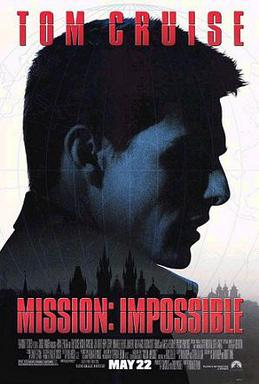
Why Jim shoots Claire first on the train; Jim and Claire's confounding relationship; Krieger's end game; what Kittredge's deal with Max amounts to; the helicopter in the train tunnel; what Max and Phelps are actually after
Nobody understands why Jim had to shoot Claire first: she only asks whether they really have to kill Ethan and tells him not to, and he guns her down on the train, which makes no sense; maybe Emmanuel Bayard (as transcribed) did not want to return, or the film needed to underline that Phelps is deranged, but it remains confusing.
Jim and Claire's relationship confounds the hosts: on reuniting with her, Phelps immediately disparages her to Ethan in crude terms and later tells Ethan to take her, which seems unnecessary when Ethan has been a gentleman apart from the handsy magic trick; the joke is that De Palma has a problem with sexual politics.
Krieger's end game is unclear beyond living and dying by the black market and cutting out the middleman; and what really happens at the end when Kittredge offers Max a deal, implying she has information they can use, after which Ethan is simply back in the mix.
The science of flying a helicopter into the train tunnel is very tough, even if Krieger's earlier boast about flying one into the lobby of Fort Knox sets it up, and where he would have learned that is unknown; when the other train comes the other way the film cuts to a hard close-up on Ethan's face because it is illogical.
Flagged earlier during the Redgrave discussion as a flaw or a nitpick: every villain in the series has elusive aims, this film has Phelps and Max, and whether they are just shifting money around is unclear.
There are not many casting what-ifs because the movie was put together by Cruise and Wagner; Juliette Binoche turned down Claire because she did not want to be known for blockbusters, which worked out for her, and it would have been a funny coincidence with Kristen Scott Thomas in two well-seen 1996 movies in the year of The English Patient.
Peter Graves and Martin Landau from the original series turned down roles after reading the script; Graves did not care for Jim Phelps being the villain and Landau thought it got away from what made the show good, though the hosts wonder whether the roles were smaller than they wanted and joke about Landau feeling himself after his 1994 Oscar.
Since Claire did not have to be European, Demi Moore is floated as a reunion with Cruise after A Few Good Men; sex scenes between Claire and Ethan were written and cut, a kiss appears in the trailer that is not in the film, and despite the grabbing and handsiness and an implied night together there is not much chemistry.
1996 was the year of Striptease for Demi Moore, so it would have been a left turn; Claire is called an underwritten part and one of the weakest aspects, a Russian doll for Jim's motivations in a Hitchcockian way; Susan Sarandon is also mentioned, but the objection is that Moore is too visceral and signals a fight scene is coming, whereas Claire's sphinx-like quality serves the narrative, so maybe Emmanuel Bayer (as transcribed) is right for it after all.
The movie is in a race against time as digital life changes; it was weirdly prescient about wireless streaming video, while things like Netscape no longer make sense; the first nominees are the Hitchcockian vibe of drawing on 1950s and 1960s Hitchcock for an espionage movie, especially in the Prague sequence, the cat-and-mouse format of the set pieces built on ducking into rooms, masks, disguises and hanging from places rather than buildings falling, and Cruise's performance.
Casting great actors in supporting roles is argued to hold up: Voight at the right stage of his career to be Phelps, a character from the television series; Manuel Bear (as transcribed), an actress few American filmgoers had seen; Jean Reno coming off Leon the Professional with his dickishness; Ving Rhames, who becomes the only other connecting figure in the series along with Monaghan; Kristen Scott Thomas, Vanessa Redgrave, Emilio Estevez and Henry Zerny (as transcribed), later of Sharp Objects, all lived in and knowing what movie they are in.
The Prague sequence is bittersweet because two or three movies of the Estevez, Kristen Scott Thomas and Cruise team would be welcome; it is set up like Alien with people who know each other, down to the wife's coffee and the barn in Kiev, and the scene where Cruise and Kristen Scott Thomas make out while tracking the arms dealer shows legitimately good chemistry, if less than Cruise's with Vanessa Redgrave; killing off those movie stars 35 minutes in is called a Hitchcockian twist like Janet Leigh in Psycho.
Estevez's line about lasagna while showing Cruise the chewing gum explosive is a favorite; red light green light and 'you've never seen me very upset' show Robert Towne style dialogue sprinkled throughout, and the hosts assign roles: Koepp the genius of action plotting, Zalian (as transcribed) the dramatic storyteller, Towne the king of memorable lines, with Tom Cruise movie starring on top.
De Palma's visual flair under control is the final nominee: the deep-focus shot where Don Lowe (as transcribed) is dressed down by Henry Zirny's (as transcribed) CIA character before being sent to Siberia, a charismatic look unlike same-looking modern blockbusters, stylish and fun where a Villeneuve film never makes you laugh; De Palma's playful visual style is named the pick.
Nominees run through the Prague sequence as a whole (a 32-minute opening act that even fades to black after Tom Cruise jumps through the Aquarium and escapes from Kittredge), Ethan and Max's negotiation, the Langley heist, and the Phelps versus Hunt coffee scene where Hunt sees what Phelps has done while Phelps lies to him, the scene that confused a generation of filmgoers.
One host admits not understanding the coffee scene until rewatching it yesterday after roughly 20 viewings; the Langley break-in is called the most iconic, incredibly staged, ripped off numerous times, and the precedent for Tom Cruise attempting something that seems impossible, even though Wu takes it to another level.
The scene one host rewound four times is Ethan on the horn with Kittredge after the team is killed, shouting that his team is dead, that they knew we were coming, that the disc is gone and the list is in the open; the clip is played, and Cruise is said to go Ruffalo before Ruffalo and to resemble Bill Paxton in Aliens.
The Kittredge call is a bookend to the Aquarium restaurant scene: before it Cruise is loud and brash, cracking jokes while Jon Voight's Phelps lays out the plan, and in the restaurant he turns cerebral, seeing the other team, the waiters and the lovers on the river bank; the Langley heist is then named the pick, iconic and almost all in silence, with the tension of Don Lowe (as transcribed) about to come back, and compared to the silent drilling heist in Rafifi (as transcribed), the host's favorite heist movie.
Further Langley favorites: the digital sound meter, the rat in the air duct likened to the final shot of The Departed, the Top Copy (as transcribed) reference to the same filmmaker Jules Dassen (as transcribed), the trope of explaining the heist on the train before doing it with Jean Reno, Ving Rhames and Emmanuel Bayard (as transcribed), Cruise's Cheshire Cat grin saying it is even worse than you think, and the first encounter with the idea of an air-gapped computer; Langley is confirmed as the most rewatchable scene.
Asked for memories earlier, the Langley drop of Cruise hanging is named the iconic image inside the movie, one the later Mission Impossible films call back to every time, and the film is called De Palma's last great movie. — Sean Fennessey