‹ All movies
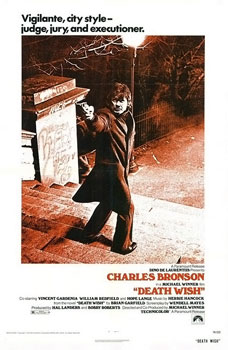
Death Wish poster

Death Wish

94

Cast

Selected cast credits · Film reference

Charles Bronson Paul Kersey
Hope Lange Joanna Kersey
Vincent Gardenia Inspector Frank Ochoa
William Redfield Sam Kreutzer
Chris Gampel Henry Ives
Steven Keats Jack Toby
Stuart Margolin Ames Jainchill
Stephen Elliott Police Commissioner Dryer
Fred J. Scollay District Attorney Peters
Kathleen Tolan Carol Kersey-Toby
Jack Wallace Detective Hank
Robert Kya-Hill Officer Joe Charles
Jeff Goldblum Freak #1
Gregory Rozakis Freak #3 (with spraypaint-can)
Christopher Guest Officer Jackson Reilly
Hank Garrett Andrew McCabe
Helen Martin Alma Lee Brown
Olympia Dukakis Officer Gemetti
Marcia Jean Kurtz Receptionist

Death Wish | The Rewatchables

Explore episodeClose episode

Producer credits not yet identified.

Roger Ebert's review

Ebert's three-star review is discussed as both attracted to and repelled by the movie.

In the discussion (2)
Approx. transcript time · 00:25:18Read transcript
  • Ebert gave the film three stars while calling it a quasi-fascist advertisement presented as slick action.
  • The New York Times review is reported to have called the film irresponsible.

Most Rewatchable Scene

The roll-of-quarters defense and extended Tucson sequence lead the opening scene discussion.

In the discussion (8)
Approx. transcript time · 00:29:41Read transcript
  • The panel says viewers troubled by the opening assault can enter the film around the Tucson passage.
  • The roll-of-quarters defense is the first action scene singled out for replay value.
  • The Wild West saloon brawl and the broader Tucson sequence receive explicit nominations.
  • Kersey's first shooting and the later three-on-one alley shooting are nominated separately.
  • The subway double murder is nominated as Kersey grows more deliberate.
  • The subway-platform attack is discussed as Kersey deliberately raising the stakes and exposing himself as bait.
  • The final park-staircase shootout, chase, and police ultimatum form the closing scene candidate.
  • The Tucson passage is preferred as part of the film, while the last shootout is called the iconic choice.

The most "year the movie came out" thing

1974 is represented by frightening New York, overcoats, magazine billboards, and long boozy lunches.

In the discussion (4)
Approx. transcript time · 00:40:44Read transcript
  • Frightening New York, a Korean War veteran hero, TWA travel, and the assault are cited as 1974 markers.
  • Wide overcoat collars and magazine billboards used to advance the plot are selected as period details.
  • Long, alcohol-heavy lunches are treated as distinctly 1974.
  • Serving liver with spaghetti prompts a separate period-food discussion.

What’s Aged the Best?

The police-station atmosphere, media machinery, Bronson's physique, and Kersey's addiction to the hunt have aged well.

In the discussion (6)
Approx. transcript time · 00:42:53Read transcript
  • The old police-station atmosphere is selected as a durable period pleasure.
  • The film's still-current conflict over guns is judged to have aged well.
  • A study about repeat viewing leads to a discussion of familiar movies as relaxing comfort food.
  • Traumatized characters becoming catatonic and the detective seeing himself on a magazine cover receive separate mentions.
  • Bronson's physique and Kersey becoming addicted to the hunt are separate Aged Best choices.
  • The newspapers, television coverage, and press conferences are praised as a pre-internet media machine.

The Den of Thieves Benihana Award for Scene-Stealing Location

The sex-worker diner and final park staircase are selected as scene-stealing locations.

In the discussion (2)
Approx. transcript time · 00:45:35Read transcript
  • The sex-worker diner is chosen for its vivid collection of background characters.
  • The park staircase used for the final shootout is a second location choice.

What’s Aged the Worst?

The assault, warrantless policing, implausible privacy, emotional detachment, and 2018 remake have aged worst.

In the discussion (6)
Approx. transcript time · 00:51:26Read transcript
  • The graphic assault and the warrantless apartment search are explicit Aged Worst selections.
  • The panel says modern cameras would identify Kersey quickly.
  • The generic Vigilante nickname is criticized as unimaginative.
  • Kersey's abrupt return to work and failure to repaint the apartment are treated as signs of emotional collapse.
  • The discussion reports that Bronson rejected casting his wife Jill Ireland in the victimized role.
  • The 2018 remake is selected as another element that aged badly.

Is There a Better Title for This Movie?

The rejected title The Sidewalk Vigilante is discussed but Death Wish remains superior.

In the discussion (1)
Approx. transcript time · 00:54:40Read transcript
  • The original proposal The Sidewalk Vigilante is discussed, but the panel prefers Death Wish.

The Stephen A. Smith Hottest Take Award

The segment debates vigilantism and distinguishes Kersey's thrill-seeking from revenge against his family's attackers.

In the discussion (2)
Approx. transcript time · 00:55:56Read transcript
  • A proposal that vigilantism may reduce crime draws audible skepticism.
  • Kersey is characterized as a thrill-seeker because he hunts random assailants instead of his family's attackers.


Casting What-Ifs

Jack Lemmon and Henry Fonda headline a large set of alternate casting possibilities.

In the discussion (3)
Approx. transcript time · 00:56:54Read transcript
  • A Sidney Lumet version pairing Jack Lemmon as Kersey and Henry Fonda as Ochoa is the favored alternate production.
  • Steve McQueen, Clint Eastwood, Burt Lancaster, George C. Scott, Frank Sinatra, Lee Marvin, and Elvis Presley are reported as other possibilities.
  • Elvis Presley and George C. Scott prompt the strongest discussion among the additional lead possibilities.

Half-Assed Internet Research

The research covers Bronson's location demand, difficult reputation, Garfield's objections, and a false Denzel rumor.

In the discussion (6)
Approx. transcript time · 01:01:10Read transcript
  • Bronson reportedly asked for a California shoot so he could remain near his family, while the production stayed in New York.
  • The discussion describes Bronson as quiet and difficult rather than socially warm on sets.
  • His physical condition and ability to handle action are offered as reasons for his long employment and eventual stardom.
  • Author Brian Garfield is reported to have called the film incendiary because his book was more critical of vigilantism.
  • Bronson defended the film as an attack on violence, prompting debate over whether the first film romanticizes it.
  • A long-running rumor that Denzel Washington appeared as an alley thug is reported and then rejected using Washington's denial.

Apex Mountain

The movie is treated as Bronson's apex and a defining vigilante film.

In the discussion (4)
Approx. transcript time · 01:04:39Read transcript
  • The film is selected as Bronson's career Apex because it launched his peak star period.
  • Vigilante films are also judged to reach an apex here.
  • The Warriors is preferred for frightening New York movies.
  • Switchblades and repainting a crime-scene apartment orange receive additional playful Apex nominations.

Cruise or Hanks?

Hanks wins because the role needs softness before the violent turn.

In the discussion (1)
Approx. transcript time · 01:06:13Read transcript
  • Hanks wins because the role requires softness before Kersey's violent turn.

Scorsese or Spielberg?

Scorsese wins for this material.

In the discussion (1)
Approx. transcript time · 01:07:29Read transcript
  • Scorsese is the immediate directing choice, while a Spielberg version is acknowledged as very different.

Picking Nits

The doctor's bedside manner, repainting the apartment, and a restaurant watching a press conference draw objections.

In the discussion (3)
Approx. transcript time · 01:08:38Read transcript
  • The doctor's abrupt delivery of the wife's death notification is the primary objection.
  • Kersey remaining in the apartment without immediately repainting or leaving is criticized.
  • Restaurant patrons stopping to watch a police press conference are judged implausible.

Sequel, Prequel, Limited Series, or All-Black Remake

The hosts pitch a prestige television prequel or contemporary remake.

In the discussion (3)
Approx. transcript time · 01:10:53Read transcript
  • Four sequels are noted as evidence of the property's long television afterlife.
  • A prestige prequel called The Architect is proposed around Kersey's earlier career and family life.
  • A contemporary serialized remake is proposed that gradually tracks Kersey's radicalization.

Is This Movie Better With…?

Wayne Jenkins as Ochoa and Nell in the park are the preferred additions.

In the discussion (2)
Approx. transcript time · 01:13:19Read transcript
  • Wayne Jenkins is proposed as Ochoa because he might appreciate Kersey reducing his workload.
  • Nell is proposed for one of the park scenes.

Just One Oscar

Herbie Hancock receives the single Oscar.

In the discussion (1)
Approx. transcript time · 01:14:14Read transcript
  • Herbie Hancock receives the episode's single Oscar.

Probably Unanswerable Questions

The police cover-up, Kersey's transfer, and the media aftermath remain unresolved.

In the discussion (3)
Approx. transcript time · 01:14:37Read transcript
  • The panel questions whether the commissioner, district attorney, and police would all suppress Kersey's arrest.
  • Kersey's ability to explain his injury and obtain a work transfer is debated.
  • The panel asks how the police and media would respond after the killings abruptly stop.

The Coach Finstock Award for Best Life Lesson

Bring groceries home yourself when the store is only two blocks away.

In the discussion (2)
Approx. transcript time · 01:16:07Read transcript
  • The first lesson is to carry groceries home when the store is only two blocks away.
  • A second lesson is to leave New York when conditions make departure feel necessary.

More from the conversation

The opening frames Death Wish through the history of urban vigilante movies and rape-revenge exploitation.
Approx. transcript time · 00:03:20Read transcript
The episode tracks Bronson's rise from supporting actor to briefly dominant action star.
Approx. transcript time · 00:11:03Read transcript
The hosts debate whether the original condemns violence or romanticizes it, especially when separated from its sequels.
Approx. transcript time · 01:02:46Read transcript