
‹ All movies
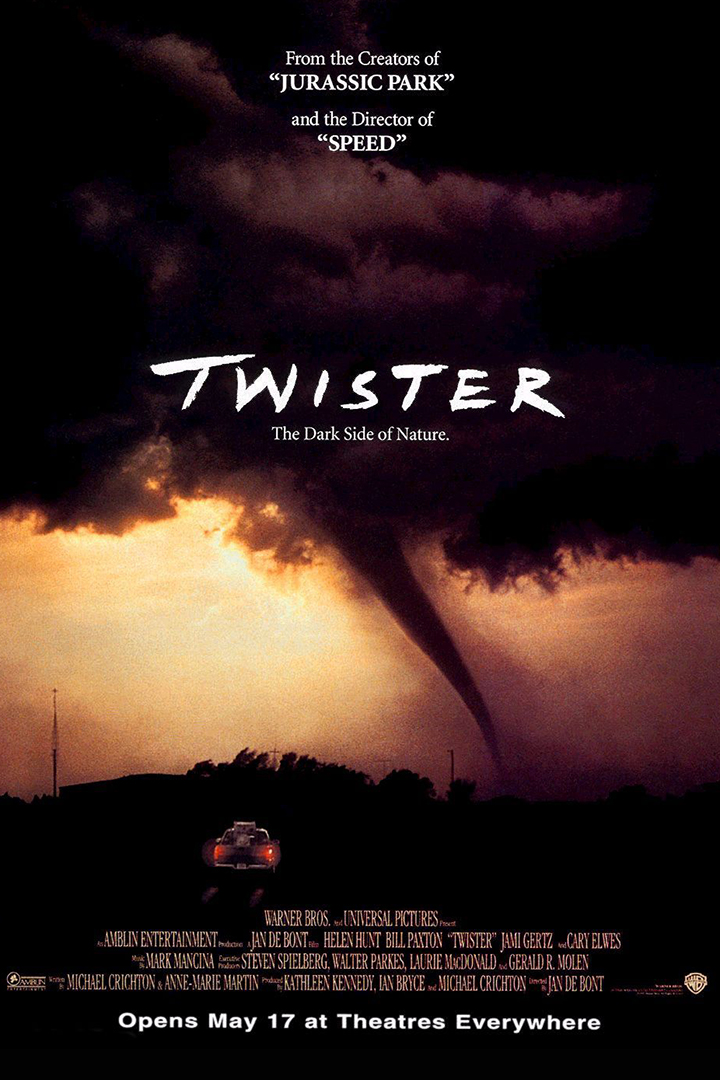
Twister poster

Twister

113 minutes

Cast

Selected cast credits · Film reference

Cary Elwes Jonas
Jami Gertz Melissa
Lois Smith Aunt Meg
Alexa Vega Young Jo
Alan Ruck Rabbit
Sean Whalen Sanders
Scott Thomson Preacher
Todd Field Beltzer
Jeremy Davies Laurence
Zach Grenier Eddie
Patrick Fischler Flanders
Nicholas Sadler Kubrick
Ben Weber Stanley
Jake Busey Mobile lab technician
Richard Lineback Mr. Thornton
Rusty Schwimmer Mrs. Thornton

Twister | The Rewatchables

Explore episodeClose episode

Half-Assed Internet Research

Production anecdotes; cast careers; practical effects; locations; storm-chasing impact

In the discussion (20)
Approx. transcript time · 00:11:48Read transcript
  • An Industrial Light and Magic proof-of-concept sequence with a truck, tornado and flying tractor tire reportedly initiated the project before the story took shape.
  • Paxton reportedly lost A Time to Kill to McConaughey.
  • The film reportedly received sound and visual-effects Oscar nominations.
  • De Bont’s difficult production reportedly involved crew walkouts, a knocked-over camera assistant, replacement cinematographers and Jack Green injured by a collapsing house before de Bont finished photography.
  • Schedule overruns reportedly delayed Mad About You; Crichton, Zaillian and Whedon worked on the script, including during filming, yet the visual result appears seamless.
  • Unexpectedly sunny conditions reportedly prompted intense lighting that temporarily impaired Hunt’s and Paxton’s eyesight.
  • Hunt reportedly suspected a concussion after a door struck her in the cornfield.
  • Paxton’s account contrasts being pelted by ice-chip hail with de Bont wearing a helmet nearby.
  • A 90 million budget and 495 million gross are reported, ranking second among 1996 movies; the transcript mistakenly renders the gross as billion.
  • De Bont reportedly blamed Hunt’s clumsiness for her concussion.
  • A missed oil-tanker explosion reportedly required a500,000 reshoot.
  • A reported accidental Hoffman exposure was edited from later home-video editions; the anecdote was not personally frame-checked.
  • Meteorology enrollment reportedly rose10percent nationally and doubled at Oklahoma after the film.
  • Production reportedly bought and demolished older Wakita houses; the low total purchase cost is recalled approximately.
  • The ditch reportedly required hepatitis shots because of bacteria, adding to the leads’ other injuries.
  • A tornado reportedly destroyed an Ontario drive-in screen scheduled to show Twister onMay24,1996; Ontario is clarified as Canada.
  • Paxton reportedly witnessed Kennedy’s final Fort Worth speech at age eight; the transcript incorrectly appends Jr to the president’s name.
  • Vegetarian de Bont reportedly disliked Meg’s meat-heavy scene.
  • De Bont reportedly personally recruited Tori Amos for the soundtrack.
  • Reported state daily tornado records complicate the five-storm objection: Texas66, Oklahoma58, Kansas70 after an Iowa correction, and Iowa34; definitions remain uncertain.

Roger Ebert's review

Rating not yet verified
In the discussion (1)
Approx. transcript time · 00:30:19Read transcript
  • The score is rendered ambiguously as two and F stars; the quoted review praises skillful escapism while calling it dumb, prompting objections that tornado entertainment needs little plot.

Most Rewatchable Scene

Drive-in tornado

In the discussion (12)
Approx. transcript time · 00:32:00Read transcript
  • The opening childhood-trauma scene is nominated, especially the father holding the shelter door.
  • Bill seeking divorce signatures and meeting the crew efficiently establishes Dorothy and distinct personalities; Dusty’s immediate familiarity with Melissa defines his energy.
  • The first chase culminates in sheltering under a bridge and the truck’s sudden fall.
  • The second tornado’s flying cows impress despite trailer exposure; Melissa watches Bill embrace his ex-wife.
  • Aunt Meg’s kitchen-table meal is a favorite: food, Jonas mockery, Bill’s past and affection for Meg advance several threads together.
  • The meal’s F5 explanation ends with the preacher’s finger-of-God line; an overqualified Brian Cox cameo is imagined.
  • The hailstorm argument turns into Bill’s declaration of lingering love, overheard by Melissa through the walkie-talkie.
  • The drive-in storm is strongly favored for the lightning reveal behind The Shining screen, sustained destruction and quiet pre-storm atmosphere.
  • Melissa’s calm breakup is praised as clean, well acted and sensible once she recognizes Bill’s storm obsession.
  • Dorothy’s launch includes Jonas’s death, driving through a house and fleeing into the cornfield.
  • The final tornado’s interior view and house-driving spectacle are admired despite disbelief that the leads survive.
  • The drive-in receives the final choice; the Me Jo love confession is a close second.

Picking Nits

Shelter door; final survival; Dorothy design; debris immunity; divorce; storm-day routines

In the discussion (9)
Approx. transcript time · 00:32:17Read transcript
  • The father’s weak lock and decision to hold the doomed door instead of retreating are criticized; dismissing Jo’s grief is challenged because she witnessed his death.
  • Strapping themselves to a pipe would not plausibly protect the leads from wind and debris; the implement-filled barn also invites questions about its owners.
  • Dorothy is criticized for spilling easily, lacking remote release and existing in only four copies.
  • The rapid improvised sensor wings prompt skepticism.
  • The leads rarely suffer flying-debris injuries across repeated tornado encounters, unlike the scraped-up preacher.
  • The divorce lacks a satisfying explanation; incompatible paths, storm obsession, drinking or a missing infidelity scene are conjectured.
  • Five tornadoes in one day seem nationally notable enough to close the drive-in and local businesses.
  • Prepositioning many Dorothys is proposed; limited money and a need to prove results are offered as an explanation.
  • Stopping for steak and eggs, showers, blow-dried hair and homemade lemonade seems implausible while storms are so active; another tornado catches the group flat-footed.

Probably Unanswerable Questions

Melissa’s background; revenge hookup; regular driver; Jo’s survival; Jonas’s business; deaths; disaster fears

In the discussion (8)
Approx. transcript time · 00:37:03Read transcript
  • Melissa’s home base is guessed as Dallas, Atlanta or Charleston; her tornado ignorance undermines Dallas, while a wealthy country-club family is jokingly imagined.
  • Dusty is imagined as Melissa’s revenge hookup; Jonas is suggested and rejected.
  • Bill’s unexpected arrival raises the question of Jo’s displaced regular driver, with Field suggested and Dusty ruled out.
  • Jo is thought likely to die that day without Bill repeatedly rescuing and redirecting her.
  • Jonas’s profit motive is questioned; selling warning technology to government is a possible explanation, and an explicit recruitment scene is imagined.
  • Killing an inner-circle member is rejected as damaging the hangout tone; Preacher is considered the least disruptive option but still unnecessary.
  • A tsunami is one scariest-disaster choice, while earthquakes are feared for rolling ground and Los Angeles geography.
  • Tornadoes are feared for unpredictability, but a driving-escape idea is challenged; another earthquake choice emphasizes helplessness.

The most "year the movie came out" thing

No Thunder references; Hunt’s hair; Dodge Ram

In the discussion (3)
Approx. transcript time · 00:48:17Read transcript
  • A returning most-year category offers no internet, the Dodge Ram, Dusty without social-media influence, no Thunder references, the Shining drive-in, actor Todd Field and Hunt’s hair.
  • No Thunder references is selected; absent Sooners sports chatter prompts season and minicamp jokes.
  • Hunt’s hair and the Dodge Ram receive separate selections.

What’s Aged the Best?

Ensemble; practical effects; sound; Fujita scale; compressed timeline; food; Jonas; Paxton’s legacy

In the discussion (15)
Approx. transcript time · 00:49:58Read transcript
  • The supporting storm-chaser crew is celebrated as a collection of distinctive character actors.
  • A preoccupation with individual storms rather than climate catastrophe evokes a less climate-anxious era, qualified as aging both well and badly.
  • Practical effects give the debris physical impact; de Bont reportedly viewed the project as a last chance before CGI dominance.
  • The phrase suck zone endures.
  • Jonas embodies the timeless wealthy, technologically equipped rival chasing money rather than science.
  • Jonas is defended as a bonding target who demonstrates the heroes’ expertise without expensive gadgets.
  • The compressed roughly24-hour timeframe keeps momentum without unnecessary lodging scenes.
  • The Fujita scale is praised as easier to understand than earthquake or DEFCON scales.
  • Sound design remains effective on improved home systems.
  • Remembering the dog during an escape reliably creates emotional investment, compared with Amityville Horror.
  • Gertz’s later Hawks ownership is celebrated.
  • Ruck’s enduring career spans Ferris Bueller, Speed, Twister, Spin City and Succession.
  • Movie aunts instantly feeding a crowd and Meg’s nourishing meal are praised, compared with Goodfellas.
  • The Shining and the still-in-love accusation remain effective.
  • Storm chasers reportedly honored Paxton with mapped initials after his2017death; he supplied memorabilia to a Twister museum.

What’s Aged the Worst?

Underused Jonas; map reader; drive-ins; Hunt’s running and hair; weather-center cutaways; parental trauma

In the discussion (8)
Approx. transcript time · 00:52:26Read transcript
  • Jonas feels underdeveloped: more rivalry scenes or removing him altogether is proposed, and neither he nor his driver seems to deserve death.
  • A longer, more graphic Jonas death is desired, though the distant airborne truck is defended as terrifying.
  • A dedicated map reader is obsolete beside a phone.
  • The decline of drive-ins is lamented despite a temporary pandemic revival.
  • Hunt’s running is criticized as awkward; injury and obstacles are offered as defenses and Bullock as a hypothetical replacement.
  • Hunt’s loose hair and bangs are criticized, with a ponytail preferred.
  • Cutaways to an unidentified meteorological center add unnecessary storm exposition.
  • The parental-trauma explanation is considered unnecessary for an already frightening story and compared with Batman’s lifelong response to loss.
In the discussion (4)
Approx. transcript time · 00:58:58Read transcript
  • Van Halen’s Humans Being energizes the movie; the soundtrack’s specially commissioned songs are appreciated.
  • The Goo Goo Dolls’ Long Way Down is preferred as a song.
  • Dusty watching Clapton’s Motherless Child video is considered inexplicable possible product placement.
  • Omitting hip-hop is called a missed opportunity, with Twista and Busta Rhymes imagined.

Sequel, Prequel, Limited Series, or All-Black Remake

Twisters; The Extreme prequel; Melissa television spinoff

In the discussion (3)
Approx. transcript time · 01:02:18Read transcript
  • A reverse-Zihuatanejo prehistory imagines Bill cleaning up a drinking problem, moving to Dallas and rapidly choosing a stable relationship; a therapist-patient origin is rejected because Melissa is a reproductive therapist.
  • Twisters is the actual sequel; imagined prequels include the shared laboratory and The Extreme’s reckless youth, with Affleck, Ledger and Maguire considered as young Bill.
  • A Melissa-after-Twister television series is imagined around a radio show or sex therapy, escalating into deliberately outrageous scenarios and a brief Dusty fling.

The Stephen A. Smith Hottest Take Award

Jo’s scientific competence; value of faster warnings

In the discussion (2)
Approx. transcript time · 01:13:26Read transcript
  • Jo is called a good daughter but bad scientist: her tenacity is contrasted with teammates’ practical expertise and Bill’s instincts.
  • The early-warning mission is challenged using a reported modern10–15-minute window; the objection is qualified by acknowledgment that the film’s period is described as roughly three minutes.

Casting What-Ifs

Spielberg; Hanks; Sorvino; Brooks

In the discussion (5)
Approx. transcript time · 01:15:56Read transcript
  • Spielberg was reportedly attached to direct before executive-producing; de Bont arrived after leaving Godzilla over creative differences.
  • Hanks reportedly prepared for the Bill role before passing and recommending Paxton.
  • Sorvino reportedly declined Melissa because she would not dye her hair.
  • A Garth Brooks-as-Jonas possibility is raised with explicit uncertainty about its credibility.
  • Dwight Yoakam or Chris Gaines is imagined as stunt casting for Jonas.

Recasting Couch

Darlene Love as Aunt Meg

In the discussion (4)
Approx. transcript time · 01:20:29Read transcript
  • A bigger-name Meg is considered: Burstyn or Field, with Field judged too prominent for the small part.
  • Sarandon, MacLaine and Winger are considered for Meg; Winger seems too young and excessive sexual appeal is treated as a mismatch.
  • Darlene Love as Meg is enthusiastically supported, revising the earlier anti-diversity joke.
  • Phylicia Rashad is added as a possible Meg.

Apex Mountain

Bill Paxton; movie tornadoes; flying cows

In the discussion (12)
Approx. transcript time · 01:26:36Read transcript
  • Paxton is affirmed.
  • Hunt is assigned to her Oscar a year later.
  • Hoffman is rejected.
  • The Dodge Ram remains uncertain amid sustained success and F150 comparisons; the Like a Rock advertisement is corrected to Chevrolet.
  • Movie tornadoes are affirmed.
  • Gravy is emphatically rejected without a settled alternative.
  • Gertz is rejected here, with Hawks ownership, The Lost Boys and Less Than Zero alternatives.
  • Flying cows are affirmed.
  • Oklahoma is rejected.
  • The Shining is rejected.
  • The1990s disaster-movie apex remains definition-dependent: Independence Day wins if alien invasions count, while natural disasters are distinguished from contained mishaps such as Jurassic Park or Apollo13.
  • Armageddon, Outbreak, Dante’s Peak and Deep Impact are considered within the disaster discussion.
In the discussion (2)
Approx. transcript time · 01:31:35Read transcript
  • Hanks is the settled choice for groundedness; Cruise’s running, romance and missing1990s disaster vehicle are enthusiastically imagined before agreement returns to Hanks.
  • Denzel is added hypothetically but considered too cool to seem endangered; Unstoppable and Tony Scott films are his closest comparisons.

Just One Oscar

Visual effects

In the discussion (1)
Approx. transcript time · 01:40:39Read transcript
  • Visual effects receives the hypothetical single Oscar.

Who Won the Movie?

Tornadoes

In the discussion (1)
Approx. transcript time · 01:48:21Read transcript
  • Tornadoes receive the final choice and explicit agreement; de Bont is raised but not adopted.
Podcast choices
Speaker not identified
Tornadoes
Speaker not identified
Tornadoes

Producer review

Enthusiastic first-view response; disputed Hoffman take

In the discussion (2)
Approx. transcript time · 01:49:38Read transcript
  • A first or unremembered earlier viewing leaves an enthusiastic impression of a tight emotional story and balanced effects; airplane turbulence reportedly amplified the experience.
  • Hoffman’s supporting work is controversially described as similar goofy outsider roles; Ripley is partially withdrawn from the comparison and The Master praised as different.

More from the conversation

An initially disappointed theatrical viewer now enjoys the film, revising an objection that it heralded effects-driven summer blockbusters.
Approx. transcript time · 00:02:34Read transcript
Practical danger and flying debris make the storm action feel physically threatening.
Approx. transcript time · 00:03:20Read transcript
Ordinary-looking scientists and an everyman lead are contrasted with modern glamorous stars and the Twisters trailer.
Approx. transcript time · 00:04:04Read transcript
A superhero-structure interpretation is countered by a Jurassic Park comparison emphasizing intelligence, Spielberg-like wonder and nature beyond human control.
Approx. transcript time · 00:05:43Read transcript
Storm chasing is read as erotic: danger, wet clothes and physical proximity reconnect the divorced couple while Melissa represents attachment without shared passion.
Approx. transcript time · 00:06:42Read transcript
The1994–96 release calendars are compared as evidence of Hollywood concentrating summer blockbusters between May and July4.
Approx. transcript time · 00:08:18Read transcript
A Cable Guy failure objection is answered with a reported104million gross; Twister is credited with495million.
Approx. transcript time · 00:09:15Read transcript
Theatrical repeat visits are recalled as common before long waits for home releases; Twister is described as the first1997DVD.
Approx. transcript time · 00:09:27Read transcript
Leaving Twister on across several days highlights its frequent storms and appealing Oklahoma hangout world of drive-ins, coffee and Aunt Meg’s food.
Approx. transcript time · 00:10:03Read transcript
The characters’ storm obsession prompts a Summer League and Bronny injury joke.
Approx. transcript time · 00:11:05Read transcript
Renewed online enthusiasm for Twister coincides with anticipation of Twisters.
Approx. transcript time · 00:12:28Read transcript
Paxton is remembered as an immediately welcome supporting presence from Weird Science, One False Move and Trespass.
Approx. transcript time · 00:13:29Read transcript
Trespass is praised as a projects-set treasure hunt and early rapper-to-actor crossover; difficulty finding it leads to Tubi programming jokes.
Approx. transcript time · 00:13:55Read transcript
Indian Summer, True Lies, Tombstone and Apollo13 are traced as supporting steps toward Twister’s major lead and then Titanic.
Approx. transcript time · 00:15:13Read transcript
Big Love sustained interest without becoming the hoped-for Tony Soprano breakthrough.
Approx. transcript time · 00:16:05Read transcript
Paxton’s character-actor strengths and spectacle overshadowing human stars are offered as reasons he did not become an A-list lead.
Approx. transcript time · 00:16:32Read transcript
System-quarterback comparisons move through Purdy, Minshew, Jeff George and Geno; Purdy is defended over the perceived Minshew slight.
Approx. transcript time · 00:17:34Read transcript
A crowded1990s male-star field is grouped into rising actors, established leads, prestige performers and comedians, placing Paxton near Bacon, Pullman and Sutherland; this is not a ranked ten-item list.
Approx. transcript time · 00:18:37Read transcript
An Out of Sight Paxton hypothetical is disputed because Clooney’s romantic magnetism is considered essential to the Lopez pairing.
Approx. transcript time · 00:19:38Read transcript
Paxton is defended as a leading man in Twister but possibly stronger as an overqualified supporting actor; a later tailored television role like Cranston’s or an Ozark villain is imagined.
Approx. transcript time · 00:20:54Read transcript
Hunt’s rise from Kiss of Death through Twister, As Good as It Gets and Mad About You is admired; later projects did not seem to supply an equally fitting role.
Approx. transcript time · 00:21:35Read transcript
Hunt’s unexpected ascent is compared with Jaylen Brown’s finals success, prompting an argument about a hypothetical Jabari Smith trade.
Approx. transcript time · 00:22:43Read transcript
The opening father is explicitly identified as not Chris Cooper despite a resemblance.
Approx. transcript time · 00:23:42Read transcript
Todd Field’s unusual acting and directing career is praised through Eyes Wide Shut, Twister and Sleep with Me.
Approx. transcript time · 00:23:59Read transcript
Hoffman’s emergence is traced differently through Scent of a Woman, Twister, Boogie Nights and The Talented Mr.Ripley; Mission:Impossible3 exemplifies elevating genre material.
Approx. transcript time · 00:24:37Read transcript
The demanding cinematographer-turned-action-director model is nostalgically defended for its kinetic results.
Approx. transcript time · 00:27:22Read transcript
A joking directed-by-Jan-de-Bont category is suggested.
Approx. transcript time · 00:30:01Read transcript
The overwhelmingly white ensemble is noted, with one Black member identified in Jonas’s group and a broader escape-fantasy argument deferred.
Approx. transcript time · 00:33:29Read transcript
Melissa’s willingness to endure four tornadoes is contrasted with an imagined partner refusing the first chase.
Approx. transcript time · 00:36:40Read transcript
Accidentally overheard private conversations are praised as a reliable trope, compared with The Bear’s walk-in freezer.
Approx. transcript time · 00:42:42Read transcript
A more extreme Shining clip featuring Scatman Crothers’s death is hypothetically substituted.
Approx. transcript time · 00:43:41Read transcript
A joking could-Chris-live-here category imagines a small-town cinephile life around the drive-in and coffee shop.
Approx. transcript time · 00:44:17Read transcript
Slap Shot’s town and Shot Caller’s prison are jokingly proposed as places the resident cinephile could live.
Approx. transcript time · 00:45:10Read transcript
Melissa’s departure removes the romantic tension between a settled forecasting career and storm chasing.
Approx. transcript time · 00:47:18Read transcript
The money-driven antagonist is compared with Jaws’s mayor and Jurassic Park, while instinct versus technology becomes an anti-analytics joke.
Approx. transcript time · 00:54:16Read transcript
Bill’s renewed vitality and changing clothes dramatize his shared passion with Jo, while Melissa’s styling casts her as the safe romantic alternative familiar from gender-reversed rom-coms.
Approx. transcript time · 01:03:28Read transcript
Staying in shelter instead of attending a drive-in during repeated tornadoes is urged, followed by jokes about refusing to miss the movie.
Approx. transcript time · 01:15:07Read transcript
Protecting a pet during disaster is defended through attachment to an individual dog; fireworks are compared with a canine tornado.
Approx. transcript time · 01:19:29Read transcript
Whether scientific storm chasing was widely known before the film is debated, distinguished from reporters standing in severe weather.
Approx. transcript time · 01:23:47Read transcript
Successive basic, deluxe, Blu-ray and HD-DVD releases prompt double-dipping jokes.
Approx. transcript time · 01:25:02Read transcript
1970s and1990s disaster cycles are contrasted with weaker modern films; invulnerable stars such as the Rock and climate-message emphasis are criticized, while Butler and Emmerich are discussed as continuing the genre.
Approx. transcript time · 01:30:15Read transcript
A fictitious prior bar disaster elaborates the Extreme’s imagined unruly past.
Approx. transcript time · 01:35:42Read transcript
Whether Hunt and Paxton were major draws returns to spectacle-led marketing, compared with Jurassic Park, Titanic and Star Wars.
Approx. transcript time · 01:52:25Read transcript
A system-quarterback analogy becomes a salary and Philadelphia-sports tangent before the closing.
Approx. transcript time · 01:53:41Read transcript
The closing explicitly credits production to Craig, with surname rendered Horrobeck.
Approx. transcript time · 01:54:20Read transcript
The next Rewatchables1999 rerelease is promoted as For Love of the Game; its baseball story is preferred to the romance.
Approx. transcript time · 01:54:32Read transcript