
‹ All movies

Axel checking into the Beverly Palm Hotel with the Rolling Stone and Michael Jackson routine, running all the way through the Serge gallery scene

Nothing in the first 20 minutes is exceedingly rewatchable to one host, who flips channels waiting for Axel to reach Beverly Hills; another disagrees, saying the chase is really good, and would watch an hour and a half of the cigarette deal as a Jim Jarmusch movie, and loves the Mean Streets moment that takes it out of 80s blockbuster territory; without the title you would not know what to make of Axel.

Axel arriving in Beverly Hills and checking into the hotel, claiming to be a Rolling Stone reporter in town to interview Michael Jackson, might be the funniest thing he has ever done; he cries racism without saying racism, playing an entitled white person and an affronted black person at the same time, which gets the manager to give him the room at half price; he overhears the no-reservations phone call so he has an opening line, and the wordless take at $240 a night is an all-timer.

"Take those bananas"

The pick is 'take those bananas', the Damon Wayans line, which draws immediate agreement.

The film

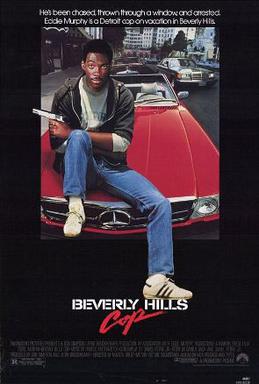
Beverly Hills Cop (1984)

Directed by Martin Brest · Action

105 minutes

Cast

Selected cast credits · Film reference

Eddie Murphy Detective Axel Foley
Judge Reinhold Detective Billy Rosewood
John Ashton Sergeant John Taggart
Lisa Eilbacher Jenny Summers
Ronny Cox Lieutenant Andrew Bogomil
Steven Berkoff Victor Maitland
James Russo Mikey Tandino
Stephen Elliott Chief Hubbard
Gilbert R. Hill Inspector Douglas Todd
Paul Reiser Detective Jeffrey Friedman
Frank Pesce cigarette buyer
Damon Wayans banana man
Rex Ryon bonded warehouse security guard
Martin Brest Beverly Palms Hotel checkout clerk (uncredited)

Everything from the episode

In the order the hosts got to it. Open a row for the discussion.

31:39

Most Rewatchable Scene

Axel checking into the Beverly Palm Hotel with the Rolling Stone and Michael Jackson routine, running all the way thr...

Axel checking into the Beverly Palm Hotel with the Rolling Stone and Michael Jackson routine, running all the way through the Serge gallery scene

In the discussion (10)
Approx. transcript time · 00:31:39Read transcript
  • Nothing in the first 20 minutes is exceedingly rewatchable to one host, who flips channels waiting for Axel to reach Beverly Hills; another disagrees, saying the chase is really good, and would watch an hour and a half of the cigarette deal as a Jim Jarmusch movie, and loves the Mean Streets moment that takes it out of 80s blockbuster territory; without the title you would not know what to make of Axel.
  • Axel arriving in Beverly Hills and checking into the hotel, claiming to be a Rolling Stone reporter in town to interview Michael Jackson, might be the funniest thing he has ever done; he cries racism without saying racism, playing an entitled white person and an affronted black person at the same time, which gets the manager to give him the room at half price; he overhears the no-reservations phone call so he has an opening line, and the wordless take at $240 a night is an all-timer.
  • From there it goes straight to Jenny Summers and the $130,000 piece with Serge, an almost impeccable nine minutes of comedy; an 80s trope of the pop song over the montage being turned down for a scene and brought back is noted as Stir It Up returns when he passes the two Michael Jacksons; the Serge part is compared to Shawn Michaels making any wrestler better, and Bronson Pinchot got a whole career and a sitcom out of two scenes after Risky Business.
  • Other nominations: the banana in the tailpipe, ordering the shrimp sandwich room service in the suite where the Rosewood and Taggart interplay starts, and the strip joint scene leading into the Super Cops monologue where everybody is cracking up; the 'Billy, you don't have to be embarrassed' bit and the Phil, Vanity Six exchange are recited.
  • The first team's 'not gonna fall for the banana in the tailpipe' outside Maitland's house became an iconic Little League taunt with no idea of the context, and Tiger Woods talking like the tailpipe guy in 1997 gave it five more years; the ending is enjoyed for the inept guards hailing bullets without hitting anyone in the age of the poorly deployed Uzi.
  • Axel getting chewed out by Cobb (as transcribed) over the truckload of cigarettes from the Dearborn hijack, with Paul Reiser's 'this is not my locker', is nominated; Cobb and James Russo are called the only two people who go over the top of Murphy, going higher than Icarus.
  • Asked for 30 seconds on James Russo and granted 45, the Michael Tandino thing is framed as a weird love story at the start of the movie that sets everything up. — Chris Ryan
  • The setup is a 24-hour working-class man using his vacation to solve a murder instead of going to Hawaii; an aside confirms Beverly Hills is its own city with its own police department, expensive, good schools, safe; the pool, bar and apartment sequence with Tandino is one host's rewatchable pick, and 'before he dies, they're doing it' is raised and saved for later.
  • Why the movie happened is saved for half-assed research; Axel at the customs facility asking about the Porsche and 'then you're my fucking problem' is added; the final pick is checking into the hotel all the way to Serge.
  • During the super cop scene John Ashton is visibly fighting laughter with his head down like a Carol Burnett show sketch, Ronnie Cox can be seen fighting it too, and Judge Reinhold reportedly pinched the inside of his thigh to keep from laughing at Eddie's ad libs; one host says it changes how he will watch the movie forever.
41:27

What’s Aged the Best?

Lisa Eilbacher as Jenny Summers (disputed); Jenny's red Mercedes convertible; the title; Harold Faltermeyer's score a...

Lisa Eilbacher as Jenny Summers (disputed); Jenny's red Mercedes convertible; the title; Harold Faltermeyer's score and the soundtrack; the Mumford Phys Ed t-shirt and cropped sweatshirts; Taggart and Rosewood; Murphy's early run of good directors; the rival cop duo

In the discussion (11)
Approx. transcript time · 00:41:27Read transcript
  • One host is still in love with Jenny Summers, played by Lisa Eilbach (as transcribed); the objection is not to the actress but to Hollywood casting interchangeable blondes with the same Kate Capshaw haircut, and another did not recognize her at all; what one host wants from the token female character in an Eddie Murphy movie is to dress well, laugh at his jokes and look great.
  • She is not a love interest for either man, though she tried with Eddie, which is saved for later; she is serious about her career and it costs her nothing, and her damselification is believable because she insists on driving to the warehouse; 'great character' is countered with 'definitely not a great character' since nothing motivates her, she works at a coke lord's art gallery, and the Jenny, Tandino and Axel triangle of friendship makes no sense.
  • Jenny is called a TV actress annihilated by everyone else on screen who did nothing afterward because she cannot hold the screen; a joke pitch imagines a Jenny Summers sequel in Don Simpson's office; she may be the first female gallerist in a movie.
  • The defense of Jenny Summers is framed as a 15-year-old's crush recalled in the past tense. — Bill Simmons
  • Jenny Summers' red Mercedes-Benz convertible is a dope car you cannot see anymore and is hard to keep in shape; in Beverly Hills they just take whatever car is closest; the little back seat is the Mikey spot.
  • The title is great, as if they came up with it before they had a script; Harold Faltemeyer's run through Top Gun and Fletch is admired, the score fit an era of synth musicians like Howard Jones and Wang Chung.
  • Faltermeyer is credited alongside Hans Zimmer on Top Gun Maverick, presumably because they use his themes; the soundtrack with The Heat Is On, Neutron Dance, Stir It Up and Nasty Girl is strong.
  • Martin Brest draws 'the less said the better' from one host and a Midnight Run defense from another, who calls it a perfect movie and credits Brest with two of the best comedies of all time, alongside Gigi (as transcribed) and Son of a Woman (as transcribed); it is hard to know how much credit he gets here beyond being smart enough to let Eddie ad-lib, and Midnight Run also does not work without its two stars.
  • The Mumford Phys Ed t-shirts were really a thing in the mid 80s with no internet to buy them, and the high school was flooded with requests; the Lions jacket in Cop 2 was intentional merchandising; the cropped sweatshirts, like the Josh Brolin Goonies look, are almost as iconic, and the hosts tease one of them about adopting cropped sweats.
  • Taggart and Rosewood have aged best because this lays the groundwork for two heroic performances in Beverly Hills Cop 2 that could have been nominated; a key to Murphy is that, apart from Brest, he mostly worked with good directors early: Walter Hill, Tony Scott, Robert Townsend, John Landis, even Michael Ritchie on The Golden Child; Cop 3 is best left unmentioned.
  • The 'not gonna fall for the banana in the tailpipe' guy is enjoyed for setting it up earlier with the first team insult for Taggart, and the hosts miss the mid-80s cop movie rivalry duo with sarcastic comments; Eilbacher is put back in by a second and declared a law, with 'Eilbacher Mountain' floated.
51:21

What’s Aged the Worst?

The first 19 minutes; obvious stunt doubles; Victor Maitland's reaction to Mikey's death; the homophobia (nominated, ...

The first 19 minutes; obvious stunt doubles; Victor Maitland's reaction to Mikey's death; the homophobia (nominated, then partly defended); Taggart punching Axel; Maitland's useless bodyguards; the Rolling Stone and Michael Jackson name-drop

In the discussion (8)
Approx. transcript time · 00:51:21Read transcript
  • The first 19 minutes could zip by faster; 1984 was not the peak of masking stunt work, so a guy gets punched and a different man flies through the window, Magnum PI level stunts: the man thrown through the buffet table is not Jonathan Banks, the truck driver has a mullet while the man who climbs out has a bald spot, Victor's tumble down the steps and Eddie through the plate glass are doubles; tumbling action has gone out of style and now reads as farce.
  • Victor Maitland's reaction to Mikey's death is so bad that Stephen Burkoff (as transcribed) should have spent weeks in character; he has been in a Bond movie and is a good 80s guy; 80s villains were almost always played by sexy men, even Jonathan Banks, the future Mike Ermantrout (as transcribed), has an attractive energy.
  • The whole movie is pairs of men, five different pairs with no female interruption, like Don Johnson and Philip Michael Thomas driving and looking at each other; it only jokes about that once at the club, is not homophobic, and is not afraid of what it means to have two men in close proximity.
  • Homophobia is proposed for what aged worst, but one host finds it less homophobic than memory suggested: you simply see gay people be gay, Damon Wayans plays an effeminate man, and the one not-great moment is Eddie using a made-up disease, Herbie simplex 10 (as transcribed), as a weapon on the maitre d'; the defense is that the characters he invents are bits to get him into the next room, like the loudmouth journalist at the Beverly Palms; Eddie's early-80s homophobia is remembered from the stand-up specials and a little of 48 Hours, not this.
  • Taggart punching Axel is pretty bad given what has been seen of the LA police, though Taggart then comes out, apologizes and offers to let charges be pressed; Maitland's bodyguards aged badly because all of them were terrible, and the strategy is dissected: five guys come in, four huge ones carry Axel through the building and the fifth just walks in front, so they can throw him through the window as evidence of a public disturbance.
  • No white person thrown through that window ends up charged with public disturbance and in a police department; Axel never resists arrest because he is a cop from Detroit and a black man who knows what cops do, and he knows Todd will eventually vouch for him; the movie star's entitlement that the plot will give him something to do sits beside the reality of a black person in police presence, and there is a character logic in revealing less to learn how these officers act.
  • When 48 Hours was a rewatchable the fight between Eddie and Nick Nolte looked like Nolte would kill him, so two years later the formula seems tweaked so Axel is never roughed up beyond a punch in the stomach, the window and being knocked out in the opening.
  • Getting into the Beverly Palm by name-dropping Rolling Stone and a Michael Jackson profile is offered for aged worst; a follow-up, explicitly not offered as aged worst, is how magazines substitute for mobile phones: Rosewood reading Time about red meat, Victor Maitland flipping through a magazine in Jenny's office, and Jonathan Banks reading National Geographic, which is just how people passed time in 1984.
1:03:12

The Joey Pants “That Guy” Award

James Russo; Michael Champion

James Russo; Michael Champion

In the discussion (2)
Approx. transcript time · 01:03:12Read transcript
  • Jonathan Banks was a first-ballot that guy from Wiseguy and Beverly Hills Cop for 20 plus years until Breaking Bad made him Emmy winner Jonathan Banks; Ronnie Cox was a that guy who ripped off Vision Quest, Cop and Cop 2, RoboCop, Total Recall and San Elsewhere (as transcribed) and eventually became Ronnie Cox.
  • James Russo is one host's winner, though another cannot name anything else he has been in; a different pick is Michael Champion, one of Maitland's men alongside Banks, who was in Total Recall, Hill Street Blues and V as the slimy sidekick to the heavy; Russo is acting as if he is in a Michael Cimino movie and taking it out on Beverly Hills Cop; Stephen Elliott, the chief, is a TV actor to end all TV actors.
1:05:17

The Ruffalo / Hanna / Rubinek / Partridge Overacting Award

Stephen Elliott as the Beverly Hills police chief

Stephen Elliott as the Beverly Hills police chief

In the discussion (3)
Approx. transcript time · 01:05:17Read transcript
  • Stephen Elliott as the chief dialed it up, whether the first time he comes in or the second; pick a time, he is bad.
  • Earlier, after praise for Paul Reiser in the locker sequence, the only time someone goes over the top of Murphy is credited to Cobb (as transcribed) and James Russo, the two actors going higher than Icarus to see what happens.
  • Victor Maitland's reaction to Mikey's death is so bad that Stephen Burkoff (as transcribed) should have spent several weeks in character.
1:05:32

The Dion Waiters Award for Best Heat Check Performance

Bronson Pinchot

Bronson Pinchot

In the discussion (2)
Approx. transcript time · 01:05:32Read transcript
  • Bronson Pinchot has two scenes, knocks them out of the park and gets a sitcom and a five-year deal out of it, the biggest Dion Waiters success story the show has had, compared to Flip Murray's 13-game run; the brilliance is that you do not know what he is playing, only he knows, a joke on the art world where his sexual orientation and whether he is Middle Eastern are unknown.
  • Earlier the Serge scenes are compared to Shawn Michaels making any wrestler better in the ring; he got a whole career from two scenes, having been only one of Tom Cruise's friends in Risky Business before, and Balky followed two years later.
1:09:37

Apex Mountain

Eddie Murphy; Lisa Eilbacher; LA cops as a possible apex that soon turned; Mumford High School; Harold Faltermeyer; K...

Eddie Murphy; Lisa Eilbacher; LA cops as a possible apex that soon turned; Mumford High School; Harold Faltermeyer; Kent cigarettes; the mansion, owner unknown to the hosts, reused in Commando

In the discussion (4)
Approx. transcript time · 01:09:37Read transcript
  • Eddie was covered earlier; Lisa Eylbacher (as transcribed) is a 100,000 percent yes, with the joke that by apex he means valley; LA cops are at a possible apex that turned dramatically, since Colors came three or four years later and a lighthearted LA cops comedy could not be made ten years on; Mumford High School and Harold Faltenmeyer (as transcribed) are yeses.
  • Kent cigarettes are a yes, as is the mansion, whose owner and location the hosts do not know, which was used again in Commando a year later.
  • The Commando mention prompts movie star physics: Eddie in Cobra, Commando or Raw Deal; Raw Deal is called an Eddie Murphy movie with Arnold Schwarzenegger doing the Eddie stuff, weird human touches that need a human being, and the softest Arnold of his peak.
  • At the top of the show the suggestion is to rename Apex Mountain after Eddie, Axel Foley Mountain or Mount Foley, for the SNL, 48 Hours, Trading Places, Beverly Hills Cop run.
1:15:48

Sequel, Prequel, Limited Series, or All-Black Remake

No

No

In the discussion (1)
Approx. transcript time · 01:15:48Read transcript
  • Asked whether it could be remade as a 10-episode Netflix show, the answer is a flat no.
1:31:21

Who Won the Movie?

Eddie Murphy

Eddie Murphy

In the discussion (1)
Approx. transcript time · 01:31:21Read transcript
Podcast choices
Speaker not identified
Eddie Murphy

Mentions across The Rewatchables