
‹ All movies

The waterfall jump

The category is set up as the scene you stay for when you catch the movie while flipping channels; one host has five and invites additions, and one participant asks to guess them first.

The guesses: the first-act fight with the huge guy in the gang that ends with one kick, which is on the list, and the third-act attempt to rob the Bolivian bank while getting the Spanish right, which was not on the list but gets added.

"I got vision and the rest of the world wears bifocals"

Nominations: the bifocals line, 'every day you get older, that's a law', called a good senior yearbook quote, 'this is no time for bravery, I'll let you', and Etta's monologue about sewing socks and stitching wounds but refusing to watch him die, a great moment.

The film

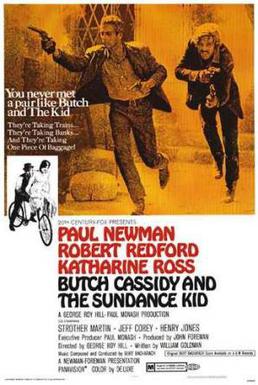
Butch Cassidy and the Sundance Kid (1969)

Directed by George Roy Hill · Western

110 minutes

Cast

Selected cast credits · Film reference

Paul Newman Butch Cassidy
Robert Redford the Sundance Kid
Katharine Ross Etta Place
Strother Martin Percy Garris
Jeff Corey Sheriff Bledsoe
George Furth Woodcock
Ted Cassidy Harvey Logan
Timothy Scott "News" Carver
Charles Dierkop Flat Nose Curry
Henry Jones Bike Salesman
Kenneth Mars Marshal
Jody Gilbert Large Woman on Train
Pancho Córdova Bank Manager
Enrique Lucero Bolivian Guard
Nelson Olmsted Photographer

Everything from the episode

In the order the hosts got to it. Open a row for the discussion.

44:06

Most Rewatchable Scene

The waterfall jump

The waterfall jump

In the discussion (8)
Approx. transcript time · 00:44:06Read transcript
  • The category is set up as the scene you stay for when you catch the movie while flipping channels; one host has five and invites additions, and one participant asks to guess them first.
  • The guesses: the first-act fight with the huge guy in the gang that ends with one kick, which is on the list, and the third-act attempt to rob the Bolivian bank while getting the Spanish right, which was not on the list but gets added.
  • The first Redford scene: with no history with the actor, the close-ups and the different 1870s-style color make you wonder what is going on, the film carefully establishes in two minutes that nobody should mess with him though he is not physically huge, and it ends with him firing six bullets around the man without killing him, instant mythology, while Newman knows what is coming and is already flying out of the way.
  • Butch kicking the giant leader in the balls is on the list; Goldman wrote that people objected because a John Wayne hero would not do that, and studio people asked why Sundance was not helping, joking dryly about bets instead; the answer is that Sundance knows exactly what is going to happen and is not worried about Butch at all.
  • The train robbery that introduces the super posse is on the list, though the first train robbery where they blow the car up could be argued; the Woodcock clip is played, the poor man nearly murdered out of loyalty to E.H. Harriman, and the actor is identified as George Firth (as transcribed); the second robbery with the horse posse is called a great seven minutes, with Goldman's book explaining how it was shot.
  • Further nominees: the Bolivian bank scene, the ending, the payroll-up-the-hill scene in Bolivia with the colorful character actor right before he is shot, its sister scene where it comes out that Butch has never shot anyone, the waterfall, and the meeting with Bledsoe where they try to enlist, which one host holds back for another category.
  • It comes down to the train robbery and super posse scene versus the waterfall; the waterfall is called one of the most rewatchable scenes of all time and the clip is played, with the angry, embarrassed 'I can't swim' named a favorite line reading, Newman's reaction praised, and the jump and the men coming in called everything you want from an action scene.
  • Earlier, Goldman is described as holding on to the secret that Sundance could not swim for as long as he could, unable to wait to write the cliff scene; the run to the edge and what they shout as they jump have been ripped off in fifty other movies, Lethal Weapon included.
48:52

What’s Aged the Best?

The widescreen cinematography

The widescreen cinematography

In the discussion (8)
Approx. transcript time · 00:48:52Read transcript
  • Young Redford is a first nomination: Downhill Racer and The Candidate are loved, Downhill Racer came out a week after this film, which studios would never allow today, and Hollywood has spent fifty years trying to manufacture another Young Redford, with Brad Pitt in Thelma and Louise the example that worked; the mysterious handsome guy whom women want and men want to hang out with is the hardest thing to find in an actor.
  • Finding another Redford is harder still because the kinds of movies where he would be discovered are rarely made now, more likely on Netflix than in the seventh installment of a superhero franchise; Redford did appear in a Marvel movie as the Secretary of Defense and turned up in Endgame for about a minute after rumors that The Old Man and the Gun would be his last film, so he is not ashamed of a paycheck.
  • Redford's first three big film roles were written by Neil Simon, William Goldman and James Salter, writers who understood his quiet pullback; Goldman wrote four more Redford movies afterward, and then Redford turned on him with a revisionist history of All the President's Men that was debunked on the internet.
  • In All the President's Men, the stretch where Dustin Hoffman grabs his copy and he finally confronts him is unbelievable Redford; he also produced it, and that film is named his Apex Mountain, with Ordinary People a close second, since in 1976 he was probably the biggest star in the world with the juice to fund his own movie.
  • Widescreen: the film had a crappy run on square TVs through the 70s, 80s and 90s because it is shot super wide, and the super posse sequence is gorgeous on the right TV and transfer where the 1982 broadcast version was cutting and panning; Conrad Hall shooting and Edith Head doing the look are perhaps the best cinematographer and costume designer of their generation on one movie, with George Roy Hill again.
  • The Butch, Etta and Sundance dynamic could have gone wrong in many ways but the chemistry works even though Butch and Etta are not dating, in the bicycle scene and her line about what would have happened if she had met him first; it is believable.
  • The scene where Etta is first met is held for what has aged worst; the love story is between Butch and Sundance, and Etta, though a key figure, recognizes that, which is why it never turns into a weird fight over her, since they are loyal to each other over anyone else.
  • Old-school dynamite hooked up to a safe, something movies no longer show, and the dialogue, where not a word would be changed, are also nominated; the final pick is the widescreen, having lived through thirty years of watching it another way, with agreement plus love for Redford and the Swingle Singers.
55:15

What’s Aged the Worst?

The scene where Sundance makes Etta undress at gunpoint

The scene where Sundance makes Etta undress at gunpoint

In the discussion (4)
Approx. transcript time · 00:55:15Read transcript
  • The scene where Etta is met: they appear to be strangers and Redford makes her undress at gunpoint, which reads like a date rape scene; today the reaction would be that it turns rape into something sexy and a woman's fantasy, and it would never be shot, much less released, though it was half a century ago and nobody is being blamed.
  • The montages are weird and make it feel distinctly a 60s and 70s movie; the New York trip and the ship to Bolivia go on for a while and would be done better now, the one place surgery would be easiest.
  • The opening credits' silent-film device is raised as possibly aging badly, since Goldman's original idea became convoluted; one host goes back and forth, forgets each time that the movie does not start the way he remembers, and still gives it an A for trying something new; starting that way made more sense in 1969, forty years after silent movies, than it would now.
  • Goldman wanted them to watch a movie of their own lives, which does not land because we are not there yet, and the point was that this was not the old, old days; he argued with a studio executive over the bifocals line, saying these men were alive when his grandmother was, in the Edison era; the date rape scene is named the winner, and the film is called as close to perfect as the show may ever do.
1:01:21

The Dion Waiters Award for Best Heat Check Performance

Strother Martin

Strother Martin

In the discussion (1)
Approx. transcript time · 01:01:21Read transcript
  • The candidates are the giant Harvey, who is confirmed not to be Richard Kiel from the Bond movies and may not be a true giant since they shot him from below, and Strother Martin, who gets the award with agreement for going for it in his scene, with the 'you're going to die bloody' line recalled; Strother Martin appears in all three 1969 westerns, True Grit, The Wild Bunch and this one.
1:11:08

Apex Mountain

Paul Newman

Paul Newman

In the discussion (3)
Approx. transcript time · 01:11:08Read transcript
  • Paul Newman is a yes: after this movie, at the end of the decade, he is at the absolute peak of his powers and could do whatever he wanted; agreed.
  • Catherine Ross is not thought to be at her peak here, and certainly not Redford; George Roy Hill is offered as a hedged yes, with his next twenty years of films admired, Funny Farm and The World According to Garp among them, plus his Goldman reunion on The Great Waldo Pepper, an underseen movie.
  • Earlier, Redford's Apex Mountain is placed at All the President's Men in 1976, with Ordinary People a close second.
1:11:26

The Joey Pants “That Guy” Award

George Firth (as transcribed), who plays Woodcock

George Firth (as transcribed), who plays Woodcock

In the discussion (2)
Approx. transcript time · 01:11:26Read transcript
  • The award is named after Joey Pants; Strother Martin is proposed first, a known name in the 60s who now reads as a that guy, then George Firth (as transcribed), who plays Woodcock, is offered instead and judged even better.
  • George Firth is actually a writer who is nonetheless seen acting a lot, with a great that-guy name and face; the joke is that he gets the roles Charles Grodin passes on.
1:12:23

The Ruffalo / Hanna / Rubinek / Partridge Overacting Award

Nobody

Nobody

In the discussion (1)
Approx. transcript time · 01:12:23Read transcript
  • The award is explained by Saul Rubinek in True Romance dialing it up when he realizes he has been betrayed; after scrolling through the movie, nobody is found to have overacted, Sweet Face at the brothel is considered and judged fine, and Cloris Leachman at the brothel is remembered.
1:16:39

Sequel, Prequel, Limited Series, or All-Black Remake

No; ten hours would dilute the movie's moments, though someone will eventually try, probably updated to the present

No; ten hours would dilute the movie's moments, though someone will eventually try, probably updated to the present

In the discussion (2)
Approx. transcript time · 01:16:39Read transcript
  • The instinct would be fury at Netflix remaking it as a ten-episode show, but the next question would be who is doing it, and the right names could suck a viewer in; after fifty years a remake seems allowed, and the pitch is written by Aaron Sorkin and starring Ben Affleck and Matt Damon.
  • The problem would be the movie itself: even with ten hours of material, people would wait for the movie moments and feel them diluted, the same problem as The Godfather, since nobody can disassociate from what is ingrained; someone will find a way, there is no sanctity, Harley Davidson already did it, and it would have to be updated to 2019, perhaps as two hackers.
1:20:35

Who Won the Movie?

William Goldman

William Goldman

In the discussion (3)
Approx. transcript time · 01:20:35Read transcript
  • The category is framed as a sport that cannot end in a tie, with no shootouts on the show; one voice first says Redford, anticipating the other will say Goldman, is surprised that a screenwriter is allowed, and concedes of course it is Bill.
  • Goldman wins hands down: he made a ton of money, it set up his career, he became the dean of screenwriters and completely rebottled the buddy movie; $400,000 for a screenplay in 1969 is likened to $100 million now, and he wrote only three drafts over eight years, prompting jokes about how screenwriters count drafts and the finality of typing on a 1969 typewriter.
  • The pick was surprisingly easy with no argument; one host had been going back and forth between Newman and Redford before realizing Goldman won.
Podcast choices
Speaker not identified
William Goldman
Speaker not identified
William Goldman

Mentions across The Rewatchables

Recorded movie reference

Pulp Fiction

The Rewatchables · aired July 29, 2024

Best Picture losers: introduced as ten, twelve titles named without ranks