
‹ All movies
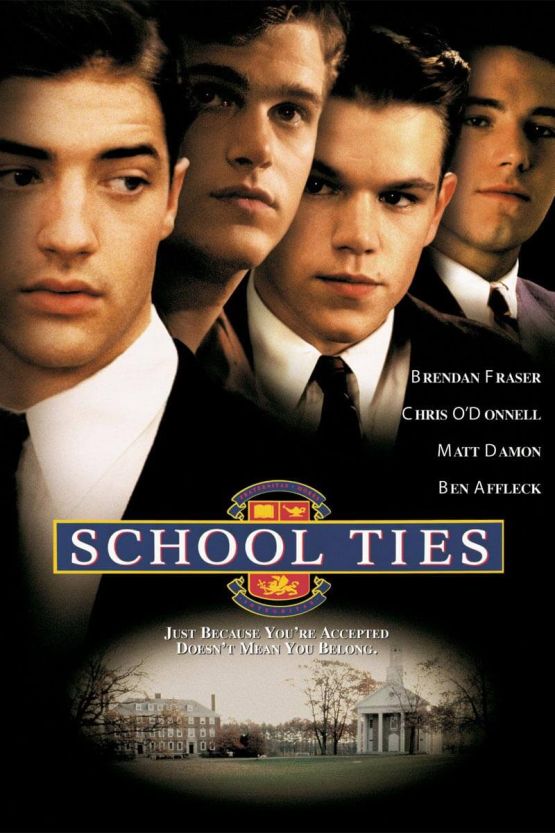
School Ties poster

School Ties

110 minutes

Cast

Selected cast credits · Film reference

Brendan Fraser David Greene
Chris O'Donnell Chris Reece
Andrew Lowery Mack McGivern
Matt Damon Charlie Dillon
Randall Batinkoff Rip Van Kelt
Cole Hauser Jack Connors
Amy Locane Sally Wheeler
Peter Donat Headmaster Dr. Bartram
Zeljko Ivanek Cleary
Kevin Tighe Coach McDevitt
Ed Lauter Alan Greene
Michael Higgins Mr. Gierasch
Anthony Rapp McGoo
Ben Affleck Chesty Smith
Peter McRobbie Chaplain
John Cunningham Grayson Dillon
Elizabeth Franz Jane Dillon
Matt Hofherr Grayson Gray Dillon III
Edward Seamon Weezer
Dan Desmond Mr. Wheeler
Claudia Everest Mrs. Wheeler
Leon B. Stevens Tom Keating
Cody Conklin Sarah
Sean Kent Keller
Kent Osborne Emile
Jeff Nichols Donald
James Quinn Boy #1
Ryan Anderson Boy #2
Will Lyman Swanson
William Meisle Winchester headmaster
Susan Johnston Mary Ellen
Gregory Chase Cal Reynolds
Alice Duffy Chaperone
Thomas Rhett Kee Boy in shower
Jane Nichols Swimming coach
Colin F. Lydon Boy in dining room

School Ties | The Rewatchables

Explore episodeClose episode

What’s Aged the Worst?

Casting identity; opening; football staging; prank; slurs; Locane’s later troubles; misleading artwork; Lowery’s career

In the discussion (13)
Approx. transcript time · 00:05:46Read transcript
  • The principal young cast not being Jewish is raised as a potentially dated casting choice despite the Jewish people behind the scenes.
  • The opening montage is considered the weakest section and seems tonally like a war movie.
  • Football editing and staging are criticized, with a wish for more plays, less dancing, and an earlier example of Dillon playing well.
  • The car prank is also placed in aged-worst.
  • The casual racial slurs are jarring to hear, even with the 1955s etting acknowledged.
  • The episode reports Locane being imprisoned after a 2010 DUI manslaughter case, treating it as a sad association.
  • The St. Luke’s uniforms are criticized as looking like an anachronistic modern football league.
  • Streaming artwork promoting Affleck as one of the four principal stars is criticized as misleading about his role.
  • Cutting the first ten minutes is proposed, but the Scranton teammates’ support and farewell with David’s father are defended as useful contrasts with the new school.
  • The lack of a visible Jewish community at home is questioned, while his openness and accepted place among teammates are offered as a defense.
  • The opening fight establishes David’s willingness to brawl, though using his throwing hand is questioned.
  • Lowry’s career is described as fading after Color of Night, which is strongly disliked.
  • The football scenes’ stationary cameras, unclear field geography, and confusing down-and-distance information are criticized.

Half-Assed Internet Research

Personal origins; Damon interview; casting publicity; production anecdotes; finances; locations; football preparation

In the discussion (15)
Approx. transcript time · 00:08:41Read transcript
  • Wolf’s screenplay is said to draw on personal experiences; a 2017 Entertainment Weekly oral history describes the filmmakers’ sense of responsibility toward the antisemitism theme.
  • A replayed 2018 Damon interview describes being cast by Jaffe and Lansing as a major credibility boost, followed by returning to college without work; publicity emphasized Fraser and O’Donnell because they had follow-up films.
  • In the interview, Damon rejects the suggestion that playing the villain itself was held against him; his hurt concerned the publicity focus on the other actors.
  • Fraser reportedly stayed in a separate hotel and socialized apart from the others, paralleling David’s outsider role.
  • The stated budget is$18 million and gross$14.7 million, with long-term cable and home-video income speculated to have made up the difference.
  • Rapp reportedly could not see through the glasses he wore as Magoo and acted without clearly locating the others.
  • Filming took place at Middlesex School in Concord and other prep schools.
  • The shower fight reportedly ran out of hot water, with artificial steam used around cold water.
  • Mandel reportedly encouraged the actors by predicting they would be the next Brat Pack.
  • McGivern’s French assignment is identified as Keats’s On Seeing the Elgin Marbles for the First Time.
  • The young cast are said to have all auditioned for Scent of a Woman, which O’Donnell won.
  • David’s 42 is interpreted as a Jackie Robinson reference, while Dillon’s 21 is proposed as half-the-man symbolism; the symbolic interpretation is not independently confirmed.
  • O’Donnell recalls the group lifting weights with the UMass Lowell football team and Damon as the strong one.
  • Fraser says he faked much of the football and disliked getting hit despite later making a career of physical roles.
  • Locane recalls Fraser remaining apart from the others’ fraternity-like social group, perhaps for the role.

Most Rewatchable Scene

Honor-code deliberation

In the discussion (46)
Approx. transcript time · 00:14:26Read transcript
  • Dillon’s reaction at the bar on learning David is Jewish is praised, with the family discussion about whether blocking is enough singled out.
  • The Smokey Joe’s Cafe dorm-room scene is nominated.
  • Affleck’s unexplained shirtlessness is enjoyed as an attempt to stand out.
  • The dorm scene is considered so exaggerated that an SNL parody would look the same.
  • Fraser’s charisma and presence in the musical gathering establish him as the big man on campus.
  • The song’s Jewish songwriting team is interpreted as early thematic preparation.
  • The dorm gathering captures both easy and awkward youthful bonding.
  • The Ex-Lax sign and McGivern’s bare feet are memorable dorm details.
  • The hi-fi bargaining exposes casual antisemitism and establishes the McGivern–Cleary tension.
  • The first win against Winchester is nominated, with an exaggerated joke about the enormous distance of David’s touchdown pass.
  • David and Dillon talking on the dock is praised as essential bonding, especially Dillon’s admission of envy and the burden of expectations.
  • David’s response to the failed French grade establishes different class expectations without making him unsympathetic.
  • The balance between privilege and genuine suffering is compared with Jaime and Brienne in Game of Thrones.
  • The dock places the two boys physically level and similarly dressed while exposing the class difference that David must earn his opportunities.
  • The St. Luke’s win is nominated, especially David throwing Dillon into a block.
  • Dillon lying on the grass while others celebrate David is a favorite image and imagined modern meme.
  • The postgame cocktail party and Dillon’s reaction to learning David is Jewish are singled out as a powerful setup for the coming confrontation.
  • The shower fight is nominated.
  • Eastern Promises is preferred in the comparison of shower fights.
  • The early question about shower timing is considered conspicuous setup for the later fight.
  • David’s confrontation with his roommate leads into the swastika discovery and cowards sequence.
  • Fraser’s performance and the lights switching on make the cowards sequence memorable.
  • The whole stretch from the St. Luke’s win through cowards is considered impossible to turn away from.
  • Connors admitting his prejudice but judging David a good person and Dillon the cheater is a key moment in the group deliberation.
  • David agreeing to honor the school’s traditions by lying is praised after the vote.
  • The deliberation combines honor-code procedure, ballot disputes, shifting loyalties, and physical confrontations.
  • The full ensemble sharing a room with space to move is praised as especially effective.
  • Unnamed classmates are introduced to help skew the deliberation vote.
  • McGoo accusing Connors briefly misdirects expectations before the expected prejudice reasserts itself.
  • Reece’s defense and Rip’s eventual disclosure provide counterpoints to the prejudice, making the predictable outcome poignant.
  • Rip’s reveal in the headmaster’s chair is praised as a satisfying reversal when David expects expulsion.
  • David telling the headmaster he will use the school to reach Harvard just as it used him for football is praised as a triumphant exit.
  • The final car exchange with Dillon supplies another satisfying ending payoff.
  • David’s final insult is considered too mild; goddamn prick is proposed.
  • Entitled fuckface is another proposed stronger insult.
  • A festering,gaping sore of a person is proposed; the first word is imperfectly transcribed.
  • Son of a bitch and bigoted son of a bitch are proposed.
  • Goddamn bigot or bigot are proposed, with a preference for including goddamn.
  • The Rosh Hashanah exchange is nominated for Fraser’s quiet anger and reply about the meek inheriting the earth.
  • The question about whose tradition was broken is praised as the counterpart to the final headmaster exchange.
  • The recognizable prayer makes the holiday sequence meaningful.
  • The father’s insistence on synagogue attendance makes the holiday sequence feel familiar.
  • David’s private prayer is praised as a personal choice about faith rather than obedience to either family or hostile authority.
  • Two final scene preferences select the deliberation.
  • The St. Luke’s-to-cowards run is selected as the strongest extended stretch.
  • David choosing his Jewish identity is contrasted with Dillon resenting an inherited identity while benefiting from its privilege.

Casting What-Ifs

Damon; Wyle; Chandler; Perry; Fraser discovery; O’Donnell

In the discussion (7)
Approx. transcript time · 00:15:23Read transcript
  • Jaffe’s oral-history praise for Damon includes considering him for the lead before deciding against it.
  • The search reportedly considered over5,000 young men across a year and a half; Noah Wyle read for David.
  • Kyle Chandler also reportedly read for David.
  • Matthew Perry also reportedly read for David.
  • Fraser was reportedly found in Seattle and immediately stood out as David in a group of actors.
  • Batinkoff recalls screen-testing with Chandler and sharing drinks afterward; Chandler as David is enthusiastically imagined.
  • O’Donnell was considered for Dillon but wanted a more likable role.

Roger Ebert's review

In the discussion (2)
Approx. transcript time · 00:27:40Read transcript
  • Ebert’s rating is three stars with no stated denominator.
  • The review praises the film as effective, perceptive, and unforgiving, emphasizing dishonesty induced by bigotry as well as antisemitism.

Picking Nits

Football continuity; brother’s attendance; car logistics; jersey; swim practice; water beads; curfew; notes; crib sheet

In the discussion (9)
Approx. transcript time · 00:37:58Read transcript
  • An objection that the team resumes offense after the fumble is corrected: they are on defense. The remaining objection is the unexplained immediate jump to third down.
  • Dillon’s brother attending during Harvard’s football season is questioned; a bye is offered as a possible explanation.
  • Moving Cleary’s car into the dorm is considered logistically impossible, especially at that speed and without visible damage.
  • David’s 42 quarterback number and impossibly long pass are questioned again.
  • David being allowed to enter the girls’ swim practice is questioned.
  • The water beads on Sally’s face remain oddly stationary.
  • Dating trips seem inconsistent with the boarding school’s lights-out rules.
  • Dillon steals Rip’s notes noisily before waiting for him to fall asleep, after effectively announcing his interest in them.
  • The history teacher sees Dillon drop his books but does not connect him to the nearby crib sheet; questioning him first is proposed as the responsible response.

What’s Aged the Best?

Ensemble; boarding-school setting; Damon; costumes; honor code; Scranton; cheating; diners; dances; football boosterism

In the discussion (18)
Approx. transcript time · 00:47:22Read transcript
  • Rip’s shawl-collar sweaters and cardigans are praised.
  • Seeing Damon, Affleck, and Hauser together before Good Will Hunting is praised.
  • 1950s boarding-school movies are endorsed as a genre worth repeatedly revisiting.
  • Damon’s expressions as the privileged racist villain are praised.
  • Cleary’s 1950 MG is admired.
  • The football uniforms’ colors, stripes, and helmets are admired, with a reservation about the body of the uniform.
  • The ancient graduate from the class of 1875 is enjoyed as a link to the Civil War era, while his apparent 98-year-old vigor is questioned.
  • Ed Lauter as David’s father is appreciated as a sports-film presence, with a wish that he attended the major game despite the travel distance.
  • The honor code is praised as an effective dramatic device precisely because it fails under pressure.
  • Scranton remains a legible hometown reference, partly because of The Office.
  • Cheating is praised as a reliable source of conflict and debate.
  • The tweed coats and blazers are admired.
  • The Scranton youths’ James Dean styling and the Rebel Without a Cause marquee are enjoyed.
  • The luncheonette and Skip’s Diner are admired as neighborhood gathering places.
  • Youth dances and the meeting of boys’ and girls’ schools evoke record hops, enforced distance between dancers, and camp memories.
  • Dillon’s fumble, missed tackle, forced block, and despondent expression are considered ideal material for a modern meme.
  • High-school football boosterism and recruiting the player needed to defeat a rival are praised as enduring traditions; David having to work a real job is contrasted with Friday Night Lights.
  • Damon’s villainous performance is praised as an underused side of his screen persona.

Probably Unanswerable Questions

Holiday observance; assigned seats; shower staging; betting line; Batinkoff; Cleary; McGivern

In the discussion (8)
Approx. transcript time · 00:51:18Read transcript
  • Whether playing football on Rosh Hashanah diminishes David’s religious standing is asked; he is defended as balancing school survival and observance during a two-day holiday.
  • Whether the classroom has assigned seats is asked because sitting at the back would make cheating less conspicuous; assigned seats are considered likely.
  • The choice of a naked shower fight rather than another bathroom activity is questioned, as is the absence of slipping.
  • A hypothetical St. Luke’s point spread moves from 3.5 to 2.5 points, accounting for its winning history and David’s arrival.
  • Batinkoff’s missing breakout is reconsidered, with a JFK or stately New England role proposed as a missed path.
  • Cleary is suspected never to have visited France despite adopting French mannerisms.
  • Why Cleary was not fired after the student’s breakdown is questioned.
  • McGivern’s condition is left unclear, with a nervous breakdown suggested rather than a clinical diagnosis.
In the discussion (4)
Approx. transcript time · 01:02:44Read transcript
  • The boarding-school dorm and its tall staircase are selected for the possibility of chaos across multiple floors.
  • The bathroom is selected for both the fight and the pre-dance preparation, including Harvard talk, the urinal, and powder in Dillon’s hair.
  • The club is an alternative for its dessert cart, indulgence, and adults giving a child scotch.
  • The quad is proposed as quintessential New England, though its similarity to other school films is noted.

The Great Shot Gordo Award for Most Cinematic Shot

Cowards in the rain; chapel procession

In the discussion (2)
Approx. transcript time · 01:05:23Read transcript
  • The rain-soaked cowards scene is one cinematic-shot choice.
  • The first chapel procession across the quad is the competing choice because David’s light trousers stand out against the others’ dark clothing.
In the discussion (4)
Approx. transcript time · 01:11:41Read transcript
  • School Ties is retained as the preferred title.
  • Honor Code is proposed and rejected.
  • Star of David is proposed and rejected despite the protagonist’s name.
  • The title’s double meaning is appreciated, though the early borrowed tie seems to imply a later callback that may have been cut.

Mallory Rubin Award: Did This Movie Need a Better Sex Scene?

Yes; more credible romantic encounters

In the discussion (2)
Approx. transcript time · 01:12:22Read transcript
  • The category response argues that the film is implausibly chaste for its boarding-school setting and proposes expanding the implied romantic encounters and awkwardness; detailed sexual suggestions about teenage characters are not reproduced.
  • A more substantial David–Sally encounter that Dillon discovers is proposed to intensify his jealousy, while the film’s restraint is judged unrealistic for either its setting or release period.

The Stephen A. Smith Hottest Take Award

Cowards overrated; shower omission; cheating minor; Sally etiquette disputed

In the discussion (4)
Approx. transcript time · 01:16:40Read transcript
  • The cowards scene is criticized as too short, rushed, and less informative than its reputation suggests; the challenge and other boys’ refusal to face David are defended as meaningful.
  • The shower confrontation is criticized for omitting a discussion of circumcision in a scene about Jewish identity; the historical assumptions are left unverified.
  • Dillon’s crib-sheet cheating is defended as relatively minor beside his other behavior and understandable under academic pressure.
  • David pursuing Sally after taking Dillon’s quarterback job is criticized as socially inconsiderate; the counterargument stresses that Sally and Dillon are not together and rejects the idea of romantic dibs.
In the discussion (3)
Approx. transcript time · 01:23:11Read transcript
  • McGivern is the preferred overacting choice.
  • Cleary is the other initial overacting candidate.
  • The history professor is another candidate for the rapid-fire quiz and honor speech, with his classroom corgi admired.

Recasting Couch

Phoenix as McGivern; Barrymore or Thorne-Smith as Sally

In the discussion (4)
Approx. transcript time · 01:25:09Read transcript
  • Phoenix as McGivern receives support as another major actor to add to the ensemble.
  • Drew Barrymore is proposed for Sally.
  • Reese Witherspoon is considered too young for Sally.
  • Courtney Thorne-Smith is proposed for Sally and enthusiastically supported.
In the discussion (10)
Approx. transcript time · 01:28:34Read transcript
  • Fraser is rejected in favor of The Mummy.
  • Damon is rejected.
  • Hauser is rejected.
  • Affleck is rejected.
  • Batinkoff receives a yes with Buffy in the same year.
  • Eastern Promises is preferred for naked shower fights.
  • Movies about casual antisemitism are considered high on the list, with Swing Kids as a companion comparison.
  • Locane is described as both at an Apex and a low point because of her later firing from Melrose Place and declining career.
  • Dead Poets Society is preferred for New England boarding-school movies.
  • French class is rejected as an Apex.

Best Race Horse Name from This Movie

Skip’s Diner; Kokes’s Sister

In the discussion (2)
Approx. transcript time · 01:30:05Read transcript
  • Skip’s Diner is a racehorse-name choice.
  • Kokes’s Sister is another racehorse-name choice; the name remains phonetic.

Sequel, Prequel, Limited Series, or All-Black Remake

All-Black version; television adaptation; Rip presidential sequel; Connors at Yellowstone

In the discussion (4)
Approx. transcript time · 01:33:39Read transcript
  • An all-Black version is enthusiastically supported.
  • A television adaptation would start in eleventh grade and retain David’s secret throughout the first season, developing football, friendship, and romance.
  • A sequel with Rip running for president against Reagan in 1984 is proposed, relying on his moral character and cardigans.
  • Another sequel would follow Connors to the Yellowstone ranch.
In the discussion (2)
Approx. transcript time · 01:35:35Read transcript
  • Damon receives two explicit Oscar choices.
  • O’Donnell is praised as a hypothetical second supporting winner.

The Andy and Red – Zihuatanejo Award for What Happens the Next Day?

Dillon at another prep school, then Harvard; David at Harvard or Yale

In the discussion (2)
Approx. transcript time · 01:38:57Read transcript
  • Dillon is imagined quickly placed in another prep school by his father, then meeting David again at Harvard as David plays quarterback.
  • A competing future sends David to Yale, setting up repeated Harvard–Yale meetings and later television seasons through the 1960s .
In the discussion (5)
Approx. transcript time · 01:40:00Read transcript
  • Liberty Heights is the explicit pairing choice; Dead Poets Society and Swing Kids are only offered in the prompt.
  • The Jewish-film Mount Rushmore names Munich, Liberty Heights, and School Ties without finding a fourth.
  • Shining Through is rejected; discussion of Woody Allen films is deferred.
  • Good Will Hunting is selected and endorsed as a pairing.
  • Dead Poets Society is a considered pairing alternative.

What Piece of Memorabilia Would You Want From This Movie?

Crib sheet; pennant; Band-Aid box and Star of David; helmet; Rip’s sweater

In the discussion (7)
Approx. transcript time · 01:41:35Read transcript
  • David’s number 42 jersey is offered and rejected.
  • Dillon’s crib sheet is a memorabilia choice.
  • The large St. Matthew’s pennant is another memorabilia choice.
  • The Band-Aid box is selected as an iconic hiding spot for secrets.
  • The concealed Star of David is also explicitly desired with the box.
  • David’s football helmet is selected.
  • Rip’s deliberation sweater is the same response’s second choice.

The Coach Finstock Award for Best Life Lesson

Question prejudice; use those who use you; protect the crib sheet

In the discussion (3)
Approx. transcript time · 01:42:27Read transcript
  • Keeping better control of a crib sheet is offered as a joking lesson about cheating.
  • Examining one’s own prejudice and judging an individual rather than assuming group stereotypes is the substantive lesson.
  • David’s responses to the headmaster support the lesson of using those who try to use you.
In the discussion (4)
Approx. transcript time · 01:43:50Read transcript
  • Damon receives an explicit final choice for his villain performance and long-term perspective; repeated name statements are part of the same choice.
  • Fraser is selected for carrying the film and making David’s physical presence and controlled anger credible.
  • A separate explicit Fraser choice praises the performance’s subtlety and range.
  • The casting team, including Pat McCorkle, receives an additional commendation for assembling actors whose later careers renewed the film’s appeal.
Podcast choices
Speaker not identified
Matt Damon
Speaker not identified
Brendan Fraser
Speaker not identified
Brendan Fraser

Producer review

Loved the film; unsatisfying ending; surprising Damon villain; poor football

In the discussion (3)
Approx. transcript time · 01:45:38Read transcript
  • The invited producer loved the film and school settings but found David’s ending insufficiently rewarding, since he still faces prejudice and receives little revenge.
  • In an explicit follow-up response, seeing young Damon as a villain is described as changing a previously good-guy image of him.
  • In response to a direct question, the football scenes are called terrible.

More from the conversation

The young ensemble is compared with the 2003 basketball draft, with Fraser, Damon, O’Donnell, Affleck, and Hauser discussed as future stars.
Approx. transcript time · 00:02:13Read transcript
The film is described as personally important Jewish cultural representation, combining identity, football, and coming of age, with Dick Wolf’s contribution emphasized.
Approx. transcript time · 00:03:15Read transcript
Boarding-school and young-ensemble films are praised through Toy Soldiers, Outside Providence, Taps, American Graffiti, The Outsiders, and Dead Poets Society; School Ties relies on the young actors rather than an established adult star.
Approx. transcript time · 00:04:09Read transcript
Fraser’s non-Jewish casting is compared with Craig in Munich and Isaac in Moon Knight and Scenes from a Marriage; the performance is defended while the identity match is considered likely to change contemporary publicity and reception.
Approx. transcript time · 00:06:44Read transcript
The film’s rewatchability despite its serious subject is credited to pace and the young cast; Hauser’s early work and Damon’s villainous entitlement are singled out.
Approx. transcript time · 00:09:02Read transcript
Damon’s villain roles are preferred as an underused strength, with The Talented Mr. Ripley and his chip-on-the-shoulder persona as comparisons.
Approx. transcript time · 00:10:24Read transcript
The New England boarding-school atmosphere is valued, with a distinction between a Massachusetts-specific identity and the wider region’s similar schools.
Approx. transcript time · 00:10:51Read transcript
Affleck’s small role and shirtless dancing are rediscovered amid larger early parts for Fraser and O’Donnell; the actor playing Cleary is recognized from many later television roles.
Approx. transcript time · 00:10:51Read transcript
Despite the publicity focus on Fraser and O’Donnell, Damon is recalled as the standout on first viewing and recognizable afterward as the School Ties actor.
Approx. transcript time · 00:13:37Read transcript
O’Donnell is recalled as a major young star and childhood crush, with Scent of a Woman, the Batman films, The Three Musketeers, Grey’s Anatomy, and later television work marking his trajectory.
Approx. transcript time · 00:18:19Read transcript
O’Donnell’s career is interpreted as losing opportunities to Damon and Wahlberg, missing the late 1990 sdirector renaissance, and suffering from Batman & Robin; Clooney’s escape from that film’s reputation is contrasted.
Approx. transcript time · 00:21:00Read transcript
The especially pretty faces of O’Donnell and Batinkoff are distinguished from Damon and Affleck, prompting disagreement about Affleck’s attractiveness.
Approx. transcript time · 00:23:55Read transcript
Batinkoff’s failure to become a major star is puzzling given his appeal as Rip and appearances in Buffy, The Player, and Higher Learning; competition and missed opportunities are proposed.
Approx. transcript time · 00:24:58Read transcript
Hamilton, Hawke, Hamm, Vaughn, Favreau, and Robert Sean Leonard are discussed in the crowded generation of actors; Leonard is imagined as a comparable Rip with slightly more gravitas.
Approx. transcript time · 00:26:03Read transcript
Siskel’s positive response is recalled alongside his own prep-school antisemitism experience, reinforcing the filmmakers’ personal sense of responsibility.
Approx. transcript time · 00:27:40Read transcript
Personal prep-school experience makes Dillon’s family legacy and insecurity feel authentic; the postgame refusal to shake his hand shows his position behind his brother.
Approx. transcript time · 00:35:29Read transcript
A possible Beverly Hills 90210 fraternity-vote borrowing is debated, with blackball voting defended as a separate Greek-life tradition.
Approx. transcript time · 00:46:11Read transcript
The father speaking German and the postwar 1955 setting raise questions about the family’s history as German Jews in Pennsylvania.
Approx. transcript time · 00:53:58Read transcript
The waiting-table scenes are praised for stressing class inequality as well as prejudice.
Approx. transcript time · 01:05:10Read transcript
Mandel’s work on F/X and The Substitute is discussed while the football staging is criticized again.
Approx. transcript time · 01:11:00Read transcript
Rapp’s later television work and public allegations against Spacey are mentioned in the discussion of his career.
Approx. transcript time · 01:24:32Read transcript
A GQ profile’s archery anecdote leads to speculation about Fraser’s personality, while his residence near Damon suggests a possible reunion.
Approx. transcript time · 01:28:10Read transcript
The better-with category is explicitly dropped; a brief Wayne Jenkins impression follows without a substantive casting discussion.
Approx. transcript time · 01:43:18Read transcript
The subsequent dropped-pass exchange criticizes Rip’s mistake and suggests using his size more; speaker identity is not established.
Approx. transcript time · 01:48:01Read transcript
The closing credits the episode’s production to Craig Horleback.
Approx. transcript time · 01:48:09Read transcript