
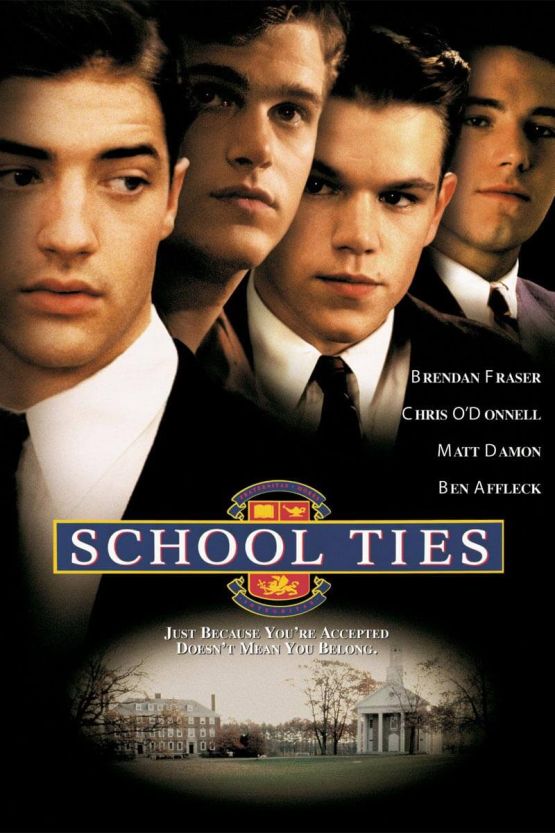

What’s Aged the Best?
Ensemble; boarding-school setting; Damon; costumes; honor code; Scranton; cheating; diners; dances; football boosterism
In the discussion (18)
Approx. transcript time · 00:47:22Read transcript
- Rip’s shawl-collar sweaters and cardigans are praised.
- Seeing Damon, Affleck, and Hauser together before Good Will Hunting is praised.
- 1950s boarding-school movies are endorsed as a genre worth repeatedly revisiting.
- Damon’s expressions as the privileged racist villain are praised.
- Cleary’s 1950 MG is admired.
- The football uniforms’ colors, stripes, and helmets are admired, with a reservation about the body of the uniform.
- The ancient graduate from the class of 1875 is enjoyed as a link to the Civil War era, while his apparent 98-year-old vigor is questioned.
- Ed Lauter as David’s father is appreciated as a sports-film presence, with a wish that he attended the major game despite the travel distance.
- The honor code is praised as an effective dramatic device precisely because it fails under pressure.
- Scranton remains a legible hometown reference, partly because of The Office.
- Cheating is praised as a reliable source of conflict and debate.
- The tweed coats and blazers are admired.
- The Scranton youths’ James Dean styling and the Rebel Without a Cause marquee are enjoyed.
- The luncheonette and Skip’s Diner are admired as neighborhood gathering places.
- Youth dances and the meeting of boys’ and girls’ schools evoke record hops, enforced distance between dancers, and camp memories.
- Dillon’s fumble, missed tackle, forced block, and despondent expression are considered ideal material for a modern meme.
- High-school football boosterism and recruiting the player needed to defeat a rival are praised as enduring traditions; David having to work a real job is contrasted with Friday Night Lights.
- Damon’s villainous performance is praised as an underused side of his screen persona.