
‹ All movies

The opening scene, Mike McD losing his 30 grand to Teddy KGB

Five nominees are read: the opening scene where Mike McD loses his shirt ('I don't think you have the spades'), and Mike McD's poker comeback, whose clip is played; 'let's play some fucking cards' plus the guitar riff gets a host fired up to gamble, like the Vegas moment in Swingers.

An aside: the comeback is a bit of a cheat, because the two hosts played cards on the same night earlier this summer and real poker is slow and awful, everyone is Joey Knish and no one is Mike McD, whereas the movie makes it feel like a jet engine down the tarmac; one host's favorite thing in life is driving to Vegas and sitting silently at a poker table for eight hours.

"Hanging around hanging around kids got alligator blood"

A rip-through of quotes: 'Welcome to Chesterfield South'; 'Rule number one, throw in your cards when you know you can't win. Fold the hand', good life advice and a senior yearbook quote; and 'you can't lose what you don't put in the middle, but you can't win much either', another yearbook quote.

The film

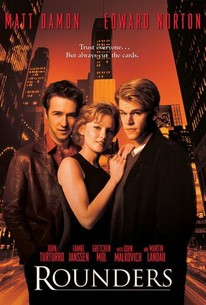
Rounders (1998)

Directed by John Dahl · Drama / Crime

120 minutes

Cast

Selected cast credits · Film reference

Matt Damon Mike McDermott
Edward Norton Lester 'Worm' Murphy
John Turturro Joey Knish
John Malkovich Teddy KGB
Martin Landau Abe Petrovsky
Josh Mostel Zagosh
Lenny Clarke Savino
Tom Aldredge Judge Marinacci
Michael Lombard District Attorney Shields
Lenny Clarke Savino
Chris Messina Higgins
Goran Višnjić Maurice
David Zayas Trooper Osborne
Johnny Chan himself
Bill Camp Eisenberg
Josh Pais Weitz
Adam LeFevre Sean Frye

Everything from the episode

In the order the hosts got to it. Open a row for the discussion.

11:35

Roger Ebert's review

In the discussion (1)
Approx. transcript time · 00:11:35Read transcript
  • While going through the weird, lukewarm 1998 reviews, one host recalls that Roger Ebert liked the movie, 3 out of 4; the other greets it with 'nice, my guy' and ribs Roger that it is about time he had a good opinion.
43:49

Casting What-Ifs

Neve Campbell turned down the role of Joe

Neve Campbell turned down the role of Joe

In the discussion (2)
Approx. transcript time · 00:43:49Read transcript
  • The only item: Neve Campbell turned down Joe; the film seems to have been locked in on Damon and Norton throughout, with little almost-happened history.
  • Both hosts think the movie would have worked better with Neve Campbell: a better actress at a nice point in her career, Party Five (as transcribed) still running and post-Scream, inherently sympathetic, which Joe needs so you believe she is trying to get Mike McD to go straight.
48:53

Half-Assed Internet Research

Joe was in only three scenes in the original draft; the law school scenes were shot at Rutgers; Malkovich built his a...

Joe was in only three scenes in the original draft; the law school scenes were shot at Rutgers; Malkovich built his accent from a Russian woman reading his lines; the original script had Mike move on Phil Hellmuth, not Johnny Chan; the closing Counting Crows song is on no album; Damon and Norton played the 1998 World Series of Poker main event, where Doyle Brunson's aces knocked out Damon's kings; the book in the opening is Brunson's Super System

In the discussion (7)
Approx. transcript time · 00:48:53Read transcript
  • Joe was in only three scenes in the original draft; all law school scenes were filmed at Rutgers, though one host assumed John Jay, as the film calls it something like City Law School; Malkovich got his accent by having a Russian woman read his lines and mimicking her, which prompts the question of whether it is convincing.
  • In the original script Mike McDermott was to make his move on Phil Hellmuth in the Atlantic City big-money game rather than Johnny Chan; relief is voiced that it was changed; Hellmuth is discussed as polarizing, Skip Bayless crossed with poker, one of the great figures in sports history whose existence makes the game more interesting, still stirring drama at this year's World Series, and also as annoying.
  • Johnny Chan is one of the biggest winners of the movie, top four for Who Won the Movie: he won the World Series of Poker twice when nobody cared, has the perfect poker name, and stands alone like the Muhammad Ali of boxing because of this film; made ten years later the spot goes to Phil Ivey.
  • Eric Seidel, who loses the famous hand to Chan, is one of the greatest players ever and still makes a fortune in cash games, but looks like a yokel in the movie and must hate it.
  • The Counting Crows song at the end, 'Baby, I'm a Big Star Now', is on no album and hard to find, though one host locates it on Spotify under Saturday Nights and Sunday Mornings; it is called one of their best twenty songs, with a double meaning, and a host wants Adam Duritz on his podcast as the band nears 25 years.
  • Matt Damon and Edward Norton played the $10,000 Texas Hold'em championship at the 1998 World Series of Poker in Vegas, where Damon's pocket kings were knocked out by Doyle Brunson's pocket aces; Brunson is the Bill Russell of poker and has the 10-2 hand named after him.
  • In the opening shots Mike McD pulls money out of a copy of Doyle Brunson's Super System, a book one host devoured at 18, dated as strategy but a cool way in; having something named after you means you did something well, and Brunson won the World Series with 10-2, not a favorite hand.
1:01:22

Picking Nits

Mike McD taunting Teddy KGB after taking his money; the Oreo tell going unnoticed for 20 hours; Teddy's tell being so...

Mike McD taunting Teddy KGB after taking his money; the Oreo tell going unnoticed for 20 hours; Teddy's tell being so basic; Mike telling Teddy he knows the tell and showing his laid-down hand; Worm not smoking; Petrovsky's 10 grand loan; how 10 grand becomes 60; KGB's fold in the opening hand; Grandma's (as transcribed) arrangement with Teddy; Worm not playing

In the discussion (12)
Approx. transcript time · 01:01:22Read transcript
  • 'You feeling satisfied now, Teddy, because I can go on busting you up all night' is said after taking 60K off a man who may head the Russian mafia; Mike McD would be killed immediately and never leave the Chesterfield for taunting the warlord whose hand he just stole; a heat check in itself.
  • Two questions about the Oreo tell, a controversial moment: Mike McD reads every judge's hand in 14 seconds yet plays Teddy for 20 hours without the tell clicking, which has no defense and is the biggest flaw; and Teddy, cleaning out basements for years, has the most basic tell imaginable, eating the cookie only when he likes his hand.
  • In a less sophisticated poker movie, like Casino Royale where everyone has five kings, the tell would not stand out, but this film is so nuanced about table tics at the Taj that one glaring tell in the villain nags; still, it was made for audiences who do not know poker, and one host did not notice it until his fourth viewing while the other caught it at once.
  • Why does Mike tell Teddy he knows the tell? One host long considered it a problem, since with the tell he could take the money in ten hands, like Belichick telling the other coach what he has figured out; the counter, credited as what the writers intended, is that it is a mind game that rattles KGB so his aggressive game falls apart.
  • Showing a hand when laying it down is a real strategic question; whenever someone does that at a Vegas table the host thinks he is an idiot without security in his game, unless it is after ten hours to prove he actually laid one down; the 'laying this down, Teddy, top two pair' line is great.
  • How is Worm not a smoker, the most likely smoker of any movie character? Research saved for here: Ed Norton is anti-smoking and did not want Worm to smoke; it also fits the plot that he plays for cigarettes in prison without smoking himself; still called the biggest reach in the movie.
  • Mike McD's law professor lending him 10 grand to set up the finale, at the cost of another yeshiva story, draws a joke that the host would rather rob a liquor store than sit through it; the defense is an admittedly bullshitty theory of an underdog bond between Irish and Jewish people, with Italians thrown in, which makes the Petrovsky storyline make sense.
  • Both like the old guy Petrovsky; Martin Landau's return as Bob Evans on a creatively dormant Entourage had a splash of Petrovsky in it, and Crimes and Misdemeanors, a favorite of both, is called incredible though unlikely to get an episode before season 19.
  • How does Mike McD go from 10 grand to 60 against Teddy rather than 40? Koppelman and Levine told one host that Teddy reloads, visible in the chip changes, and that they fought for reload scenes but could only go so far into poker minutiae before it got boring; it is still weird that Teddy rebuys into his own game instead of calling it a day at 40K.
  • Raised early and told it belongs in picking nits: KGB folding and walking away in the opening hand without seeing whether Mike McD had four nines; the reply is that he read Mike's face.
  • Grandma (as transcribed) is a weird character whose arrangement with Teddy KGB is unclear; how the money works at the end is confusing, since Grandma got paid yet is upset, and the juice on Worm's debt, suddenly 15K, seems arbitrary with the numbers shifting; parked for nitpicks.
  • Forgotten in nitpicking: why Worm, clearly good at poker, does not play with Mike to double their chances; the answer is that Mike does not trust him, and his instincts prove right when Worm sits down at the cop game and cheats.
1:12:21

Probably Unanswerable Questions

Was Knish the smartest of them and the hero? Where does Johnny Chan's cameo rank among sports cameos? Is this the bes...

Was Knish the smartest of them and the hero? Where does Johnny Chan's cameo rank among sports cameos? Is this the best gambling movie ever made? Does 'women are the rake' hold up? Where did Worm go after Binghamton? Did Joe give Petrovsky the 10 grand? What was the perfect release year? Could Damon and Norton have switched parts?

In the discussion (9)
Approx. transcript time · 01:12:21Read transcript
  • Was Knish the smartest of all these people and the hero? He owned his own business, grinded out the rent money, was smart enough not to lend Mike McD 10 grand he would never see again, stayed away from Worm, and gives the Turkish bath speech that it is about making a living, not the World Series; he seems to live okay with his truck business despite alimony and child support.
  • The ending at the World Series of Poker, which nobody watched then because you could not see the cards, became everyone's dream within five years; Positively Fifth Street by James McManus, about the World Series and Binion's, is recommended as one of the great crime and sports books, and Grantland tried to hire him.
  • Where does Johnny Chan's cameo rank among sports-related cameos? The bar is Hulk Hogan in Rocky III; also Kareem in Airplane, Xavier McDaniel in Singles, Larry Bird in Blue Chips, though Koozie (as transcribed) with the left-handed free throws is the real Blue Chips flex and is acting rather than a cameo, and Bob Watson and Cesar Cedeno in the Bad News Bears sequel; Chan is up there even though he only mouths words.
  • Is this the best gambling movie ever made? It is a host's favorite poker movie but not favorite gambling movie, which is Robert Altman's California Split with George Segal and Elliot Gould, about how befriending a gambler is bad for you; Koppelman and Levine are surely California Split guys, but as poker movies go Rounders is head and shoulders above everything.
  • Where do we stand on 'in the poker game of life, women are the rake'? Iconic twenty years ago, it now reads as misogynist in the woke era, but the hosts still like it: it is Worm's line, this is a movie about card-playing, prison-dwelling dirtbags and that is how they talk, not a movie about the president or the Navy.
  • Where did Worm go after Binghamton? In a 2013 Grantland mailbag Koppelman and Levine answered that he meant 'highway time' but needed road money, found a Bronx backroom game far from KGB's territory, and was chased across town by the man he had fleeced for cigarettes in the prison hearts game, a scene they shot, edited, screened and cut; they imagine he later scammed his way through the Moneymaker online boom, where Rounders 2 would pick up.
  • Are we sure Joe gave Petrovsky the 10 grand? Why would she, and how would he know; and why did Petrovsky lend it in the first place to a bad student with a gambling problem, since nobody would give 10 grand to an untrusted, failing Ringer employee; Joe's look through the window pane suggests they will go another round, but nothing is certain.
  • What year would have been perfect for release? It would have to be about two weeks before Moneymaker so the movie was still in theaters during the rush of interest, but Damon and Norton would be too old by then; a year later, after Fight Club and Ripley, is floated, yet both like how it played out and doubt a later release would have led to this podcast.
  • An early question saved from this category: could Damon and Norton have switched parts? Norton 100 percent, since at the time he seemed the new Marlon Brando and the most important actor in a decade; Damon no, and Norton as the embodiment of filth and dishonesty is probably the more irreplaceable of the two.