
‹ All movies

Axel checking into the Beverly Palm Hotel with the Rolling Stone and Michael Jackson routine, running all the way through the Serge gallery scene

Nothing in the first 20 minutes is exceedingly rewatchable to one host, who flips channels waiting for Axel to reach Beverly Hills; another disagrees, saying the chase is really good, and would watch an hour and a half of the cigarette deal as a Jim Jarmusch movie, and loves the Mean Streets moment that takes it out of 80s blockbuster territory; without the title you would not know what to make of Axel.

Axel arriving in Beverly Hills and checking into the hotel, claiming to be a Rolling Stone reporter in town to interview Michael Jackson, might be the funniest thing he has ever done; he cries racism without saying racism, playing an entitled white person and an affronted black person at the same time, which gets the manager to give him the room at half price; he overhears the no-reservations phone call so he has an opening line, and the wordless take at $240 a night is an all-timer.

"Take those bananas"

The pick is 'take those bananas', the Damon Wayans line, which draws immediate agreement.

The film

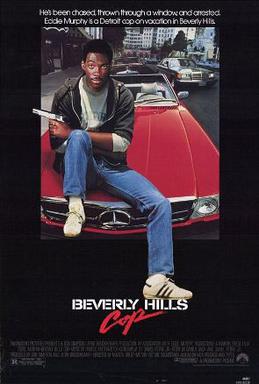
Beverly Hills Cop (1984)

Directed by Martin Brest · Action

105 minutes

Cast

Selected cast credits · Film reference

Eddie Murphy Detective Axel Foley
Judge Reinhold Detective Billy Rosewood
John Ashton Sergeant John Taggart
Lisa Eilbacher Jenny Summers
Ronny Cox Lieutenant Andrew Bogomil
Steven Berkoff Victor Maitland
James Russo Mikey Tandino
Stephen Elliott Chief Hubbard
Gilbert R. Hill Inspector Douglas Todd
Paul Reiser Detective Jeffrey Friedman
Frank Pesce cigarette buyer
Damon Wayans banana man
Rex Ryon bonded warehouse security guard
Martin Brest Beverly Palms Hotel checkout clerk (uncredited)

Everything from the episode

In the order the hosts got to it. Open a row for the discussion.

29:55

Roger Ebert's review

In the discussion (1)
Approx. transcript time · 00:29:55Read transcript
  • Ebert gave it two and a half stars and did not really like it, writing that Eddie Murphy looked like the latest victim of star magic syndrome, the assumption that a movie will be a hit simply because it stars an enormously talented person; the host retorts that this is exactly what happened.
1:00:59

Casting What-Ifs

Mickey Rourke signed a $400,000 holding deal and left; Sylvester Stallone rewrote it as a straight action film with A...

Mickey Rourke signed a $400,000 holding deal and left; Sylvester Stallone rewrote it as a straight action film with Axel Cobretti and quit two weeks before filming; Martin Scorsese was offered the director's chair and dismissed the script; Eddie Murphy was hired two weeks before shooting

In the discussion (6)
Approx. transcript time · 01:00:59Read transcript
  • Mickey Rourke signed a $400,000 holding contract and then left the project; a New York Times quote has Don Simpson tearing a picture of Rourke out of a magazine, holding it up and saying 'isn't he great', which the hosts attribute to all the cocaine, although one says you did not need cocaine to want Rourke in 1984.
  • This is the movie missing from Rourke's run before he started messing up his face: Heaven's Gate, Body Heat, Diner, Rumblefish, Pope of Greenwich Village, then the gap where Beverly Hills Cop could sit, followed by Eureka, Year of the Dragon and Nine and a Half Weeks; the holding deal's schedules did not work out.
  • Stallone was more extreme: he made it a straight action film with the lead renamed Axel Cobretti, Michael Tandino as his brother and Jenny as his love interest, an opening meant to be like Saving Private Ryan on the beaches of Normandy, ideas deemed too expensive, and a climax of him driving a Lamborghini down the train tracks at a freight train driven by the villain; an urban legend has him quitting two weeks before filming over orange juice in his trailer.
  • Scorsese was offered the director's chair while trying to get Last Temptation of Christ made, was bewildered by the script and dismissed it.
  • Earlier context: Eddie was hired two weeks before filming on a script kicking around since the 70s, a cop-comes-to-another-town movie set up for various stars and directors, and he transformed it with improv; it does not work with Sylvester Stallone, who would have made it a dramatic action movie, and if Stallone is in that cigarette truck the movie weighs 150 pounds more; with anyone else it would be actively bad because we know who killed his friend in the first 30 minutes.
  • The parts of Bogomil, Rosewood and Taggart were probably not rewritten after the casting changes, so the other actors are playing a script written for Mickey Rourke or Stallone with Eddie as the star; it was hard for them to handle his ad libs because takes got ruined by laughter.
1:06:04

Half-Assed Internet Research

Michael Eisner and Don Simpson argued over who originated the idea until Simpson died; Gilbert Hill was a real Detroi...

Michael Eisner and Don Simpson argued over who originated the idea until Simpson died; Gilbert Hill was a real Detroit detective; the theme reached number three on the Billboard chart; a 2013 CBS pilot with Brandon T. Jackson as Axel's son failed; Eddie improvised much of an Oscar-nominated screenplay

In the discussion (5)
Approx. transcript time · 01:06:04Read transcript
  • The origin is claimed by Michael Eisner, who on a podcast with the host told the story of a 1975 speeding ticket from a cop who seemed a bit of a dick gave him the germ of a movie about a Hollywood police officer; Don Simpson, who worked for him, had a 1977 idea about an East LA cop transferred to Beverly Hills but could not get a screenplay done; Eisner's lesson that being pulled over in a beater meant he needed a Mercedes-Benz is called the most privileged thing ever heard.
  • Nobody planned on a black cop, so it is a high-level irony that a what-if-Stallone, pride of Italian Americans, vehicle became salient commentary neither Eisner nor Simpson intended; Simpson had just made Flashdance, and the two argued about the origin until Simpson died.
  • Gilbert Hill, the Detroit police lieutenant, was an actual Detroit detective who appeared in only three movies; 48 Hours is suggested as the first instance of giving the lone black character in a movie the most powerful job with 30 seconds of screen time, a pattern that kept happening.
  • The theme to Beverly Hills Cop reached number three on the Billboard chart, with Neutron Dance, The Heat Is On, Stir It Up and New Attitude also in the film; in 2013 The Shield creator Shawn Ryan tried a Beverly Hills Cop TV show, a CBS pilot with Brandon T. Jackson as Axel Foley's son that did not work.
  • Writer Daniel Petrie and director Martin Brest carried pieces of different screenplays; according to Petrie, Eddie would take a line, expand it and put it in a comic persona invented for the moment, and according to Brest, whenever they got in a jam he asked Eddie for something and it knocked him to the floor; the movie was nominated for best screenplay though Eddie improvised about two thirds of it.
1:12:39

Picking Nits

Mikey's bearer-bond theft and flight to Detroit; what a bearer bond is; Jenny and Axel not upset enough about Mikey; ...

Mikey's bearer-bond theft and flight to Detroit; what a bearer bond is; Jenny and Axel not upset enough about Mikey; machine guns in the strip club; Axel's car making the Detroit-to-LA drive; how Jenny affords her clothes and car

In the discussion (4)
Approx. transcript time · 01:12:39Read transcript
  • Mikey was a warehouse security guard who stole a bunch of German bearer bonds, threw them in his jacket, ran back to Detroit and thought nobody would notice, a tough plan; one host does not watch movies for logic but knows a movie is bad when asking why something is happening; it is also weird that he shows Axel the stolen bonds 30 seconds into seeing him again after prison.
  • Bearer bonds, transcribed as bear bonds, are still not understood since the Die Hard episode and sound like something from Provincetown in July; Jenny should have been more upset that Mikey was dead, and Axel too, though both seem to have expected he would end up that way.
  • In 1984 it was really fluid; the robbers were not subtle, walking into the strip club in long leather dusters with machine guns under their coats and just standing there, so Axel gets too much credit for spotting them, and their plan, robbing everyone or just the register, is unclear. — Chris Ryan
  • Axel's car could not have made the drive from Detroit to Los Angeles, and he drives it back even though they paid for his hotel; how much Jenny Summers made running the art gallery is questioned given her nice clothes and car, with the suspicion that she was a drug dealer and the expectation that she would make a heel turn.
1:16:32

Probably Unanswerable Questions

Was Beverly Hills Cop 2 better than Beverly Hills Cop? Was Axel Foley gay?

Was Beverly Hills Cop 2 better than Beverly Hills Cop? Was Axel Foley gay?

In the discussion (17)
Approx. transcript time · 01:16:32Read transcript
  • Whether Cop 2 is better: it is a better story and a flat-out good, more fun movie with good music, the Taggart and Rosewood thing and Brigitte Nilsson (as transcribed), with Eddie still great; the fondness for Cop 1 comes from everything it meant for the Eddie arc.
  • Was Axel Foley gay gets a yes, but the answer first returns to the period reviews, which were also upset about how the movie made white people look.
  • Pauline Kale (as transcribed) did not believe in Eddie Murphy's stardom and found it offensive because he used it as a joke on how dumb white people could be made to look by a smart black person, a sort of pro-minstrel argument against an anti-minstrel work; LA Times letters in 1985 characterized Murphy's swagger with a racial slur and worried that black confidence would replace white comedians.
  • One host as a kid felt the opposite, that it was the greatest thing that ever happened; Kale was about 65, not a racist, but had an interesting take on how black audiences responded to The French Connection, and old guard critics felt that way, so the rewatch was done aware that people were nervous Eddie was someone white people should fear.
  • To one host it is a movie about a gay black man in the Detroit police whose former best friend, probably lover or hookup buddy, gets killed, sending him on a mission; not having sex with a woman does not make you gay, but a near two-hour movie whose protagonist on the verge of major stardom never gets a moment with the girl is striking, even allowing that Eddie arrived two weeks before filming and nothing was rewritten.
  • Evidence: Jenny looks completely enamored, goes to the big three-room suite and immediately lies on the bed batting her eyelashes, and the only thing on Axel's mind is ordering room service for Taggart and Rosewood.
  • The Mikey scenes are weird to watch: at the bar they look like they are about to make out, they exchange 'I love you', and when Axel gets home after the chewing-out by Inspector Todd to find Mikey broken in with the fridge open he is elated; the counter is that a friend out of prison eating a mayo sandwich in your kitchen would get 'get out of my house, you felon'.
  • Gay characters are sprinkled throughout; it is an unintended consequence of a movie made with a ton of cocaine by the seat of its pants; at the strip joint he only tells Rosewood to give the dancer a dollar and does not partake, and his pretending is for plot rather than character; the movie is all pairs of men with emotional energy who could be on the verge of kissing, so subtext becomes text; 'is Axel gay' is a long-running Reddit conspiracy theory; James Russo brings a wild method energy to a two-minute part, a reckless guy out of prison who almost cries seeing his friend, which feels very real.
  • Eddie is drawn into Russo rather than watching a method performance, they are on the same page; the original ending reportedly had Eddie back in his Detroit apartment opening the closet to find Mikey's shirt and sniffing it, prompting the joke that Martin Brest was robbed of an Oscar; the movie probably intended none of it.
  • Intent does not matter because those things are in the movie we got; one host noticed it independently and wrote about it in a 2010 mailbag because the Jenny Summers scene jumped out, and may have inspired the theory; no other 80s action or genre movie lacks some nod to the hero's romantic life.
  • Even in 48 Hours Nick Nolte's girlfriend calls to complain and Eddie gets laid by Olivia Brown, his primary obsession in that film; Eilbacher is a beautiful blonde, not a character actress like Joan Cusack, whose function in any other movie of the period, see Stripes, is to give a straight hero somewhere to put his sexuality; perhaps it was a black-white thing, since the sex scene was cut from The Golden Child and they were not ready for Eddie to do that in a mainstream movie.
  • The conspiracy theory is compared to early Will Smith, who had Vivica A. Fox to get back to but few romantic leads for someone in his position, and did not help himself by skipping the kiss in Six Degrees of Separation, after which he always has a girlfriend, wife or dead spouse; the wish is that movies would acknowledge gay people exist and have sex lives instead of flicking at it.
  • Damon Wayans giving him the fruit plate with the banana for the tailpipe is text, not subtext, and Eddie turns around on his way out to say thank you, perfectly comfortable with the man; the movie's own setup is the you-killed-my-lover revenge premise of other action movies, taken as a vacation; one host watched it for 26 years without noticing until the other wrote about it.
  • The passion for Jenny Summers is the giveaway, how could a man not kiss her; the wish for one line where she hits on him and he insinuates he does not do that anymore is answered with 'that makes it worse'; it makes her character more interesting and hornier, and Eddie's complicated history with homophobia in his comedy makes the whole thing more frictive.
  • A tangent on Eddie's homophobia turns into a bit about one host's bullies now being gay married with three kids: bully someone and your sexuality will come for you.
  • During the scene discussion, 'before he dies, they're doing it' was raised about Axel and Mikey and saved for later.
  • During what aged best, Jenny is said to be a love interest for neither man, though she really tried with Eddie, and the subject is parked until later.

Mentions across The Rewatchables