
‹ All movies
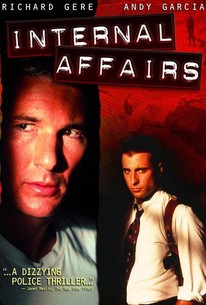
Internal Affairs poster

Internal Affairs

115 minutes

Cast

Selected cast credits · Film reference

Richard Gere Dennis Peck
Andy Garcia Raymond Avilla
Nancy Travis Kathleen Avilla
Laurie Metcalf Amy Wallace
William Baldwin Van Stretch
Michael Beach Dorian Fletcher
Faye Grant Penny Stretch
Katherine Borowitz Tova Arrocas
John Kapelos Steven Arrocas
Xander Berkeley Rudy Mohr
Allan Havey Judson
Julio Oscar Mechoso Cousin Gregory
Marco Rodriguez Demetrio
Annabella Sciorra Heather Peck
Ron Vawter Jaegar
Elijah Wood Sean Stretch

Internal Affairs | The Rewatchables

Explore episodeClose episode

Producer credits not yet identified.

Probably Unanswerable Questions

Van Stretch’s name; wives seeking novelty; murder-for-hire prices; the burger stand; Kathleen’s underwear.

In the discussion (5)
Approx. transcript time · 00:22:19Read transcript
  • Is Van Stretch his full name or a surname like Van Horn? The panel believes Van is his given name.
  • Whether all wives seek something new remains unanswered.
  • What is the fair 1990 price for killing wealthy parents? The hosts suggest roughly $40,000–75,000 while questioning what Peck actually received.
  • Where is the burger-and-prostitution hangout? Downtown and the Beverly–Alvarado area are proposed without resolution.
  • Peck apparently stole Kathleen's underwear by breaking in; the hosts question whether Raymond would recognize it immediately.


Roger Ebert's review

Rating not yet verified
In the discussion (1)
Approx. transcript time · 00:26:16Read transcript
  • No written review was located; the television review praised the personalities and Gere's performance. The host guesses three or three-and-a-half stars rather than citing a confirmed score.

Most Rewatchable Scene

The first Dennis–Raymond encounter; the jealousy sequence through the elevator fight.

In the discussion (11)
Approx. transcript time · 00:30:23Read transcript
  • The middle hour is praised as the film's strongest stretch; the first nominated scene is Raymond meeting Dennis at the taco stand.
  • Dennis turns Raymond's insinuation about Penny into an intimate attack on his own marriage, blurring manipulation with apparent friendly advice.
  • Dennis's speech that all wives seek something new is a memorable part of the taco-stand encounter.
  • The taco-stand scene reveals Peck's real nature after earlier scenes present him as a helpful father figure to colleagues.
  • Dennis meets the Arrocas, fondles the wife while the husband asks him to kill his parents, and converts the secret into leverage; John Kapelos's awkwardness is praised.
  • The second Dennis–Raymond encounter deliberately provokes punches with explicit sexual taunts. The first encounter is considered subtler and harder to perform.
  • The camera pulls back during Van's phone call to reveal Penny having sex with Dennis, a shocking and sad reveal.
  • Dennis arranges Van's shooting, kills the shooter and finishes Van as he pleads to return to his child; the initially abusive man becomes sympathetic.
  • The later shootout and chase are solid additional action scenes.
  • Raymond's jealousy after Dennis's lunch with his wife leads to the elevator ambush and brutal sexual taunts.
  • Final preferences divide between the first restaurant encounter and the jealousy-to-elevator sequence, whose sudden danger resembles horror.

What’s Aged the Best?

Evidence planting; menswear and haircuts; Los Angeles; Figgis; Metcalf; marriage tension; co-parenting; revised ending; mall security; cuckolding.

In the discussion (13)
Approx. transcript time · 00:45:11Read transcript
  • Evidence planting remains an effective fictional device, especially before ubiquitous cameras and phones.
  • The good investigator beginning to resemble the corrupt man he pursues.
  • Off-duty menswear, including Gere's polo and sunglasses, remains contemporary.
  • Figgis contributing music and appearing as Nancy Travis's dinner companion.
  • Los Angeles as a vibrant crime-film setting, and Gere and Garcia's early-1990s haircuts.
  • Laurie Metcalf excels despite a limited role and has strong chemistry with Garcia.
  • The unusual sexual slang root, made ironic by Peck's affair with Van's wife.
  • Unfinished suburban developments as crime-film locations and suspiciously expensive houses revealing corruption.
  • Faye Grant's performance and the tense Garcia–Travis marriage, with her sexual frustration and his fixation on work.
  • Peck's unconventional co-parenting and the dirty-cop excuse that a woman is his informant.
  • Replacing the convoluted original ending, with a threatened assault, shooting, window fall and apparent drowning, after hostile test reactions.
  • Xander Berkeley as Rudy and cops forced to work second jobs as mall security.
  • The cuckolding theme is much more widely recognized in contemporary culture.

The Great Shot Gordo Award for Most Cinematic Shot

Van’s death with the approaching ambulance; the under-table touch; Penny’s phone-call reveal.

In the discussion (3)
Approx. transcript time · 00:54:24Read transcript
  • Peck choking Van as the ambulance approaches behind him, reflected lights visible on the door.
  • The rear view of Peck touching Mrs. Arrocas's leg with her husband between them.
  • The pullback revealing Penny atop Dennis during the phone call.

The Vincent Chase Award: Are We Sure This Character Is Actually Good at Their Job?

Raymond as an investigator; Kathleen as an art dealer and spouse.

In the discussion (2)
Approx. transcript time · 00:55:42Read transcript
  • Raymond quickly goes rogue, fights outside City Hall and stalks his wife rather than conducting a sound investigation.
  • Raymond's wife is questioned as an art dealer who can disappear for lunch and shopping, and for not warning him that his colleague requested a private lunch.

What’s Aged the Worst?

Domestic violence, Amy’s lost authority, old computers, missing boxing and nightclub scenes, and lost Raiders tickets.

In the discussion (8)
Approx. transcript time · 00:57:54Read transcript
  • The film treats possessive obsession and violence as evidence of love.
  • Taking the officer's Raiders tickets denies him a chance to see peak Bo Jackson and sends him to mall duty instead.
  • Old police computers with green text.
  • The cousin's nightclub scene is too brief to explore its world.
  • Veteran investigator Amy inexplicably lets Raymond take over, with his physical assertion of power carrying a sexual charge.
  • A boxing-training scene could establish Raymond's toughness; his actual fighting offers little support for his reputation.
  • The film's overall attitude toward domestic violence is condemned.
  • Garcia's angry laughing mannerism is enjoyed but questioned as an effective reaction to his wife.

Recasting Couch

Swap Sciorra and Travis; Reeve, Johnson, Ford, Denzel or modern-day Gosling as Peck.

In the discussion (4)
Approx. transcript time · 00:59:36Read transcript
  • Swap Annabella Sciorra and Nancy Travis: Sciorra's passion and contrast with Peck would strengthen Raymond's marriage story.
  • Christopher Reeve is an intriguing against-type option; Don Johnson has the right appeal, though his acting range is questioned. Harrison Ford is another preferred alternative.
  • Denzel Washington could play Peck, but the racial dynamics would make a substantially different movie.
  • Ryan Gosling is the modern Peck choice, with Murder by Numbers recalled as evidence he can play a villain.

Is This Movie Better With…?

Byron Mayo; Ramon Raymond proposed as a future option.

In the discussion (2)
Approx. transcript time · 01:03:59Read transcript
  • Ramon Raymond is proposed as a recurring addition to the category's stock characters.
  • Wayne Jenkins is almost too scandalized by these cops; Byron Mayo instead proposes gathering the characters over oysters at an unfinished house.

Advanced Analytics Award

Peck’s estimated 11 deaths to five sexual partners: 2.2, with uncertainty.

In the discussion (1)
Approx. transcript time · 01:06:10Read transcript
  • A proposed advanced-analytics award compares Peck’s estimated 11 deaths with five sexual partners, yielding 2.2. Amy’s uncertain survival qualifies the count, and the list includes claimed rather than confirmed sex.

The Stephen A. Smith Hottest Take Award

Internal affairs deserves more credit; Tova may be the true villain.

In the discussion (2)
Approx. transcript time · 01:07:27Read transcript
  • Internal affairs is more worthwhile work than films admit; police-centered storytelling makes accountability officers look like obstructive snitches and encourages sympathy for Peck.
  • Tova may be the true villain, engineering the deaths of her husband's parents and then her husband.

Casting What-Ifs

Nick Nolte declined Peck; the extensive other-candidate list is treated skeptically.

In the discussion (2)
Approx. transcript time · 01:10:23Read transcript

The Joey Pants “That Guy” Award

John Kapelos; Marco Rodriguez and the cousin at the bar are alternatives.

In the discussion (2)
Approx. transcript time · 01:13:25Read transcript

Half-Assed Internet Research

Deleted bar scene, cars, Daryl Gates’s condemnation and Faye Grant’s later marriage history.

In the discussion (4)
Approx. transcript time · 01:16:03Read transcript
  • A deleted bar scene has Raymond and Peck discussing the desire to be bad while an informant strips; the hosts would like it restored if placed appropriately.
  • Peck drives a 1963 Chevrolet Sting Ray and Amy a Volkswagen convertible.
  • LAPD chief Daryl Gates condemned the film.
  • Faye Grant's marriage to Stephen Collins and their divorce following child-sexual-abuse allegations are discussed as an unhappy later-life association.

Apex Mountain

Richard Gere and Andy Garcia in 1990; cops sleeping with partners’ wives; slapping.

In the discussion (8)
Approx. transcript time · 01:17:32Read transcript
  • Gere is affirmed for the 1990 combination with Pretty Woman, and Garcia for the same year's Godfather Part III combination.
  • Billy Baldwin is rejected in favor of Backdraft or the film described as Thief of Hearts in the transcript.
  • The Valley receives a suggested case for looking cool and wild, contrasted with Boogie Nights and Magnolia.
  • Dirty Los Angeles cops is debated against Colors, The Onion Field and L.A. Confidential. Internal affairs and cops moonlighting as hitmen are floated without a clear final declaration.
  • Nancy Travis loses to So I Married an Axe Murderer; Metcalf and Sciorra are rejected; Faye Grant gets only a probable yes.
  • Imagining one's wife with another man loses to Indecent Proposal after comparisons with The Best Man, The Big Picture and Unfaithful.
  • Cops sleeping with partners' wives and slapping in movies receive affirmative answers.
  • Gere is tentatively proposed as the apex of an attractive villain, without a firm conclusion.

Picking Nits

Unsupervised Raymond, Arrocas’s wealth, the phone call, Peck’s children and criminals’ instant knowledge.

In the discussion (6)
Approx. transcript time · 01:21:08Read transcript
  • Raymond's fights and erratic behavior receive no apparent supervision.
  • Arrocas already owns a Malibu home, making the urgency of murdering his parents for business control difficult to understand; elapsed time is unclear.
  • Penny could let the phone ring during sex; the counterargument is that an unanswered call might make her husband suspicious or bring him home.
  • Murdering his parents seems an extreme business solution for Arrocas, though Tova may be driving the scheme.
  • Eight children with another on the way seems excessive for Peck's age, though starting young offers an explanation.
  • Criminal contacts instantly know details of a secret shooting despite only a few participants knowing the plan, an unexplained genre convention.

Sequel, Prequel, Limited Series, or All-Black Remake

A revisionist pro-Peck documentary; a sequel about his grown children.

In the discussion (2)
Approx. transcript time · 01:28:58Read transcript
  • A revisionist documentary could portray Peck as a loving father and relationship fixer, recutting Garcia as the villain.
  • A sequel follows Peck's grown children terrorizing Los Angeles in the late 2000s, blaming their father and perhaps sharing an influencer house.

More from the conversation

Chris Ryan's Durham Bulls cap and Van Lathan's cowboy hat introduce the panel before the film trailer.
Approx. transcript time · 00:01:44Read transcript
The film combines police corruption with an unusually extreme psychosexual thriller; Gere's sexually predatory charisma makes it uncomfortable to watch with others nearby.
Approx. transcript time · 00:03:02Read transcript
Dirty-cop favorites include The Departed, Training Day, Cop Land, Serpico, The French Connection, The Seven-Ups and Prince of the City.
Approx. transcript time · 00:05:55Read transcript
Peck's many criminal activities include extortion, alliances with criminals and pimps, and hired killing; the precise pimp relationship remains unclear.
Approx. transcript time · 00:06:48Read transcript
Peck's constant sexual activity, including his ex-wife, contrasts with the film's effective Los Angeles crime story; his charisma makes the excess believable.
Approx. transcript time · 00:07:44Read transcript
Annabella Sciorra's beauty and later career frame the breakfast scene where Peck's current and former wives interact; his treatment of Michael Beach's character shows manipulative charisma.
Approx. transcript time · 00:09:05Read transcript
Gere's performance is ranked alongside An Officer and a Gentleman, above American Gigolo's simpler charisma, with Pretty Woman illustrating his ability to remain likable.
Approx. transcript time · 00:10:13Read transcript
1990 is presented as Gere's comeback after many failures and Garcia's ascent with this film and The Godfather Part III.
Approx. transcript time · 00:11:06Read transcript
Garcia and Ray Liotta seemed one role away from greater stardom; Garcia's ethnicity and limited opportunities may have mattered despite his leading-man qualities.
Approx. transcript time · 00:11:59Read transcript
Gere and Garcia's rivalry combines acting competition with sexual power; leading men may resist playing the man whose wife another actor can seduce.
Approx. transcript time · 00:13:45Read transcript
The actors reportedly disliked one another, with extra force in the elevator fight and an uncertain story that Garcia skipped the wrap party.
Approx. transcript time · 00:15:50Read transcript
The film predates the Rodney King-era shift in how audiences view police corruption; Training Day and Colors provide contrasts.
Approx. transcript time · 00:16:31Read transcript
Dirty-cop television comparisons include We Own This City, The Shield and The Wire, whose humanized officers still commit violence and corruption.
Approx. transcript time · 00:18:27Read transcript
Billy Baldwin's early run through Flatliners, Backdraft, Three of Hearts and Sliver gave way to diminished opportunities; his good looks may have limited gritty credibility.
Approx. transcript time · 00:19:42Read transcript
Alec and Billy Baldwin's overlapping careers raise whether one displaced the other, with Malice an example of Alec's more serious roles.
Approx. transcript time · 00:21:08Read transcript
Bad Lieutenant is judged more forced and less rewatchable in its depravity than Internal Affairs.
Approx. transcript time · 00:22:02Read transcript
Van recalls rarely seeing his name in films and being called Van Wilder in college.
Approx. transcript time · 00:22:19Read transcript
Mike Figgis is characterized as a provocative studio filmmaker interested in sexual psychology; the film remains modern apart from phones and the shootout.
Approx. transcript time · 00:23:24Read transcript
Its desperate sexuality and corrupted setting are compared with Leaving Las Vegas, leading to hypothetical Rock Bottom Month titles and sponsor jokes.
Approx. transcript time · 00:24:39Read transcript
The source states a $50 million budget and $47.7 million gross, then calls it successful; this internally awkward machine-transcript number is not independently corrected.
Approx. transcript time · 00:25:41Read transcript
Cable edits dilute Peck and make the black-and-white imagined footage confusing.
Approx. transcript time · 00:25:55Read transcript
The police premise becomes a story about power, manipulation and marriages; Ghost and Bad Influence illustrate comparable dynamics outside policing.
Approx. transcript time · 00:26:37Read transcript
Single White Female prompts a debate about erotic-thriller classification and prospective coverage.
Approx. transcript time · 00:28:43Read transcript
Garcia's character is addressed as both Ramon and Raymond, and the hosts settle on Raymond for their discussion.
Approx. transcript time · 00:30:42Read transcript
Peck's favors bind colleagues and criminals into relationships he controls.
Approx. transcript time · 00:37:34Read transcript
L.A. Confidential is added to the dirty-cop film discussion, specifically its planted-gun execution.
Approx. transcript time · 00:45:56Read transcript
The city's geography seems traversable unusually quickly, perhaps because of night shifts.
Approx. transcript time · 00:47:39Read transcript
Blue Steel's serial-killer plot leads to a story about interviewing Ron Silver and bonding over Silent Rage.
Approx. transcript time · 00:52:27Read transcript
The phone-call reveal made a host's partner leave the room despite her initial interest in a Gere film.
Approx. transcript time · 00:55:00Read transcript
A participant's former-police-officer father called internal affairs the rat squad but said his smaller department accepted the rotating assignment.
Approx. transcript time · 01:05:24Read transcript
The Baldwin-era casting list prompts discussion of Don Johnson's The Hot Spot and Reeve's Superman IV choice.
Approx. transcript time · 01:11:19Read transcript
A brief Beverly Hills 90210 digression asks why Dylan's father was wealthy.
Approx. transcript time · 01:14:34Read transcript
Potential theme months include sex work, prison, dirty cops, Nancy Travis and canceled movies; no theme is assigned to this episode.
Approx. transcript time · 01:20:02Read transcript
A fictional Los Angeles movie-location map and working from a burger parking lot are imagined.
Approx. transcript time · 01:33:05Read transcript
Craig's first viewing leaves him rooting for Gere because Garcia is unlikable; the film gains momentum after a slow opening.
Approx. transcript time · 01:35:36Read transcript
The hosts wish more leading men played villains, citing Ford, Willis and Damon, and contrast Gere's sexual charisma with modern stars.
Approx. transcript time · 01:36:32Read transcript
Peck's charisma, taunting to the end and dying claim about loving his children sustain the hosts' fascination.
Approx. transcript time · 01:39:11Read transcript
The closing production credit is badly transcribed as Greg Greilback; official metadata is needed for any identity normalization. April's theme remains undecided.
Approx. transcript time · 01:40:18Read transcript