
‹ All movies

The ending

Offered the ending, the lunch in Guantanamo Bay, or Cruise and Bacon meeting for a beer, one panelist calls the last scene the best last scene of a movie ever but, despite hating to be too cute about these answers, goes with the Guantanamo Bay lunch as the sneaky choice.

Another likens the question to picking the home run scene in The Natural, then, getting cute, names the favorite interaction as Jack and Caffey getting a beer that ends with 'you're a lousy fucking softball player'.

"I like all you navy boys every time we got to go someplace to fight you fellas always give us a ride"

Nominees include 'these are the facts of the case and they are indisputable', 'I'm sorry I lost your set of steak knives' (prompting a Glenn Gary (as transcribed) and Ginsu knives aside), the 'you want me on that wall, you need me on that wall' speech, 'we live in a world that has walls', the softball-player line, a profane threat from Jessup, 'you, Lieutenant Weinberg' and 'thank you for playing'.

The film

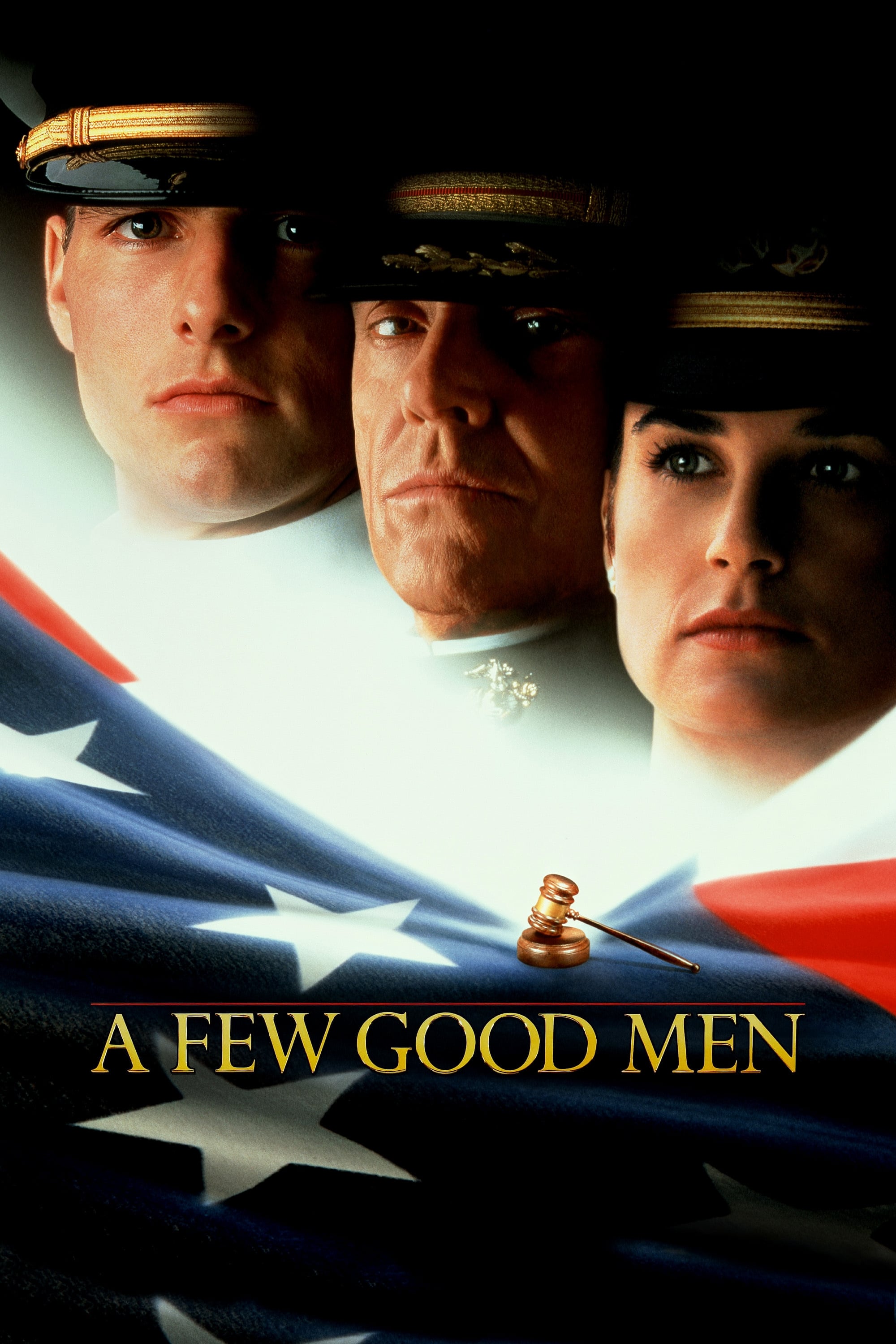
A Few Good Men (1992)

Directed by Rob Reiner · Drama

138 minutes

Cast

Selected cast credits · Film reference

Tom Cruise Daniel Kaffee
Jack Nicholson Nathan Jessep
Demi Moore JoAnne Galloway
Kevin Bacon Jack Ross
Kevin Pollak Sam Weinberg
James Marshall Louden Downey
J.T. Walsh Matthew Markinson
Kiefer Sutherland Jonathan Kendrick
Christopher Guest Dr. Stone
J.A. Preston Judge Randolph
Matt Craven Dave Spradling
Wolfgang Bodison Harold Dawson
Xander Berkeley Whitaker
Noah Wyle Jeffrey Barnes
Cuba Gooding Jr. Carl Hammaker
Lawrence Lowe Bailiff
Josh Malina Orderly
Oscar Jordan Steward
Aaron Sorkin Man in bar
Al Wexo Guard2
Jan Munroe Jury foreman
Matthew Saks David
Harry Caesar Luther
Michael DeLorenzo William Santiago
Arthur Senzy Robert McGuire
Cameron Thor Lawrence
David Bowe Gibbs
Gene Whittington Mr. Dawson
Maud Winchester Aunt Ginny

Everything from the episode

In the order the hosts got to it. Open a row for the discussion.

16:55

Half-Assed Internet Research

Kiefer Sutherland clipped Marines while driving a Jeep; Ebert gave it two and a half stars; Nicholson did 40 to 50 ta...

Kiefer Sutherland clipped Marines while driving a Jeep; Ebert gave it two and a half stars; Nicholson did 40 to 50 takes of the code red scene; it cost $30 million and made $230 million; Jason Alexander was meant to play Sam Weinberg; Sorkin wrote it on bar napkins and bought an early Macintosh with his roommates; Dawson's actor was Reiner's assistant; Sorkin cameos as a lawyer at the bar

In the discussion (7)
Approx. transcript time · 00:16:55Read transcript
  • Kiefer Sutherland drove the military Jeep so badly that he clipped a couple of Marines and scenes had to be redone, though he drives in only one scene, perhaps rewritten so Noah Wiley drove.
  • Ebert's two-and-a-half-star review, which said the film telegraphed the ending, is noted and rejected.
  • Nicholson did 40 to 50 takes of the 'you can't handle the truth' code red scene and kept performing during everyone else's coverage, telling the crew he loves to act, which becomes a joke about loving to podcast.
  • Unlike productions full of casting stories and disasters, nothing went wrong here: it cost 30 million, made 230 million, Nicholson cost a lot, everyone calls it their best experience, and Reiner's directing is joked down to pointing the camera at the movie stars.
  • Jason Alexander was supposed to play Sam Weinberg until season 2 of Seinfeld was picked up; Plan B was Kevin Pollard (as transcribed).
  • Sorkin wrote it on bar napkins at a bar off Broadway, he and his roommates chipped in to buy an early Macintosh to write the script, and Dawson was Reiner's assistant.
  • Sorkin was a bartender and appears in the film as the lawyer at the bar; the hosts like writers and directors showing up in their own movies, citing Oliver Stone as a football announcer and Scorsese playing the creepiest guy, though Sorkin has ten seconds too much dialogue, out of focus but clearly audible.
17:27

Roger Ebert's review

In the discussion (1)
Approx. transcript time · 00:17:27Read transcript
  • Ebert only gave it two and a half stars, saying it telegraphed the ending; the host reporting it disagrees and asks how he dares.
31:09

Probably Unanswerable Questions

Bigger impact in fewest minutes, Jessup or Lecter? What position did Caffey play? Did Sam Weinberg mail it in? Who is...

Bigger impact in fewest minutes, Jessup or Lecter? What position did Caffey play? Did Sam Weinberg mail it in? Who is treated more like a subordinate? Can you make a flight disappear? Did Caffey and Galloway end up together? Which on-the-rise actor should have played Harold? What if Jessup never admits it? Was the code red scene Cruise's career highlight? Did Santiago kind of deserve to die?

In the discussion (17)
Approx. transcript time · 00:31:09Read transcript
  • Bigger impact in the fewest minutes, Nicholson's Jessup or Anthony Hopkins's Lecter: Jessup, since Hopkins is in jail most of that movie while Jessup has three scenes (the letter, the lunch, the ending); Lecter is put at about 18 minutes and Jessup at 11 or 12.
  • The usage-rate joke gives Nicholson a 12-for-13 line with eight threes, ten rebounds and nine assists in 12 minutes, very Iguodala game six.
  • Caffey's softball position: as player-coach probably shortstop, or second base, a middle infielder either way, while Herby (as transcribed) wants shortstop and the others grumble.
  • Did Sam Weinberg mail it in? Yes: nobody found out Downey was not there to hear the order, and while a spouse watching blamed Joe Galloway, preparing witnesses was Weinberg's one job.
  • That is a big hole in the movie; Sam is also dunked on hardest when, after Joe storms out and Daniel trashes the apartment, he starts tidying and is told to stop, like a houseboy.
  • A speech shortly after about Caffey's father, meant to be motivational, backfires, since the father is recalled as an attorney general who did Brown v. Board: with a life on the line one would pick the father over the son who settles every case; Cruise is weirdly casual in a military court, as in his 'just ain't so' opening statement.
  • The panel agrees Weinberg mailed it in: uncommitted until late in the trial, thinking the defendants were bullies, useful as a middle position that tempers Sorkin's ideology but useless as a lawyer.
  • Asked who gets sent for legal pads, pens and lamps and who is treated more like a subordinate, Sam or Joe, the answer is Joe; whether an entire flight can be erased from the logs without the internet never sits right.
  • Did Caffey and Galloway end up together or ever hook up? No; a third draft of Sorkin's script had him ask her on a date with a matching-socks callback, which one panelist prefers to 'The End' in big script letters.
  • The objection is that they have less than zero chemistry, which leads to asking who Cruise has chemistry with at all, even Nicole Kidman in Days of Thunders (as transcribed), before a joke that they hooked up once after a softball game.
  • Caffey's love life is floated and the answer offered is that he is asexual or too busy with work.
  • Which on-the-rise Black actor of 1991 would have been better as Harold: the role has about ten big scenes, Cuba Gooding could have done it, the actor had to be big because Dawson leads the troop, and Morris Chestnut would make little difference and was not known then.
  • What if Jessup never admits the code red: Caffey (transcribed as Kathy) goes to jail or is court-martialed and ends up coaching softball; in a real-life version the marshals come in, Bacon's character would not allow it, and it is game over once contempt is called.
  • Caffey almost does not go for it until Jessup taunts him about phone records and toiletries; the realization that Santiago did not pack, prompted by seeing his own shirts in the closet, is praised against the usual bird-across-the-sky light-bulb moments.
  • Was the code red scene the highlight of Cruise's career? He goes toe to toe with a multiple Oscar winner, Sean's view that Cruise beats Nicholson is held for later, and no single Cruise scene is better, not 'You complete me', Top Gun, the barman's poet in Cocktail or the Risky Business dance; it is called his career highlight.
  • Whether Joe Galloway set back the women's movement by one, three or five years is answered with 'Demi Moore might have' and pushed to Picking Nits.
  • Did Santiago (transcribed as San Diego) kind of deserve to die? Answers range from no to just a tiny bit; one panelist inches closer each viewing to thinking Jessup has a point, since the private could not keep up, ratted on his troop and broke the chain of command, and another goes that far but not to deserving to die.
41:15

Picking Nits

Putting Jessup on the stand; Caffey calling Jessup a son of a bitch in court; whether Joe Galloway was a terrible law...

Putting Jessup on the stand; Caffey calling Jessup a son of a bitch in court; whether Joe Galloway was a terrible lawyer; who should have played Joe Galloway

In the discussion (13)
Approx. transcript time · 00:41:15Read transcript
  • Putting Jessup on the stand was insane: they gamble six months and their careers on a fake-out with the two airmen whom Sam almost fails to get to court in time, a huge bluff that, like Rounders, is fun to rewatch even knowing how it ends.
  • Cruise's 'Don't call me son. I'm a lawyer and an officer in the United States Navy, and you're under arrest, you son of a bitch' would not really happen in court, though another notes the formality had already gone once Nicholson was screaming his own threats.
  • Was Joe Galloway a terrible lawyer? A prepared list argues she is good: she knows what a code red is, a quote from her advisors calls her a hell of an investigator, and she memorizes extensive biographical details.
  • The list continues: she believes in due process, unlike Caffey's '12 years and out in six' deals, and at the Gitmo lunch she angers Jessup into admitting off the record that he condones code reds and will take any bait, which becomes the winning strategy.
  • Further points: being a lawyer is client services, she is not friends with the prosecution, she has the idea to put Jessup on the stand, and she is never held in contempt; she is not a litigator in a film about litigation as performance, so she gets no credit, but he would not win without her and she motivates him.
  • Non-legal points in her favor: her jeans are back in style, she has great taste in bar-and-grills such as the crab shack, her hair, the business suit she wears off duty on the first night with the tower logs and Chinese food, and Malcolm X glasses worn in one scene.
  • The 'twice as hard as you' dynamic is called a good foil for Cruise's character and an honest picture of a woman in that workplace, making her one of the best Sorkin female characters despite the disrespect; 'I strenuously object' is bad, but she earns credit for the 'exceptional lawyer' speech that pumps Cruise up, and a host wishes Ringer colleagues gave speeches like that.
  • The case against her: she is blamed for Downey, having befriended Aunt Ginny without learning Downey was not in the room; the reply is that Weinberg did witness prep, Caffey was lead counsel, and the defendants never volunteered anything they were not asked, which is when Cruise freaks out.
  • 'Strenuously object' is her scarlet letter, before she was in The Scarlet Letter, along with saying 'we're going to win'; one panelist calls it a bad performance with Demi Moore miscast.
  • Julia Roberts is floated as better, though she could not have been cast for the same reason as Bacon's haircut; Roberts and Cruise never made a movie together; asked to split the blame 65 to 35 between Demi Moore and Sorkin or blame 1991, the answer is that it is majority Demi Moore's fault.
  • In a 2017 version the character could not just be stuck in middle-management paperwork; one suggestion flips it, making Caffey a woman and Joe Galloway a man.
  • Jodie Foster was also up for the role, with one other name forgotten; Foster with Cruise is mocked as having no chemistry, measured against McConaughey and Foster in Contact and Helen Hunt with Nicholson in As Good as It Gets.
  • The Galloway question is left unsolved but seeds are planted; with Julia Roberts getting every part back then, Linda Hamilton in Terminator 2 shape is suggested as a good alternative.