
‹ All movies

The ending

Offered the ending, the lunch in Guantanamo Bay, or Cruise and Bacon meeting for a beer, one panelist calls the last scene the best last scene of a movie ever but, despite hating to be too cute about these answers, goes with the Guantanamo Bay lunch as the sneaky choice.

Another likens the question to picking the home run scene in The Natural, then, getting cute, names the favorite interaction as Jack and Caffey getting a beer that ends with 'you're a lousy fucking softball player'.

"I like all you navy boys every time we got to go someplace to fight you fellas always give us a ride"

Nominees include 'these are the facts of the case and they are indisputable', 'I'm sorry I lost your set of steak knives' (prompting a Glenn Gary (as transcribed) and Ginsu knives aside), the 'you want me on that wall, you need me on that wall' speech, 'we live in a world that has walls', the softball-player line, a profane threat from Jessup, 'you, Lieutenant Weinberg' and 'thank you for playing'.

The film

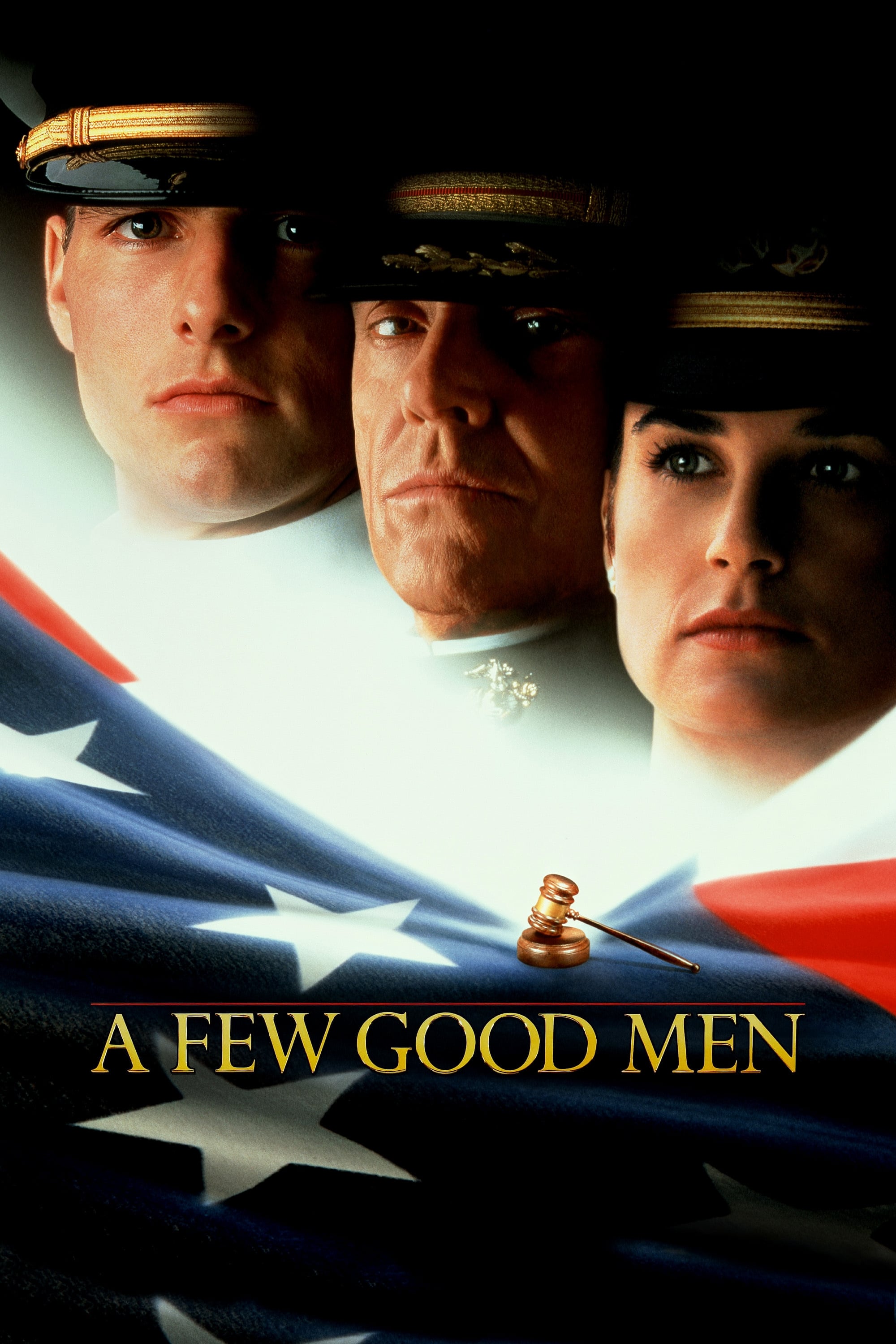
A Few Good Men (1992)

Directed by Rob Reiner · Drama

138 minutes

Cast

Selected cast credits · Film reference

Tom Cruise Daniel Kaffee
Jack Nicholson Nathan Jessep
Demi Moore JoAnne Galloway
Kevin Bacon Jack Ross
Kevin Pollak Sam Weinberg
James Marshall Louden Downey
J.T. Walsh Matthew Markinson
Kiefer Sutherland Jonathan Kendrick
Christopher Guest Dr. Stone
J.A. Preston Judge Randolph
Matt Craven Dave Spradling
Wolfgang Bodison Harold Dawson
Xander Berkeley Whitaker
Noah Wyle Jeffrey Barnes
Cuba Gooding Jr. Carl Hammaker
Lawrence Lowe Bailiff
Josh Malina Orderly
Oscar Jordan Steward
Aaron Sorkin Man in bar
Al Wexo Guard2
Jan Munroe Jury foreman
Matthew Saks David
Harry Caesar Luther
Michael DeLorenzo William Santiago
Arthur Senzy Robert McGuire
Cameron Thor Lawrence
David Bowe Gibbs
Gene Whittington Mr. Dawson
Maud Winchester Aunt Ginny

Everything from the episode

In the order the hosts got to it. Open a row for the discussion.

6:24

Most Rewatchable Scene

The ending; the Guantanamo Bay lunch; Jack and Caffey's beer

The ending; the Guantanamo Bay lunch; Jack and Caffey's beer

In the discussion (9)
Approx. transcript time · 00:06:24Read transcript
  • Offered the ending, the lunch in Guantanamo Bay, or Cruise and Bacon meeting for a beer, one panelist calls the last scene the best last scene of a movie ever but, despite hating to be too cute about these answers, goes with the Guantanamo Bay lunch as the sneaky choice.
  • Another likens the question to picking the home run scene in The Natural, then, getting cute, names the favorite interaction as Jack and Caffey getting a beer that ends with 'you're a lousy fucking softball player'.
  • In the bar, Cruise orders simply 'a beer' and makes a big show of refusing the frosted glass, which suggests he had never really done bar interactions on screen; the Vin Diesel beer tilt from the Fast and Furious films is the comparison.
  • One panelist agrees the ending is the best and the most rewatchable, but says you cannot sleep on the Guantanamo Bay scene.
  • The lunch makes them want the deleted small talk; Kendrick, whom Sean Phenasy (as transcribed) called 25 years early for what the alt-right looked like in 2016, is played by Kiefer Sutherland, hard to believe as the future Jack Bauer and the guy from The Vanishing, in a supporting part he was probably too big for.
  • Kiefer slummed it, and Bacon a little too; the hosts recall the Flatliners period and the collapse of the wedding with Julia Roberts, 'the all time greatest getting left at the altar story'.
  • Kendrick never cracks a smile, and when they ask to see the room where Santiago died he says the private died because he had no honor, no code.
  • A fourth alternative is Jessup reading Santiago's letter, asking who PFC William Santiago is and sarcastically proposing they surrender their position in Cuba; Josh Malina is in that scene too.
  • At the lunch Kendrick laughs only once, at Jessup's crude joke to Demi Moore's character about a superior officer, which TV prints cut; the hosts think it belongs because it shows how vicious Jessup is, and joke about a milder substitute word.
11:05

What’s Aged the Best?

Cruise's 'why the two orders' brainstorm; the mess hall cross-examination; Harold and Caffey at the end

Cruise's 'why the two orders' brainstorm; the mess hall cross-examination; Harold and Caffey at the end

In the discussion (9)
Approx. transcript time · 00:11:05Read transcript
  • Nominees: the ending, the 'galactically stupid' tirade when a drunk Cruise loses it on Demi Moore, the mess hall cross-examination that Bacon later praises as a great redirect, Cruise's Nicholson impersonation, Harold's 'ten hut' with Cruise, the 'why the two orders' brainstorm in the Jessup cross, and Jack Ross's face at Jessup's code red admission.
  • Like a decanted wine, the subtler moments should age best, which rules out Cruise doing Nicholson, since people their age have spent their lives watching others imitate Nicholson.
  • 'Why the two orders' always gets one panelist, and another answers 'me too'.
  • Picks the mess hall cross-examination: rewatched it last night, it is subtle and lands every time, and the way Cruise grabs the notebook back from Kevin Bacon is peak Cruise swagger. — Amanda Dobbins
  • The scene has an early Noah Wiley (as transcribed), later important on ER, and shows the cleverness of the script solving problems without being showy or straining plausibility.
  • Another pick is Harold and Cruise's character finding common ground at the end, which still gives chills on the 557th viewing: 'Harold, you don't have to have a badge to have honor' and the 'Ten Hut'; Harold is never seen again.
  • The actor playing Harold appeared in a couple of nineties action movies and is believed to have been Rob Reiner's assistant before being thrown into the film.
  • The ending leaves the film dying for a coda: it is unclear how much trouble Jessup is in, unlike the court-martial that follows the submarine battle in Crimson Tide, and the two Marines are still dishonorably discharged.
  • A small flaw: after the code red admission Bacon's character later says he has to go arrest Kendrick, prompting the question of why he waited a week.
14:45

What’s Aged the Worst?

The token black newsstand guy; Cruise zoning out during the Jessup examination; the gay slurs; JT Walsh's farewell sp...

The token black newsstand guy; Cruise zoning out during the Jessup examination; the gay slurs; JT Walsh's farewell speech; Joe Galloway; Cruise rehydrating with Yoohoo

In the discussion (6)
Approx. transcript time · 00:14:45Read transcript
  • The token black newsstand guy, just shouting, is rough, and 2017 barely has newsstands.
  • Cruise melting down during the Jessup examination, with about ten extra seconds of zoning out while the water glass shakes, is too long; not even Christopher Darden did that in the OJ trial, he is already in contempt, and an edit could save it.
  • The gay slurs reflect 1991 and are rough in the unedited version, less so on TNT.
  • JT Walsh's farewell speech as Lieutenant Colonel Matthew Markinson, the letter saying the son is dead because 'I wasn't strong enough to stop it', is a tough farewell that is done in ten seconds before he shoots himself.
  • Joe Galloway is nominated but tabled as a major conversation; a sixth nominee is Cruise rehydrating with Yoohoo after softball practice, with a joke about Paul George chugging one in the playoffs and his diet of Yoohoo, Cocoa Puffs and Jack Daniels.
  • Cruise's D.C. apartment shows a TBS Padres-Braves game and then an Orioles game, each with amazing plays such as an inside-the-park home run; one panelist personally thinks Joe Galloway has aged the worst.
16:55

Half-Assed Internet Research

Kiefer Sutherland clipped Marines while driving a Jeep; Ebert gave it two and a half stars; Nicholson did 40 to 50 ta...

Kiefer Sutherland clipped Marines while driving a Jeep; Ebert gave it two and a half stars; Nicholson did 40 to 50 takes of the code red scene; it cost $30 million and made $230 million; Jason Alexander was meant to play Sam Weinberg; Sorkin wrote it on bar napkins and bought an early Macintosh with his roommates; Dawson's actor was Reiner's assistant; Sorkin cameos as a lawyer at the bar

In the discussion (7)
Approx. transcript time · 00:16:55Read transcript
  • Kiefer Sutherland drove the military Jeep so badly that he clipped a couple of Marines and scenes had to be redone, though he drives in only one scene, perhaps rewritten so Noah Wiley drove.
  • Ebert's two-and-a-half-star review, which said the film telegraphed the ending, is noted and rejected.
  • Nicholson did 40 to 50 takes of the 'you can't handle the truth' code red scene and kept performing during everyone else's coverage, telling the crew he loves to act, which becomes a joke about loving to podcast.
  • Unlike productions full of casting stories and disasters, nothing went wrong here: it cost 30 million, made 230 million, Nicholson cost a lot, everyone calls it their best experience, and Reiner's directing is joked down to pointing the camera at the movie stars.
  • Jason Alexander was supposed to play Sam Weinberg until season 2 of Seinfeld was picked up; Plan B was Kevin Pollard (as transcribed).
  • Sorkin wrote it on bar napkins at a bar off Broadway, he and his roommates chipped in to buy an early Macintosh to write the script, and Dawson was Reiner's assistant.
  • Sorkin was a bartender and appears in the film as the lawyer at the bar; the hosts like writers and directors showing up in their own movies, citing Oliver Stone as a football announcer and Scorsese playing the creepiest guy, though Sorkin has ten seconds too much dialogue, out of focus but clearly audible.
17:27

Roger Ebert's review

In the discussion (1)
Approx. transcript time · 00:17:27Read transcript
  • Ebert only gave it two and a half stars, saying it telegraphed the ending; the host reporting it disagrees and asks how he dares.
20:07

Frat Boy Number One Award for Most Unexpected A-List Cameo

Christopher Guest

Christopher Guest

In the discussion (3)
Approx. transcript time · 00:20:07Read transcript
  • Nominees are Josh Malina, Cuba Gooding Jr., Noah Wiley and Joe Mooney (as transcribed), and the presenter's own choice is Christopher Guest as the internist.
  • Guest plays it straight, explaining acidosis for five minutes when you expect a Christopher Guest bit, which is baffling; the guess is that someone called in sick and Reiner asked his best friend to come in for one day.
  • Later roles add baggage: you expect Cuba Gooding Jr. to turn into Rod Didwell (as transcribed) and Noah Wiley into a sensitive young ER doctor, while James Marshall from Gladiator and Twin Peaks is not even a 'that guy' anymore to anyone under 30.
21:08

Apex Mountain

JT Walsh; Wolfgang Bodison; Tom Cruise; Kevin Bacon; Jack Nicholson (late career)

JT Walsh; Wolfgang Bodison; Tom Cruise; Kevin Bacon; Jack Nicholson (late career)

In the discussion (10)
Approx. transcript time · 00:21:08Read transcript
  • JT Walsh gets an 'Apex for me for sure' and a second yes calling it his most infamous role, prompting a joke about how seriously the question was taken.
  • Aaron Sorkin is close but not the apex, a nice view but not the top; the first season of The West Wing and The Social Network are his apex, this film is likened to his 63-point Michael Jordan game with not a bad scene in it, and Moneyball is set aside because he rewrote somebody else's script.
  • Kevin Pollack is a no because of The Usual Suspects, which another agrees with.
  • Kevin Bacon is a no from one panelist, who calls him great and underrated here but notes how many films he has made, with The River Wild mentioned; another says no too, theorizing his bad haircut was deliberate so he would not distract from Cruise, like Kiefer's haircut, and puts his apex at Footloose, also liking him in Mystic River.
  • A third panelist disagrees with both and says this is Bacon's apex: not a meaty part but memorable, likable, with a dash of unintentional comedy, and hard to imagine anyone from that era, such as Matt Dillon, playing it without competing with Cruise.
  • Bacon was taking smaller parts in bigger movies then, as in JFK; though he is on the prosecuting side backing Jessup, he has some morality, saying he does not think the guys deserve jail but does not make that call; after an aside that his leaving the pickup game is unforgivable, a 'yes' for him is restated, possibly by the same panelist.
  • Wolfgang Bodesen (as transcribed) is a yes: 'that's the Apex for Wolfgang. I wish him well.'
  • Jack Nicholson's career overall draws four 'No' answers; then 'Late Jack Nicholson. Yes.' is offered, with one voice naming As Good as It Gets, and challenged over The Departed the late-career yes holds, because the Departed performance with its accent as a Whitey Bulger figure is called out of control and the weak link of that film.
  • Tom Cruise gets two yeses, with this chosen over Cocktail and a 'this or The Firm' aside; no one else in 30 years could bring this mix of unintentional comedy, good acting, sarcasm and bravado, Leo DiCaprio could not, though Matt Damon ten years later might have.
  • A TV version is planned for next year with Alec Baldwin, who is called amazing, but Caffey has not been cast; James Franco was rumored, a terrible idea, since the part needs an airhead who is really smart, a lawyer who plays softball, attractive but not a romantic lead; Demi Moore is left off the list as the nadir of her career.
26:32

Unintentional Comedy Award

Kevin Bacon leaving the hoops game; Joe Galloway's 'they stand on a wall' answer; Tom Cruise holding a bat

Kevin Bacon leaving the hoops game; Joe Galloway's 'they stand on a wall' answer; Tom Cruise holding a bat

In the discussion (9)
Approx. transcript time · 00:26:32Read transcript
  • Nominees start with Cruise swinging a softball bat and drunk Cruise, which may not be unintentional, though it is funny to watch him play drunk when he has clearly never had a drink.
  • More nominees: randomly anti-Semitic Jessup ('You, Lieutenant Weinberg'), Kendrick's one laugh, Kevin Pollack asking why she likes the Marines so much and Joe Galloway answering 'because they stand on a wall and they say, nothing's gonna hurt you tonight not on my watch', Bacon leaving the hoops game, and Amazon billing Wolfgang Bodison first.
  • The presenter's choice is Bacon leaving the hoops game: walking into a pickup game and shouting about doctored logbooks is a life dream, the players protest 'what the hell, Jack' at 10-8, and his slick ballet-like half turn is called Footloose training.
  • The hallway scene where she says they are going to do this and he answers no, you're not, is also very good Bacon.
  • Asked for a pick, another goes with Galloway's 'they stand on a wall' answer, noting the panel keeps dancing around the Galloway question.
  • A third pick is Cruise holding a bat, with a subsection for him shooting Nerf basketballs while asking 'where's my bat?', two sports at once.
  • Cruise's screen sports: hustling basketball in Cocktail with a shot like a six-year-old's, a suspicion he was a wrestler, All the Right Moves, football and a future Super Bowl in Oblivion, a catch in War in the Worlds (as transcribed), and volleyball in Top Gun in jeans on the beach.
  • His softball swing is too fast: the tight shot has him hitting ball after ball like a batting machine; the early grounders are fine, but the batting practice when Joe comes to talk is not.
  • A favorite nineties screenwriting trope: after 'you don't even know me', a character recites the other's résumé from memory, which one host plans to try on Amanda in their next argument.
31:09

Probably Unanswerable Questions

Bigger impact in fewest minutes, Jessup or Lecter? What position did Caffey play? Did Sam Weinberg mail it in? Who is...

Bigger impact in fewest minutes, Jessup or Lecter? What position did Caffey play? Did Sam Weinberg mail it in? Who is treated more like a subordinate? Can you make a flight disappear? Did Caffey and Galloway end up together? Which on-the-rise actor should have played Harold? What if Jessup never admits it? Was the code red scene Cruise's career highlight? Did Santiago kind of deserve to die?

In the discussion (17)
Approx. transcript time · 00:31:09Read transcript
  • Bigger impact in the fewest minutes, Nicholson's Jessup or Anthony Hopkins's Lecter: Jessup, since Hopkins is in jail most of that movie while Jessup has three scenes (the letter, the lunch, the ending); Lecter is put at about 18 minutes and Jessup at 11 or 12.
  • The usage-rate joke gives Nicholson a 12-for-13 line with eight threes, ten rebounds and nine assists in 12 minutes, very Iguodala game six.
  • Caffey's softball position: as player-coach probably shortstop, or second base, a middle infielder either way, while Herby (as transcribed) wants shortstop and the others grumble.
  • Did Sam Weinberg mail it in? Yes: nobody found out Downey was not there to hear the order, and while a spouse watching blamed Joe Galloway, preparing witnesses was Weinberg's one job.
  • That is a big hole in the movie; Sam is also dunked on hardest when, after Joe storms out and Daniel trashes the apartment, he starts tidying and is told to stop, like a houseboy.
  • A speech shortly after about Caffey's father, meant to be motivational, backfires, since the father is recalled as an attorney general who did Brown v. Board: with a life on the line one would pick the father over the son who settles every case; Cruise is weirdly casual in a military court, as in his 'just ain't so' opening statement.
  • The panel agrees Weinberg mailed it in: uncommitted until late in the trial, thinking the defendants were bullies, useful as a middle position that tempers Sorkin's ideology but useless as a lawyer.
  • Asked who gets sent for legal pads, pens and lamps and who is treated more like a subordinate, Sam or Joe, the answer is Joe; whether an entire flight can be erased from the logs without the internet never sits right.
  • Did Caffey and Galloway end up together or ever hook up? No; a third draft of Sorkin's script had him ask her on a date with a matching-socks callback, which one panelist prefers to 'The End' in big script letters.
  • The objection is that they have less than zero chemistry, which leads to asking who Cruise has chemistry with at all, even Nicole Kidman in Days of Thunders (as transcribed), before a joke that they hooked up once after a softball game.
  • Caffey's love life is floated and the answer offered is that he is asexual or too busy with work.
  • Which on-the-rise Black actor of 1991 would have been better as Harold: the role has about ten big scenes, Cuba Gooding could have done it, the actor had to be big because Dawson leads the troop, and Morris Chestnut would make little difference and was not known then.
  • What if Jessup never admits the code red: Caffey (transcribed as Kathy) goes to jail or is court-martialed and ends up coaching softball; in a real-life version the marshals come in, Bacon's character would not allow it, and it is game over once contempt is called.
  • Caffey almost does not go for it until Jessup taunts him about phone records and toiletries; the realization that Santiago did not pack, prompted by seeing his own shirts in the closet, is praised against the usual bird-across-the-sky light-bulb moments.
  • Was the code red scene the highlight of Cruise's career? He goes toe to toe with a multiple Oscar winner, Sean's view that Cruise beats Nicholson is held for later, and no single Cruise scene is better, not 'You complete me', Top Gun, the barman's poet in Cocktail or the Risky Business dance; it is called his career highlight.
  • Whether Joe Galloway set back the women's movement by one, three or five years is answered with 'Demi Moore might have' and pushed to Picking Nits.
  • Did Santiago (transcribed as San Diego) kind of deserve to die? Answers range from no to just a tiny bit; one panelist inches closer each viewing to thinking Jessup has a point, since the private could not keep up, ratted on his troop and broke the chain of command, and another goes that far but not to deserving to die.
41:15

Picking Nits

Putting Jessup on the stand; Caffey calling Jessup a son of a bitch in court; whether Joe Galloway was a terrible law...

Putting Jessup on the stand; Caffey calling Jessup a son of a bitch in court; whether Joe Galloway was a terrible lawyer; who should have played Joe Galloway

In the discussion (13)
Approx. transcript time · 00:41:15Read transcript
  • Putting Jessup on the stand was insane: they gamble six months and their careers on a fake-out with the two airmen whom Sam almost fails to get to court in time, a huge bluff that, like Rounders, is fun to rewatch even knowing how it ends.
  • Cruise's 'Don't call me son. I'm a lawyer and an officer in the United States Navy, and you're under arrest, you son of a bitch' would not really happen in court, though another notes the formality had already gone once Nicholson was screaming his own threats.
  • Was Joe Galloway a terrible lawyer? A prepared list argues she is good: she knows what a code red is, a quote from her advisors calls her a hell of an investigator, and she memorizes extensive biographical details.
  • The list continues: she believes in due process, unlike Caffey's '12 years and out in six' deals, and at the Gitmo lunch she angers Jessup into admitting off the record that he condones code reds and will take any bait, which becomes the winning strategy.
  • Further points: being a lawyer is client services, she is not friends with the prosecution, she has the idea to put Jessup on the stand, and she is never held in contempt; she is not a litigator in a film about litigation as performance, so she gets no credit, but he would not win without her and she motivates him.
  • Non-legal points in her favor: her jeans are back in style, she has great taste in bar-and-grills such as the crab shack, her hair, the business suit she wears off duty on the first night with the tower logs and Chinese food, and Malcolm X glasses worn in one scene.
  • The 'twice as hard as you' dynamic is called a good foil for Cruise's character and an honest picture of a woman in that workplace, making her one of the best Sorkin female characters despite the disrespect; 'I strenuously object' is bad, but she earns credit for the 'exceptional lawyer' speech that pumps Cruise up, and a host wishes Ringer colleagues gave speeches like that.
  • The case against her: she is blamed for Downey, having befriended Aunt Ginny without learning Downey was not in the room; the reply is that Weinberg did witness prep, Caffey was lead counsel, and the defendants never volunteered anything they were not asked, which is when Cruise freaks out.
  • 'Strenuously object' is her scarlet letter, before she was in The Scarlet Letter, along with saying 'we're going to win'; one panelist calls it a bad performance with Demi Moore miscast.
  • Julia Roberts is floated as better, though she could not have been cast for the same reason as Bacon's haircut; Roberts and Cruise never made a movie together; asked to split the blame 65 to 35 between Demi Moore and Sorkin or blame 1991, the answer is that it is majority Demi Moore's fault.
  • In a 2017 version the character could not just be stuck in middle-management paperwork; one suggestion flips it, making Caffey a woman and Joe Galloway a man.
  • Jodie Foster was also up for the role, with one other name forgotten; Foster with Cruise is mocked as having no chemistry, measured against McConaughey and Foster in Contact and Helen Hunt with Nicholson in As Good as It Gets.
  • The Galloway question is left unsolved but seeds are planted; with Julia Roberts getting every part back then, Linda Hamilton in Terminator 2 shape is suggested as a good alternative.
50:54

Greatest Exchange

The 'you can't handle the truth' exchange; the 'why the two orders' shouting match

The 'you can't handle the truth' exchange; the 'why the two orders' shouting match

In the discussion (5)
Approx. transcript time · 00:50:54Read transcript
  • Three choices: 'You want answers. I want the truth. You can't handle the truth'; 'Harold, you don't need to wear a patch in your arm to have honor' followed by 'Ten hut. There's an officer on deck'; and 'Did you order the code red?' answered 'you're goddamn right I did'.
  • One panelist's favorite is the 'why the two orders' moment, when everyone gets up and shouts at once, staged so each voice is audible, ending with Cruise's 'you cut these guys loose' as the hosts quote it.
  • Cruise was reportedly self-conscious about how high his voice got when yelling, audible in Risky Business, but by this film he had worked on it, joked to be with a German vocal scientist.
  • 'You want answers. I want the truth. You can't handle the truth' is called unbelievable, recalled as raising the scene to another level when watched with a daughter for the first time.
  • Asked for a favorite exchange, another says it is definitely 'you can't handle the truth', which exists outside the movie, memes before there were memes.
53:14

The Neil McCauley “A Book about Metals” Award for Best Line from the Movie

"I like all you navy boys every time we got to go someplace to fight you fellas always give us a ride"; "should we or...

"I like all you navy boys every time we got to go someplace to fight you fellas always give us a ride"; "should we or should we not follow the advice of the galactically stupid"; "you have to ask me nicely"

In the discussion (4)
Approx. transcript time · 00:53:14Read transcript
  • Nominees include 'these are the facts of the case and they are indisputable', 'I'm sorry I lost your set of steak knives' (prompting a Glenn Gary (as transcribed) and Ginsu knives aside), the 'you want me on that wall, you need me on that wall' speech, 'we live in a world that has walls', the softball-player line, a profane threat from Jessup, 'you, Lieutenant Weinberg' and 'thank you for playing'.
  • The presenter reveals a personal favorite early: the navy-boys line, a great dig full of contempt for Cruise.
  • Asked for a favorite, one panelist likes the galactically stupid line, and another, allowed to add one, says the favorite is still 'you have to ask me nicely', savored and applicable to any situation, though the impersonation is not good enough yet for office use.
  • From the same scene another adds 'I'm a fair guy, but this fucking heat is making me absolutely crazy'.
55:20

Who Won the Movie?

Tom Cruise

Tom Cruise

In the discussion (7)
Approx. transcript time · 00:55:20Read transcript
  • The question draws four quick 'Cruz' answers and 'That easy', for how much time he spends on camera running the gamut while physically doing little: funny, panicked, cool, sad.
  • Asked which athlete performance it compares to, the answer is a quarterback performance, cool and going for it when everything is on the line, followed by 'I think Cruise too'.
  • As a last question, who won the code red scene: Sean Phenasy (as transcribed 'fantasy') thought Cruise did, and one panelist agrees, citing how Cruise walks around and quietly approaches the camera while Jessup is stuck in a chair, so Nicholson works at a disadvantage.
  • Says Tom Cruise wins the movie largely because of this scene and calls it his best performance, but Nicholson owns every inch of the frame: the 'entitled' speech drips with contempt only Nicholson could deliver, and his quiet, growling, low-register power is the most powerful. — Amanda Dobbins
  • 'I think Nicholson wins. Go Nicholson' is offered with evidence from an interview in which Cruise marvels at the subtle things Nicholson did, while the reverse never happened.
  • One panelist rides or dies with Nicholson; the case made is that Cruise gives the platonic ideal of a Cruise performance, while this and The Shining are atypical late-career Nicholson unlike Chinatown and Fizey's pieces (as transcribed), catching him past his prime after Terms of Endearment, known from Lakers games, tan and clearly having fun; the section closes with 'I think Nicholson first when I think of this movie' and agreeing to disagree.
  • Asked whether the late Bacon appreciation means going rogue for Bacon, the reply is no, since he has about four scenes and is like a table in most, despite the softball line, the basketball scene and his shell-shocked look at the end; 'I just can't get off Cruise Island'.
Podcast choices

More from the conversation

The show is introduced as the first episode, built on loving to rewatch movies and talk about the same ones repeatedly; one panelist has seen the first 20 minutes only twice but the rest at least 50 times, 'spiritually 600'.
Approx. transcript time · 00:00:48Read transcript
Can bang out the lines before they come, owns the film on multiple formats as a cable rewatchable, and calls it the go-to movie to laugh or be gripped, still noticing new things.
Approx. transcript time · 00:01:23Read transcript
After a LaserDisc joke: taped off cable and watched on TNT and pay cable, the film plays as well edited as on HBO because only a couple of inappropriate comments and F-bombs are cut; it is Sorkin's first movie, adapted from his play, and builds to Cruise versus Nicholson.
Approx. transcript time · 00:01:58Read transcript
One panelist is a true Sorkin head, ranking him the favorite screenwriter across The West Wing, The Social Network and this film, having seen The American President four times in theaters at 11, a sneaky all-time great rom-com; the film is a verbal action movie.
Approx. transcript time · 00:02:46Read transcript
Loves process, jargon and professional lingo, which nobody writes like Sorkin; the film works on several levels even when the procedure is opaque, and this is Sorkin before his work got overly weighted down.
Approx. transcript time · 00:03:30Read transcript
The film captures an era when a whole movie could be a law movie, which might not get made now, a hipper version of The Verdict; released 25 years ago in December 1992, only the clothes date it, such as Bacon's Georgetown Supreme Court tank top with tube socks and Demi Moore's hair.
Approx. transcript time · 00:04:29Read transcript
Cruise was at the perfect point of his career; the nineties had a run of law movies, The Pelican Brief, The Firm, The Client and The Rainmaker (briefly confused with Rain Man), plus Scott Turow's Presumed Innocent, when Grisham was the most popular writer alive; unlike those, nobody knew what the code red was.
Approx. transcript time · 00:05:25Read transcript
The film has no references to the world outside the case beyond Guantanamo, so it could be set anytime; D.C. always looks like twilight in early fall because it is still structured like a play.
Approx. transcript time · 00:52:43Read transcript
One panelist calls this the most handsome Cruise ever; another names it a favorite cute Demi Moore performance, the military Demi being her most relatable, while her celebrity is judged larger than her filmography, with About Last Night her best acting and a cameo in Rough Night this year.
Approx. transcript time · 00:59:18Read transcript
Has nothing to add except that the conversation made the Kevin Bacon performance even more appreciated.
Approx. transcript time · 01:01:17Read transcript
The sign-off calls this the newest Ringer Podcast Network show, with future episodes in the same vein, and plugs the relaunched theringer.com.
Approx. transcript time · 01:01:51Read transcript