‹ All movies
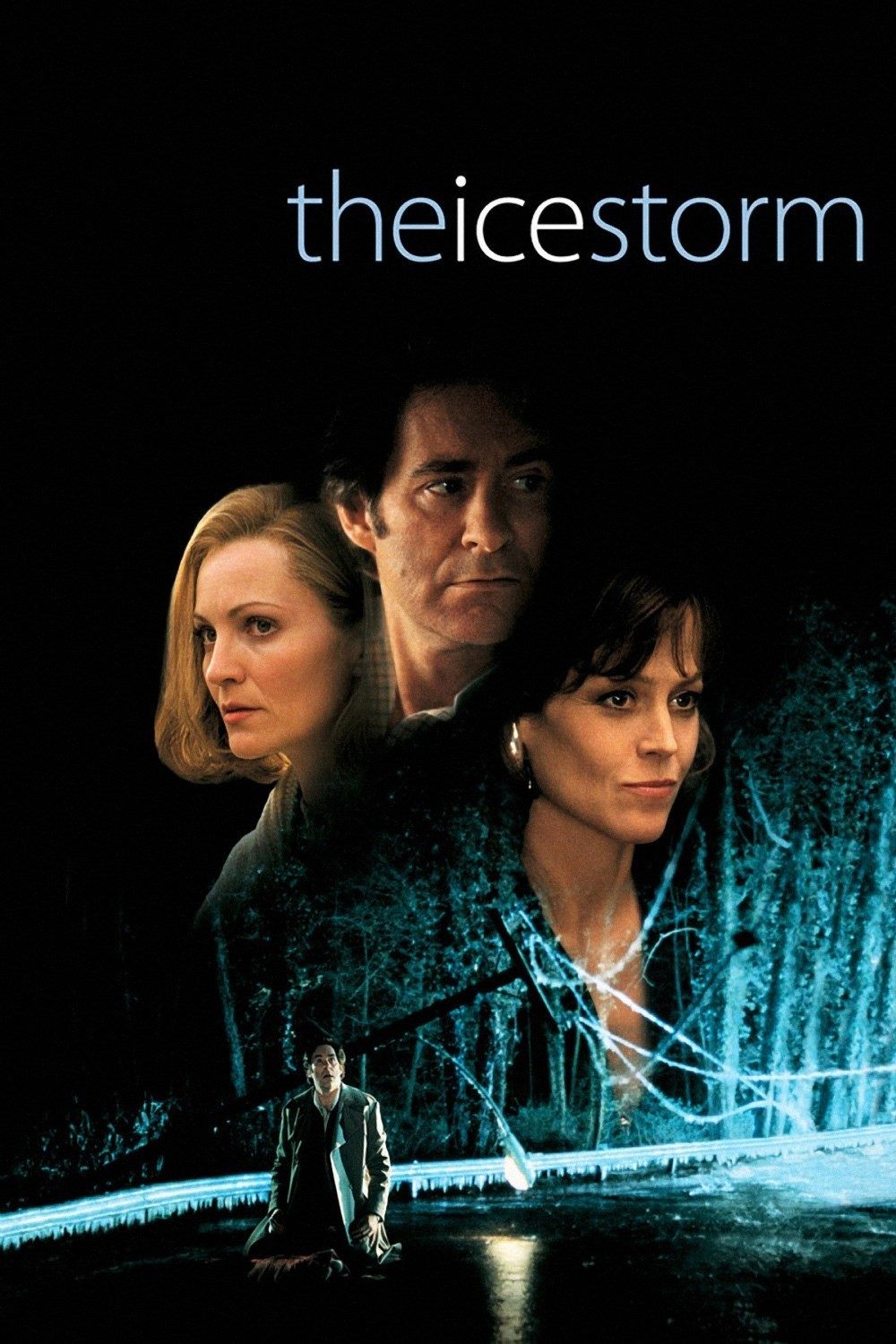
The Ice Storm poster

The Ice Storm

113 minutes

Cast

Selected cast credits · Film reference

Kevin Kline Ben Hood
Joan Allen Elena Hood
Sigourney Weaver Janey Carver
Jamey Sheridan Jim Carver
Christina Ricci Wendy Hood
Tobey Maguire Paul Hood
Elijah Wood Mikey Carver
Adam Hann-Byrd Sandy Carver
Michael Cumpsty Philip Edwards
Katie Holmes Libbets Casey
Henry Czerny George Clair
David Krumholtz Francis Davenport
Allison Janney Dot Halford
Barbara Garrick Weather Reporter

The Ice Storm | The Rewatchables

Explore episodeClose episode

Roger Ebert's review

In the discussion (2)
Approx. transcript time · 00:40:48Read transcript
  • Roger Ebert gave the film four stars, calling it often satirical despite its undertones, frequently very funny, and quietly observant in its performances; a host agrees.
  • It was Gene Siskel’s favorite movie of 1997.
In the discussion (15)
Approx. transcript time · 00:41:47Read transcript
  • Nominations are framed as good scenes rather than truly rewatchable ones.
  • The first dinner party, from the spilled wine to the couples sitting beside spouses they seem not to like, sets the tone.
  • Ben’s affair reveal with Weaver’s character is nominated, including his golf babbling and her reply that she already has a husband and needs no other.
  • Kline left alone in Weaver’s house then discovering Wendy and Mikey with the Nixon mask is nominated and called one of the most unnerving scenes in a non-horror film.
  • The film handles Christina Ricci’s character without feeling exploitative; carrying her home because her feet are cold captures a child longing to be older.
  • Paul’s homecoming exchange with his sister shows the kids know their parents are odd.
  • The car ride to the key party, where Ben and Joan Allen’s character debate what will happen, is where tensions come to a simmer.
  • The Elton John needle drop is loved even though the party it scores lacks a payoff; the song is called a top-five Elton John song.
  • The key party itself is nominated, returned to in pieces until one key remains and Ben is passed out in the bathroom.
  • The electrocution is not fun to rewatch but is called brilliant and horror-like, with impressive ice effects for 1997.
  • The final 30 minutes cross-cut three storylines in a novelistic way, making it hard to isolate scenes; the key party spans about 30 minutes.
  • Under the Fucked Up Family February “most gripping” framing, the final 15 minutes would win, though a channel-flipper would start at the key party.
  • Joan Allen at the book sale meeting the Reverend and seeing Wendy on her bike is nominated by two hosts.
  • Ben driving Paul home from the train and discussing self-abuse is held for Aged Best.
  • The key party is settled on as the scene.

What’s Aged the Best?

Self-abuse talk; key parties; split-level house; Nixon shadow; Kline and Weaver pairing; bong scenes; Maguire and Holmes debuts; dorm posters; Francis and Paul; Weaver

In the discussion (12)
Approx. transcript time · 00:51:29Read transcript
  • Ben’s awkward self-abuse advice to his son is the first pick.
  • Key parties as a pop-culture gimmick age well; CBS’s Swingtown tried and failed, and Mad Men had adultery but no key party.
  • The 1970s house with a single step up between rooms is a style never seen again, recalling the sunken living room in Help!
  • The Nixon and Watergate shadow is cited again.
  • Kline and Weaver, who played a president and first lady four years earlier, reuniting as adulterers is enjoyed.
  • Bong scenes and the Amaretto-and-brandy combination are enjoyed.
  • This was the Paul actor’s breakout before Pleasantville and Katie Holmes’s first film, before Dawson’s Creek and Disturbing Behavior; admiration for Holmes and a sneaky-tall anecdote follow.
  • Paul’s boarding-school posters, including Planet of the Apes, the Doors, and Nixon, reward set-dressing attention.
  • Francis and Paul’s roommate banter, including their reading-recommendation exchange, is a welcome change of gear.
  • Sigourney Weaver is picked out of simple love for her.
  • Asked who should have been Oscar-nominated since the film had no acting nominations, the hosts agree on Joan Allen, citing her tearing up when the Reverend hits on her.
  • Reviewing that year’s supporting-actress field, the Titanic nomination is called an abomination that took Allen’s spot, and Heather Graham in Boogie Nights is also raised.

What’s Aged the Worst?

Water beds; Jim Carver’s premature ejaculation; Mikey’s dropped pass

In the discussion (4)
Approx. transcript time · 00:58:21Read transcript
  • Water beds are baffling; Licorice Pizza revived them, but they are blamed for a generation’s back problems.
  • Jim Carver’s premature ejaculation literally aged the worst, drifting into sports-roster jokes.
  • Mikey dropping an easy pass in the football game is mocked as the one moment that feels directed by someone who did not grow up in America; one host also had it as a nit.
  • A defense says Mikey was in an emotional crisis as the world shifted beneath him.
In the discussion (3)
Approx. transcript time · 01:01:00Read transcript
  • Natalie Portman reportedly turned down Wendy, which would have come shortly after The Professional and Beautiful Girls.
  • That casting would have been a third sexualized role for her before 18; Ricci is judged more authentic, with a darker, more withering energy that Wendy needs.
  • Portman in an Ang Lee film would still have been interesting.
In the discussion (3)
Approx. transcript time · 01:02:13Read transcript
  • A host’s wife recognized the TV weather reporter as the over-laughing date from Sleepless in Seattle.
  • The actor playing the Reverend (transcribed “Michael Comstey”) is called the definition of a that guy who often plays clergy.
  • For a second he was thought to be the guy from another show, whom he kind of looks like; it is weird the two never teamed up.
In the discussion (2)
Approx. transcript time · 01:03:40Read transcript
  • Instead of an overacting pick, an award is proposed for Jim Carver needing a bigger reaction on seeing his electrocuted son.
  • Jamey Sheridan could go big as Randall Flagg in The Stand but is restrained here; nearly everyone is restrained, with the Ben character only at about a seven.

Recasting Couch

Sharon Stone for Weaver; Harrison Ford for Kline; a Culkin for Elijah Wood or Sandy; Philip Seymour Hoffman anywhere; a bigger name for Jim Carver

In the discussion (9)
Approx. transcript time · 01:05:41Read transcript
  • Sharon Stone for Sigourney Weaver is posed as a thought exercise.
  • Weaver is judged better because she is believable as a suburban housewife while Stone would read as there to tear up the suburbs. — Chris Ryan
  • Agreement that Weaver is more believable. — Sean Fennessey
  • Harrison Ford as Ben is floated; objections say horny Ford is awkward and his sex scenes tend to be under duress.
  • Swapping Elijah Wood for a Culkin is suggested. — Sean Fennessey
  • A Good Son flip with any Culkin, including Kieran as Sandy, is added.
  • Wood is knocked as a one-move bulging-eyes actor, then defended for Lord of the Rings and The Faculty.
  • Philip Seymour Hoffman in any role, such as the Reverend, Jim Carver, or Paul, would elevate the film.
  • The Jim Carver role is the one to upgrade to a Jeff Bridges or Nick Nolte, though top stars would not want to play a premature ejaculator.

Half-Assed Internet Research

Real ice storm; Ang Lee’s attraction to the climax; magazine-cutout prep; MTA and Marlboro Lights anachronisms

In the discussion (3)
Approx. transcript time · 01:10:33Read transcript
  • The ice storm depicted was a real December storm.
  • The director reportedly said the book moved him at the climax and the next-morning family reunion, and he gave the cast stacks of early-1970s magazine cutouts.
  • The MTA did not exist yet, and Marlboro Lights were not introduced until 1977; menthols are judged period-plausible.

Apex Mountain

Joan Allen; key parties

In the discussion (10)
Approx. transcript time · 01:11:45Read transcript
  • Kline is not at Apex; Weaver is also a no, her peak being around Ghostbusters, Aliens, and Working Girl.
  • Ang Lee is a no, with Brokeback Mountain cited among his two directing Oscars.
  • Joan Allen’s Apex is opened as this film versus her first spy-franchise role. — Chris Ryan
  • Counter-alternatives are her Pamela Landy role, Face/Off and Pleasantville, or The Contender, which earned an Oscar nomination.
  • Her filmography is recapped, from Manhunter and a chess-prodigy film through The Crucible and The Contender.
  • This is declared her Apex for the podcast’s purposes while still admiring her Pamela Landy. — Chris Ryan
  • The Upside of Anger is praised, and Allen is called one of the most believable movie moms.
  • Maguire and Holmes are no; key parties are an emphatic yes.
  • Whether key parties peaked elsewhere is questioned, perhaps with Elizabeth Taylor and Richard Burton, at the Playboy Mansion, in John Updike’s fiction, or in Thy Neighbor’s Wife.
  • Forrest Gump remains the peak for premature-ejaculation scenes, so this film is not.

Picking Nits

Nixon poster; no follow-up about the death; key-party invitations; marked keys

In the discussion (5)
Approx. transcript time · 01:18:12Read transcript
  • A 1973 boarding-school student having a Nixon poster seems unlikely unless ironic.
  • Jim Carver never asks whether the drunk Ben hit his son with a car.
  • The key party guest list is questioned: one woman brought her son, and a single reverend attended.
  • Early key-party rules are compared to early fantasy football and salary-cap stretch provisions.
  • Proposed rules bar solos, reverends, and kids, and call for a blind draw so no one can mark their own keys.

Sequel, Prequel, Limited Series, or All-Black Remake

Ten-episode series with aftermath; five-day miniseries; Jim Carver spinoff; one-family-per-episode anthology

In the discussion (6)
Approx. transcript time · 01:20:52Read transcript
  • A 10-episode remake is judged likely to be bad by one host.
  • A series could add an aftermath coda about Sandy and his mother, though the film’s abrupt tragic ending is both its best and worst quality.
  • The trailer’s lighthearted voiceover misrepresents the film.
  • A five-part miniseries could cover one day of Thanksgiving weekend per episode.
  • A joke IP spinoff would center on Jim Carver’s condition.
  • A remake would need to be bigger and more 1970s; a 13-episode show following one New Canaan family per episode is proposed.

Probably Unanswerable Questions

Families’ futures; Sandy’s fate; Jim Carver’s preparation; worst movie night; Paul and Libbets

In the discussion (6)
Approx. transcript time · 01:23:26Read transcript
  • Both families are expected to divorce.
  • Sandy is imagined in jail, having killed someone driving drunk, or jokingly becoming president.
  • Why Jim Carver did not take precautions before the key party is asked, citing Ben Stiller’s and Matthew McConaughey’s movie examples.
  • His silicone invention may have made him rich, with jokes about his efficiency.
  • Whether anyone had a worse movie night without jail is asked; After Hours is the competition.
  • Whether Paul and Libbets ever got together, and where the name Libbets comes from, are left for a sequel.

What Piece of Memorabilia Would You Want From This Movie?

Nixon mask; sweaters; football playbook; Buick; key party bowl

In the discussion (3)
Approx. transcript time · 01:25:52Read transcript
  • The Nixon mask or one of Mikey’s sweaters are the first options.
  • Mikey’s football playbook and Jim Carver’s Buick are added.
  • The key party bowl with its keys is embraced as the best.
In the discussion (4)
Approx. transcript time · 01:26:31Read transcript
  • Ang Lee is the first pick.
  • Ang Lee and Joan Allen are the finalists; Allen wins among the actors, Jim Carver clearly lost, and Lee is favored because the film confirmed him as a major American filmmaker.
  • Lee is rejected because the film did not do well; Joan Allen is picked for her run of roles and her best dramatic performance besides The Contender, which has aged poorly.
  • Her Face/Off and Ice Storm work together are said to have solidified 1997 for her.
Podcast choices
Speaker not identified
Ang Lee
Speaker not identified
Joan Allen

Producer review

Hated the movie

In the discussion (3)
Approx. transcript time · 01:31:42Read transcript
  • The hosts call this the most negative response they have ever gotten from Craig.
  • The reaction offered for the segment sits the movie out, indifferent to its cultural moment and unwilling to watch children drinking vodka in bed; the speaker is not identified in the transcript.
  • The closing credit says he hated this movie.

More from the conversation

A trailer excerpt plays before the hosts open: 1973 setting, a key party, and the principal cast.
Approx. transcript time · 00:02:05Read transcript
The episode is framed as the last 2022 installment of Fucked Up Family February, an experiment that might return in 2023.
Approx. transcript time · 00:03:01Read transcript
Picking rewatchable scenes is called unusually hard because the film offers few standalone scenes beyond the key party, yet it is judged important, well aged, and worth watching whenever it airs.
Approx. transcript time · 00:04:02Read transcript
A list of fall 1997 releases (The Game, L.A. Confidential, Boogie Nights, Titanic, Jackie Brown and others) prompts the claim that the film would now be an eight-episode streaming series; the others note those were adult movies from a different industry.
Approx. transcript time · 00:04:50Read transcript
The key party was part of the film’s marketing, but its final 25 minutes are described as painful and grim despite the film being exceptional.
Approx. transcript time · 00:07:44Read transcript
The film is argued to work as a total package, cross-cutting three storylines over an ominous post-Thanksgiving night more like a poem than separate stories.
Approx. transcript time · 00:08:26Read transcript
Rick Moody reportedly cried on seeing a cut of the adaptation of his 1994 novel; this was Ang Lee’s first American film, following Sense and Sensibility.
Approx. transcript time · 00:08:57Read transcript
Ang Lee is praised for a varied filmography and a sight-and-sound philosophy, and the film is called one of the most perfectly cast movies ever.
Approx. transcript time · 00:09:41Read transcript
The film is said to carry a dark, satirical sense of humor that improves the viewing if accepted.
Approx. transcript time · 00:11:11Read transcript
A question about whether two decades had to pass before this story could be told leads to a 20-year nostalgia-cycle answer tracing Brady Bunch parodies and early-1990s nostalgia into mid-1990s reexaminations such as Oliver Stone’s Nixon.
Approx. transcript time · 00:11:29Read transcript
Bob & Carol & Ted & Alice is suggested as an interesting pairing: a late-1960s satire at the start of the sexual revolution, whereas this film shows yuppies catching up at its end.
Approx. transcript time · 00:14:55Read transcript
The key party is read as the most barbed idea: revolutionary rhetoric about marriage turned into a license to cheat.
Approx. transcript time · 00:15:40Read transcript
Early-1990s nostalgia (The Doors, Forrest Gump, 1970s wedding music) is said to give way to deeper reexamination; Mad Men’s out-of-step Don Draper is compared with Kline’s character.
Approx. transcript time · 00:16:17Read transcript
The film is called a subtext movie that nearly announces its themes through the Fantastic Four comic that frames the family.
Approx. transcript time · 00:17:44Read transcript
Television’s hypnotic hold on the kids is noted, with Wendy learning about the world through Nixon’s fall; childhood memories follow of Winter Olympics viewing, scavenging at the Chestnut Hill dump, and playing in the Blizzard of ’78.
Approx. transcript time · 00:18:23Read transcript
The film is reported to have had an $18 million budget and about $8 million at the box office, possibly the least successful film the show has covered, though well reviewed.
Approx. transcript time · 00:23:08Read transcript
The key party’s role in the marketing is compared to the withheld reveal in Boogie Nights and to Jaws.
Approx. transcript time · 00:24:09Read transcript
The key party is found funny then and now; its dynamics could have filled an hour or a two-parter with telestrator-style announcers, and Tony Romo is jokingly nominated.
Approx. transcript time · 00:24:50Read transcript
Midlife ennui makes a 1970s key party plausible yet insane; hosts recall parents with social lives and unsupervised childhoods.
Approx. transcript time · 00:26:41Read transcript
The key party is described as fumbling and compelled: most participants are scared or confused, while Allison Janney’s character is eager like an Oscars host.
Approx. transcript time · 00:28:33Read transcript
Couples openly discussing therapy at the first dinner reflects private life going public and self-help ideas reaching the suburbs.
Approx. transcript time · 00:29:28Read transcript
Stages of sexual awakening are traced from Deep Throat through video-store back rooms and scrambled cable to the internet.
Approx. transcript time · 00:30:01Read transcript
With Deep Throat in 1972 and Texas Chain Saw Massacre in 1974, the film is set as culture coarsens around Watergate; it is praised for triangulating politics, sex, and media, including Wendy’s Thanksgiving grace.
Approx. transcript time · 00:31:33Read transcript
Nixon hangs over the film through a dorm poster, a televised speech, and the mask scene.
Approx. transcript time · 00:33:46Read transcript
A host who went to high school near New Canaan confirms its spread-out split-level houses, wooded isolation, and drunk-driving culture; anecdotes follow about unsupervised party houses, including a friend’s and a host’s own teenage home.
Approx. transcript time · 00:33:46Read transcript
Wendy casually checking the Carvers’ fridge prompts memories of neighborhoods that collectively raised kids and treated each other’s homes as open.
Approx. transcript time · 00:36:37Read transcript
A Wikipedia synopsis is read: Thanksgiving 1973, two dysfunctional upper-class New Canaan families escaping through alcohol, adultery, and sexual experimentation.
Approx. transcript time · 00:37:50Read transcript
Ang Lee is credited with nailing the book; this film and Brokeback Mountain share a style built on what goes unsaid, aided by longtime collaborator James Schamus (ASR “James Seamus”), and even Lee’s Hulk is called interesting in intent.
Approx. transcript time · 00:38:17Read transcript
Lee is praised for depicting loneliness: Weaver’s character ends curled alone on a bed, the Carvers’ son cannot tell whether his father was home, and Kline’s character finds no one to hear about golf.
Approx. transcript time · 00:39:37Read transcript
Silences and unspoken tension are linked to the theme month, with Kramer vs. Kramer cited from the previous week.
Approx. transcript time · 00:41:23Read transcript
A college anecdote about a friend called the Birdman singing Levon twice while a host lay sick became a decades-long running joke.
Approx. transcript time · 00:46:59Read transcript
Parental birds-and-bees talks are recalled, including a father’s evasive answer to a Judy Blume reference in the car.
Approx. transcript time · 00:51:48Read transcript
The Reverend is discussed as an apparently Unitarian or New Age figure neglected by the town.
Approx. transcript time · 01:02:56Read transcript
Ang Lee is noted to have two directing Oscars, and Brokeback Mountain is floated as a 2023 theme-month contender.
Approx. transcript time · 01:12:13Read transcript
Weaver reportedly felt Titanic and The Full Monty undercut the release, and American Beauty is said to have blocked a revival until its own reputation dipped.
Approx. transcript time · 01:27:00Read transcript
A joke claims Miami Vice’s reputation was rescued by the hosts’ persistence.
Approx. transcript time · 01:28:14Read transcript
Closing banter covers family reflections after the theme month, a dog incident, 2023 candidates such as The Squid and the Whale, Over the Top, and Margot at the Wedding, and a Tarantino-programmed idea.
Approx. transcript time · 01:29:12Read transcript
Two big movies are promised for the next two weeks, with teasing about Pulp Fiction and a list of Tarantino films covered or not.
Approx. transcript time · 01:30:54Read transcript