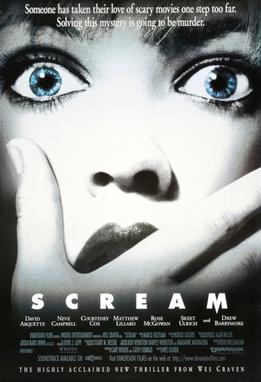
There is not a lot of unintentional comedy except the Winkler scenes, which are funny now, and Arquette, who is just off, funny in retrospect given people thought he might be something.
Skeet Ulrich giving a performance he probably does not believe is satire is unintentionally funny, since he was cast as a carbon copy of someone the director worked with fifteen years earlier, which an actor could never be told; Casper Van Deem (as transcribed) thinking Starship Troopers was a drama is the comparison.
The Liev Schreiber cameo is thrown in because his voice comes to mind immediately, imagining him testifying at the trial for killing Sidney's mother or narrating Magic vs. Bird.
Wes Craven could be argued but Elm Street is still his Apex Mountain; his amazing career spans the three stages of late-century horror, from Hills Have Eyes and Last House on the Left to creating Freddy and reinventing the genre in the nineties, and he is underrated, on a Mount Rushmore with Tobey Hooper (as transcribed), George Romero and John Carpenter; the movie still moves today.
The coming Halloween remake with Jamie Lee Curtis is asking audiences to forget some sequels, like Rocky Balboa waving off Rocky V, which is what 48 Hours should have done.
A confession that Nightmare on Elm Street was a shitty movie meets a fan of the first two and Dream Warriors; Heather Langenkamp is dismissed, and Wes Craven's New Nightmare, the meta Freddy movie, failed just before this, leaving Scream as a bit of a last gasp for his career.
Neve Campbell's nominees are this or the intervention scene with Bailey in Party of Five.
Another feels the same way about the intervention, called the saddest hour in television history with Bailey as the rock of the family, and it stands even against Scream's $290 million.
Skeet Ulrich is clearly at his Apex, with nothing else competing; he was in As Good as It Gets, went a couple of rounds with Jericho, and is now known to kids as Riverdale's Skeet Ulrich.
A tangent on Skeet Ulrich's first name becoming slang, popularized by Dave Chappelle, and whether his stage name was a bad choice slides into a crude callback to the Silence of the Lambs episode's Migs discussion.
Reader Howard from Calgary writes that Stuart Rudin, who played Migs, was in Sticky Fingers and has an IMDb of homeless men, winos and patients; Migs was his Apex Mountain, and listeners are invited to the mailbag.
Matthew Lillard: it has got to be, with SLC Punk raised; considering how good he is in Scream, this is his Apex.
Jamie Kennedy was forced on the culture with an MTV show after this and never took; his Apex Mountain is definitively dating Jennifer Love Hewitt, an achievement rather than a performance, which leads to a tangent on why women disliked her.
For David Arquette the reminder is that he held the WCW heavyweight title, a movie tie-in, the belt once held by Ric Flair.
Eight Legged Freaks is also raised for Arquette; Rose McGowan is a no, her later weirdness and dating Marilyn Manson jokingly called her apex, though she had a cool indie career, the Rodriguez Grindhouse movie with the gun leg, and is now a filmmaker and activist.
Courtney Cox is first a no, since it has got to be Friends and you cannot get higher; one voice later counters, unresolved, that the combination is her apex, since this came out during Friends season three when Monica was dismissed as having no personality and showed she could be the bitch too; her later characters are more Gail Weathers than Monica.
She reportedly pursued the role to play someone not traditionally nice and to get punched in the face; her later sitcoms were Dirt and the Bill Lawrence show about people in LA drinking wine, whose title nobody can remember.
Henry Winkler is joked to have been the mountain itself.
Earlier, while praising the cast, Drew Barrymore is followed by the garbled phrase 'I'd heard, like, Mad Love Apex' (as transcribed).
The award is treated as a wrap that needs only the charade of walking through it; Henry Winkler is joked to have had his heat check at the premiere telling everyone he was uncredited, and Jamie Kennedy is named.
Whether Matthew Lillard is a role player or the star is asked; on reflection he is the most exciting thing in the movie, not the best performance but really going for it and hilarious, and his 'your daddy's the chief suspect' clip is played.
His interview on The Watch with Chris and Andy, where he said he thought he was hot and then his career fizzled after Scooby-Doo, makes the performance elegiac; his face does things, as on Twin Peaks, like a kid in a Norman Rockwell painting, with eye bulges, frowns and finger pointing making him a really weird performer.
He is declared the winner of the award; he counts as a role player, in maybe a third to forty percent of the movie; the award should be renamed the Henry Winkler Award, or a separate award for unplaceable arrogance, the Kobe Award.
Landlines lead into what aged worst: after twenty-one years one host is not convinced any 1996 cell phone was good enough to be a murder prop in wine country around Sonoma, with trees and driveways and nobody near anybody.
A secret favorite part: Drew Barrymore's character says she will call the cops, the killer says they are too far away, and she accepts it even though her boyfriend is bleeding.
A counterpoint cites Michael Douglas's gigantic cell phone on the beach in Wall Street: phones then were for doctors and rich people and may have worked better for that elite group; the hosts wonder whether Wall Street had the first cell phone in a major movie, followed by Zach Morris.
Asked how the movie would be received in the outrage culture era, the hosts expect outrage at two guys killing the mother and calling her a whore before people swung around to its tongue-in-cheek intent; one does not find the movie problematic at all and calls everything problematic about it hilarious.
The sexualized staging of Rose McGowan's death is read as a deliberate joke on the bimbo-who-dies trope; per IMDb trivia she could have fit through the opening and escaped, and she flips the killer like a pro wrestler, part of a slapstick way of fighting the villain that exposes the killers as high school kids getting beaten by teenage girls and makes Ghostface very vulnerable.
The seeds of David Arquette and Courtney Cox falling in love, knowing it ended badly and she went on to date Will Arnett, make their marriage what aged worst, though it is pure in the movie.
Part two is that David Arquette is really terrible, playing Dewey as if brain damaged, and it is unclear why he became a phenomenon afterwards; a defender says Dewey is supposed to be extra dumb and is charming, though his 'I was 24 for a whole year' line is too good for such a character.
The Henry Winkler scenes had more impact at the time because of his fame; the principal putting two fingers on Sidney's chin would be a real problem today, and together with his scissors threat to the two kids in masks suggests a background worth checking.
A Ross tangent: People vs. OJ helped one host like David Schwimmer, but Ross is blamed for turning Friends from a great first season into a rom-com, and another protests that Ross was just a character, a human being sometimes.