
Film credit
Don Simpson
Also referred to as John Simpson
Stats
- Episodes featuring their films
- 1
- Movies in this archive
- 1
Rewatchables episodes featuring Don Simpson’s films

Mentioned in discussions


Casting What-Ifs
Val Kilmer; Al Pacino as Ramsey; Brad Pitt as Hunter; Warren Beatty; Tommy Lee Jones as Ramsey; Tom Cruise as Hunter
In the discussion (7)
- The hosts say Simpson and Bruckheimer offered Val Kilmer a headlining role, which he declined and later regretted; the role was never specified. — Bill Simmons
- Guesses for the Kilmer role are Viggo's part or Hunter, possibly turned down for not being big enough; he could have played every part except Hackman's. — Bill Simmons
- Al Pacino was originally offered Captain Ramsey and would have dialed it up to 90 in his Vincent Hanna zone. — Bill Simmons
- Brad Pitt wanted to play Hunter when Pacino might be Ramsey, then passed when Pacino dropped out. — Bill Simmons
- Warren Beatty was courted, another case of Beatty flirting with a part for a year before declining, as with the Burt Reynolds part in Boogie Nights, which is called the bigger miss; he would not have fit this movie. — Bill Simmons
- Tommy Lee Jones passed on the Hackman part; he would have worked, having done something similar in Under Siege. — Bill Simmons
- Per a Don Simpson interview at Santa Anita, Pitt and Tom Cruise were considered for Denzel's part; Cruise was the first call for such parts for a decade, but it worked out perfectly. — Bill Simmons

What’s Aged the Best?
Sub-descent montage; Denzel's lines; real-time final hour; Jason Robards cameo; EAMs; opening and closing title cards
In the discussion (10)
- Tony Scott makes a two-minute montage of the sub slowly descending riveting with Hans Zimmer's score; only Spielberg or McTiernan, who made Hunt for Red October, might have pulled it off. — Bill Simmons
- Denzel's line 'in the nuclear world, the true enemy is war itself' is one of about seven such Denzel lines. — Bill Simmons
- Viggo lights a cigarette when he decides to refuse the launch, and many sailors smoke Marlboro Reds underwater with no smoking section. — Bill Simmons
- George Dzundza's IMDb highlights include The Deer Hunter, No Way Out, Basic Instinct and Law & Order; a lowlight is co-leading the 1985 TV movie The Rape of Richard Beck with Richard Crenna. — Bill Simmons
- The Richard Beck plot summary is read, a 35th-anniversary episode is joked about, and early-80s cocaine is blamed for bad decisions. — Bill Simmons
- The last 60 minutes play basically in real time, with Weps doing the clock; it may have inspired Snake Eyes. — Bill Simmons
- Jason Robards, uncredited, comes flying in off the top rope for about 90 seconds. — Bill Simmons
- The EAMs are cinematically great, with messages three people must read aloud and confirm and run down the hallway; it is also disturbing that nuclear war hinged on them. — Chris Ryan
- The opening title card names the three most powerful people in the world, including a nuclear submarine captain, and the closing card says captains lost launch authority on January 1, 1996; Bruckheimer pitches the card almost word for word in a featurette. — Sean Fennessey
- Don Simpson is joked to be number four; David Stern would belong in the top three. — Sean Fennessey

In the discussion (1)
- Eilbacher is jokingly named first; Ronnie Cox and Don Simpson are floated; Eddie Murphy wins his own movie, of course it is Eddie, with 'big win Friday'; Ronnie Cox did not get enough love, he is good, and Bogomil is a big thing in Cop 2.
Podcast choices
- Speaker not identified
- Eddie Murphy
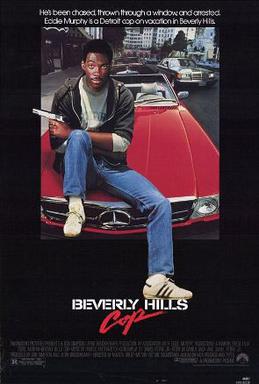
Half-Assed Internet Research
Michael Eisner and Don Simpson argued over who originated the idea until Simpson died; Gilbert Hill was a real Detroit detective; the theme reached number three on the Billboard chart; a 2013 CBS pilot with Brandon T. Jackson as Axel's son failed; Eddie improvised much of an Oscar-nominated screenplay
In the discussion (5)
- The origin is claimed by Michael Eisner, who on a podcast with the host told the story of a 1975 speeding ticket from a cop who seemed a bit of a dick gave him the germ of a movie about a Hollywood police officer; Don Simpson, who worked for him, had a 1977 idea about an East LA cop transferred to Beverly Hills but could not get a screenplay done; Eisner's lesson that being pulled over in a beater meant he needed a Mercedes-Benz is called the most privileged thing ever heard.
- Nobody planned on a black cop, so it is a high-level irony that a what-if-Stallone, pride of Italian Americans, vehicle became salient commentary neither Eisner nor Simpson intended; Simpson had just made Flashdance, and the two argued about the origin until Simpson died.
- Gilbert Hill, the Detroit police lieutenant, was an actual Detroit detective who appeared in only three movies; 48 Hours is suggested as the first instance of giving the lone black character in a movie the most powerful job with 30 seconds of screen time, a pattern that kept happening.
- The theme to Beverly Hills Cop reached number three on the Billboard chart, with Neutron Dance, The Heat Is On, Stir It Up and New Attitude also in the film; in 2013 The Shield creator Shawn Ryan tried a Beverly Hills Cop TV show, a CBS pilot with Brandon T. Jackson as Axel Foley's son that did not work.
- Writer Daniel Petrie and director Martin Brest carried pieces of different screenplays; according to Petrie, Eddie would take a line, expand it and put it in a comic persona invented for the moment, and according to Brest, whenever they got in a jam he asked Eddie for something and it knocked him to the floor; the movie was nominated for best screenplay though Eddie improvised about two thirds of it.
Casting What-Ifs
Mickey Rourke signed a $400,000 holding deal and left; Sylvester Stallone rewrote it as a straight action film with Axel Cobretti and quit two weeks before filming; Martin Scorsese was offered the director's chair and dismissed the script; Eddie Murphy was hired two weeks before shooting
In the discussion (6)
- Mickey Rourke signed a $400,000 holding contract and then left the project; a New York Times quote has Don Simpson tearing a picture of Rourke out of a magazine, holding it up and saying 'isn't he great', which the hosts attribute to all the cocaine, although one says you did not need cocaine to want Rourke in 1984.
- This is the movie missing from Rourke's run before he started messing up his face: Heaven's Gate, Body Heat, Diner, Rumblefish, Pope of Greenwich Village, then the gap where Beverly Hills Cop could sit, followed by Eureka, Year of the Dragon and Nine and a Half Weeks; the holding deal's schedules did not work out.
- Stallone was more extreme: he made it a straight action film with the lead renamed Axel Cobretti, Michael Tandino as his brother and Jenny as his love interest, an opening meant to be like Saving Private Ryan on the beaches of Normandy, ideas deemed too expensive, and a climax of him driving a Lamborghini down the train tracks at a freight train driven by the villain; an urban legend has him quitting two weeks before filming over orange juice in his trailer.
- Scorsese was offered the director's chair while trying to get Last Temptation of Christ made, was bewildered by the script and dismissed it.
- Earlier context: Eddie was hired two weeks before filming on a script kicking around since the 70s, a cop-comes-to-another-town movie set up for various stars and directors, and he transformed it with improv; it does not work with Sylvester Stallone, who would have made it a dramatic action movie, and if Stallone is in that cigarette truck the movie weighs 150 pounds more; with anyone else it would be actively bad because we know who killed his friend in the first 30 minutes.
- The parts of Bogomil, Rosewood and Taggart were probably not rewritten after the casting changes, so the other actors are playing a script written for Mickey Rourke or Stallone with Eddie as the star; it was hard for them to handle his ad libs because takes got ruined by laughter.
What’s Aged the Best?
Lisa Eilbacher as Jenny Summers (disputed); Jenny's red Mercedes convertible; the title; Harold Faltermeyer's score and the soundtrack; the Mumford Phys Ed t-shirt and cropped sweatshirts; Taggart and Rosewood; Murphy's early run of good directors; the rival cop duo
In the discussion (11)
- One host is still in love with Jenny Summers, played by Lisa Eilbach (as transcribed); the objection is not to the actress but to Hollywood casting interchangeable blondes with the same Kate Capshaw haircut, and another did not recognize her at all; what one host wants from the token female character in an Eddie Murphy movie is to dress well, laugh at his jokes and look great.
- She is not a love interest for either man, though she tried with Eddie, which is saved for later; she is serious about her career and it costs her nothing, and her damselification is believable because she insists on driving to the warehouse; 'great character' is countered with 'definitely not a great character' since nothing motivates her, she works at a coke lord's art gallery, and the Jenny, Tandino and Axel triangle of friendship makes no sense.
- Jenny is called a TV actress annihilated by everyone else on screen who did nothing afterward because she cannot hold the screen; a joke pitch imagines a Jenny Summers sequel in Don Simpson's office; she may be the first female gallerist in a movie.
- The defense of Jenny Summers is framed as a 15-year-old's crush recalled in the past tense. — Bill Simmons
- Jenny Summers' red Mercedes-Benz convertible is a dope car you cannot see anymore and is hard to keep in shape; in Beverly Hills they just take whatever car is closest; the little back seat is the Mikey spot.
- The title is great, as if they came up with it before they had a script; Harold Faltemeyer's run through Top Gun and Fletch is admired, the score fit an era of synth musicians like Howard Jones and Wang Chung.
- Faltermeyer is credited alongside Hans Zimmer on Top Gun Maverick, presumably because they use his themes; the soundtrack with The Heat Is On, Neutron Dance, Stir It Up and Nasty Girl is strong.
- Martin Brest draws 'the less said the better' from one host and a Midnight Run defense from another, who calls it a perfect movie and credits Brest with two of the best comedies of all time, alongside Gigi (as transcribed) and Son of a Woman (as transcribed); it is hard to know how much credit he gets here beyond being smart enough to let Eddie ad-lib, and Midnight Run also does not work without its two stars.
- The Mumford Phys Ed t-shirts were really a thing in the mid 80s with no internet to buy them, and the high school was flooded with requests; the Lions jacket in Cop 2 was intentional merchandising; the cropped sweatshirts, like the Josh Brolin Goonies look, are almost as iconic, and the hosts tease one of them about adopting cropped sweats.
- Taggart and Rosewood have aged best because this lays the groundwork for two heroic performances in Beverly Hills Cop 2 that could have been nominated; a key to Murphy is that, apart from Brest, he mostly worked with good directors early: Walter Hill, Tony Scott, Robert Townsend, John Landis, even Michael Ritchie on The Golden Child; Cop 3 is best left unmentioned.
- The 'not gonna fall for the banana in the tailpipe' guy is enjoyed for setting it up earlier with the first team insult for Taggart, and the hosts miss the mid-80s cop movie rivalry duo with sarcastic comments; Eilbacher is put back in by a second and declared a law, with 'Eilbacher Mountain' floated.


Apex Mountain
Kelly McGillis, Rick Rossovich, and Simpson–Bruckheimer: yes
In the discussion (7)
- Tom Skerritt is debated against Alien
- Kelly McGillis’s Witness–Top Gun stretch is accepted
- Rick Rossovich is accepted
- The Navy is debated against Zero Dark Thirty
- The Beverly Hills Cop–Top Gun run is accepted for Don Simpson and Jerry Bruckheimer
- Cruise and Kilmer are rejected as being at their apex here
- Beach volleyball is debated against Karch Kiraly


