
Film credit
Michael J. Fox
Also referred to as Fox
Stats
- Episodes featuring their films
- 4
- Movies in this archive
- 4
Rewatchables episodes featuring Michael J. Fox’s films


Mentioned in discussions

In the discussion (3)
- Michael J. Fox is selected after Robert Zemeckis is reconsidered — Sean Fennessey
- Fox is also selected because replacing Stoltz supplied the needed comedy and physicality — Bill Simmons
- Without Fox, the film is argued more likely to have become a smaller cult science-fiction movie than a culture-changing hit — Bill Simmons
In the discussion (6)
- Michael J. Fox is judged at his apex through the combination of Family Ties and the film — Bill Simmons
- Huey Lewis, Christopher Lloyd, Claudia Wells, Crispin Glover, and Thomas F. Wilson are assigned apexes — Bill Simmons
- Libyan terrorists are rejected in favor of Gaddafi as their apex
- Pepsi Free is assigned an apex while the larger Pepsi brand is debated — Chris Ryan
- Robert Zemeckis is assigned an apex because Romancing the Stone and this film enabled later ambitious projects — Sean Fennessey
- Time travel is assigned an apex over Lost for popularizing difficult concepts — Chris Ryan
In the discussion (6)
- The original climax reportedly involved driving through a Nevada nuclear test before cost prompted the clock tower — Bill Simmons
- Lea Thompson was reportedly dating Dennis Quaid during filming — Bill Simmons
- A shot of Eric Stoltz’s hand reportedly remains in Biff’s punch scene — Bill Simmons
- Michael J. Fox reportedly worked Family Ties by day and the film overnight — Bill Simmons
- The To Be Continued card was reportedly added to VHS but absent from theatrical and DVD versions — Bill Simmons
- Power of Love was Oscar-nominated but lost to Say You, Say Me — Bill Simmons

Casting What-Ifs
John Lithgow and other alternate casting history
In the discussion (4)
- John Lithgow is reported as the first choice for Doc Brown and is judged plausible — Bill Simmons
- J.J. Cohen was reportedly moved from Biff to a cohort because he was not imposing enough opposite Stoltz — Bill Simmons
- Melora Hardin was reportedly released as Jennifer after Fox replaced Stoltz because of their height difference — Bill Simmons
- An Al Pacino Doc Brown is performed as a comic hypothetical rather than reported casting — Bill Simmons

What’s Aged the Worst?
Franchise replacement, makeup, Libyan terrorists, sexual misconduct, PG content, guitar mime, and rock-history premise
In the discussion (8)
- Claudia Wells leaving the sequels because her mother had cancer is treated as a sad lost opportunity — Bill Simmons
- Lorraine’s heavier-body makeup is criticized as unconvincing — Bill Simmons
- The unexplained Libyan-terrorist plot is criticized, with Zemeckis reportedly apologizing for its insensitivity — Bill Simmons
- George spying on Lorraine and Biff’s attempted assault are criticized
- The violence and repeated profanity are considered surprising for a PG film
- Michael J. Fox’s guitar mime is criticized as unrealistic — Bill Simmons
- Marty being framed as inventing rock and roll is criticized — Bill Simmons
- The high-school dance band is added belatedly to Aged Best — Bill Simmons
Casting What-Ifs
Eric Stoltz filmed five weeks as Marty before Michael J. Fox replaced him
In the discussion (8)
- Michael J. Fox was initially unavailable because Family Ties needed him while Meredith Baxter Birney was absent — Bill Simmons
- Eric Stoltz filmed for five weeks but was judged too dramatic, insufficiently comic, and unconvincing on a skateboard — Bill Simmons
- The studio approved spending another $3 million to replace Stoltz and reshoot with Fox — Bill Simmons
- Stoltz continued filming temporarily after the replacement decision while the production secured Fox — Bill Simmons
- Christopher Lloyd and Lea Thompson are quoted describing Stoltz as talented but too intense for the needed comedy — Bill Simmons
- Johnny Depp, Charlie Sheen, John Cusack, Ralph Macchio, and C. Thomas Howell were also considered or auditioned — Bill Simmons
- John Cusack is judged a plausible alternate because he could balance comedy, drama, awkwardness, and charm — Sean Fennessey
- Fox’s athletic physical comedy is credited as essential to the final performance — Bill Simmons


Apex Mountain
Chris Farley; David Spade; brake pads; "Holy schnikes"
In the discussion (7)
- Chris Farley is at Apex Mountain, with 100 percent agreement. — Bill Simmons
- David Spade is a yes; younger viewers know him as the Grown Ups guy, and like Mike and the Mad Dog the two must go together. — Bill Simmons
- Julie Warner is proposed but countered with Doc Hollywood and its emerging-from-the-water moment; Tommy Boy has lived on more; Michael J. Fox is taller than her there. — Bill Simmons
- The Midwest is proposed and doubted, with the Packers' Super Bowl the next year and Wisconsin mentioned. — Bill Simmons
- Brake pads get a 100 percent yes. — Bill Simmons
- He could not describe what a brake pad does. — Bill Simmons
- 'Holy schnikes' is suggested and liked; Farley reportedly took it from John Candy in Planes, Trains and Automobiles, which the movie resembles; 'son of a' is used about a dozen times. — Cousin Sal
Casting What-Ifs
No affirmative selection
In the discussion (2)
- No real casting alternatives turned up in research.
- A garbled joke offers Michael J. Fox in a role, with a "don't call him chicken" riff.

In the discussion (8)
- Ajax is simultaneously a great character and badly aged for his language and being a sexual assaulter.
- The counterargument is that a movie about gangs who stalk the streets needs a bad guy, and Ajax contrasts with Swan's King Arthur moral code; a bad guy in a 1979 New York gang is plausible, though some of his words are hard to hear now, and what is said to Mercy is not great.
- Cleon dying has aged terribly and hurts every time; the stunt double thrown onto the tracks and the character never being mentioned again is one host's vote.
- The story recited: Michael Beck as Swan and Thomas Waits (as transcribed) as Fox were to be the two stars, but Fox's actor feuded with Walter Hill, who killed the character off midway, rewrote the last 45 minutes, and used a crew member with the same hair as a stunt double, seen from behind with Mercy before a cop throws him into the train; nobody later asks what happened to Fox the way they ask about Ajax.
- The actor told the story at a 2015 reunion where the cast rode the subway to Coney; another host disliked his face in the zoom-in and was glad he died.
- The death should have established the stakes of the all-night journey and made the arrival a relief, but it is so quick and so hamstrung together that it has no emotional payoff.
- Today a studio would recast as with Eric Stoltz and Michael J. Fox in Back to the Future rather than concoct a stunt death; it also creates a hole when Swan returns to an empty station with no ambulances or police after a man was thrown in front of a train.
- Why the Warriors run from police is debated: they are a gang in colors where they should not be, and the fire, the assassination and the DJ keep police on alert; starting the fire five stops down is called a smart move by the other gangs, and Masai is said to have been pulling the strings like Masai Uhiri (as transcribed).
Half-Assed Internet Research
A 2006 sequel script, Old School Dos (transcribed 'Dose'), by Scott Armstrong was turned down by Ferrell and Vaughn; Luke Wilson said in 2016 he would do it; Todd Phillips plays the man at the door; Ferrell streaked for real near a 24-hour gym and shot it in two parts; Patrick Cranshaw (transcribed 'Crenshaw') acted for fifty years, played the sheriff in the Air Bud films and died about four years later; the frat house is a real Pasadena house on Bushnell Avenue used in Back to the Future, Back to the Future 2 and Teen Wolf
In the discussion (6)
- In 2006 Scott Armstrong wrote a sequel, Old School Dose (as transcribed), about the aging fraternity going to spring break, turned down by Will Ferrell and Vince Vaughn; Ferrell's 2008 explanation was that it had funny set pieces but felt like repeating the fraternity setting; one host would still have seen it, another does not need it after The Hangover 2 and 3.
- Of the era's comedies, Old School 2 is the sequel one host would most want; great comedy sequels are rare, Austin Powers aside, Caddyshack 2 was a tragedy, Wayne's World 2 is defended as genius after it came up with McKay, Anchorman 2 will have a life once off Epix, and both Anchorman films have hours of alternate footage.
- Luke Wilson was ready in 2016, saying he would do it at the drop of a hat; Todd Phillips plays the man in the curly wig who knocks on Luke Wilson's door for the gangbang, a role he reprises in most of his films including The Hangover.
- Will Ferrell ran naked for real, horrifying locals at a 24-hour gym; the streak was filmed in two parts, the second in front of everyone during the Snoop Dogg performance, and he needed to get a little drunk first.
- Patrick Crenshaw (as transcribed), who played Blue, had acted in films for fifty years before this role made him famous, played the sheriff in all the Air Bud films, and died about four years after the film.
- The fraternity house is a real residential house in Pasadena on Bushnell Avenue, obviously LA, used in three Michael J. Fox films; the hosts guess Doc Hollywood and The Secret of My Success before landing on Back to the Future, Back to the Future 2 and Teen Wolf, and joke about Redfinning it as more attainable than the Boogie Nights house, though it may be a two-block stretch rather than one house.
In the discussion (13)
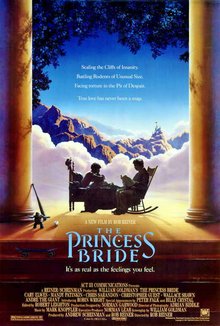
- Rob Reiner directed the film from William Goldman’s 1973 novel, and the grandfather framing preserves the book’s asides and genre commentary. — Juliet Litman
- 20th Century Fox paid Goldman $500,000 for the rights in 1973 but did not make the movie; Goldman later bought the rights back. — Juliet Litman
- Norman Lear produced the film and is credited with signing off after Rob Reiner selected the lead actor. — Juliet Litman
- Reiner wanted Carrie Elways after Lady Jane, while Robin Wright’s late audition is described through the story of her appearing backlit at Goldman’s door. — Juliet Litman
- Andre the Giant was the first choice, but an apparent Tokyo wrestling commitment initially made him unavailable. — Juliet Litman
- Andre’s back surgery required the production to rig Robin Wright, use a masked double for impact, and put Carrie Always on a box for close shots. — David Shoemaker
- Kareem Abdul-Jibar, Lou Forigno, a Scottish strongman, and the actor known from Twin Peaks were considered while Andre was unavailable. — Juliet Litman
- Robin Wright’s post-film career discussion highlights Forrest Gump, House of Cards, She’s So Lovely, the film rendered “white old Leander,” and Wonder Woman. — Juliet Litman
- The actor rendered Carrie Always is described as an ideal fairy-tale lead whose later career moved through spoofs and villain roles. — David Shoemaker
- The Crush and Clueless discussion traces Alicia Silverstone’s career around the Aerosmith-video period. — Juliet Litman
- The production contacted the WWF because Andre’s wrestling bookings controlled his availability. — David Shoemaker
- Andre’s availability is compared with the Michael J. Fox and Back to the Future scheduling story. — David Shoemaker
- William Goldman was a wrestling fan who reportedly wrote the novel with Andre in mind and asked casting to find someone like him. — David Shoemaker


