Burns is disputed: She’s the One is preferred as his moment of opportunity, while Ryan is defended as a larger role in a major film; the absence of subsequent momentum is held against Ryan.
The broader World War II movie Apex question remains debated, with Stalag 17, From Here to Eternity, Where Eagles Dare, The Guns of Navarone, The Great Escape, Von Ryan’s Express, and Castle Keep among the alternatives.
Filmed combat receives an explicit affirmative Apex assessment and agreement. — Sean Fennessey
Kaminski receives an affirmative Apex assessment. — Bill Simmons
The transition from young to old Ryan is proposed for morphing, but its dissolve is distinguished from Terminator 2’s effects and Mystique in Days of Future Past is preferred by another speaker. — Bill Simmons
Pepper receives a yes, with 25th Hour offered as another personal preference. — Bill Simmons
Picking up one’s own arm and the expression FUBAR are raised without a settled affirmative selection; the claim that this film invented FUBAR is explicitly rejected. — Bill Simmons
Taking gum out of another person’s mouth is offered as an Apex, followed by disgust and discussion of the different rules for spouses or children.
Replacing the family cemetery visit with Ryan and Reiben visiting together is proposed as a less sentimental ending that would also show their lasting friendship.
Damon’s reaction to learning his brothers are dead is compared with his Good Will Hunting breakdown, prompting an imagined repetition of it’s not your fault. — Bill Simmons
Whether Ryan earned the sacrifice is asked; marriage and children are visible, while a regional Chevrolet sales job is speculation and more explanatory life history is rejected.
The mother framed in the doorway as the car approaches, followed by her collapse onto the porch, is a selected cinematic image. — Chris Ryan
The men walking across the field and heads appearing over the hill are offered as other striking compositions. — Chris Ryan
The wide shot of the men on the steps listening to the record player, apart from Hanks and Damon, is praised as poster-like. — Chris Ryan
A soldier surviving a shot that hits his helmet, removing it, and then being shot in the head is singled out as a brutal visual moment. — Sean Fennessey
The intricate handheld battle shots are praised for coordinating several moving actions within one shot. — Sean Fennessey
The tank crossing the opening in the final battle visually shows that the planned defense must change without explanatory dialogue. — Sean Fennessey
The underwater imagery during the landing is praised, including the realization that soldiers can be shot underwater. — Bill Simmons
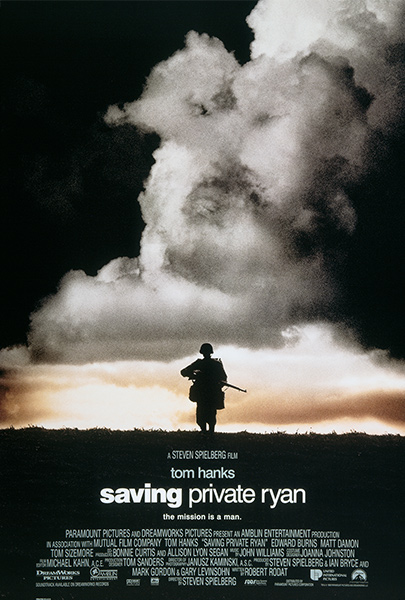
The cinematography is described as using altered lenses, film technique, and desaturation to produce a gray, muddy, visceral image. — Sean Fennessey
Spielberg is recalled as arriving without a shot list, shooting largely handheld and sometimes operating the camera himself, despite the huge number of extras and complicated effects resets. — Chris Ryan
The discussion names eleven Oscar nominations and enumerates wins for directing, cinematography, sound, editing, and sound-effects editing; the transcript renders the intervening win count unclearly. — Sean Fennessey
Brokeback Mountain and La La Land are identified as the two other films matching the described combination of precursor wins and a directing Oscar without Best Picture. — Sean Fennessey
Robert Rodat is credited with building the screenplay from an anecdote he read, with Mark Gordon producing. — Bill Simmons
The stated budget is $70 million and worldwide gross $485 million, placing it second for 1998; its cost is contrasted with The Gray Man and expensive television.
It is described as the third R-rated film to reach $200 million domestically, after Terminator 2 and Beverly Hills Cop. — Bill Simmons
Diesel’s account that Spielberg saw his filmmaking and created the role for him is discussed with explicit skepticism about the strongest version of the story. — Bill Simmons
The actors are said to have helped shape their parts, with Goldberg’s involvement in Mellish raised as an example. — Chris Ryan
The widely repeated account of Sizemore being drug-tested daily and threatened with replacement even at the end of filming is discussed; the threat to reshoot is doubted.
Goldman’s criticism is read from his essays on the five Best Picture nominees collected in The Big Picture; the publication attribution is corrected tentatively from New York to Premiere.
Darabont is credited with uncredited rewrites and creating the Bible-quoting sniper, whose dialogue is praised. — Bill Simmons
The story is traced to a D-Day book Rodat’s wife gave him and an account of a family whose surviving son was removed from Normandy; the transcript’s book date and family spelling are unclear. — Bill Simmons
The actors reportedly attended a ten-day boot camp while Damon trained separately to encourage resentment toward him. — Bill Simmons
The Omaha Beach sequence is said to have been filmed in Ireland for $12 million with 1,500 extras.
The movie’s body count is stated as 255 after guesses of 10,000, 500, and 192. — Bill Simmons
An alleged Spielberg ban on admitting late arrivals is discussed but rejected as implausible to enforce.
The historical account behind the Lincoln–Bixby letter is questioned; the sons’ outcomes are given inconsistently rather than treated as a verified tally. — Chris Ryan
Phoenix is also proposed for Wade, prompting joking reshuffles of Ribisi and Davies; Reiben is characterized as the film’s best straightforward movie-star part.
The original 1998 casting is retained; for a modern Miller, Clooney is considered too old and Reynolds too youthful-looking. — Bill Simmons
Reilly is rejected as too old and Driver is doubted despite his military service because he lacks the desired reassuring Hanks quality; Dave Franco is briefly floated. — Bill Simmons
DiCaprio and Gyllenhaal are discussed, with Gyllenhaal considered too handsome and nervy; Ledger is mourned as someone who could have filled this type of role. — Bill Simmons
Title; personal tokens; pencil callback; Hanks; young cast; returning German; Farina and Danson; older Ryan; cinematography; squad archetypes; barn story
The title receives an enthusiastic ten-out-of-ten assessment; Horvath speaking the title adds to its appeal for one speaker.
Horvath’s title speech is criticized as corny and stapled into the film, but defended through its resemblance to Sizemore’s bank-is-worth-the-risk speech in Heat. — Bill Simmons
Horvath collecting dirt from different countries is praised as a small character detail. — Chris Ryan
Mellish crying after receiving the Hitler Youth knife is praised as another meaningful personal token. — Chris Ryan
The pencil is praised as a recurring detail, from Miller responding to Upham’s typewriter question to the later need to write a note for a deaf soldier. — Chris Ryan
The spared German returning works as an action-movie device despite Goldman’s objection; his return is defended as plausible because he rejoins other Germans rather than appearing alone.
Farina and Danson’s unexpected appearances are enthusiastically praised, with Farina receiving the stronger joking exclamation-point rating. — Bill Simmons
The older Ryan is praised for looking like an aged Damon, and the image’s later use as an aging meme is noted.
Ryan’s attentive family at the cemetery is admired and contrasted jokingly with how the speakers’ own children might behave. — Bill Simmons
Kaminski’s cinematography is praised for lens-coating changes, shutter timing, and bleach-bypass treatment.
Saving Ryan’s Privates is nominated as an especially funny porn-parody title, without a claim to having seen it. — Bill Simmons
Watching Burns’s scenes while joking that he is in one of his own romantic dramas is described as a recurring pleasure.
The squad’s archetypes are praised as a strong lineup: Brooklyn guy, Italian guy, Jewish guy, religious guy, writer, medic, sergeant, and captain.
Ryan’s crude story is now appreciated more because its awkwardness and Miller’s patient reaction show the gap between a young soldier and an experienced teacher. — Chris Ryan
The film is credited with establishing the cloudy, foggy visual style of the later Spielberg–Kaminski partnership, contrasted with Amistad. — Sean Fennessey
The invited producer loved the film and school settings but found David’s ending insufficiently rewarding, since he still faces prejudice and receives little revenge. — Craig Horlbeck
In an explicit follow-up response, seeing young Damon as a villain is described as changing a previously good-guy image of him. — Craig Horlbeck
In response to a direct question, the football scenes are called terrible. — Bill Simmons
Damon receives an explicit final choice for his villain performance and long-term perspective; repeated name statements are part of the same choice. — Juliet Litman
Fraser is selected for carrying the film and making David’s physical presence and controlled anger credible. — Bill Simmons
A separate explicit Fraser choice praises the performance’s subtlety and range. — Mallory Rubin
The casting team, including Pat McCorkle, receives an additional commendation for assembling actors whose later careers renewed the film’s appeal.