‹ All movies
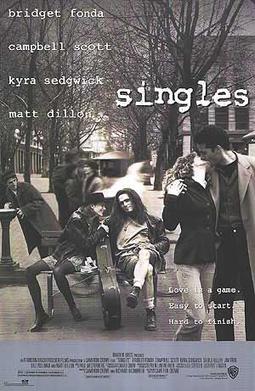
Singles poster

Singles

99 minutes

Cast

Selected cast credits · Film reference

Bridget Fonda Janet Livermore
Campbell Scott Steve Dunne
Kyra Sedgwick Linda Powell
Sheila Kelley Debbie Hunt
Jim True David Bailey
Bill Pullman Dr. Jamison
Matt Dillon Cliff Poncier
Jeremy Piven Doug Hughley
Tom Skerritt Mayor Weber
Peter Horton Jamie
Bill Smillie Boston doctor
Chuck McQuary Garage opener clerk
Jaffar Smith Kid #2
Dana Eskelson Club girl
Mykol Hazen Club bouncer
Art Cahn Magazine stand clerk
Jane Jones Denise
Paul Giamatti Kissing man
Alicia Roper Kissing woman
Xavier McDaniel Himself
Wayne Cody Himself
Eddie Vedder Eddie
Jeff Ament Jeff
Cameron Crowe Club interviewer
Thomas A. Doyle Wrong phone number
Alice Marie Crowe Dr. Jamison’s nurse
Joan Giammarco Receptionist
Jim Hechim Rich
Tim Burton Brian
Bruce Pavitt Bruce
Sandra Grant Waitress
Tom Herbert Deputy mayor
Jerry Ziesmer Councilman Jordan Fisher
Nina Escudero Airline clerk
Dan Wartman Single kid on plane
Amy Hill Hospital nurse
Mike Parker Mover

Singles | The Rewatchables

Explore episodeClose episode

What’s Aged the Best?

Music; mature emotional resonance; fully formed characters; Seattle scene; title cards; romance callbacks; fourth-wall narration; pregnancy test

In the discussion (26)
Approx. transcript time · 00:05:28Read transcript
  • The loneliness and romantic uncertainty resonate more strongly with age, even when youthful viewers originally connected mostly with scenes and music.
  • Pre-internet loneliness is captured through going to bars alone, hoping to meet people, leaving answering-machine messages and sharing music or mixtapes.
  • Crowe lets characters with full, complicated lives gradually fit together through love, compared with Jerry Maguire, Say Anything and Almost Famous.
  • Linda and Janet are convincingly written women whose choices remain understandable, including Janet considering surgery to reach Cliff.
  • The characters feel like whole people with unseen lives rather than profiles defined by a few interests; their apparent confidence masks how meeting another person can unsettle them.
  • The music has gained power and accidentally preserves several bands that became enormous.
  • Steve and Linda’s relationship anchors the movie; an older viewer recognizes avoidable defensive mistakes and wants them simply to call and talk, making weaker material easier to forgive.
  • Alice in Chains performing feels strikingly authentic and still exciting after many viewings; more band footage is wished for at the expense of the garage-opener material.
  • The soundtrack is proposed as the greatest ever and exceptionally good value, with strong songs rather than leftover band contributions.
  • State of Love and Trust is called a top-twelve Pearl Jam song, Drown a personal top-five Pumpkins song, and the Screaming Trees and Westerberg tracks unusually prominent; these are individual placements, not complete ranked lists.
  • Cornell’s solo contribution and the Alice in Chains and Soundgarden performances are praised; the solo-song title is garbled in this transcript.
  • The live band footage lets viewers experience shows they were too young or distant to attend, functioning partly as a concert film.
  • Vedder, Gossard and Ament are funny and natural in their acting cameos, though Pearl Jam never actually performs; the hostile review-reading scene exploits that presence.
  • Java Stop captures an emerging Seattle coffee-shop culture distinct from older screen diners; whether earlier movies such as Slacker contained comparable cafés remains uncertain.
  • Album-like title cards are praised and fully enumerated: Have Fun Stay Single, The Hourglass Syndrome, Blues for a T-Shirt, Blue Seattle, Expect the Best, The Theory of Eternal Dating and What Took You So Long.
  • A date leaning over to unlock the driver’s door is remembered as a considerate gesture, also used in A Bronx Tale; automatic locks largely erased the ritual.
  • The film’s poster is considered excellent and worth framing.
  • The film’s many cameos are praised.
  • Debbie’s country video is praised as hilarious.
  • The two Westerberg tracks are praised as exceptionally strong solo songs.
  • The newsstand warning that clubgoers will lose their hearing seems prescient.
  • Dillon reveals a funny side that had not been familiar, including his unfinished musical ideas.
  • Crowe’s corny romantic one-liners work because he plants meanings and returns to them, including the neighborhood excuse and final reunion line.
  • Direct-to-camera narration builds familiarity and can fit the era’s casual home-video culture; uncertainty about whom the characters address remains part of its effect.
  • Steve’s claim that modern society barely requires leaving home seems even truer in the present.
  • The pregnancy-test scene captures the woman’s bodily certainty, the man’s nervous fixation on instructions and the immediate shift in their relationship.

Most Rewatchable Scene

Alice in Chains sequence; implant consultation

In the discussion (21)
Approx. transcript time · 00:08:03Read transcript
  • The garage-door-opener detail and the Xavier McDaniel sexual-distraction scene became clearer and funnier with age.
  • Steve’s drunken club phone call once seemed as romantic as Lloyd Dobler’s boombox gesture.
  • Linda’s betrayal by the apparently mysterious Luis is a gutting opening that establishes emotional chaos before Steve enters.
  • Linda insisting she will not lose another garage opener and Steve resolving to focus on work express defensive certainty before romance disrupts it.
  • The Peter Horton negotiation and the “popcorn with half this city” line remain memorable.
  • Janet’s adoration cuts to Cliff’s Hendrix posturing and Touch Me I’m Dick, then his insistence that he sees other people meets her refusal to believe him.
  • Stoltz’s bitter talking mime provides an excellent transition into Alice in Chains performing.
  • Steve seeing Linda at the club is a love-struck reversal of his declared disinterest, followed by the sharp rejection that not having an act is itself his act.
  • The first date reveals Steve’s albums, wall decorations and X-Man poster, then his supertrain pitch meets Linda’s attachment to her car.
  • The Andy flashback establishes the sensitive-ponytail man and his emotional-larceny line.
  • The parking-underneath callback and Steve admitting he was nowhere near Linda’s neighborhood deepen the first-date sequence.
  • Xavier McDaniel’s basketball clip becomes the sexual-distraction cameo ending in the instruction not to come.
  • The café discussion that casual sex is lethal, with Cliff reacting as though he needs a clinic, is praised as the apparent blueprint for Friends’ dating-neighbors coffee-shop setup.
  • Vedder reading the devastating Citizen Dick review while Cliff tries to remain positive is a favorite short sequence; the review attacks his mediocre talent and urges him to leave town.
  • Piven’s fan recognizes Steve and invites him to DJ, demonstrating the Elvis Costello–Public Enemy mix; the short cameo felt authentic in 1992.
  • Debbie’s dating video and Tim Burton’s aspiring-director cameo are singled out as especially funny early-nineties material.
  • Depressed Steve passes the mime, then Soundgarden and the phone-booth call create another strong sequence.
  • Janet visiting the withdrawn Steve leads through the parallel-universe couple line into Drown.
  • The implant consultation is a final favorite: Pullman’s refusal to manipulate Janet’s body helps her recognize her worth, and he seems a better match than Cliff.
  • The concluding “What took you so long?” reunion is admired as an early example of Crowe’s climactic romantic line, later echoed in Jerry Maguire.
  • The whole Alice in Chains sequence, including the car ride, mime and Linda’s no-act rejection, receives two final scene choices.

What’s Aged the Worst?

Luis; Nirvana’s absence; dated communications; Bobby Van; Gibson reference; intrusive gestures

In the discussion (9)
Approx. transcript time · 00:11:33Read transcript
  • The same romantic gestures could now feel frightening or intrusive: drunken possessiveness, a boombox outside a window and appearing at someone’s workplace are criticized.
  • Post-club newsstand visits and the fear surrounding casual sex feel historically remote.
  • Video dating looks obsolete but can also be read as a precursor to Tinder rather than wholly dated.
  • Answering machines, broken machines and overheard live messages are dated plot mechanisms, with Swingers invoked as a later example.
  • Luis’s elaborate romance deception is condemned as predatory and bizarre, especially pretending to leave for Spain while remaining nearby.
  • The Bobby Van reference now requires explanation as a Make Me Laugh host.
  • Nirvana’s absence is regretted; Crowe wanted Imodium, but the band publicly rejected appearing in a Seattle love story or rock movie.
  • Linda’s ideal combining Holden Caulfield and Mel Gibson now carries baggage because of Gibson’s later conduct.
  • The fax machine is dated, prompting an uncertain discussion of when faxing faded from ordinary use.

Apex Mountain

Campbell Scott; anguished phone messages; Xavier McDaniel era; garage openers; video dating; early-nineties Seattle; red Saab

In the discussion (16)
Approx. transcript time · 00:45:20Read transcript
  • Newsstands are nominated as a possible Apex, with the fuller discussion deferred.
  • Crowe is rejected as an Apex here.
  • Sedgwick’s later The Closer is preferred.
  • Scott receives an affirmative choice based on this film and the Julia Roberts movie.
  • Dillon and Pearl Jam are rejected; Kelley’s television work is offered instead.
  • Long, anguished nineties phone messages receive an emphatic affirmative choice.
  • McDaniel’s Knicks–Bulls playoff and Singles period is accepted as a career-era peak, with his Celtics signing mentioned.
  • Garage-door openers receive immediate agreement.
  • Video dating in movies is accepted, reinforced by Burton directing the fictional video.
  • Tim Burton cameos are proposed as a separate candidate without a clear response.
  • The supertrain concept is compared with the 1979 NBC series; its repeated failure leaves no clear winner.
  • Apartment buildings as plot devices lose to Melrose Place or Rosemary’s Baby.
  • Sub Pop is rejected in favor of roughly two years earlier.
  • Early-nineties Seattle is favored, though the exact year is debated through Sleepless in Seattle, the Sonics and Griffey; later civic and musical changes complicate the nostalgia.
  • The old red Saab fastback is an affirmative final candidate.
  • Douglas Coupland’s Generation X is noted as another major contemporary touchstone; no explicit final ruling is stated.

The Great Shot Gordo Award for Most Cinematic Shot

Linda outside the club; power-plant wide shot

In the discussion (2)
Approx. transcript time · 01:06:38Read transcript
  • Linda being comforted after Luis’s betrayal, framed outside the club with Love Bone lettering visible, is a cinematic-shot choice.
  • The wide power-plant shot after the chili dog is a second cinematic-shot choice.

The Butch’s Girlfriend Award for the Weakest Link in the Film

Older-looking cast, especially Scott; disputed

In the discussion (1)
Approx. transcript time · 01:07:06Read transcript
  • The apparent age of the cast, especially thirty-year-old Scott as Steve, is questioned; others defend his maturity and the characters’ professional lives, leaving Scott disputed rather than a settled weak link.

The Stephen A. Smith Hottest Take Award

Bad supertrain pitch; underused Bailey; Nirvana contradiction; Friends borrowing; Reality Bites comparison

In the discussion (6)
Approx. transcript time · 01:14:18Read transcript
  • An earlier Klosterman argument favored Reality Bites as a Gen X film and contrasted its romanticized slacker with Singles’ pathetic version; the current response ultimately values both without requiring a winner.
  • Steve may be a bad train designer: his pitch supplies coffee, music and vibes instead of evidence justifying billion-dollar disruption, so the mayor’s quick rejection and his firing make sense.
  • Bailey is badly underused, with no arc; identifying Jim True-Frost as The Wire’s Prez prompts a joking Baltimore-police future for the character.
  • Nirvana should have been included, yet its refusal and contempt for fame are also what made it special; Unplugged, Saturday Night Live and MTV appearances complicate the selling-out argument.
  • A counterproposal favors using Imodium in the stereo scene rather than an actual Nirvana performance or Cobain cameo; a live appearance might distract Steve from calling Linda.
  • Friends is accused of borrowing the setup and character types, with Janet–Rachel and Steve–Ross parallels; opinions differ on whether Crowe deserved compensation or had simply refused the opportunity.

The Joey Pants “That Guy” Award

Jim True-Frost; Devon Raymond; Giamatti; Garber; Pullman; Walker

In the discussion (3)
Approx. transcript time · 01:25:40Read transcript
  • Jim True-Frost as Bailey, also known as The Wire’s Prez, is the primary that-guy choice.
  • Devon Raymond as Linda’s friend Ruth is another familiar presence, with her limited use compared to being left in the corner to shoot threes.
  • The many small appearances bring up Giamatti, Garber, Pullman and Ally Walker; Walker’s later crime series is recalled without a settled title.
In the discussion (3)
Approx. transcript time · 01:26:45Read transcript
  • The announced eleven-candidate list is Vedder and Ament as one entry, Stoltz, Horton, Pullman, Piven, Giamatti, LeGros, Walker, Burton, Skerritt and McDaniel; alternatives remain unranked.
  • McDaniel and Piven are an initial toss-up, while Stoltz is acknowledged as an obvious award choice.
  • Piven receives final choices for the intensity of his arrival and pregnancy-test reaction; Stoltz receives a separate choice for making the smoking mime memorable.

Sequel, Prequel, Limited Series, or All-Black Remake

Black ensemble in Atlanta/New Orleans or Seattle; Atlanta1995; D.C. punk prequel

In the discussion (4)
Approx. transcript time · 01:38:04Read transcript
  • An all-Black version is enthusiastically proposed, set in present-day Atlanta or New Orleans with hip-hop.
  • An alternative Black Seattle grunge-revival ensemble is suggested.
  • Atlanta in 1995 is considered a better creative setting but a more expensive, harder-to-finance period version than a contemporary film.
  • A D.C. punk-scene prequel around 1989 is joked about through Fugazi and a purple-haired Joe House.

Is This Movie Better With…?

Kathryn Hahn as Ruth; Buscemi possibilities; Philip Baker Hall as mayor

In the discussion (4)
Approx. transcript time · 01:39:43Read transcript
  • Kathryn Hahn as Ruth is considered an excellent spiritual fit.
  • Buscemi as Bailey feels potentially believable but his Mr. Pink association interferes; the mime or Luis are additional options.
  • Philip Baker Hall could play the mayor.
  • Wayne Jenkins is imagined teasing the supertrain planner, without a clear casting choice.

Just One Oscar

Soundtrack; Westerberg’s Waiting for Somebody

In the discussion (1)
Approx. transcript time · 01:40:33Read transcript
  • The soundtrack is chosen first, then Westerberg and Waiting for Somebody are named as a possible original-song route; eligibility is discussed uncertainly.

What Piece of Memorabilia Would You Want From This Movie?

Cantrell’s long johns; Citizen Dick poster; garage opener; stereo-shattered glass; X-Man bumper sticker

In the discussion (5)
Approx. transcript time · 01:47:39Read transcript
  • Cantrell’s long johns are a memorabilia choice.
  • The original Citizen Dick Smarter Than You poster is another choice.
  • The garage opener is desired as an inside joke.
  • Shards from Janet’s stereo-shattered car window are another choice, explicitly corrected away from Linda’s separate traffic accident.
  • Steve’s X-Man bumper sticker is another desired object; its exact wording is garbled in the transcript.

Who Won the Movie?

Grunge; the nineties

In the discussion (2)
Approx. transcript time · 01:49:58Read transcript
  • Steve is the initial choice, Bridget Fonda is proposed in response, and the discussion shifts to grunge with explicit agreement and a final explanation about renewed soundtrack listening.
  • The producer separately chooses the nineties.
Podcast choices
Speaker not identified
Grunge
Speaker not identified
Grunge
Speaker not identified
The nineties