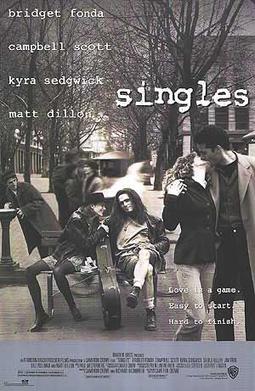
Newsstands are nominated as a possible Apex, with the fuller discussion deferred.
Crowe is rejected as an Apex here.
Sedgwick’s later The Closer is preferred.
Scott receives an affirmative choice based on this film and the Julia Roberts movie.
Dillon and Pearl Jam are rejected; Kelley’s television work is offered instead.
Long, anguished nineties phone messages receive an emphatic affirmative choice.
McDaniel’s Knicks–Bulls playoff and Singles period is accepted as a career-era peak, with his Celtics signing mentioned.
Garage-door openers receive immediate agreement.
Video dating in movies is accepted, reinforced by Burton directing the fictional video.
Tim Burton cameos are proposed as a separate candidate without a clear response.
The supertrain concept is compared with the 1979 NBC series; its repeated failure leaves no clear winner.
Apartment buildings as plot devices lose to Melrose Place or Rosemary’s Baby.
Sub Pop is rejected in favor of roughly two years earlier.
Early-nineties Seattle is favored, though the exact year is debated through Sleepless in Seattle, the Sonics and Griffey; later civic and musical changes complicate the nostalgia.
The old red Saab fastback is an affirmative final candidate.
Douglas Coupland’s Generation X is noted as another major contemporary touchstone; no explicit final ruling is stated.
The garage-door-opener detail and the Xavier McDaniel sexual-distraction scene became clearer and funnier with age.
Steve’s drunken club phone call once seemed as romantic as Lloyd Dobler’s boombox gesture.
Linda’s betrayal by the apparently mysterious Luis is a gutting opening that establishes emotional chaos before Steve enters.
Linda insisting she will not lose another garage opener and Steve resolving to focus on work express defensive certainty before romance disrupts it.
The Peter Horton negotiation and the “popcorn with half this city” line remain memorable.
Janet’s adoration cuts to Cliff’s Hendrix posturing and Touch Me I’m Dick, then his insistence that he sees other people meets her refusal to believe him.
Stoltz’s bitter talking mime provides an excellent transition into Alice in Chains performing.
Steve seeing Linda at the club is a love-struck reversal of his declared disinterest, followed by the sharp rejection that not having an act is itself his act.
The first date reveals Steve’s albums, wall decorations and X-Man poster, then his supertrain pitch meets Linda’s attachment to her car.
The Andy flashback establishes the sensitive-ponytail man and his emotional-larceny line.
The parking-underneath callback and Steve admitting he was nowhere near Linda’s neighborhood deepen the first-date sequence.
Xavier McDaniel’s basketball clip becomes the sexual-distraction cameo ending in the instruction not to come.
The café discussion that casual sex is lethal, with Cliff reacting as though he needs a clinic, is praised as the apparent blueprint for Friends’ dating-neighbors coffee-shop setup.
Vedder reading the devastating Citizen Dick review while Cliff tries to remain positive is a favorite short sequence; the review attacks his mediocre talent and urges him to leave town.
Piven’s fan recognizes Steve and invites him to DJ, demonstrating the Elvis Costello–Public Enemy mix; the short cameo felt authentic in 1992.
Debbie’s dating video and Tim Burton’s aspiring-director cameo are singled out as especially funny early-nineties material.
Depressed Steve passes the mime, then Soundgarden and the phone-booth call create another strong sequence.
Janet visiting the withdrawn Steve leads through the parallel-universe couple line into Drown.
The implant consultation is a final favorite: Pullman’s refusal to manipulate Janet’s body helps her recognize her worth, and he seems a better match than Cliff.
The concluding “What took you so long?” reunion is admired as an early example of Crowe’s climactic romantic line, later echoed in Jerry Maguire.
The whole Alice in Chains sequence, including the car ride, mime and Linda’s no-act rejection, receives two final scene choices.