

What’s Aged the Best?
Music; mature emotional resonance; fully formed characters; Seattle scene; title cards; romance callbacks; fourth-wall narration; pregnancy test
In the discussion (26)
Approx. transcript time · 00:05:28Read transcript
- The loneliness and romantic uncertainty resonate more strongly with age, even when youthful viewers originally connected mostly with scenes and music.
- Pre-internet loneliness is captured through going to bars alone, hoping to meet people, leaving answering-machine messages and sharing music or mixtapes.
- Crowe lets characters with full, complicated lives gradually fit together through love, compared with Jerry Maguire, Say Anything and Almost Famous.
- Linda and Janet are convincingly written women whose choices remain understandable, including Janet considering surgery to reach Cliff.
- The characters feel like whole people with unseen lives rather than profiles defined by a few interests; their apparent confidence masks how meeting another person can unsettle them.
- The music has gained power and accidentally preserves several bands that became enormous.
- Steve and Linda’s relationship anchors the movie; an older viewer recognizes avoidable defensive mistakes and wants them simply to call and talk, making weaker material easier to forgive.
- Alice in Chains performing feels strikingly authentic and still exciting after many viewings; more band footage is wished for at the expense of the garage-opener material.
- The soundtrack is proposed as the greatest ever and exceptionally good value, with strong songs rather than leftover band contributions.
- State of Love and Trust is called a top-twelve Pearl Jam song, Drown a personal top-five Pumpkins song, and the Screaming Trees and Westerberg tracks unusually prominent; these are individual placements, not complete ranked lists.
- Cornell’s solo contribution and the Alice in Chains and Soundgarden performances are praised; the solo-song title is garbled in this transcript.
- The live band footage lets viewers experience shows they were too young or distant to attend, functioning partly as a concert film.
- Vedder, Gossard and Ament are funny and natural in their acting cameos, though Pearl Jam never actually performs; the hostile review-reading scene exploits that presence.
- Java Stop captures an emerging Seattle coffee-shop culture distinct from older screen diners; whether earlier movies such as Slacker contained comparable cafés remains uncertain.
- Album-like title cards are praised and fully enumerated: Have Fun Stay Single, The Hourglass Syndrome, Blues for a T-Shirt, Blue Seattle, Expect the Best, The Theory of Eternal Dating and What Took You So Long.
- A date leaning over to unlock the driver’s door is remembered as a considerate gesture, also used in A Bronx Tale; automatic locks largely erased the ritual.
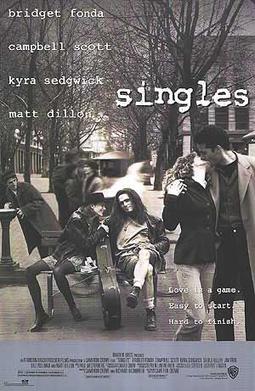
- The film’s poster is considered excellent and worth framing.
- The film’s many cameos are praised.
- Debbie’s country video is praised as hilarious.
- The two Westerberg tracks are praised as exceptionally strong solo songs.
- The newsstand warning that clubgoers will lose their hearing seems prescient.
- Dillon reveals a funny side that had not been familiar, including his unfinished musical ideas.
- Crowe’s corny romantic one-liners work because he plants meanings and returns to them, including the neighborhood excuse and final reunion line.
- Direct-to-camera narration builds familiarity and can fit the era’s casual home-video culture; uncertainty about whom the characters address remains part of its effect.
- Steve’s claim that modern society barely requires leaving home seems even truer in the present.
- The pregnancy-test scene captures the woman’s bodily certainty, the man’s nervous fixation on instructions and the immediate shift in their relationship.