
‹ All movies

The opening scene, Mike McD losing his 30 grand to Teddy KGB

Five nominees are read: the opening scene where Mike McD loses his shirt ('I don't think you have the spades'), and Mike McD's poker comeback, whose clip is played; 'let's play some fucking cards' plus the guitar riff gets a host fired up to gamble, like the Vegas moment in Swingers.

An aside: the comeback is a bit of a cheat, because the two hosts played cards on the same night earlier this summer and real poker is slow and awful, everyone is Joey Knish and no one is Mike McD, whereas the movie makes it feel like a jet engine down the tarmac; one host's favorite thing in life is driving to Vegas and sitting silently at a poker table for eight hours.

"Hanging around hanging around kids got alligator blood"

A rip-through of quotes: 'Welcome to Chesterfield South'; 'Rule number one, throw in your cards when you know you can't win. Fold the hand', good life advice and a senior yearbook quote; and 'you can't lose what you don't put in the middle, but you can't win much either', another yearbook quote.

The film

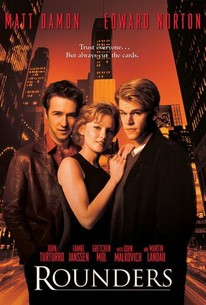
Rounders (1998)

Directed by John Dahl · Drama / Crime

120 minutes

Cast

Selected cast credits · Film reference

Matt Damon Mike McDermott
Edward Norton Lester 'Worm' Murphy
John Turturro Joey Knish
John Malkovich Teddy KGB
Martin Landau Abe Petrovsky
Josh Mostel Zagosh
Lenny Clarke Savino
Tom Aldredge Judge Marinacci
Michael Lombard District Attorney Shields
Lenny Clarke Savino
Chris Messina Higgins
Goran Višnjić Maurice
David Zayas Trooper Osborne
Johnny Chan himself
Bill Camp Eisenberg
Josh Pais Weitz
Adam LeFevre Sean Frye

Everything from the episode

In the order the hosts got to it. Open a row for the discussion.

20:07

Most Rewatchable Scene

The opening scene, Mike McD losing his 30 grand to Teddy KGB; Mike McD and Worm arriving at the emptied apartment and...

The opening scene, Mike McD losing his 30 grand to Teddy KGB; Mike McD and Worm arriving at the emptied apartment and leaving to 'play some fucking cards'

In the discussion (9)
Approx. transcript time · 00:20:07Read transcript
  • Five nominees are read: the opening scene where Mike McD loses his shirt ('I don't think you have the spades'), and Mike McD's poker comeback, whose clip is played; 'let's play some fucking cards' plus the guitar riff gets a host fired up to gamble, like the Vegas moment in Swingers.
  • An aside: the comeback is a bit of a cheat, because the two hosts played cards on the same night earlier this summer and real poker is slow and awful, everyone is Joey Knish and no one is Mike McD, whereas the movie makes it feel like a jet engine down the tarmac; one host's favorite thing in life is driving to Vegas and sitting silently at a poker table for eight hours.
  • The remaining nominees: the Johnny Chan scene, Chan being one of the movie's big winners, with the Russian lady's intimate familiarity with World Series of Poker hands and the Chan versus Seidel 'look at the patience' hand; Mike and Worm trying to win everything back ('I've gone on runs like this before'); and the final Mike McD versus Teddy KGB showdown.
  • Runner-up nomination: the judges' game, Mike McD putting every judge in the room on a hand so that Judge Marinacci offers a clerkship on the strength of one read; every movie like this needs a moment showing how smart the lead is. — Sean Fennessey
  • The other runner-up is the trip to Binghamton and the card game with the police officers, corrected to municipal workers: the scariest scene but one of the best made, the shot of Mike and Worm getting beaten after Norton's mechanic work is caught, real tension in a movie where the stakes are otherwise hard to gauge.
  • The opening scene is picked as the most rewatchable: a testament to how the film draws you in, the soundtrack, Mike McD rolling in with 30 grand, taking three stacks of high society and explaining the game's nuances; voiceover is a no-no that the host hates, but here it works for the first ten minutes.
  • A quibble about the opening hand: Mike McD holds ace-nine, KGB holds aces, the board runs ace nine eight, then another nine gives both a full house, and a rag comes on the river; KGB is so sure he has won that he shows his aces, drops them and walks away, yet Mike could have held pocket nines for four of a kind, something the host has never heard anyone discuss.
  • The quibble is told to save it for picking nits; the counter is that KGB read Mike's devastated face and needed to see nothing else, which the questioner half accepts while still wanting to see the cards.
  • The other favorite is when Gretchen Mull (as transcribed) moves out: not the moving but Mike McD and Worm arriving at the emptied apartment, Ed Norton's 'women are the rake' speech, Mike's wheels turning to 'fuck it, let's go, let's play some fucking cards', and the music, almost a sports-movie scene.
25:53

What’s Aged the Best?

The 'spot the sucker' opening line; the Billions DNA; the Mike McD face; the throwaway poker lingo; Damon and Norton ...

The 'spot the sucker' opening line; the Billions DNA; the Mike McD face; the throwaway poker lingo; Damon and Norton at fun points of their careers; the look and the New York setting; Russians as villains; Teddy KGB's accent; the World Series of Poker ending

In the discussion (14)
Approx. transcript time · 00:25:53Read transcript
  • The first line, 'if you can't spot the sucker in your first half hour at the table then you are the sucker', may not be the greatest opening line in movie history but is one of the most memorable; the hosts want to see that list, which must exist on the internet, and float it as a vacation column.
  • There is Billions DNA in the film: watching Rounders is like watching Tracy McGrady on the Raptors, and the pop culture throwaways such as Buckner going into Shea became signatures of Billions, which also brought in Malkovich in season three.
  • The face Mike McD makes after losing the 30K is one of the best acting moments of Damon's career: the face everyone makes when destroyed in poker or blackjack, the life sinking out of your body; the sports-fan equivalent is the Marco Bellinelli corner three or the Case Keenum pass.
  • Having a big hand cracked while deluded with euphoria is called the most crushing unimportant thing that can happen in life; all the throwaway poker lines have aged beautifully and one host understands the lingo partly because of this movie.
  • Damon and Norton at fun points in their careers: Norton arrives with Primal Fiction (as transcribed), American History X, one of the most interesting performances of the last 25 years, then Rounders and Fight Club; 25th Hour mixes that guy with Worm; also Everyone Says I Love You, a terrible Woody Allen musical, and The People vs. Larry Flint, which has not aged well.
  • The Larry Flint writers, Larry Krasuski and Scott Alexander (as transcribed), also wrote the OJ Ryan Murphy show and Ed Wood and set the template for the clever, controversial biopic, like Man in the Moon, a style that now lives on TV in 13-episode runs.
  • The late-nineties talent cluster: in a fantasy draft Leo, Damon and Norton are the top three or in the top five, with Brad Pitt, Affleck gravitating to popcorn movies, feeder films like School Ties and Dazed and Confused, and Vince Vaughn; weirdly no black actors went to the stratosphere, Halle Berry aside.
  • Clooney, Matthew Perry twenty years ago, Wahlberg after Boogie Nights, Will Smith and Jim Carrey round out one of the best clusters, all 35 and under, compared with the Godfather generation around Brando; these people get credit as movie stars rather than actors, in the era when the Entertainment Weekly cover mattered and Carrey got $20 million a movie.
  • Norton took a left turn after the mid-nineties string: directing Keeping the Faith, which Juliette Littman likes, The Score with De Niro, Death to Smoochie, then 25th Hour, probably his best of the 2000s, and The Illusionist; he never had the Pacino or Gene Hackman career one host wanted, though he may still.
  • Worm is a character unique to Norton, out of the John Cazale 1970s: the lovable scumbag you root for without knowing why, with a little Fredo in him.
  • The movie looks surprisingly cool and undated for 1998 and is a good New York movie that still looks like the New York the hosts remember; the Chesterfield is based on a club called the Mayfair, and one host once played in a private room like it, the film's room being a slightly nicer red leather version of his, with that seedy but exciting feeling.
  • Russians as villains has aged the best: in 1998 the Cold War had ended eight years earlier and Russia was in free fall, but twenty years on Roman, Maurice, Teddy KGB and the underground network are far more believable villains.
  • Forgotten from aged best: Teddy KGB's accent, ridiculous in 1998 and loved in 2018 largely from familiarity; in the theater it was the movie's biggest flaw, a completely unnatural choice in a natural film, but twenty years later it works, is distinct, fun to imitate and almost a parody of bad Russian accents.
  • The ending of Mike McD heading to Vegas and the World Series of Poker makes far more sense now, since within five years that became the dream of basically everyone who played; it could have been aged best too.
35:49

What’s Aged the Worst?

Gretchen Maul's (as transcribed) wet-blanket girlfriend Joe and her performance; the judges' instant hand-reading sce...

Gretchen Maul's (as transcribed) wet-blanket girlfriend Joe and her performance; the judges' instant hand-reading scene; Mike McD not hooking up with Famke Janssen's character

In the discussion (11)
Approx. transcript time · 00:35:49Read transcript
  • Gretchen Mala (as transcribed) plays the stereotypical wet-blanket girlfriend, a staple of 80s and 90s sports movies for undermining the hero: a girlfriend or wife who does not believe in what he is doing.
  • A Mount Rushmore of wet-blanket girlfriends: Adrian Balboa in Rocky IV, who quits on Rocky and shows up belatedly in Russia, leaving one host still in go-fuck-yourself-Adrian mode; Myra Fleener in Hoosiers, the number one, subject of an old ESPN magazine column, with no idea why Gene Hackman liked her.
  • A theory: many men do not know how to write female characters, so they pour their own relationship anxieties into a figure who is holding the hero back, which is why so many movies have a woman you cannot place; the last Rushmore member is Ned Braden's wife in Slapshot (as transcribed), a tough hang who even throws it at Paul Newman.
  • The defense from Koppelman and Levine, given in a back-and-forth with one host: Damon's girlfriend was originally in only three scenes, and a law-school best friend named Atkinson, a counterpoint to Worm, was in the script until the studio made them merge Joe and Atkinson and boost Joe, leaving her inessential and simply in Worm's way.
  • Not a great performance either, though she rallied in the 2000s; she is flat-out bad and unlikable here, around the time of the Vanity Fair cover anointing her the next ingenue when she had made little more than Donnie Brasco, and hers is the only stretch where the movie loses its rhythm.
  • The judges' card scene, which both like, has aged worst: Mike McD standing for eight to fourteen seconds and reading everyone's hand is not believable, even if Koppelman and Levine claim to have seen it happen; the clip is played; such reads take hours of study.
  • The judges' game is not Texas Hold'em, perhaps a seven-card stud variant with many cards showing, which makes the reads more plausible, and the judges' cards are never shown, so he might have missed some; it sets him up as a savant, a reach one host is fine with.
  • Martin Lando's (as transcribed) character is described as a cross between a law professor, Confucius, the fairy godmother and Red Arbeck (as transcribed); not a great character but essential, and the bar scene where he pours gin and tells the yeshiva story is loved; movies like this need an old guy, as Charlie Pierce was for Grantland.
  • Mike McD not hooking up with Famke Jansen (as transcribed) is called the biggest flaw of the movie and maybe of a host's life, raised with Koppelman and Levine multiple times: his girlfriend has moved out, he is home alone watching an old World Series of Poker, she comes over about Worm's tab and makes a hard pass, and he says now is not the time, which is called inexplicable and indefensible.
  • Her character is the manic poker dream girl, after the manic pixie dream girl of Penny Lane and the Zooey Deschanel movies: beautiful, a Bond girl three years earlier, works at the Chesterfield and recounts World Series hands; the case against is that he loves Joe, is trying to go straight, and Petra represents the old version of him.
  • On rewatch the hosts think the two should simply have gotten together; Koppelman and Levine admit it is their biggest mistake, prompting a joke about adding a scene for the 25th anniversary; for one host it is the what's aged the worst, and the explanation offered does not convince him.
44:19

The Dion Waiters Award for Best Heat Check Performance

John Malkovich as Teddy KGB

John Malkovich as Teddy KGB

In the discussion (5)
Approx. transcript time · 00:44:19Read transcript
  • The category is loaded for this movie: John Malkovich as Teddy KGB, Famke Jansen (as transcribed), John Turturro as Knish, Martin Landau with only three scenes who has to be mentioned, and the actor who played Grandma (as transcribed), Michael Rispoli, saved for the Joey Pants Award.
  • Both agree there is only one answer, 'pay this man his fucking money', KGB: he is in the opening and closing scenes, maybe three in all, and his NBA box score is 12 minutes with 35 points, 10 rebounds and seven blocked shots.
  • Famke Jansen (as transcribed) gets a shout-out and a case that she should have been Joe with another Russian character invented; Knish should not be overlooked either, with some of the greatest lines, representing lifetime grinders, based on a real man named Joel Bagels (as transcribed) whom Koppelman and Levine wrote about in 2014, whose real-life line was 'women are the rake'.
  • The sauna confrontation where Knish refuses Mike McD the money is loved and the clip is played: two grand buys a day, Knish will not chase cards or pipe dreams of winning the World Series on ESPN because he owes rent, alimony and child support and his kids eat, offering calls and a place to stay instead.
  • Knish is almost not a heat check because he is in too many scenes, whereas Malkovich is in two or two and a half, the ultimate Deion Weirder (as transcribed) and a fucking heat check.
47:22

The Joey Pants “That Guy” Award

Michael Rispoli, who plays Grandma (as transcribed); a shout-out to Lenny Clark

Michael Rispoli, who plays Grandma (as transcribed); a shout-out to Lenny Clark

In the discussion (2)
Approx. transcript time · 00:47:22Read transcript
  • Many that-guys fill the random poker scenes; a shout-out goes to Lenny Clark, now recognizable but back then known only in Boston, who has a couple of lines in one poker scene.
  • Michael Raspoli (as transcribed), who plays Grandma (as transcribed): a host in the 99th percentile for this stuff did not know his name until looking it up, and the key fact is that he lost the Tony Soprano bake-off to James Gandolfini, then played Jackie April (as transcribed) as a consolation prize; an amazing what-if that likely changed his life, and he is a good actor.
54:29

Apex Mountain

Johnny Chan

Johnny Chan

In the discussion (5)
Approx. transcript time · 00:54:29Read transcript
  • Matt Damon is a no because the movie was not a hit; his real apex is probably the first movie of his franchise that made a shitload of money (the transcript has 'that first born movie'), unless it was covered in the Good Will Hunting episode; Ed Norton is a no, with Fight Club his apex given his body of work, though he was on his way up; Gretchen Maul (as transcribed) is definitely a no, with The Notorious Betty Page (as transcribed) her comeback.
  • Johnny Chan is put forward as a 100 percent yes; the other reacts 'No way!' and the proposer repeats 100 percent yes, since Chan won two World Series of Poker in a row, this was effectively his third title, and he is immortalized pulling the greatest poker move, waiting out his man; the hosts wonder whether it is the same wheel hand Mike uses to beat Teddy KGB.
  • John Turturro is a no: this and Jesus in The Big Lebowski the same year are a great one-two, but Barton Fink is probably his apex, even though one host is not a Coen Brothers guy.
  • For Malkovich, Dangerous Liaisons is argued as his apex, coming off Killing Fields, with an underrated over-the-top performance opposite Glenn Close; then the other realizes it must be Being John Malkovich, since they named a movie after him, which is conceded as the cherry on the sundae.
  • For Koppelman and Levine, Billions is their apex mountain right now; their dream is Kevin Durant telling them at a party that he loves their show.
57:39

Is This Movie Better With…?

Steve Buscemi

Steve Buscemi

In the discussion (2)
Approx. transcript time · 00:57:39Read transcript
  • The easy quick answer is Buscemi, but Michael K. Williams should not be slept on: there is not a lot of diversity in the movie and he could have been dropped into any poker scene, or played Grandma (as transcribed), or even Worm, which leads to the idea of Black Rounders.
  • Black Rounders, a Ringer Films presentation, would be incredible, with Williams as Worm, though he is probably too old, so it goes back to the drawing board; both settle on Buscemi, who fits at the Taj table or the Chesterfield as a New York guy.
58:33

The Ruffalo / Hanna / Rubinek / Partridge Overacting Award

The Grandma (as transcribed) scenes; John Malkovich's Teddy KGB

The Grandma (as transcribed) scenes; John Malkovich's Teddy KGB

In the discussion (2)
Approx. transcript time · 00:58:33Read transcript
  • The Grandma (as transcribed) scenes are rough and hard to read: the pit bull abuse, which a dog lover dislikes, is a quick way to make the audience hate him, but it tips into evil, and if he is evil why does he not just kill Worm; what he actually did to the dog is unclear because the camera cuts away.
  • Asked for another overactor, a host wonders whether Teddy KGB could win both the overacting and the heat-check awards: the 'splash the pot' clip is played and called a bit of a reach, trying too hard; Malkovich is captivating and everything he says gets a laugh, but there should be menace, and instead he is an oddball, shut-in, Oreo-eating quasi-Russian with a weird exaggerated accent that is fun without necessarily being good.
1:28:16

Who Won the Movie?

John Malkovich; Matt Damon; Koppelman and Levine (as transcribed)

John Malkovich; Matt Damon; Koppelman and Levine (as transcribed)

In the discussion (4)
Approx. transcript time · 01:28:16Read transcript
  • The first pick is Malkovich, to the other's surprise: his character is the most memorable and most quoted, still the phrasing used at tables today; this is not Damon's or Norton's biggest movie, not what John Dahl is best remembered for, Famke Jansen (as transcribed) was about to be in a superhero franchise and Turturro has bigger films, but for men of a couple of generations this is where Malkovich went for it.
  • The counter-pick is Damon: an old-school Tom Cruise role that just needs a star, since Mike McD is a mediocre law student with the wrong friend who likes poker and yet makes you care; Affleck, Leo, Brad Pitt and Clooney would not pull it off, with Norton ironically the only other choice.
  • The reply is that Damon was going to be fine regardless and a movie-star part is inherently blank, never too far or too good; another candidate is Koppelman and Levine, since few TV or movie writers are known to normal people, Steve Zalian (as transcribed) aside, and even Succession's Jesse Armstrong or Veep's David Mandel lack public profile.
  • Koppelman and Levine positioned themselves well in the guys' pop culture world of the late nineties and probably won, since they have thriving careers and made something people love; Damon loses initially but retroactively the Good Will Hunting, Ripley, Rounders run is an all-timer, and the best rewatchables are movies where the major players are in their sweet spot, as Damon and Norton were.
Podcast choices
Speaker not identified
John Malkovich
Speaker not identified
Matt Damon