‹ All movies
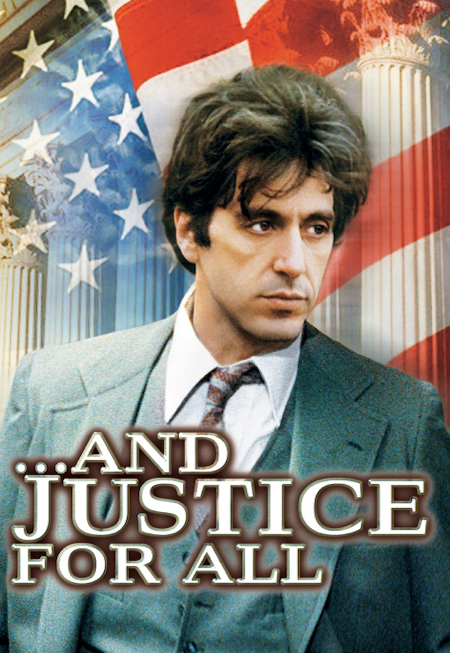
...And Justice for All poster

...And Justice for All

119 minutes

Cast

Selected cast credits · Film reference

Al Pacino Arthur Kirkland
Jack Warden Judge Rayford
John Forsythe Judge Fleming
Lee Strasberg Grandpa Sam
Jeffrey Tambor Jay Porter
Christine Lahti Gail Packer
Sam Levene Arnie
Robert Christian Ralph Agee
Thomas Waites Jeff McCullaugh
Larry Bryggman Warren Fresnell
Craig T. Nelson Frank Bowers
Dominic Chianese Carl Travers
Victor Arnold Leo Fauci
Vincent Beck Officer Leary
Michael Gorrin Elderly man
Joe Morton Prison doctor
Alan North Deputy sheriff
Tom Quinn Desk clerk Kiley
Charles Siebert Assistant D.A. Keene
Robert Symonds Judge Burns
Keith Andes Marvin Bates
Stephen Blackmore Robert Wenke
Terrence Currier George Reisler
Walter Davy Dapper defendant
Rita Fredricks Judge Howe
Jack Hollander Prison warden
Carl Pistilli Matt Gibson
Darrell Zwerling William Zinoff
John Hertzler Driver
Teri Wootten Leah Shepard
John Aquino Deputy sheriff
Sidney Clute Polic
Angus Duncan Gallagher
Johnny Haymer Crenna
Molly Kohler Young woman
Cathleen Schurr Mrs. Barnes
Donald S. Saiontz Defense attorney
Bill Polk Paramedic
Bonita Cartwright Woman in car
Frank Sliwka Court clerk
Julius Dunbar Court reporter
Angelyn Forbes Waitress
Newton Scott Prison guard
McLindsey Hawkins Escort officer

...And Justice for All | The Rewatchables

Explore episodeClose episode

Half-Assed Internet Research

Awards; budget and gross; Baltimore filming; rehearsals; armed judge; coffee cake; courtroom research

In the discussion (7)
Approx. transcript time · 00:22:08Read transcript
  • The original-screenplay nominees were this film, The China Syndrome, Manhattan, All That Jazz and winner Breaking Away; the winner is respected but a retrospective result is uncertain.
  • The actor field pairs Pacino with Jack Lemmon, Roy Scheider, Peter Sellers and winner Dustin Hoffman, with Scheider considered a likely winner in most other years.
  • The film reportedly cost $4 million and earned $33 million.
  • The production is reported to have filmed entirely in Baltimore; the claim of 26 performances of the final speech is corrected to 26 rehearsals.
  • Jewison’s commentary reportedly attributes the gun-firing judge to a real Texas judge.
  • The coffee-cake scene reportedly required 26 takes and made Warden vomit from overeating.
  • Levinson’s courtroom research emphasized misleading first impressions and the distinction between truth and justice; the theme is connected to Homicide: Life on the Street.

Casting What-Ifs

Pacino chose this over Kramer vs. Kramer

In the discussion (1)
Approx. transcript time · 00:23:01Read transcript
  • Pacino reportedly was first choice for Kramer vs. Kramer but chose this film instead; the group favors that outcome while debating whether he could also have matched Hoffman’s performance.

Roger Ebert's review

In the discussion (1)
Approx. transcript time · 00:41:24Read transcript
  • Ebert awarded three stars and praised the angry comedy’s high-voltage central performance; one participant would raise it to 3.5.

Most Rewatchable Scene

The final opening statement and out-of-order eruption

In the discussion (12)
Approx. transcript time · 00:44:14Read transcript
  • The opening follows Aggie before unexpectedly revealing Arthur in jail, establishing the institution’s indignities.
  • Arthur’s visits with his grandfather divide opinion: the Godfather II reunion appeals, but one visit might suffice; the dementia and missed visits underline another personal failure caused by lack of time.
  • Arthur and Lahti’s character moving from an argument into flirting and a Chinese-food date is nominated.
  • The bathroom announcement of Fleming’s rape charge is praised for the difficult, sustained hysterical laughter and the choice of setting.
  • The helicopter ride is a fun but tonally separate sequence, and the unexpected actual crash into the water is especially effective.
  • Tambor’s plate-throwing breakdown is admired for its apparently practical staging and the transformation from joking lawyer to morally overwhelmed man.
  • Arthur attacking the car after Aggie’s death is the defining explosive Pacino showcase, with genuine grief and a demand that lawyers care about their clients’ humanity.
  • The incriminating photographs supplied by Chianese’s character are nominated for Fleming’s brazen posing and the strange glimpse of the sexual gathering.
  • Fleming’s admission of guilt exposes casual entitlement and his certainty of impunity; pointing out the complainant in court pushes Arthur toward breaking.
  • The final opening statement and Arthur’s out-of-order eruption are the unanimous scene choice, including his final insistence that he has completed the statement.
  • The final performance carries distinct stakes for the jury, the client, the complainant, the judge and the earlier victims of the system.
  • Tambor tipping his wig is belatedly recalled as one of the film’s most famous images.

What’s Aged the Best?

Failed negotiation; period music, disputed; Strasberg’s advice; Baltimore; Aggie; petty offenses; early cast roles

In the discussion (8)
Approx. transcript time · 00:44:48Read transcript
  • The late 1970s-to-early 1980s synthesizer, trumpet and jazzy soundtrack is proposed as a period feature but criticized for not fitting the action; Grusin’s later Firm score is favorably contrasted.
  • The failed attempt to talk an armed man down before he stands and is shot is an effective tragic trope and a crucial step in Arthur’s breakdown.
  • The period soundtrack’s saxophones, congas and disco elements remain enjoyable despite earlier reservations.
  • Strasberg reportedly urged the improvising Pacino to learn his lines, advice Pacino later appreciated.
  • Levinson’s Baltimore setting anticipates his later work and the systemic concerns of The Wire.
  • Aggie is treated with surprising sensitivity for 1979, with dignity and humanity central to Arthur’s defense rather than merely a joke.
  • The film questions devoting punitive institutional resources to petty offenses while more serious abuses persist.
  • Early roles for Tambor, Lahti and Nelson are praised as strong discoveries, alongside Jewison’s broader filmography.

Picking Nits

Police response; omitted punch; absent Black lawyers; Fleming’s choice of counsel

In the discussion (4)
Approx. transcript time · 00:49:49Read transcript
  • The police’s reluctance to rush a man throwing plates is questioned.
  • Omitting Arthur’s punch at Fleming is questioned, then defended as an economical opening that starts with Arthur already jailed.
  • The absence of Black lawyers in a Baltimore courthouse is questioned; a response finds that exclusion credible despite Black people elsewhere in the building.
  • Fleming’s strategy of hiring the lawyer who punched him is criticized as arrogant and foolish compared with simply hiring Baltimore’s best available defense lawyer.

The Great Shot Gordo Award for Most Cinematic Shot

Warden on the ledge; industrial harbor walk

In the discussion (2)
Approx. transcript time · 01:06:57Read transcript
  • Warden on the ledge is praised for its apparent danger and Baltimore backdrop; a hidden harness reportedly protected him.
  • Arthur and Lahti’s character walking past industrial buildings and the Domino sugar plant provide another admired Baltimore composition.

What’s Aged the Worst?

Metallica search results; pledge and credits; shaved head; Gail’s neutrality; white victim; score

In the discussion (6)
Approx. transcript time · 01:09:45Read transcript
  • The Metallica title overwhelming search results frustrates one participant, while others note both works borrow the Pledge of Allegiance.
  • The children reciting the pledge and lengthy opening credits feel conspicuously of their era; the credits receive a strong defense as acknowledgment of the filmmakers.
  • Tambor shaving his head no longer delivers the shock it did when the gesture signaled instability.
  • Lahti’s lawyer is criticized as an inconsistent, fence-sitting device with no firm beliefs, despite appreciation for the actor’s natural presence.
  • Centering a white man as the system’s most obvious victim in 1979 Baltimore is questioned, despite the character’s emotional effectiveness.
  • The score is criticized for immediately dating the movie.

The Stephen A. Smith Hottest Take Award

Pacino’s second-best performance after The Godfather Part II, strongly disputed

In the discussion (17)
Approx. transcript time · 01:15:50Read transcript
  • This is proposed as Pacino’s second-best performance after The Godfather Part II, with Heat placed third; another response rejects even a top-five ranking.
  • Dog Day Afternoon is preferred for greater nuance, and Donnie Brasco, Heat, Any Given Sunday, The Godfather, Scarecrow, Serpico and Sea of Love are offered as competing peaks.
  • Carlito’s Way is offered as a soulful alternative, and The Insider is added to the competing Pacino performances.
  • Dick Tracy and The Godfather Part III are added to the performance debate; this film is proposed as the moment Pacino overtook De Niro.
  • The top-two or top-three defense treats Arthur as the culmination of Pacino’s early mastery: quiet and explosive passages form a coherent journey as the system breaks him.
  • Both Godfather performances and Dog Day Afternoon are placed definitively above Arthur in the opposing ranking; Dog Day receives admiration but is called personally exasperating.
  • The Godfather’s Kay scenes and marital storyline are criticized as obstacles to placing Michael in the top two; the challenge of playing Brando’s son is offered in defense.
  • The distinction is clarified as carrying and justifying an entire film rather than delivering a bad performance within an ensemble.
  • Playing Michael in the first Godfather is provocatively called comparatively easy, while Part II is considered much harder; a particular scene remains admired without being named in this exchange.
  • Michael’s transformation is defended as indispensable to the film; the counterargument imagines De Niro or John Cazale in the role.
  • The ensemble is said to elevate Michael’s performance, and James Caan is ranked above Pacino by one participant; a suggestion that Cazale is better is retracted.
  • Arthur is defended as the full range of Pacino’s abilities, requiring trust in the director and editor, in contrast with Michael’s more observational role.
  • The Godfather ranking dispute returns: Part II is called the best male screen performance in 50 years, while the first film is framed as a young actor still discovering the role.
  • Raging Bull and Scarface are called damaging influences on later actors who imitate them, as an argument against accepting inherited performance rankings.
  • The first Godfather’s stature is argued to confer automatic greatness on Pacino, while the restaurant assassination is singled out as exceptional.
  • A defense enumerates Michael’s wedding exposition, revenge planning, Italian interlude and hospital protection of his father as stages of a demanding transformation.
  • Michael is defended as the role that made Pacino a star and helped make The Godfather great; the opposing argument distinguishes iconic characters from great acting to defend Arthur’s high ranking.

Recasting Couch

Meryl Streep; Jane Alexander; Margot Kidder, with objections

In the discussion (3)
Approx. transcript time · 01:30:10Read transcript
  • Meryl Streep and Jane Alexander are proposed for Lahti’s part, though a more serious presence might make the character even more irritating.
  • Margot Kidder is proposed, initially considered too daffy and later reconsidered as potentially effective.
  • Kidder’s overt energy might overwhelm the role or make its fence-sitting neutrality unbelievable, contrasting with Lahti’s less assertive presence.

Apex Mountain

Warden’s era, qualified; courtroom meltdowns, competing with A Few Good Men

In the discussion (7)
Approx. transcript time · 01:33:45Read transcript
  • Pacino’s peak remains The Godfather Part II.
  • Warden is placed around this period, Heaven Can Wait and the years after Shampoo; a Muppets connection is rejected.
  • Tambor’s simultaneous sitcom activity marks an early rise, but Arrested Development or Transparent is preferred for his peak.
  • Lahti’s peak is assigned to her five-year Chicago Hope run.
  • Jewison’s alternatives are In the Heat of the Night and Moonstruck; Moonstruck’s endurance with younger viewers is praised without dismissing the former’s legendary status.
  • The courtroom meltdown is a strong candidate, competing with Jessup in A Few Good Men and described as possibly the most cited.
  • Diner is preferred for Baltimore movies, with Tin Men also mentioned.

Sequel, Prequel, Limited Series, or All-Black Remake

Prestige television about Baltimore courts

In the discussion (1)
Approx. transcript time · 01:39:14Read transcript
  • A prestige series about the Baltimore courts, potentially produced by Levinson, earns interest; Aaron Paul as Arthur is rejected, and The Night Of is compared for a similar sense of hopelessness.

Is This Movie Better With…?

Young Philip Baker Hall; tentative young Danny Trejo; Wayne Jenkins disputed

In the discussion (3)
Approx. transcript time · 01:39:55Read transcript
  • A young Philip Baker Hall is suggested because the film’s age complicates the usual casting list; a young Danny Trejo is briefly considered.
  • Adding Joe Pesci to the standing list is proposed, while a response praises his sparse filmography for keeping individual roles iconic.
  • Wayne Jenkins fits Baltimore but would overwhelm an already explosive movie; the performance is compared with Pacino in this period.

Probably Unanswerable Questions

Arthur’s decision to force a mistrial; Fleming’s covered pool

In the discussion (2)
Approx. transcript time · 01:41:06Read transcript
  • Arthur’s decision to force a mistrial is located in the immediate pretrial exchange, particularly Fleming’s wish to assault the victim again rather than his initial admission alone.
  • Fleming’s outdoor covered pool is questioned as an unfamiliar pool-sauna arrangement and interpreted as another sign of his sinister private world.
In the discussion (4)
Approx. transcript time · 01:41:58Read transcript
  • Dog Day Afternoon is selected as a Pacino pairing.
  • Diner and Tin Men are offered as Baltimore pairings, with Diner receiving explicit support.
  • The Devil’s Advocate is recommended as another Pacino-lawyer film.
  • Frederick Wiseman’s Domestic Violence is suggested for another immersion in a city and its criminal-justice system.

The Andy and Red – Zihuatanejo Award for What Happens the Next Day?

Possible disbarment; relocation; new work; teaching

In the discussion (3)
Approx. transcript time · 01:42:37Read transcript
  • Disbarment is predicted but acknowledged as uncertain; relocation to California, work in an uncle’s nursing home or independent business are imagined.
  • A joking basketball-management career is floated before the discussion returns to Arthur’s bleak prospects.
  • Teaching is proposed as work Arthur might still perform if barred from practicing law.

The Coach Finstock Award for Best Life Lesson

Distrust the system and avoid law; keep fighting for reform dissent

In the discussion (2)
Approx. transcript time · 01:49:18Read transcript
  • Distrusting the justice system and avoiding a legal career compete with the more optimistic lesson to keep fighting.
  • Reform is defended as necessary because the system improves through people who uphold its virtues; Arthur’s expulsion is tragic, and the film is treated as the beginning of an argument rather than a reason to surrender.

More from the conversation

Wesley Morris joins the courtroom-month discussion, which has prompted reflection on how movies portray the legal system.
Approx. transcript time · 00:01:29Read transcript
New York moviegoing in 1977–1979 is imagined as an ideal period, with 1979’s remarkable release slate emphasized.
Approx. transcript time · 00:02:56Read transcript
The 1979 list includes Apocalypse Now, All That Jazz, Manhattan, Alien, Life of Brian, Kramer vs. Kramer, The Warriors, Being There, The Jerk, RockyII, Breaking Away, Mad Max, North Dallas Forty, The Wanderers, Over the Edge and The Amityville Horror.
Approx. transcript time · 00:03:41Read transcript
The film gives Pacino unusual freedom while moving unpredictably from a light, almost comic opening toward a darker ending; its jazz score anticipates the 1980s.
Approx. transcript time · 00:04:19Read transcript
The film bridges Pacino’s inward 1970s performances and his later explosive style, with his relatively small filmography making the career range striking.
Approx. transcript time · 00:05:37Read transcript
Pacino’s run through Serpico, the Godfather films, Dog Day Afternoon, Bobby Deerfield, this film and Cruising is celebrated; Bobby Deerfield is called underseen and Cruising rich despite being a possible weakest entry.
Approx. transcript time · 00:06:30Read transcript
Jewison describes Pacino as the rational figure surrounded by bizarre people, reversing his earlier roles as an eccentric in a sane world; others argue the environment ultimately drives him toward irrationality.
Approx. transcript time · 00:07:34Read transcript
The ending is interpreted as a system expelling a man for speaking uncomfortable truth, leaving him outside the institution he tried to serve.
Approx. transcript time · 00:07:52Read transcript
The film’s indirect argument and bleak ending are contrasted with more literal contemporary storytelling and conventional star vehicles.
Approx. transcript time · 00:08:56Read transcript
The 1970s political context and declining trust in institutions inform the film’s last-honest-man premise; its victims are failed by corrupt officials, incompetent lawyers and rigid procedure.
Approx. transcript time · 00:09:46Read transcript
The film is placed alongside 1970s corruption and conspiracy stories: The Parallax View, The Eiger Sanction, All the President’s Men, Invasion of the Body Snatchers, Three Days of the Condor, Capricorn One, Network and The China Syndrome.
Approx. transcript time · 00:12:23Read transcript
The famous out-of-order speech dominates the film’s reputation as a courtroom movie, even though its commonly remembered wording is inaccurate.
Approx. transcript time · 00:13:17Read transcript
Despite its famous courtroom ending, the film is principally about institutional design and the people harmed by it, rather than the mechanics of one case.
Approx. transcript time · 00:13:37Read transcript
Baltimore links the film to The Wire; David Simon’s television work is suggested as a modern counterpart to its systemic critique.
Approx. transcript time · 00:13:58Read transcript
Aggie’s humiliation on entering jail exposes both racial and gender-based exclusion, and anchors the emotional arc; Arthur’s simultaneous release links two vulnerable figures.
Approx. transcript time · 00:14:14Read transcript
Urine crossing the jail floor beneath Arthur’s feet provides a brief but forceful image of incarceration, followed by an unexpected shift into freewheeling comedy.
Approx. transcript time · 00:16:18Read transcript
Jewison maintains control of a film that combines workplace comedy, romance and corruption drama, with space for actors’ behavior.
Approx. transcript time · 00:16:54Read transcript
The lawyers’ past errors and compromises haunt them, while the judges seem increasingly dehumanized by unchecked authority.
Approx. transcript time · 00:17:50Read transcript
The film’s post-Watergate context is connected with Nixon’s pardon and institutional distrust; a mistaken reference to Ford as the current president is corrected to Carter.
Approx. transcript time · 00:20:08Read transcript
Carter’s truth-telling and 1979 crisis-of-confidence speech are compared with the film’s uncomfortable honesty and audience resistance to it.
Approx. transcript time · 00:21:04Read transcript
Pacino’s spontaneous-seeming reactions are contrasted with a more preplanned Hoffman approach, and his dominance is compared with Patrick Mahomes.
Approx. transcript time · 00:23:30Read transcript
Nelson, Tambor, Bryggman, Chianese and Strasberg seem to elevate or intensify their performances opposite Pacino; Lahti is singled out for remaining restrained.
Approx. transcript time · 00:24:43Read transcript
Lahti’s character’s ethics-committee role and immediate romance with Arthur seem contradictory, though that contradiction fits the broader corruption satire.
Approx. transcript time · 00:25:40Read transcript
The screenplay is imagined as a less editorial version of Paddy Chayefsky’s satire, allowing actors and dramatic situations to convey its argument without direct speeches to the audience.
Approx. transcript time · 00:26:16Read transcript
Further films mentioned alongside the 1979 discussion are The Fish That Saved Pittsburgh, Fast Break, The Onion Field and Same Time, Next Year.
Approx. transcript time · 00:27:07Read transcript
The continuing 1979 film list adds The Rose, The Champ, Starting Over, Norma Rae, Butch and Sundance:The Early Days, Meatballs, Moonraker,10, The Black Stallion, The Muppet Movie and Star Trek:The Motion Picture.
Approx. transcript time · 00:28:03Read transcript
Warden’s 1975–1982 run includes Shampoo, All the President’s Men, Heaven Can Wait, The Champ, this film, Being There, Used Cars and The Verdict; his presence is compared with a reliably winning supporting teammate.
Approx. transcript time · 00:30:13Read transcript
Forsythe’s chilling villainy contrasts with his familiar Charlie’s Angels voice and Dynasty patriarch persona; the Carrington character’s first name is corrected to Blake.
Approx. transcript time · 00:30:44Read transcript
The plot’s core trap is the judge choosing the lawyer who attacked him to bolster his own apparent innocence, while Arthur hopes to free a wrongfully held client in exchange.
Approx. transcript time · 00:32:08Read transcript
The judge’s casual entitlement and handsome respectability make him a more unsettling villain than overt theatrical evil, with Ted Knight comparisons.
Approx. transcript time · 00:33:57Read transcript
The story exposes the moral predicament of lawyers defending guilty people while innocent clients remain imprisoned; the hostile lawyer defending the judge provides a powerful central premise.
Approx. transcript time · 00:34:28Read transcript
Jewison’s unawarded Oscar nominations and later Thalberg recognition prompt a joking proposal for retrospective basketball career awards.
Approx. transcript time · 00:35:09Read transcript
Jewison’s range is illustrated by The Cincinnati Kid, In the Heat of the Night, The Thomas Crown Affair, Fiddler on the Roof, Jesus Christ Superstar, Rollerball, this film, A Soldier’s Story, Agnes of God, Moonstruck, Only You and The Hurricane.
Approx. transcript time · 00:36:03Read transcript
Jewison’s best-picture contenders are recalled, with The Russians Are Coming, The Russians Are Coming and A Soldier’s Story added and The Hurricane distinguished as an acting nominee.
Approx. transcript time · 00:36:34Read transcript
Jewison is praised for pursuing major acting talent and coherent stories; Rollerball is a personal favorite and another critique of systems, power and money.
Approx. transcript time · 00:37:01Read transcript
Jewison bridged studio-era romantic comedies and New Hollywood, with Sidney Poitier helping elevate his status and Hal Ashby becoming a significant mentee.
Approx. transcript time · 00:37:53Read transcript
Jewison’s collaborations with Ashby and gifted eccentrics are linked to his strong taste across musicals, romantic comedies, epics, sports films and courtroom drama.
Approx. transcript time · 00:38:36Read transcript
The ensemble strength of this film and Moonstruck illustrates Jewison’s ability to make actors effective across very different material; Stephen Frears is offered as a partial comparison.
Approx. transcript time · 00:39:24Read transcript
The film’s contemporary reputation seemed to give Pacino an edge over De Niro before Raging Bull shifted the comparison, and other actors sought similarly transformative showcases.
Approx. transcript time · 00:40:56Read transcript
A flawed but entertaining three-star film can be more satisfying than a self-consciously prestigious higher-rated one; star systems are debated, with five-star scales preferred by some.
Approx. transcript time · 00:42:28Read transcript
Pacino’s exhaustion and unglamorous physical presence divide reactions during the romantic scenes, with Cruising offered as a more extreme comparison.
Approx. transcript time · 00:46:54Read transcript
Great courtroom scenes are compared across The Verdict, A Time to Kill, Legally Blonde, My Cousin Vinny, Music Box, A Few Good Men and JFK, with different forms of lawyering and emotional stakes distinguished.
Approx. transcript time · 00:55:36Read transcript
A Few Good Men may supply greater suspense and satisfaction, while Arthur’s final outburst carries a broader institutional argument and the risk of self-exile.
Approx. transcript time · 00:57:30Read transcript
The climactic reveal is compared with Tootsie’s televised confession, although the emotional direction is different and Arthur’s loss of control has accumulated across the film.
Approx. transcript time · 01:00:28Read transcript
A pending real-life jury-service decision prompts jokes about Letterboxd habits and the panel’s courtroom-month experience.
Approx. transcript time · 01:04:35Read transcript
The jury’s attention to Pacino contrasts with Nelson’s more bombastic opening statement.
Approx. transcript time · 01:04:53Read transcript
Shaved heads evolved from a cinematic sign of instability toward ordinary male appearance, with Bickle, Jordan, Gossett, Savalas, Willis and Harrelson discussed.
Approx. transcript time · 01:11:10Read transcript
Marisa Tomei is imagined in Sofia Coppola’s Godfather Part III role, with playful disagreement over who first proposed the recasting and acknowledgment that other flaws would remain.
Approx. transcript time · 01:18:19Read transcript
A woman left blurred in the background of the car-crash encounter supplies a quiet visual indictment of the men’s behavior without an explanatory speech.
Approx. transcript time · 01:28:05Read transcript
The Warriors reportedly removed Thomas Waits after difficult behavior and used an extra for his death; the discussion links his confidence to the upcoming Pacino film.
Approx. transcript time · 01:28:58Read transcript
Sisters prompts praise for Margot Kidder, criticism of Jennifer Salt and rare enthusiasm for a possible remake; Kidder’s Amityville Horror and Superman work are also recalled.
Approx. transcript time · 01:30:38Read transcript
Coffee cake receives enthusiastic defenses after one participant questions its appeal.
Approx. transcript time · 01:32:50Read transcript
The prevalence of Black judges with limited dramatic agency is criticized as token diversity; examples include Presumed Innocent, A Few Good Men, Primal Fear, From the Hip and The Bonfire of the Vanities.
Approx. transcript time · 01:36:40Read transcript
The distinction between a justice and a judge briefly interrupts the movie discussion.
Approx. transcript time · 01:38:43Read transcript
An explicitly invited response finds the storytelling disjointed and too many plot threads unresolved, especially Warden’s suicidal judge.
Approx. transcript time · 01:51:04Read transcript
The unresolved endings are defended as a 1970s style concerned with questions, atmosphere and institutional hopelessness rather than plot closure; bleak hypothetical futures are imagined for Warden and Tambor.
Approx. transcript time · 01:51:44Read transcript
The overlapping stories and scenes away from Arthur emphasize how arbitrary procedural delays can determine a client’s fate.
Approx. transcript time · 01:53:00Read transcript
The closing thanks Isaiah Blakely by full name and reiterates that more courtroom-month movies remain.
Approx. transcript time · 01:54:34Read transcript