‹ All movies
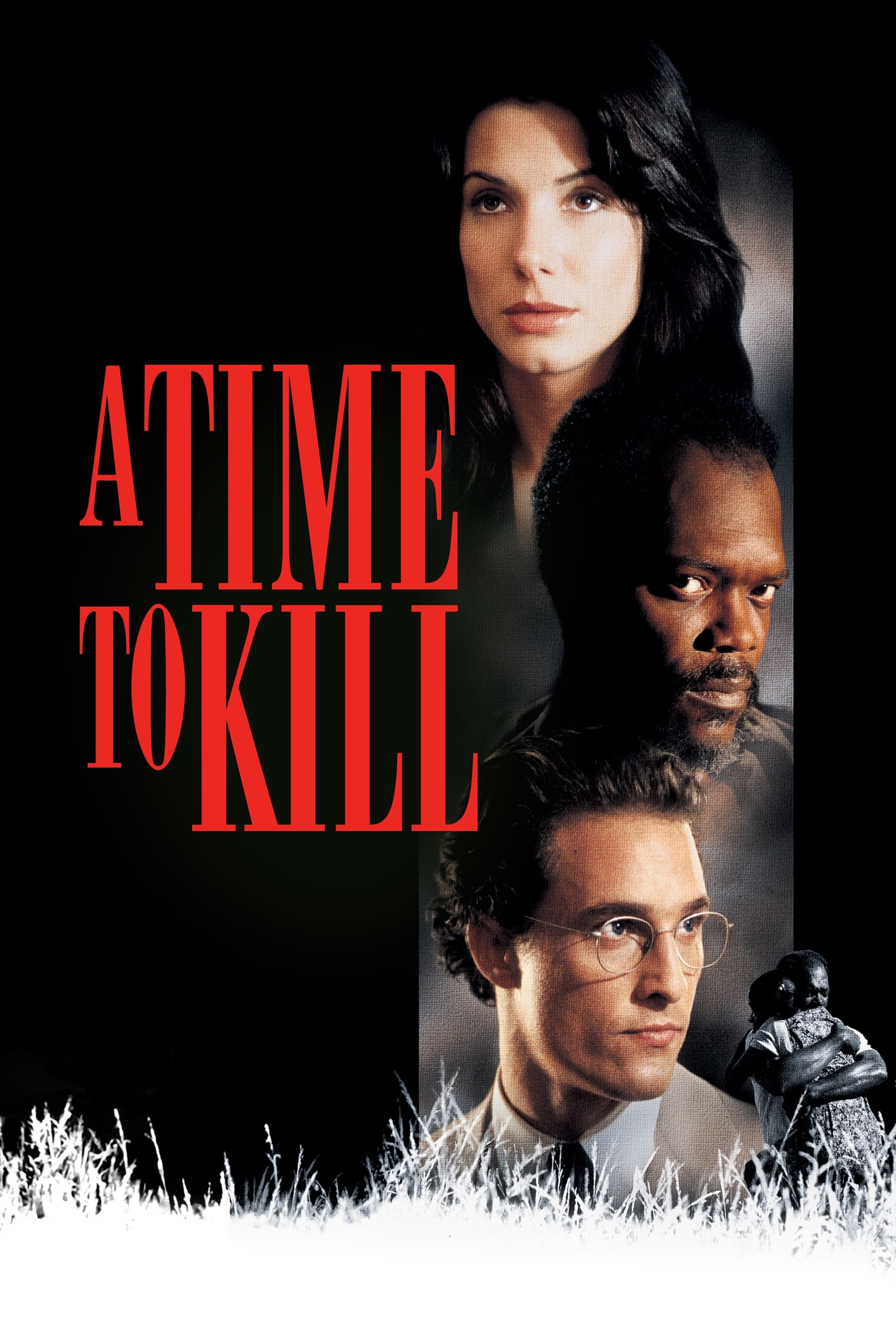
A Time to Kill poster

A Time to Kill

149 minutes

Cast

Selected cast credits · Film reference

Matthew McConaughey Jake Brigance
Sandra Bullock Ellen Roark
Samuel L. Jackson Carl Lee Hailey
Kevin Spacey Rufus Buckley
Ashley Judd Carla Brigance
Donald Sutherland Lucien Wilbanks
Oliver Platt Harry Rex Vonner
Charles S. Dutton Ozzie Walls
Brenda Fricker Ethel Twitty
Kiefer Sutherland Freddie Lee Cobb
Patrick McGoohan Judge Omar Noose
Tonea Stewart Gwen Hailey
John Diehl Tim Nunley
Chris Cooper Dwayne Looney
Nicky Katt Billy Ray Cobb
Doug Hutchison Pete Willard
Kurtwood Smith Stump Sisson
Tim Parati Winston
Beth Grant Cora Mae Cobb
Anthony Heald Wilbert Rodeheaver
M. Emmet Walsh Willard Tyrell Bass (uncredited)
Octavia Spencer Roark's Nurse
Darrin Mitchell Skip Hailey
LaConte McGrew Slim Hailey
Devin Lloyd Willie Hailey
Mark W. Johnson Willie Hastings
Joe Seneca Reverend Isaiah Street
Thomas Merdis Reverend Ollie Agee
Alexandra Kyle Hannah Brigance
Terry Loughlin Jury Foreman
Andy Stahl Reluctant Male Juror
Joe Bullen Joe Frank Perryman
Lorraine Middleton Blonde Woman Juror
Graham Timbes Male Juror
Jonathan Hadary Norman Reinfield
Benjamin Mouton Klan Bomber
Byron Jennings Brent Musgrove
Patrick Sutton Militant Teenager
Greg Lauren Taylor
Danny Nelson Bud Twitty
Mike Pniewski Deputy Tatum
Elizabeth Omilami Woman Angry at Klan
Lukas Cain Looney's Son
Stacy Rae Toyon Looney's Wife
Wayne Dehart Claude
Helen E. Floyd Waitress at Claude's
David Brian Williams Customer at Claude's
James M. Crumley Jr. Guardsman Mackenvale
Jim Ritchie Tom Hardy
Perry Ritchie Sarah Hardy
Mike McLaren Administrator at Whitfield
Tim Monich Reverend Fink
Leonard L. Thomas Man in Lumberyard
Brance H. Beamon Noose's Butler
Mildred J. Gilbreath Noose's Housekeeper
Will Crapps Minister
David U. Hodges Bailiff
Maggie Wade Dixon T.V. Anchor
Russell Hambline Old Man Bates
Robert Chapman Young Fisherman
Robert R. Bell Jr. Fisherman
Tommy McCullough Old Fisherman
Bettina Rose Evelyn
Terrance Freeman Court Deputy
Alice Julius-Scott N.A.A.C.P. Woman
William Truly Jr. N.A.A.C.P. Man #1
Walter L. Hutchins N.A.A.C.P. Man #2
Jerry Hunt John
Howard Ballou Reporter #1 with Hastings
Todd Demers Reporter #1 with Jake
Stephanie Strickland Stephanie (Reporter #1 with Buckley)
Kim Hendrix Kim (Reporter #2 with Buckley)
Rob Jay Reporter #3 with Buckley
Sherri Hilton Reporter #2 with Jake
Steve Coulter Klansman
Jackie Stewart Fire Chief
Rosebud Dixon-Green Woman at Rally

A Time to Kill | The Rewatchables

Explore episodeClose episode

The Stephen A. Smith Hottest Take Award

McConaughey peaked before stardom; career ambition and hairline speculation; Bullock’s appearance

In the discussion (3)
Approx. transcript time · 00:18:26Read transcript
  • This is proposed as Bullock’s most attractive screen appearance, explicitly offered as a backup hot take.
  • The favorite McConaughey performances are Dazed and Confused and this film, both made before his stardom; the following decade failed to deliver on the breakthrough promise.
  • McConaughey’s hairline and reluctance to perform the work of maintaining fame are proposed as factors limiting his career, with Cusack and Cage comparisons; this is speculative interpretation.

Half-Assed Internet Research

Oscar count; auditions; Grisham’s inspiration; Lucien’s drunkenness; Dazed and Confused reunion

In the discussion (7)
Approx. transcript time · 00:22:07Read transcript
  • The cast reportedly contained two Oscar winners during production—Spacey and Fricker—and six by the discussion, adding McConaughey, Bullock, Cooper and Spencer.
  • The film received no Oscar nominations, despite discussion of possible recognition for McConaughey and Jackson.
  • The film reportedly cost $40 million and grossed $152 million.
  • McConaughey reportedly auditioned for Freddie Lee Cobb before lobbying to play Jake; the discussion inaccurately describes that initial role as one of the men killed.
  • Grisham reportedly developed the story after hearing a young rape victim’s testimony in 1984 and imagining her father killing the attackers.
  • Sutherland reportedly wanted Lucien to be much drunker, but Schumacher rejected that approach, leaving an uncertain characterization.
  • McConaughey and Nicky Katt had both appeared in Dazed and Confused.

Roger Ebert's review

In the discussion (1)
Approx. transcript time · 00:34:44Read transcript
  • Ebert awarded three stars, praising Jackson and McConaughey and calling this the best Grisham screen adaptation, directed with skill.

Most Rewatchable Scene

Carl Lee’s jail speech and Jake’s closing summation, combined

In the discussion (13)
Approx. transcript time · 00:37:35Read transcript
  • Dutton arresting the two attackers in a Southern bar, followed by Jake learning what happened from Cooper, is praised as an effective setup.
  • Carl Lee’s courthouse shooting is nominated as an effective, shameless action sequence, including his preparation the night before.
  • The early hearing with Bullock’s motion and Kiefer’s hostile sideways look is nominated.
  • Carl Lee visiting Cooper after shooting him is an emotional favorite.
  • Carl Lee turning the tables on the reverend and civil-rights organization is nominated.
  • Jake and Ellen’s flirty lunch while recruiting her to the case is praised for the actors’ chemistry, distinct from the later hotel sequence.
  • The jury-selection sequence is nominated.
  • Deputy Looney’s insistence that Carl Lee is a hero who should be freed is a major witness-stand highlight.
  • Carl Lee’s declaration that the attackers deserved to die and should burn in hell is another explosive courtroom highlight.
  • Carl Lee’s jail speech identifies Jake as his secret weapon precisely because he shares the white jury’s perspective.
  • Jake’s final summation is one participant’s first choice and proposed as McConaughey’s greatest career moment.
  • The verdict itself is also nominated.
  • The final preference combines the jail speech and summation because Carl Lee’s challenge supplies the emotional and moral foundation for Jake’s closing.

What’s Aged the Best?

Mississippi atmosphere; cast presence; surnames; familiar character actors; lawyer’s office

In the discussion (8)
Approx. transcript time · 00:45:56Read transcript
  • The sweaty Mississippi atmosphere makes the setting physically palpable.
  • Bullock and Judd’s screen presence and Kiefer’s committed villainy remain strengths.
  • Platt’s prepared but spontaneous presence and playful chemistry with Bullock are praised.
  • Attractive female characters addressed by surname, such as Roark, are nominated.
  • Anthony Heald’s familiar smarmy-doctor persona makes his unreliability instantly recognizable from The Silence of the Lambs.
  • John Diehl’s sympathetic Klansman role is recalled, while the idea that a Klansman can be a good guy is explicitly challenged.
  • Research reportedly claims McConaughey began filming while dating Judd and subsequently dated Bullock for two years; the claim surprises the other participant and is not independently established.
  • The old-fashioned lawyer’s office with a secretary announcing visitors and managing the day is a timeless movie device.

What’s Aged the Worst?

Accents; thin Black characters; Spacey; Lucien; dynamite; near-affair

In the discussion (6)
Approx. transcript time · 00:53:00Read transcript
  • Fricker’s Southern accent is criticized as an unnecessary use of an Irish actor in Mississippi.
  • The lack of developed Black characters and Schumacher’s suitability as a white director are challenged.
  • Spacey’s later reputation and broadly villainous performance are both criticized, while the film itself is not blamed for later events.
  • Donald Sutherland’s drunken mentor and accent disappoint; Richard Harris, Peter O’Toole, Hopkins or an actual Southern veteran are imagined as alternatives.
  • The dynamite disposal, throwing it toward a tree before it explodes, is called ridiculous.
  • Jake and Ellen’s drunken near-affair is considered implausibly restrained; the discussion distinguishes physical fidelity from emotional adultery and notes Hollywood’s need to preserve audience sympathy.
In the discussion (1)
Approx. transcript time · 00:57:50Read transcript
  • Roark’s purpose and ending are questioned: she volunteers, approaches an affair, suffers severe violence and is left with only a hospital reaction to the acquittal; missing scenes or test-screening cuts are speculation.

Is There a Better Title for This Movie?

Town-based title; specific wording not supplied

In the discussion (1)
Approx. transcript time · 00:59:16Read transcript
  • A title using the town’s name is proposed because the community and its residents should be the real subject; no specific replacement wording is supplied.

Casting What-Ifs

Kilmer; Newman; Costner; Harrelson; Dern

In the discussion (5)
Approx. transcript time · 01:08:40Read transcript
  • Schumacher reportedly offered Jake to Kilmer during Batman Forever, but he declined; McConaughey’s lack of prior star baggage is considered an advantage.
  • Newman reportedly declined Lucien because he found the message distasteful, a decision praised as good taste.
  • Costner was considered for Jake but wanted complete control, which Grisham rejected.
  • Harrelson wanted Jake but was reportedly vetoed by Grisham.
  • Bruce Dern was reportedly the original judge choice before Patrick McGoohan.
In the discussion (5)
Approx. transcript time · 01:10:04Read transcript
  • Patrick McGoohan is the principal choice.
  • John Diehl is another candidate.
  • Anthony Heald is nominated, with the participant suggesting he is recognizable by name.
  • Joe Seneca is nominated through his familiar Verdict role, with a brief eligibility dispute because one participant knows his name.
  • LaTanya Richardson is nominated and praised for theater work; this is the conversation’s nomination, not an independently confirmed cast credit.

Recasting Couch

Nicholson as Lucien; Sally Field or Shirley MacLaine as Ethel

In the discussion (3)
Approx. transcript time · 01:12:33Read transcript
  • Nicholson is proposed for drunken Lucien.
  • Sally Field is proposed to replace Fricker.
  • Shirley MacLaine is another idea but is thought unlikely to accept.

Apex Mountain

Grisham’s mid-1990s adaptation boom; Nicky Katt villains, qualified

In the discussion (7)
Approx. transcript time · 01:14:32Read transcript
  • McConaughey’s later Dallas Buyers Club, True Detective, Magic Mike and Wolf of Wall Street period is preferred over this film.
  • Jackson’s peak is placed around Jackie Brown the following year rather than here.
  • Grisham is placed in this mid-1990s adaptation boom, with The Pelican Brief’s release corrected back to 1993.
  • Bullock is judged not yet at her peak, with The Blind Side Oscar offered as a later milestone.
  • Judd’s peak is assigned to Double Jeopardy.
  • Nicky Katt villains receive a qualified affirmative choice over Dazed and Confused, based on the impact of a few minutes as an overt racist.
  • The early-1960s green Porsche is rejected in favor of Dylan McKay’s longer television run.

Picking Nits

Acquittal; Roark’s motives; Rufus; opening statements; smoking; drunken drive; destroyed home; Jake’s response to thanks

In the discussion (8)
Approx. transcript time · 01:25:16Read transcript
  • The not-guilty outcome is questioned as legally implausible: the jury appears to set aside the killing rather than resolve a coherent defense, though the emotional payoff works.
  • Roark’s origin and reason for choosing this case remain unexplained.
  • A white character named Rufus is questioned, with the objection itself challenged and a dog-name anecdote offered.
  • The lack of opening statements disappoints one participant, while the other argues that the crime and stakes are already clear.
  • Bullock’s unconvincing smoking is criticized as a superficial attempt to signal toughness.
  • Jake’s drunken drive and near-affair seem designed solely to remove him before his house is destroyed, despite the obvious risk of arrest derailing the case.
  • The absence of a meaningful reaction from Jake’s wife to the destruction of their home is criticized as a missing necessary scene.
  • Jake’s resentful response to Carl Lee’s thanks undermines the emotional summation; an apology and acknowledgment of what he learned would be more appropriate.

Sequel, Prequel, Limited Series, or All-Black Remake

Prestige TV; A Time for Mercy adaptation reported in development

In the discussion (1)
Approx. transcript time · 01:33:36Read transcript
  • Prestige television is considered promising; the reported 2020 sequel novel A Time for Mercy and McConaughey’s attachment to an HBO adaptation supply the concrete possibility, with development status unknown.

Probably Unanswerable Questions

Kiefer’s villain versus antihero roles; Kurtwood Smith’s worst character

In the discussion (2)
Approx. transcript time · 01:34:39Read transcript
  • Kiefer is preferred as an antihero over a villain by one response, while his bratty menace as Kendrick remains a favorite for the other.
  • Kurtwood Smith’s most loathsome character is debated among the Klan leader, Neil’s father in Dead Poets Society and RoboCop; the father is judged worse than the Klan role by one response.

The Coach Finstock Award for Best Life Lesson

White people; racial identification wins the case, a depressing conclusion

In the discussion (2)
Approx. transcript time · 01:37:33Read transcript
  • White people is offered as an exasperated lesson rather than a clear moral conclusion.
  • The apparent happy ending is challenged as depressing: Carl Lee avoids prison by exploiting racial identification, which offers little genuine resolution for Black viewers.

More from the conversation

Wesley Morris joins courtroom month for a discussion of the film as a mid-1990s cultural time capsule.
Approx. transcript time · 00:01:39Read transcript
The decline of courtroom films is attributed speculatively to Court TV, true-crime podcasts and documentaries, real political adjudication and online moral outrage crowding out trashy fictional entertainment.
Approx. transcript time · 00:03:20Read transcript
A contemporary remake is considered unlikely without fundamental changes, including a Black defense lawyer; the film’s fascination with the Klan and Ebert’s unease about that presentation are discussed.
Approx. transcript time · 00:05:31Read transcript
Schumacher’s visual flair and attraction to stars connect The Wiz, St. Elmo’s Fire, The Lost Boys and Flatliners to this film’s provocative treatment of the South.
Approx. transcript time · 00:06:52Read transcript
The film made McConaughey a star and arrived during Jackson’s post-Pulp Fiction rise; an initial Lethal Weapon reference is corrected to Die Hard.
Approx. transcript time · 00:07:52Read transcript
Initial theatrical enthusiasm becomes more conflicted on later viewings, yet McConaughey’s performance remains compelling.
Approx. transcript time · 00:08:35Read transcript
The ensemble’s appeal includes Bullock, Judd, both Sutherlands, Fricker, Platt, Spencer, Dutton, Cooper, Spacey and Kurtwood Smith; several Southern accents are criticized.
Approx. transcript time · 00:08:50Read transcript
The Firm’s later reputation is defended while this film is described as the Grisham adaptation whose casting and presentation created immediate impact.
Approx. transcript time · 00:09:34Read transcript
Courtroom tropes include the explosive witness, climactic closing statement, prosecutor baiting the defendant, and smug laughter on learning the defense lawyer’s identity.
Approx. transcript time · 00:10:15Read transcript
The subtle closing in The Verdict is contrasted with bombastic speeches, with Pacino in …And Justice for All proposed as a pinnacle.
Approx. transcript time · 00:11:07Read transcript
The closing speech is proposed as McConaughey’s best moment, but The Wolf of Wall Street is preferred by another response, with affection for his Kate Hudson chemistry.
Approx. transcript time · 00:11:55Read transcript
McConaughey is argued to be strongest in smaller doses, using Dazed and Confused, Reign of Fire, Magic Mike and The Wolf of Wall Street rather than leading-man roles as examples.
Approx. transcript time · 00:12:30Read transcript
McConaughey’s introduction is remembered as a manufactured magazine-cover campaign, contrasted with Julia Roberts’s audience-driven rise.
Approx. transcript time · 00:13:32Read transcript
Hollywood wanted a mature, virile presence with an old-Hollywood quality; DiCaprio was too young, Pitt not yet fully established, and Jason Patric’s repeated chances had not produced equivalent stardom.
Approx. transcript time · 00:14:25Read transcript
The Paul Newman comparison and advance publicity raised doubts about McConaughey until the climactic breakdown delivered authentic emotion in theaters.
Approx. transcript time · 00:15:26Read transcript
The film is framed as a summer blockbuster drama designed to manufacture stardom rather than win Oscars, with Bullock still developing an identity after Speed and While You Were Sleeping.
Approx. transcript time · 00:16:56Read transcript
Bullock’s early roles are interpreted as parts Julia Roberts declined, with Forces of Nature an example and substitute teacher offered as the analogy rather than market correction.
Approx. transcript time · 00:17:41Read transcript
The stars’ sweaty, less emaciated physical presence is admired, especially McConaughey’s pairing opposite Bullock and Judd.
Approx. transcript time · 00:18:39Read transcript
Judd had already impressed in Ruby in Paradise and Heat but had not reached the commercial stardom of Kiss the Girls and Double Jeopardy.
Approx. transcript time · 00:19:36Read transcript
Jackson is placed in a serious-actor phase between Pulp Fiction and the later popcorn persona associated with Deep Blue Sea and comic-book roles.
Approx. transcript time · 00:20:07Read transcript
Spacey arrives after The Usual Suspects Oscar, before his later best-actor win, but plays this prosecutor as broad Southern entertainment rather than solemn prestige acting.
Approx. transcript time · 00:21:10Read transcript
Jackson’s intervening credits are checked: Kiss of Death, Die Hard with a Vengeance, Hard Eight and The Long Kiss Goodnight; the last receives strong action-film praise.
Approx. transcript time · 00:21:41Read transcript
Jackson is proposed as an Oscar snub who could replace James Woods in Ghosts of Mississippi; criticism of centering Medgar Evers’s assassin rather than the struggle for justice is recalled.
Approx. transcript time · 00:22:48Read transcript
The inability to make this movie unchanged today is treated as partly welcome: Carl Lee’s family and wife are underdeveloped beside white supporting characters and Klansmen.
Approx. transcript time · 00:23:43Read transcript
Uncertainty about the screenwriter is corrected when Akiva Goldsman is identified; the film’s sprawling freedom outside the courtroom is appreciated despite its formula.
Approx. transcript time · 00:25:01Read transcript
Constant threats to the lawyer generate plot momentum, but the emotional and moral center should be the family living through the daughter’s assault and father’s imprisonment rather than his lawyer’s marriage or the Klansmen.
Approx. transcript time · 00:26:15Read transcript
Grisham novels invited casting fantasies while offering an accessible sense of legal procedure; Cruise initially came to mind for multiple lawyers, though his age and Southern accent are questioned here.
Approx. transcript time · 00:27:46Read transcript
McConaughey is considered unusually well suited to Jake, while even an imagined Christian Bale casting seems wrong.
Approx. transcript time · 00:28:35Read transcript
The legal machinery initially feels plausible, but the marginalization of Carl Lee’s wife and community reveals the film’s priorities; possible deleted family scenes are debated rather than assumed.
Approx. transcript time · 00:28:53Read transcript
The white-lawyer love triangle and reconciliatory barbecue are criticized as commercial choices that flatten the racial story.
Approx. transcript time · 00:30:36Read transcript
The film’s release after the O.J. verdict is connected with unresolved racial division and the imagery of opposing crowds outside the courthouse.
Approx. transcript time · 00:31:09Read transcript
Generic crowd acting undermines the high stakes, and the film is criticized for staging racial tension as impending action rather than exploring it dramatically.
Approx. transcript time · 00:31:58Read transcript
Parenthood shifts identification from the lawyer to Carl Lee and the question of whether one would retaliate after harm to a child; the movie reaches that perspective too late.
Approx. transcript time · 00:33:46Read transcript
Schumacher’s popcorn pleasures are defended through St. Elmo’s Fire, The Lost Boys and 8MM despite disagreement over how well individual films hold up.
Approx. transcript time · 00:35:25Read transcript
Charles Dutton’s television show Roc is praised before the scene discussion begins.
Approx. transcript time · 00:37:21Read transcript
The film is compared with JFK’s sensationalism but considered less ideologically sophisticated; New South language is read as a different institutional form of racial humiliation.
Approx. transcript time · 00:38:43Read transcript
Jury selection is compared with speed dating for unwanted people, and Jury Duty is praised; both sides strategically shaping the jury is treated as a revealing American mechanism.
Approx. transcript time · 00:40:09Read transcript
The jail speech is compared with the strategy rehearsal in A Few Good Men: preparing the audience makes the later courtroom payoff possible.
Approx. transcript time · 00:43:13Read transcript
Ellen’s arrival as a wealthy volunteer is compared with Bagger Vance, then the critique of her privilege is qualified by the violence she suffers.
Approx. transcript time · 00:44:09Read transcript
Oliver Platt’s appeal is explored through Flatliners, Chef and The Bear, with speculation that Alfred Molina occupied similar casting territory and that a Boogie Nights role might have altered Platt’s career.
Approx. transcript time · 00:46:26Read transcript
The attempted good-Klansman figure is compared with the sympathetic Nazi in Victory and criticized as a contradiction intensified by attractive casting.
Approx. transcript time · 00:49:21Read transcript
A mistaken identification of Lucien prompts a brief aside about the prosecutor’s conspicuously attractive, uninformed young assistant.
Approx. transcript time · 00:57:03Read transcript
McConaughey’s next decade is inventoried through Contact, Amistad, EDtv, U-571, The Wedding Planner, Frailty, How to Lose a Guy in 10 Days, Sahara, Two for the Money, Failure to Launch and We Are Marshall; the expected dramatic payoff is judged absent.
Approx. transcript time · 01:00:34Read transcript
Contact and McConaughey’s chemistry with Foster divide opinion, while Two for the Money has a defender.
Approx. transcript time · 01:01:14Read transcript
Competition from Damon, Affleck, DiCaprio, Wahlberg, Reeves and Smith is offered as context for McConaughey’s uneven choices, with an aborted Phoenix name corrected rather than treated as another candidate.
Approx. transcript time · 01:02:35Read transcript
Greenlights is strongly recommended and used to argue that McConaughey lacked the career hunger of some peers, with Vince Carter as the sporting comparison.
Approx. transcript time · 01:03:30Read transcript
McConaughey’s ambition is compared with Monfils, Gerulaitis and Kyrgios accepting successful lives without maximal titles; Osaka is distinguished as having a different relationship to fame rather than no ambition.
Approx. transcript time · 01:03:46Read transcript
Pitt and Fraser join the list of competing leading men, while Travolta’s comeback and Batinkoff’s failure to break through illustrate the crowded market.
Approx. transcript time · 01:05:10Read transcript
Cooper’s growing intensity is connected with Lone Star and a later peak in American Beauty.
Approx. transcript time · 01:12:00Read transcript
Grisham’s strong story concepts prompt frustration that more of his books are not adapted; possible difficulty working with him is speculation.
Approx. transcript time · 01:13:34Read transcript
Bullock’s long career overturns an early view of her as a substitute for Roberts; Miss Congeniality is identified as the point when her distinct comic persona became undeniable.
Approx. transcript time · 01:15:44Read transcript
Early Bullock enthusiasm is traced through Love Potion No. 9, The Vanishing and Speed; Ormond, Heigl and Witherspoon illustrate the continuing search for another Roberts.
Approx. transcript time · 01:18:47Read transcript
Bullock’s approachable, reluctant-to-please comic persona is contrasted with Roberts becoming almost too famous for romantic comedy through Notting Hill and America’s Sweethearts.
Approx. transcript time · 01:19:48Read transcript
Her ability to carry long stretches alone and then work opposite Clooney in Gravity or McCarthy in The Heat is praised, with Bird Box another later-career example.
Approx. transcript time · 01:20:56Read transcript
A personal photographer acquaintance’s relationship with Bullock is offered as an anecdote supporting her down-to-earth image, without naming him.
Approx. transcript time · 01:22:10Read transcript
Double Jeopardy’s betrayal-and-revenge structure is praised as rewatchable and easily reproducible, prompting an AI-writing sidebar.
Approx. transcript time · 01:22:53Read transcript
Frustration with this film comes from its neglect of Carl Lee rather than the plot provoking empathy on his behalf.
Approx. transcript time · 01:23:25Read transcript
A Saab preference prompts memories of repeated repairs, ownership and the marque’s disappearance.
Approx. transcript time · 01:24:16Read transcript
Despite objections to the legal resolution, courtroom films are defended as useful windows into American empathy and aspirations.
Approx. transcript time · 01:26:19Read transcript
The racist jury’s sudden identification with a Black victim is criticized as an indictment of the white audience’s limited empathy rather than a simple triumph.
Approx. transcript time · 01:27:19Read transcript
A smoking-performance sidebar contrasts unconvincing Bullock and Linney with Falco in Cop Land, De Niro in Goodfellas and Travolta; drinking beer and brushing teeth are additional everyday actions actors often mishandle.
Approx. transcript time · 01:29:25Read transcript
A friend’s aversion to watching toothbrushing prompts a playful Hitchcock comparison.
Approx. transcript time · 01:31:37Read transcript
The mid-1990s breakthrough class is revisited through Damon/Affleck, DiCaprio, Vaughn, Fraser, O’Donnell and Batinkoff; today’s broader range of nonwhite actors is contrasted with fewer substantial roles.
Approx. transcript time · 01:39:38Read transcript
Kyle Crichton is explicitly credited as producer in Craig’s absence for his wedding; the closing confirms more courtroom-month episodes and teases …And Justice for All.
Approx. transcript time · 01:41:11Read transcript