‹ All movies
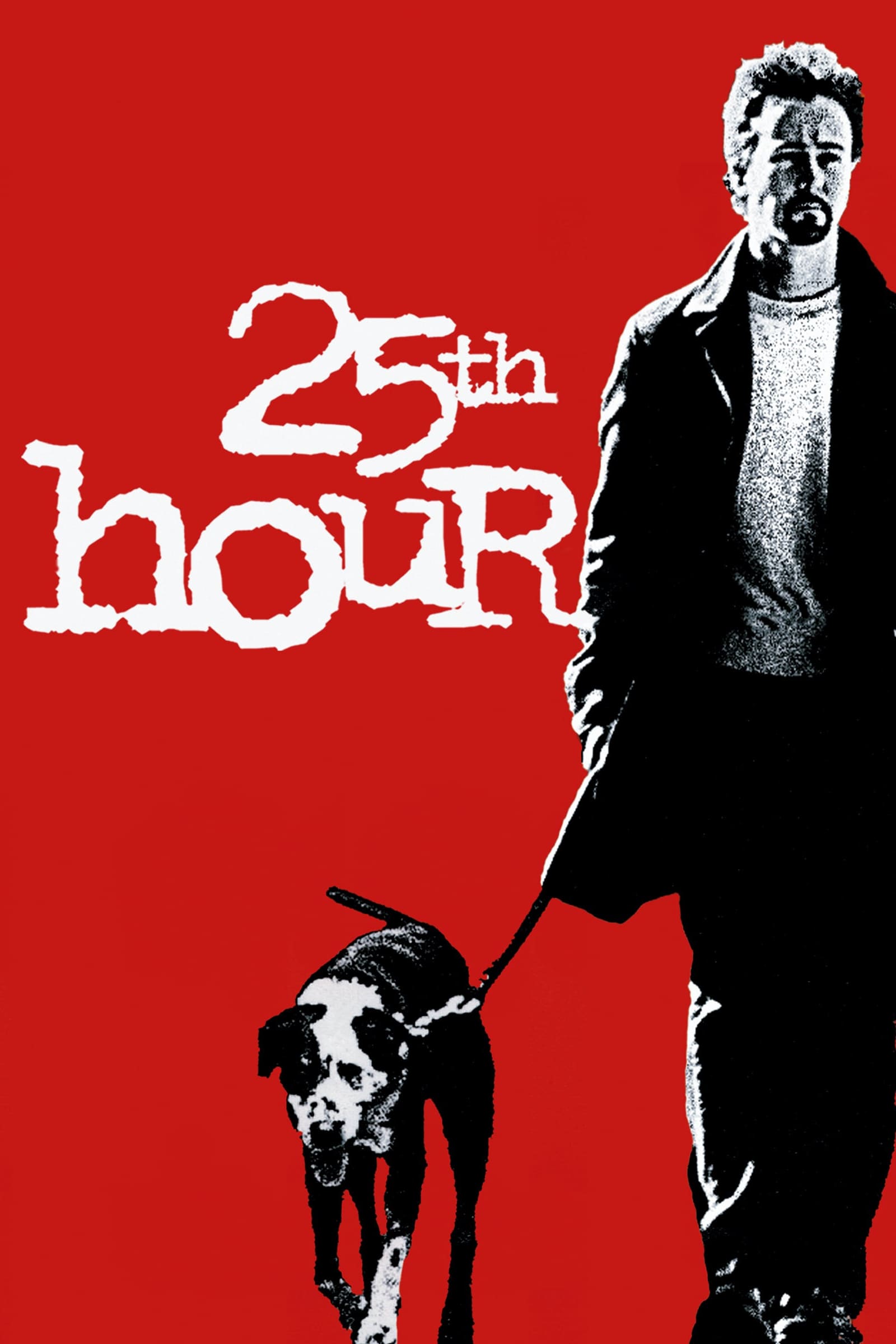
25th Hour poster

25th Hour

135 minutes

Cast

Selected cast credits · Film reference

Edward Norton Monty Brogan
Philip Seymour Hoffman Jacob Elinsky
Barry Pepper Frank Slaughtery
Rosario Dawson Naturelle Riviera
Anna Paquin Mary D'Annunzio
Brian Cox James Brogan
Tony Siragusa Kostya Novotny
Levan Uchaneishvili Uncle Nikolai
Isiah Whitlock Jr. Agent Flood
Michael Genet Agent Cunningham
Tony Devon Agent Allen

25th Hour | The Rewatchables

Explore episodeClose episode

Producer credits not yet identified.

Most Rewatchable Scene

Nightclub sequence

In the discussion (15)
Approx. transcript time · 00:54:22Read transcript
  • The opening credits are great and a little emotional, and the opening scene of deciding whether to save the wounded dog sets up the question of whether somebody can be saved.
  • An internet theory that the wounded dog resembles America after 9/11 is mentioned but called a little too English-literature to fully buy.
  • The Feds busting Monty for the drugs in his couch is highly rewatchable because Isaiah Whitlock, Jr. is essentially Clay Davis from The Wire as a drug agent.
  • The big bathroom speech insults every part of New York before turning on Monty himself.
  • The hosts report that Disney wanted to cut the bathroom scene and that Spike and Benioff refused, with Spike calling it one of the reasons he wanted to make the movie.
  • Pepper and Hoffman looking over Ground Zero and arguing about Monty is a great scene with two great actors; the Ground Zero imagery is described as jarring and alarming, with touches like "fuck the Times, I read the Post."
  • Other favorites: the bar scene with Rosario Dawson, Pepper and Hoffman where the bartender invites them to her birthday party; Pepper trying to figure out whether Dawson flipped; Monty deciding not to kill his associate and handing him to the Russians.
  • Frank beating up Monty is called some of the best directing of Spike Lee's career: wide shots, silence except park sounds, and alternating slow motion and live action; it is intense rather than fun.
  • The dream sequence narrated by Brian Cox of the life Monty could have had is praised; a counterview would ask to cut that fantasy montage and end on Monty's face in the car, keeping that last shot.
  • Producer Craig's favorite scene in the movie is said to be the montage; the old-age makeup on Rosario Dawson and Edward Norton is praised, and the imagined kids resemble her more than him.
  • Asked for a most rewatchable scene, the answer is the nightclub sequence, counted at 24 minutes from entering the club to leaving, with the sound design best heard on good headphones.
  • The reply agrees: the sound was incredible on better speakers, and from the Patrice O'Neill bouncer moment through leaving the bar is the best part of the movie.
  • Comparisons are drawn to busy Michael Man scenes in Collateral and Miami Vice, and Spike is called a good chaos director, as in Inside Man, though not when chaos is the point, as in Old Boy.
  • The club is read as a purgatory with three levels (heaven, hell, purgatory); the film withholds the pleasure a morally unrestrained, maybe pre-9/11 movie would indulge, including the Hoffman-Pacquin encounter and the women dancing.
  • While the women dance above, Norton and Pepper discuss whether his girlfriend ratted him out, with his associate pushing that suspicion; the trust-your-partner plot is always welcome.

What’s Aged the Best?

Clay Davis casting; Spike Lee and Rosario Dawson tandem; Norton and Hoffman career timing; the score; three-dimensional cops and Feds; Cool Hand Luke poster; the title

In the discussion (6)
Approx. transcript time · 01:08:36Read transcript
  • Clay Davis as the agent is the first item.
  • The Spike Lee and Rosario Dawson tandem holds up; she is felt to be at her best in his movies, including He Got Game, maybe across three films together.
  • The point in their careers at which the film catches Norton and Hoffman has aged well, and the music is included.
  • Spike Lee's constant distrust of cops, Feds and the D.A. is called understandable, and they are always three-dimensional characters rather than simple bad guys; Inside Man's police hierarchy is a favorite example.
  • The Cool Hand Luke poster in Norton's apartment is great, big and unusually sized; a search for it came up empty.
  • The title 25th Hour, taken from the book, is a strong idea for a title.

What’s Aged the Worst?

Hoffman's teacher-and-student subplot; Frank beating up Monty

In the discussion (2)
Approx. transcript time · 01:18:31Read transcript
  • The subplot of Hoffman's character and his 17-year-old student is a little dicey; it could be removed entirely and the movie would be fine.
  • Frank beating up Monty is beautifully shot but rough and painful to watch; a related nitpick is promised for later.

Casting What-Ifs

Brittany Murphy as Mary; Tobey Maguire as Monty

In the discussion (5)
Approx. transcript time · 01:19:03Read transcript
  • The hosts report that Britney Murphy was originally lined up to play Mary, taken to be the Anna Pacoan role, and it fell through; she might have fit Rosario Dawson's role instead.
  • The hosts report that Toby McGuire bought the rights to the novel and was supposed to star, then chose Spider-Man and stayed on as a producer.
  • The movie is judged not as good with McGuire as Monty, though he is called a dark horse who can surprise.
  • Favorite McGuire performances named include Brothers with Jake Gyllenhaal, Spider-Man 2 for its reaction shots in action scenes, and the first 40 minutes of Spider-Man 3; Ice Storm is called his best movie.
  • The Ice Storm is described by a host as one of the great movies about whiteness made by a non-white filmmaker, with James Shamish writing and Engley directing; a future Ice Storm episode is promised.
In the discussion (4)
Approx. transcript time · 01:22:32Read transcript
  • Clay Davis is ruled out because Isaiah Whitlock Jr. has transcended the role; Brian Cox is ruled out after Succession; Patrice O'Neill does not count either.
  • The pick is Saragusa, because younger viewers barely remember him as a football player; his accent is questioned but he is called good.
  • A host recounts that early in his time at ESPN his book agent proposed that he ghostwrite Tony Seraguse's biography for $40,000 "or whatever it was"; he declined and quickly got another agent.
  • He is praised for aging into his post-sports body and pulling off the accent.
In the discussion (2)
Approx. transcript time · 01:24:34Read transcript
  • There is only one answer, Doyle the dog, given nine out of ten; he has multiple scenes and viewers root for his redemption.
  • After a remark that Doyle could be a symbol of America according to some people, the score goes up to nine and a half out of ten.

Recasting Couch

The Russian gangster role, with an unnamed better actor

In the discussion (4)
Approx. transcript time · 01:25:43Read transcript
  • The actor playing the Russian gangster did not work for one participant.
  • Spike Lee could have called De Niro, Pacino, Kytel or Pesci, but that is walked back since the role is a Russian gangster.
  • The Malcovich-in-Rounders path is fun but distracting, and the film wants focus on what it cares about, in keeping with its restraint.
  • Even so, a better actor would have been the choice; no actor is named.

Half-Assed Internet Research

Skipped: research already shared

In the discussion (1)
Approx. transcript time · 01:26:51Read transcript
  • Half-assed internet research is passed over because it was all given already during the episode.

Apex Mountain

Ed Norton: Fight Club; 25th Hour as the signature movie where 9/11 is a character

In the discussion (6)
Approx. transcript time · 01:26:51Read transcript
  • For Ed Norton, coming off Red Dragon into this movie is considered, but because this film was not very successful the answer moves from "probably Fight Club" to "It's definitely Fight Club," since he had the most juice after Fight Club, which came a year after his American History X nomination.
  • Afterward his choices seemed like diminishing returns, including the in-between Hulk movie rather than the Angley version with Eric Bona.
  • Norton is called one of the best and for a while the most exciting actor, but the pressure to make good choices and the needs of ego and career locked him into a pattern; Birdman let him lean into that ego.
  • Spike Lee, Benioff and Hoffman are each a no.
  • Movies where 9/11 is a character is a yes: this is called the signature 9/11 movie even though it is not about 9/11, a no-brainer.
  • Barry Pepper is saved for later; his run from 1998 to 2002 (Saving Private Ryan, Enemy of the State, 61, Knock Around Guys, 25th Hour) leads to "his Apex Mountain was probably 61," after which he seemed headed for leading roles that never came.

Picking Nits

Whether the beating helps Monty in prison

In the discussion (2)
Approx. transcript time · 01:30:57Read transcript
  • The only nit: would being made ugly really help Monty in prison? It is called dubious.
  • A counter-reading is that he wanted to be punished by someone he knew because he was upset at letting his life slip away; that reading is found convincing.

The Neil McCauley “A Book about Metals” Award for Best Line from the Movie

"I've been in three prisons and three countries, and you know what I learned? Prison is a bad place to be."

In the discussion (2)
Approx. transcript time · 01:31:11Read transcript
  • "Champagne for my real friends, real pain for my sham friends" is offered first, but objected to as just a saying people use that the film did not invent; the reply is that it was just nice to hear.
  • The line from the movie is the prison observation, which the host mocks with the sarcastic reaction "Oh, you think so, doctor?"

Sequel, Prequel, Limited Series, or All-Black Remake

Yes, as a last-day-before-prison series

In the discussion (3)
Approx. transcript time · 01:31:45Read transcript
  • The answer is yes, though neither participant wants it made.
  • Somebody's last day before going to jail is a good idea for a Netflix show.
  • It would probably be a terrible Apple TV show that has to be filled out, joked about as starring a Helmsworth brother, or all three with them beating up one.

Probably Unanswerable Questions

Matt Damon in the Barry Pepper role; the Hoffman character's Monday; whether Monty's girlfriend waits; her job

In the discussion (7)
Approx. transcript time · 01:32:34Read transcript
  • Is the movie better with Matt Damon in the Barry Pepper part? Reasons: whether he would be better, whether it is a fun new role for him, and whether a Rounders-reunion cast with Norton, Hoffman and Spike Lee raises its Oscar ceiling; this is asked while liking Pepper.
  • A reply: Damon changes the stakes and would require fleshing the character out more; Pepper became a better actor as the decade went on.
  • Another view: it is probably a longer movie but taken more seriously as an awards movie because of the names.
  • Pepper's career is reviewed, with his run ending after this period; playing a role in Battlefield Earth alongside Travolta is called a red flag, but he is called a good actor and great in this movie.
  • What is the Hoffman character's Monday like? Awkward, probably handing in his resignation.
  • Will Rosario Dawson's character be waiting when Monty gets out in seven years? The answer is no, she is long gone, and the dad is probably dead.
  • What is her job? It is unclear; maybe a waitress, maybe a student, since she was 17 when they met, the same age as the Anna Pacquin character.
In the discussion (6)
Approx. transcript time · 01:36:53Read transcript
  • Asked who won the movie, the answer comes in three parts: number three is Rodrigo Preeto for a beautiful-looking movie.
  • An interjection claims the answerer has come all the way around and now counts this among their favorite Spike Lee movies.
  • Number two is Terrence Blanchard for the mournful, restrained score, compared with his sometimes too-bright, major-key scores in the vein of Aaron Copeland.
  • Number one is Spike Lee, who directs with his hands in his pockets and focuses on the moral matter at hand, unlike other films where other interests compete, as in Inside Man.
  • A second pick: Spike, hands down; nobody could have directed it better, though a 1990s-early-2000s Scorsese version (the Bringing Out the Dead era) would have been fascinating, and the director needs a real connection to New York.
  • A suggestion: a first-time director, 25 to 33 years old, might have brought the rawness that the restraint keeps out; the restraint leaves the viewer a spectator like Norton and Pepper looking down on the dancers.
Podcast choices
Speaker not identified
Spike Lee
Speaker not identified
Spike Lee

More from the conversation

The episode opens with a 25th Hour trailer naming Edward Norton, Philip Seymour Hoffman, Barry Pepper, Rosario Dawson, Anna Pacquin and Brian Cox in a Spike Lee Joint.
Approx. transcript time · 00:00:35Read transcript
Wesley Morris is introduced as an old friend and one of the preeminent Spike Lee enthusiasts, joked about as a Spikeophile or Lee maniac.
Approx. transcript time · 00:00:57Read transcript
The film is described as a 2002 release that was shut out of every major award, even nominations; it is called one of the best movies of the last 20 years and Spike Lee's most efficiently well-crafted, satisfying film, if not his most important or best.
Approx. transcript time · 00:01:28Read transcript
The case against: on rewatch there was no feeling for these characters; Spike Lee is often interested in archetypes rather than characters; the one extraordinary sequence is the nightclub.
Approx. transcript time · 00:02:14Read transcript
Rodrigo Preeto's cinematography, including his later Scorsese work such as The Irishman, and Terrence Blanchard's score are praised as reasons the film is rewatchable.
Approx. transcript time · 00:03:13Read transcript
A wish for a longer film, like an old Italian movie about three estranged friends gathering for what is essentially a funeral, with more of the Hoffman character; made now, it would probably be a 10-episode series.
Approx. transcript time · 00:04:00Read transcript
The hosts frame the film in the context of 9/11: it came from David Benioff's book written before 9/11, was in pre-production when the attacks happened, and was adjusted to reflect New York in 2002; 9/11 appears only a few times, in the opening credits, the Ground Zero apartment scene and flags in the closing flashback.
Approx. transcript time · 00:04:48Read transcript
The hosts call it the only movie that fully figured out how to make 9/11 part of the story without forcing it, recalling the power of Fahrenheit 9/11's 9/11 scene in theaters and seeing this film in December 2002 when the wound felt raw; they note that 19 years later, people 25 and under have no memory of it.
Approx. transcript time · 00:06:21Read transcript
The hosts say that 14 or 15 months after the attacks it would have been impossible to set a New York movie in 2002 without addressing them; New York is a character in most Spike Lee films; the restraint is called fascinating but underwhelming on a third viewing.
Approx. transcript time · 00:07:22Read transcript
25th Hour is described as the B side to Clockers, which took many chances and ends with a hopeful final shot of Mackay Fyfer on a train heading west; in reply, Clockers is liked much less than 25th Hour.
Approx. transcript time · 00:09:24Read transcript
Spike Lee top-six lists vary widely except for Do the Right Thing; directing someone else's script is praised; his visual eye, collage and use of backgrounds matter more than his dialogue; the bathroom monologue unleashes out-of-control Spike; The Five Bloods is called frustrating and out of control.
Approx. transcript time · 00:11:27Read transcript
His more personal films are called his strongest, such as Crooklyn with Zelda Harris as a Spike stand-in; a host notes that here he turns the whole narrative over to three white people in parts of New York he does not usually explore; Inside Man, another film from someone else's script, would make a top six, with agreement.
Approx. transcript time · 00:13:42Read transcript
In 2002 Norton was a top-five favorite actor and Hoffman was about to be; Flawless with De Niro is called bad; Hoffman's run from Magnolia, The Talented Mr. Ripley and Almost Famous through Love Liza, Punch-Drunk Love, Red Dragon and 25th Hour, then Capote and Along Came Polly, shows every character different from the last.
Approx. transcript time · 00:16:14Read transcript
Along Came Polly is called a lost good 2000s rom-com watched during the pandemic, while the reply dislikes its needless gross-out material though Hoffman is really going for it.
Approx. transcript time · 00:17:39Read transcript
Hoffman's role here is subdued, creepy and old-school New York in a Yankees hat, related to his Happiness character as an uptight loner with suppressed desire; the Anna Pacquin student subplot is debated for 2020, and the bathroom moment is called great though her performance is called bad.
Approx. transcript time · 00:18:37Read transcript
At a 2011 Lincoln Center event Spike reportedly called the monologue a love-hate letter to New York where love wins out; a host says the scene comes from the pre-9/11 book, with 9/11 worked in by Benioff and Spike; it resembles the Do the Right Thing montage in one person's mind, which a host describes as a tour of one white guy's racisms before he turns it on himself.
Approx. transcript time · 00:21:06Read transcript
Norton's filmography from 1996 is listed; American History X is joked to be one of the two weirdest future Rewatchables with Cruising; a host says Norton used his Red Dragon money to become a producer on 25th Hour; having him on the podcast the previous year is recalled.
Approx. transcript time · 00:23:35Read transcript
This is a restrained Norton, torn between character actor and leading man, in a role that Robert Ryan or Richard Widmark could have played in the 1950s; Leo is judged too handsome for such a seedy part; Pepper plays the macho Wall Street type, compared to Margin Call, Glengarry and Boiler Room.
Approx. transcript time · 00:24:49Read transcript
Norton has another layer in reserve, reaching it in the racist tantrum; a contrasting view calls him perfect, seedy and tormented in a movie about whether redemption exists, and describes the dad-narrated escape fantasy that cuts back to Monty in the car.
Approx. transcript time · 00:28:05Read transcript
The lack of a second chance is compared to 2020, framed by a host as a time when one mistake means being canceled forever.
Approx. transcript time · 00:30:51Read transcript
The bouncer is identified as Patrice O'Neill giving Norton a prison lecture; the film is an adult movie uninterested in making viewers feel better, which may explain its reception; the hosts identify it as a Touchstone release and say it made 23.9 million on a five million budget.
Approx. transcript time · 00:31:15Read transcript
This, rather than Black Clansman, is preferred as the film that should have taken Spike Lee to the Oscars.
Approx. transcript time · 00:33:22Read transcript
The 2003 Oscar nominations are reviewed: Chicago, Lord of the Rings, The Hours, Gangs of New York and The Pianist for best picture; The Hours is called indefensible; swapping Spike and Scorsese is floated; Spike could have taken Stephen Daldry's directing slot; the best actor field and About Schmidt are argued over; the hosts note 25th Hour was shut out even for adapted screenplay; "they wanted Middle-earth, not real earth."
Approx. transcript time · 00:34:16Read transcript
The hosts say Spike Lee was shut out repeatedly and mocked as whining when he spoke about it; a host argues Clockers suffered from very few Black critics reviewing it seriously, and praises it as a film about racism in the NYPD and policing; 25th Hour is paired with it as a film about the luxury of a last night out before prison.
Approx. transcript time · 00:38:50Read transcript
A passing idea: director double bills of cousin films like Clockers and 25th Hour; Reservoir Dogs and Pulp Fiction are siblings instead; Tarantino nearly directing Speed could have derailed him in a Tony Scott direction; the film caught Spike at the right time to make 9/11 a character.
Approx. transcript time · 00:41:54Read transcript
The restraint gives the film a funereal quality unlike any other Spike Lee movie; a wish that he would make a musical, citing musical moments in Black Klansman, The Five Bloods and School Days, and his filming of Passing Strange.
Approx. transcript time · 00:44:29Read transcript
A Scott Tobias piece is cited: two works strongly associated with September 11, 25th Hour and Bruce Springsteen's My City of Ruins, were conceived before and woven into the aftermath; a host says Springsteen changed the song from Asbury Park to New York.
Approx. transcript time · 00:47:17Read transcript
A host argues America is bad at depicting its own pain and at self-interrogation, and wonders what art will come from the pandemic and the current racial reckoning.
Approx. transcript time · 00:48:54Read transcript
The worst 9/11 movie is named as the Robert Pattinson film Remember Me, called appalling and offensive, with its ending singled out; World Trade Center with Nick Cage is liked; the Adam Sandler film Rain on Me is recalled.
Approx. transcript time · 00:50:02Read transcript
World Trade Center is discussed: audiences wanted Michael Moore but got Frank Capra from Oliver Stone, yet 30 minutes of it are gripping; Michael Pena is praised as a great actor who gets little to do, and putting him in movies is a running joke with Shay.
Approx. transcript time · 00:51:54Read transcript
A tangent: Charlize Theron as the queen of the is-my-boyfriend-someone-I-have-to-kill role, and Devil's Advocate on HBO Max, called a terrible movie with an amazing Theron.
Approx. transcript time · 01:07:52Read transcript
A shared Spike Lee pet peeve: documentary-history endings, cheap in The Five Bloods and Black Klansman, with the Malcolm X ending the exception; his nonfiction, such as When the Levees Broke and Four Little Girls, is praised; his prolific filmography is compared to Joyce Carol Oates, Stephen King and Philip Roth.
Approx. transcript time · 01:10:07Read transcript
Most disappointing Spike Lee movie: one pick is Son of Sam, which veered in too many directions, which is loved in reply; the He Got Game hooker subplot should be cut; it could have been a miniseries; a Jonathan Mailer book captured that era.
Approx. transcript time · 01:13:47Read transcript
The hosts note that Benioff went on to make Game of Thrones; a coworker is joked to be the go-to source for Benioff photos.
Approx. transcript time · 01:17:37Read transcript
Birdman is discussed: fun to rewatch but best the first time; the hosts recall it once seemed the guaranteed Oscar winner before, in their view, a media narrative cooled it off in the final weeks.
Approx. transcript time · 01:28:41Read transcript
A last question on Shawshank Redemption and this film: no relationship, since Shawshank is about hope; American History X is closer, and Norton makes viewers root for untrustworthy men in Rounders, American History X and Primal Fear.
Approx. transcript time · 01:40:48Read transcript
A running joke over calling him Ed Norton versus Edward.
Approx. transcript time · 01:43:33Read transcript
Sign-off with a promised Ice Storm episode and a note that the show returns the next Monday.
Approx. transcript time · 01:43:57Read transcript