
‹ All movies
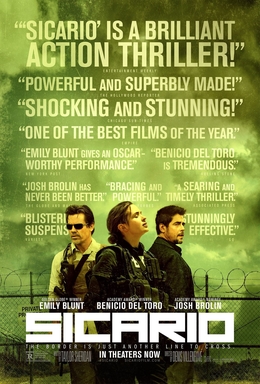
Sicario poster

Sicario

121 minutes

Cast

Selected cast credits · Film reference

Emily Blunt Kate Macer
Benicio Del Toro Alejandro
Josh Brolin Matt Graver
Victor Garber Dave Jennings
Daniel Kaluuya Reggie Wayne
Jeffrey Donovan Steve Forsing
Julio Cesar Cedillo Fausto Alarcon
Hank Rogerson Phil Coopers
Bernardo Saracino Manuel Diaz
Kevin Wiggins Burnett
Edgar Arreola Guillermo
Kim Larrichio Silvio’s Wife
Dylan Kenin Delta Leader
John Trejo Delta #2
Marty Lindsey SWAT Officer
Alex Knight Coroner (Phoenix)
Rio Alexander Phoenix Cop
Eric Steinig Air Force MP
Vic Browder US Marshal
Boots Southerland US Marshal Keith
Adam Taylor US Marshal Kevin
David Garver Bob Fisks
Jesse Ramirez Migrant #1
James Espinoza Migrant #2
Arrazolo Migrant #3
Tomas Martinez Migrant #4
Alejandro Rodriguez Migrant #5
Jorge Rocha Fuentez Migrant #6
Eb Lottimer Bank Manager
Matt Tompkins Jessie Garza
Michael Sheets Treasury Agent
Sarah Minnich Reggie’s Dance Partner
Matt Page Operator
Julian Ortega Fausto’s Son #1
Ian Posada Fausto’s Son #2
Antonio Leyba Border Bandit #1
Frank Andrade Border Bandit #2
Juan Carlos Mora Border Bandit #3
Jesus Mayorga Border Bandit #4
Joseph P. Santillanes Homeland Security Officer
Basil Iwanyk, Sr. DEA Agent (Motel Room)
Ivan Allen Ransopher News Anchor
John Burke Chandler News Reporter

Sicario | The Rewatchables

Explore episodeClose episode

Most Rewatchable Scene

The border crossing

In the discussion (10)
Approx. transcript time · 00:04:15Read transcript
  • Four rewatch entry points are the opening, border crossing, tunnel descent and final cartel-family confrontation.
  • The opening raid, bodies, explosion and shower are scene candidates; the brutality establishes a nightmare and a war beyond the agents’ experience.
  • The Juárez convoy and Graver recruitment are scene candidates, though recruitment is explicitly not the overall winner.
  • The border sequence is praised for precise geography, pacing, heat, sound and Kate’s forced complicity. The conspicuous tattooed gunman prompts a proposed category and nitpick; the cartel’s objective is debated.
  • The bar, Kate/Reggie chemistry, Bernthal’s performance and strangling scene are candidates. Whether Alejandro was watching and whether Kate was deliberately bait are discussed.
  • The car interrogation is a scene candidate, including the ear torture and Graver’s prison threat; the ear moment is proposed as an apex for wet willies.
  • The infrared tunnel and Kate being shot in her vest are praised; the shooting is an early Dan Campbell candidate.
  • The family dinner wins the food-and-drink award and is a major scene candidate. Killing the children is contrasted with the script’s reported ending in which the family escaped.
  • The adequacy of Alejandro’s revenge is debated, with watching the family die offered as the punishment and time pressure as a reason for speed.
  • The final confession is another scene candidate, but the border-crossing sequence is the unanimous most-rewatchable choice.

The Coach Finstock Award for Best Life Lesson

Doubt gives way to understanding

In the discussion (2)
Approx. transcript time · 00:09:02Read transcript
  • Early life lessons concern degrees of wrong, personal revenge defeating business logic and the failure of an expected hero. Kate’s final understanding is qualified as acceptance.
  • The life-lesson choice is Alejandro’s warning that doubt will eventually become understanding.

What’s Aged the Worst?

Kate’s smoking; sequel differences; supposed unattractiveness; Alejandro’s cartel connections; Reggie Wayne name; period-specific Juárez

In the discussion (5)
Approx. transcript time · 00:12:11Read transcript
  • Three adult films competing in 2015 is an early aged-worst comparison with current releases; a genre movie exceeding expectations makes Chris return to theaters immediately.
  • Kate’s smoking is criticized under aged-worst and a Tom Cruise bad-smoking award, with disagreement that she smokes convincingly.
  • The sequel is judged acceptable but different and unusually evil; an initial claim that it changed screenwriter is explicitly corrected to Sheridan.
  • Aged-worst objections include treating Blunt as unattractive, insufficient detail on Alejandro’s cartel connections and the script naming Reggie Wayne. The geopolitical premise is defended as plausible.
  • Juárez’s portrayal is discussed as tied to the writing period rather than the later city, with contemporary crime claims presented as the hosts’ reported research.

Half-Assed Internet Research

Replica border; thermal cameras; heated soles; title origin; food poisoning; improvised pause; boxing; bar history

In the discussion (3)
Approx. transcript time · 00:15:19Read transcript
  • Sheridan’s first screenplay and the removal of most Alejandro dialogue are praised; the script reportedly showed his dream and opening narration, whereas the film conveys information visually.
  • Research reports a replica border crossing, practical thermal camera use, heated shoe soles, the word’s Latin origin, Blunt’s food poisoning and Brolin’s effective pause after forgetting dialogue. Night vision is an added personal-enjoyment answer.
  • Research reports Blunt striking experienced boxer Bernthal and the filming bar’s later shooting, closure and reuse, with uncertainty about the new venue.

Apex Mountain

Bodies in walls; qualified Juárez and Brolin

In the discussion (5)
Approx. transcript time · 00:26:20Read transcript
  • Villeneuve’s early disturbing films divide preferences, with Enemy a one-timer for one host. His later run and forthcoming work prompt an early apex assessment.
  • Blunt’s apex is assigned to A Quiet Place; her recent choices divide opinion, with The Fall Guy defended.
  • Juárez is qualified as a film-location apex; Brolin’s apex splits among the post-No Country run, Sicario and Infinity War.
  • Cartel-film apex is disputed against Scarface; vats of acid face a Batman counterexample.
  • Traffic is Del Toro’s apex; Kaluuya and Bernthal are rejected here. Bodies in walls receive an affirmative. Tunnel examples form an unranked Mount Rushmore; dinner executions and Donovan in Shot Caller are considered.

The Great Shot Gordo Award for Most Cinematic Shot

Soldiers disappearing into dusk; Kate crossing the rooftop

In the discussion (2)
Approx. transcript time · 00:27:37Read transcript
  • Deakins’ dusk descent and framing behind Graver during recruitment are praised; the no-lawyers line and withheld face imply danger. His animation work answers a joke about lighter projects.
  • Great-shot choices are the soldiers disappearing into dusk and Kate crossing the rooftop toward fireworks.
In the discussion (4)
Approx. transcript time · 00:29:52Read transcript
  • Blunt’s career run leads to approval of her casting, with early-2000s Kate Winslet imagined; credibility as an agent is separated from concerns about the character’s later moral reasoning.
  • Recasting discussion rejects Hathaway and Adams, considers the Blunt/Johansson Black Widow counterfactual, and credits Edge of Tomorrow for Blunt’s credible physicality.
  • Early-2000s Kate Winslet is the preferred hypothetical recast, qualified by Kate’s younger age.
  • Philadelphia replacing Juárez is a joking recasting-city suggestion tied to sports.

Just One Oscar

Del Toro; Deakins; Jóhann Jóhannsson’s score

In the discussion (2)
Approx. transcript time · 00:35:13Read transcript
  • Del Toro’s Oscar omission is challenged; alternatives remove Hardy or Stallone, with Harrison Ford also proposed. Hardy’s Fury Road work is preferred to The Revenant.
  • One-Oscar choices are Del Toro, Deakins and Jóhann Jóhannsson’s score.

Roger Ebert's review

Rating not yet verified
In the discussion (1)
Approx. transcript time · 00:36:29Read transcript
  • The hosts explicitly say Ebert died before the film and never reviewed it. A ChatGPT guess of three-and-a-half to four stars is hypothetical.

Picking Nits

Hidden bodies’ smell; Ted’s plan and money band; missed shot; unspecified beer; post-assault smoking; arrest and signature; tracking logistics; selective candor

In the discussion (9)
Approx. transcript time · 00:39:42Read transcript
  • The smell of dozens of concealed bodies is an early nitpick, with tight packaging and drywall offered as uncertain explanations.
  • Nitpicks question Ted’s plan after killing an FBI agent and his carrying the distinctive cartel money band, with police connections and poor judgment offered as explanations.
  • The opening gunman missing Kate at close range is a nitpick; confusion with the later crossing shot is corrected.
  • Ordering unspecified beers is a nitpick, followed by speculative discussion of Kate’s drink preferences.
  • Smoking immediately after strangulation is a nitpick, countered by a smoker’s desire for a cigarette after any stressful event.
  • Kate trying to arrest Alejandro and the coerced signature are nitpicked: she could later disclose duress, while the document might incriminate her; Graver letting her leave and the possibility of forgery are questioned.
  • Ted’s reliance on Reggie introducing him is questioned; a longer-term seduction plan is offered as a possible explanation.
  • Alejandro finding the right car, Silvio and Manuel is questioned, with intelligence and timing offered as partial explanations; arriving exactly at dinner prompts jokes.
  • Graver’s selective candor is criticized as serving the script rather than his own interests.

The Stephen A. Smith Hottest Take Award

Foreign-policy allegory; Yellowstone’s cost to cinema; Del Toro’s romantic reputation

In the discussion (4)
Approx. transcript time · 00:51:16Read transcript
  • A hottest take ranks the crossing alongside Heat’s robbery and The Dark Knight’s truck chase; the hosts recall the chaotic Grantland period.
  • A hottest take reads the film as an allegory of American foreign policy exploiting crises and desires for justice.
  • Another hottest take calls Yellowstone’s success a major loss for film screenwriting, with Mike White discussed as a different film-to-TV example.
  • Bill’s hottest take is that Del Toro’s reputation as a ladies’ man is underrecognized; purported relationships are recited as hearsay rather than independently established facts.

The most "year the movie came out" thing

Walking Dead-era Bernthal; pre-Yellowstone Sheridan; extrajudicial squads; shock at government misconduct

In the discussion (1)
Approx. transcript time · 00:52:24Read transcript
  • Most-2015 choices include younger Walking Dead-era Bernthal, pre-Yellowstone Sheridan, rooting for extrajudicial squads and still being shocked by government misconduct.

What’s Aged the Best?

Light-to-dark progression; economical introductions; structural problems; title cards; behavioral details; wedding ring; Mexican cop payoff; Bernthal’s switch

In the discussion (4)
Approx. transcript time · 00:54:22Read transcript
  • Aged-best choices include the progression from daylight through darkness to gray and economical character introductions.
  • The hosts praise Sheridan’s attention to structural problems while debating the film’s apparent romanticizing of operators and his later tendency to overexplain.
  • The title, opening information cards, small behavioral details, Alejandro’s wedding ring and the delayed payoff to the Mexican cop’s story age well.
  • Bernthal’s switch from friendly to threatening and his apparent loss of control during the assault are praised.

Floyd Gondolli Enjoyment Award

Tunnel rumors; thick glasses on an armed operator; debrief; night vision

In the discussion (2)
Approx. transcript time · 01:01:41Read transcript
  • Bill introduces a listener-proposed Floyd Gondolli personal-enjoyment award and uses rumors of a tunnel. Other answers are an armed operator with thick glasses and a debrief, with Donovan’s reported visual inspiration discussed.
  • Research reports a replica border crossing, practical thermal camera use, heated shoe soles, the word’s Latin origin, Blunt’s food poisoning and Brolin’s effective pause after forgetting dialogue. Night vision is an added personal-enjoyment answer.

The Butch’s Girlfriend Award for the Weakest Link in the Film

Agency mechanics; Kate’s reporting insistence

In the discussion (2)
Approx. transcript time · 01:06:34Read transcript
  • The complex agency mechanics are a weak-link candidate; Garber’s explanatory scene is praised but considered late, and Kate’s official role is unpacked.
  • Kate’s insistence on reporting the operation after the tunnel is another weak-link/nitpick choice, despite a five-star overall opinion.

When I Would Have Died

Early scenes; the tunnel

Flex pick · Sean Fennessey

In the discussion (1)
Approx. transcript time · 01:16:03Read transcript
  • Sean explicitly chooses When Would I Have Died and answers essentially every early scene; another answer is the tunnel. Kate’s bulletproof-vest injuries prompt a Dörfler’s Door reference and speculative recovery discussion.

Casting What-Ifs

Brolin’s initial refusal and Deakins’s persuasion

In the discussion (1)
Approx. transcript time · 01:22:18Read transcript
  • Casting What-Ifs reports Brolin initially declining after Everest and Deakins persuading him by email; no specific alternate actor is established.

Probably Unanswerable Questions

Alternate ending; soccer aftermath; Halloween costume; Kate’s future

In the discussion (4)
Approx. transcript time · 01:25:34Read transcript
  • The interrogation’s unseen actions are debated, including a Reddit sexual-assault interpretation raised by Craig; the hosts remain uncertain and do not establish what occurred.
  • Kate killing Alejandro is rejected as an improvement. The Mexico soccer ending is defended for showing nothing has changed and ordinary people bear the cost, despite a joking objection to the children’s play.
  • An unanswerable question imagines the concealed bodies as an awful Halloween costume, with horror-film alternatives.
  • The Watney next-day question considers Kate’s future relationships and work, with police, desk job, post office and crafts suggested; no outcome is established.

Franchise Tag: Should This Movie Have Sequels?

Protect Sicario from sequels; continuation disputed

The panel proposes a new category here.

Flex pick · Craig Horlbeck

In the discussion (3)
Approx. transcript time · 01:27:20Read transcript
  • Craig introduces a Movie Franchise Tag flex proposing that a small annual group of films, including Sicario and The Devil Wears Prada, be protected from sequels.
  • Chris counters that once Sicario’s sequel exists the series should continue, while a prestige television version is discussed and Del Toro’s participation doubted.
  • The franchise-tag proposal expands to Sinners, Barbie and Oppenheimer with disagreement; Limitless is explicitly exempted and its television series recalled.
In the discussion (1)
Approx. transcript time · 01:38:46Read transcript
  • Cruise is preferred over Hanks, with Alejandro, Ted and Graver possibilities qualified by casting fit; Scorsese wins over Spielberg.
In the discussion (1)
Approx. transcript time · 01:38:46Read transcript
  • Cruise is preferred over Hanks, with Alejandro, Ted and Graver possibilities qualified by casting fit; Scorsese wins over Spielberg.

Best Hang / Worst Hang

Best: Graver; worst: Kate disputed

In the discussion (1)
Approx. transcript time · 01:39:29Read transcript
  • Graver is best hang. Kate is initially proposed for worst hang but defended as fun at the bar.

Sequel, Prequel, Limited Series, or All-Black Remake

Prestige series; third film; Alejandro prequel; Kate as sheriff; Donovan series

In the discussion (1)
Approx. transcript time · 01:45:58Read transcript
  • Continuation ideas are a news-responsive prestige series, a third film, Alejandro’s prosecutor-to-assassin prequel, Kate as a small-town sheriff and a Donovan-centered show.

Who Won the Movie?

Taylor Sheridan

In the discussion (6)
Approx. transcript time · 01:53:28Read transcript
  • Sheridan replaces an initial written Del Toro choice because the film launched his powerful career.
  • A second answer explicitly agrees on Sheridan.
  • Criticism of Sheridan’s later work is qualified as frustration at wasted writing talent, while his desire for control is understood.
  • Another initial Del Toro choice acknowledges the Sheridan case; Sheridan is then reaffirmed, without a clearly countable additional voter.
  • Villeneuve’s contribution is defended through the editing and refinement of the screenplay. Craig Horlbeck
  • The others distinguish artistic achievement from career impact, citing Villeneuve’s other breakthroughs and larger hits.
Podcast choices
Speaker not identified
Taylor Sheridan
Speaker not identified
Taylor Sheridan

Producer review

Underwhelming laptop viewing; excellent television rewatch

In the discussion (1)
Approx. transcript time · 01:57:51Read transcript
  • Craig corrects his earlier claim of seeing Sicario theatrically: he first watched on a laptop and was underwhelmed, then loved the full television-and-sound rewatch. Aerial shots and the plane shadow are praised.

Perfect Age to See This Movie

Nineteen is too young; no ideal age selected

In the discussion (1)
Approx. transcript time · 01:59:15Read transcript
  • A recalled perfect-age category says nineteen is too young to grasp the subtext, without choosing a specific ideal age.
In the discussion (1)
Approx. transcript time · 01:59:45Read transcript
  • The two-hour running time is praised. Cutting Bernthal is proposed and defended as structurally necessary; cutting Silvio is only a forced alternative, opposed for losing emotional grounding.

More from the conversation

The hosts introduce the first live Netflix Rewatchables and CR Month; Bill, Chris and Sean are named. Advertising shares boundary segments with editorial material.
Approx. transcript time · 00:00:01Read transcript
Chris calls Sicario a near-perfect film and his favorite Villeneuve; Bill reconsiders its placement below Limitless on his rewatchability ranking.
Approx. transcript time · 00:02:30Read transcript
Chris compares the film with Apocalypse Now, including its early action peak, journey into darkness and Alejandro/Kurtz and Graver/Kilgore parallels. Sean qualifies the scale and mysticism comparison.
Approx. transcript time · 00:04:55Read transcript
Repeated viewing clarifies the agencies’ plan; a lawnmower interrupts the live recording.
Approx. transcript time · 00:08:08Read transcript
Kate is compared with Clarice Starling but judged less developed; her perspective sets up a heroic expectation that the ending subverts. Proposed male recasting is recalled as a rejected production idea.
Approx. transcript time · 00:10:12Read transcript
Craig recalls choosing The Martian first; the ensemble’s careers and the film’s absence from Best Picture are discussed against a strong awards year.
Approx. transcript time · 00:13:21Read transcript
The hosts distinguish Kate as viewpoint from Alejandro as the story’s active protagonist, praising the gradual perspective shift and debating strict point-of-view rules. Sheridan’s later freedom is contrasted with the effective cuts here.
Approx. transcript time · 00:17:59Read transcript
Del Toro’s restrained gestures, stare and memorable sparse lines are praised; his reported contributions to One Battle After Another illustrate creative collaboration.
Approx. transcript time · 00:21:35Read transcript
A proposed multi-decade-bangers game credits Del Toro with The Usual Suspects, Traffic, Sicario and One Battle After Another; Denzel’s current-decade entry is questioned.
Approx. transcript time · 00:22:25Read transcript
The multi-decade game considers De Niro and Cruise, then qualified cases for Pacino, Stallone and Streep; it is not a ranked top-ten list.
Approx. transcript time · 00:24:50Read transcript
Brolin’s long path from Goonies to mature roles is discussed. His Graver performance is praised for naps, gestures, footwear, menace and effortless charisma.
Approx. transcript time · 00:30:47Read transcript
Brolin is proposed as having the second-best career among 1980s child actors behind Bale, excluding DiCaprio as a 1990s child actor; other contenders and the long career gap are considered.
Approx. transcript time · 00:33:51Read transcript
The child-actor comparison continues with Bale and a joking soccer-parent anecdote.
Approx. transcript time · 00:34:36Read transcript
Wesley Morris’s mixed review is recalled as comparing the film to a gym selfie, prompting discussion of its muscular style.
Approx. transcript time · 00:37:27Read transcript
Bill recalls Guillermo as his Spanish-class name and an enduring college nickname.
Approx. transcript time · 00:44:35Read transcript
The handball scene is liked enough to want more time on it.
Approx. transcript time · 01:10:27Read transcript
A Survivor digression covers Mike White’s fitness and the hosts’ hypothetical difficulties with contacts, nicotine and missing sports news.
Approx. transcript time · 01:18:27Read transcript
Reptile is recommended by Chris and another host, with its title corrected from Alligator and its length noted.
Approx. transcript time · 01:21:50Read transcript
A fantasy-baseball invitation digression follows.
Approx. transcript time · 01:32:35Read transcript
Project Hail Mary receives a brief positive recommendation.
Approx. transcript time · 01:33:43Read transcript
A street anecdote about finding an Infinity Gauntlet prop interrupts the apex discussion; suspected drug dealing remains speculation.
Approx. transcript time · 01:34:39Read transcript
Blunt’s appeal even when the character is exhausted prompts a Dana Wheeler-Nicholson award reference.
Approx. transcript time · 01:42:01Read transcript
Sheridan’s cell-phone interview leads to memories of early podcast guests and the three-man weave format.
Approx. transcript time · 01:54:31Read transcript
The close confirms Sicario as CR Month’s first installment and discusses later choices, exclusions, a possible mystery project and anniversary plans.
Approx. transcript time · 02:01:13Read transcript
The hosts thank Craig Horlbeck, Gahao, Eduardo and Jack Wilson with ASR spellings retained for identity review, and confirm the Netflix live format.
Approx. transcript time · 02:04:35Read transcript