‹ All movies
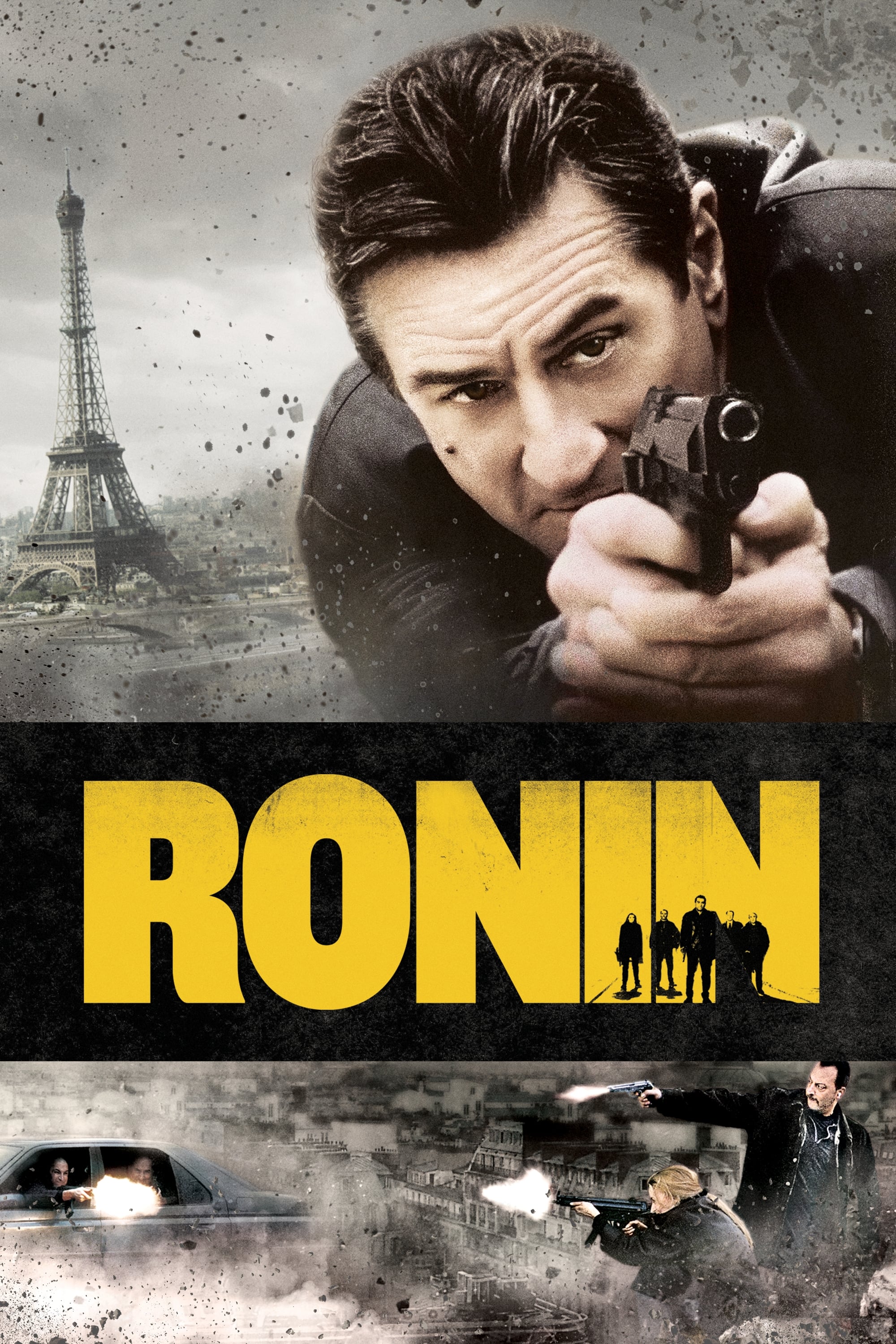
Ronin poster

Ronin

121 minutes

Cast

Selected cast credits · Film reference

Jean Reno Vincent
Sean Bean Spence
Jonathan Pryce Seamus O'Rourke
Michael Lonsdale Jean-Pierre
Jan Triska Dapper gent
Katarina Witt Natacha Kirilova

Ronin | The Rewatchables

Explore episodeClose episode

Producer credits not yet identified.

Roger Ebert's review

In the discussion (2)
Approx. transcript time · 00:27:00Read transcript
  • Roger Ebert gave the film three stars; the hosts joke that he has loved their recent picks since Tommy Boy.
  • Ebert's quoted review calls it an entertaining exercise by Frankenheimer with a fine cast, a movie not really about anything that nonetheless comes pretty close to amounting to something.

Most Rewatchable Scene

Second car chase

In the discussion (13)
Approx. transcript time · 00:28:35Read transcript
  • The first shootout is left off as merely fine; the list opens with De Niro turning on Sean Bean's character, demanding he draw the diagram again and asking the color of the boathouse, before Bean's character is paid off and dismissed.
  • De Niro snapping and getting in someone's face is a favorite De Niro mode.
  • The first big shootout and chase is shot on location; De Niro shooting evokes Neil McCauley, and a host suggests that had McCauley escaped LAX he would become this character, a thought saved for unanswerable questions.
  • Jean Reno's driving faces and cars crashing through an outdoor bistro, with people scrambling, make it a how-did-they-do-that scene.
  • The film is defined by how many innocent bystanders get killed, unlike action movies' usual invisible rules; the hosts approve, citing a Speed comparison and the motorcycle rider being wiped out.
  • Low car-mounted cameras, wide shots and narrow streets make the chase feel car-sick real; the first Bourne movie borrows it, and a host quotes Frankenheimer's DVD commentary that violence does not happen in slow motion.
  • The switched-case gimmick is a favorite action trope; Gregor is sneaky, De Niro spots the switch from paint on his jacket, and Focus is mentioned for its bag switching.
  • In the playground scene Gregor nearly shoots a child to make a point until the Russian moves his gun, and Sam's meeting with his handler ('Do I know you?') is also cool.
  • The amphitheater scene and the France footage in general are praised, including realistic tourist crowds at landmarks.
  • The second chase is called the more legendary one: McElhone's character drives, Gregor quietly putting on his seatbelt minutes in is the funniest moment, and the wrong-way highway driving looks real and storyboarded, not CGI; it is named as the favorite.
  • The Katarina Witt figure-skating countdown ends with her boyfriend and then her being shot, a tense scene.
  • The final coffee scene, De Niro in a sling, has a Midnight Run goodbye feel; the hosts say an alternate ending had the IRA grab McElhone's character, that test audiences hated it while Frankenheimer preferred it, and one host calls cutting it a mistake.
  • Asked for a favorite, the answer is the second chase, one of the best car chases ever filmed, with added praise for the warehouse banter ('labor or management'), the French tavern meeting, and the post-skating crowd chase and MacGuffin reveal.

What’s Aged the Best?

Katarina Witt; McElhone's accent and outfits; De Niro's case-photo setup; slow-building first 40 minutes; self-operation scene; wrong-people realization; the 'any doubt' lessons; gritty French locations; shifting stakes

In the discussion (12)
Approx. transcript time · 00:41:26Read transcript
  • Katarina Witt is the first pick: a host loved her and calls her the best-looking female athlete of his first 20 years, joking she could be a Bond villain.
  • Witt, an iconic gold-medal skater, turns up playing a gold-medal figure skater with barely a line.
  • McElhone's Irish accent is praised though she is from England, and her baggy-jeans outfits are back in style.
  • De Niro handing a stranger his camera to photograph the case, then studying the photos, is a favorite setup.
  • The first shootout into the first chase is only borderline, liked mainly for Sean Bean going for it, with Bean floated for the Dion Waiters or Vincent Hanna award and compared to a reality-show villain.
  • The first 40 minutes build and build.
  • The makeshift self-surgery to remove a bullet is a favorite action trope; other examples named are Heat, First Blood, Master and Commander (called the all-timer), Cast Away and John Wick, while The Fugitive does not count because he is a doctor.
  • The realization that only the Russians could have produced the second case, 'we're following the wrong people', is a nice swerve an hour in.
  • The lessons 'whenever there is any doubt, there is no doubt', 'that's the second thing they teach you' and 'no questions, no answers' are praised; a host says he should have adopted the first for Grantland.
  • The grey, gritty, chilly south of France locations are praised.
  • The movie changes from a guys-on-a-mission film to international intrigue to a cat-and-mouse game with De Niro, Deirdre and Mickey.
  • Whether the MacGuffin aged well is left undecided, joked as a new 'what's aged the I don't know' category: it felt like a Pulp Fiction ripoff, but Sam's reveal that he was there for Seamus makes it work.
In the discussion (4)
Approx. transcript time · 00:44:28Read transcript
  • Sean Bean is listed for the Dion Waiters award and could change the award's name.
  • Katarina Witt is floated out of affection, then conceded ('You're right').
  • Bean's short run is recounted: walking the team into an ambush, wild machine-gun fire, the 'bit of raspberry jam' line, throwing up, and De Niro's cup-of-coffee ambush leading to the boathouse-at-Hereford exchange.
  • Bean could change the award's name, and winning both awards is compared to winning MVP and Rookie of the Year.

What’s Aged the Worst?

De Niro not playing Neil McCauley; De Niro kissing; unmotivated De Niro-Deirdre romance; 1970s-style score; visible stunt doubles

In the discussion (6)
Approx. transcript time · 00:51:46Read transcript
  • De Niro should simply have been Neil McCauley, with Frankenheimer calling Michael Mann for permission.
  • Seeing De Niro kiss someone is gross; he rarely puts himself in that position.
  • A Sea of Love tangent mocks Pacino's kissing style and recalls joking about its sex scenes with a best man.
  • The De Niro-Deirdre romance is shoehorned with no connection scene; a counterpoint says the making out is cover, but De Niro's other behavior suggests he would have killed or abandoned her, and the hosts cite an LA Times piece saying Mamet added the love interest.
  • The score is the most 1970s thing in the movie; a pulsing Heat-style or Prodigy-era score, as in The Saint or The Bourne Identity, would work.
  • Middle-aged actors are welcome, but the stunt doubles show: a young man with black hair stands through the sunroof with the bazooka, and gymnast-like doubles tumble in the amphitheater.
In the discussion (2)
Approx. transcript time · 00:56:52Read transcript
  • Casting What-Ifs is announced and skipped: no research on casting alternatives could be found.
  • The research segment repeats that there were no casting-what-if pieces, only driving pieces.
In the discussion (4)
Approx. transcript time · 00:57:15Read transcript
  • Whether Katarina Witt belongs in the Joey Pants award or Who Won the Movie is deferred.
  • Sudduth's part suits a late-1990s up-and-comer, so Ben Affleck is proposed, filming before Good Will Hunting broke when he had Chasing Amy and Mallrats.
  • Sudduth is recalled from TV, possibly as a precinct captain on a Chicago show.
  • Colin Farrell would have been too early for the part but is answered 'that would have been cool'; he could maybe also have done the Sean Bean part.

The Neil McCauley “A Book about Metals” Award for Best Line from the Movie

"What's the color of the boathouse at Hereford?"; "Either you're part of the problem or you're part of the solution or you're just part of the landscape"; "You ever kill anybody?" "I hurt somebody's feelings once"; "Lady, I never walk into a place I don't know how to walk out of"; "If you don't mind, I'm going to pass out"; "I ambush you with a cup of coffee"; "A man and a woman going for a walk, and all that that entails"

In the discussion (6)
Approx. transcript time · 01:00:06Read transcript
  • The boathouse-at-Hereford exchange is called the greatest line of the movie.
  • The part-of-the-problem, part-of-the-solution, part-of-the-landscape line would be a good senior yearbook quote, alongside the hurt-somebody's-feelings exchange.
  • 'Lady, I never walk into a place I don't know how to walk out of' is called right out of Heat.
  • The pass-out line after the bullet removal is liked.
  • 'I ambush you with a cup of coffee' is repeated as a favorite.
  • The man-and-a-woman-going-for-a-walk line is recommended for use with one's wife; De Niro's characters never seem to understand marriage.

Half-Assed Internet Research

80 cars destroyed; practical chases with race drivers; actor driving school; Teflon-coated bullet; two alternate endings; added peace-process radio report

In the discussion (4)
Approx. transcript time · 01:00:38Read transcript
  • The hosts report that 80 cars were destroyed, that Frankenheimer avoided special effects in the chases, storyboarding them and mounting cameras as in Grand Prix, with actors driven at up to 100 mph by Formula One and high-performance drivers.
  • The actors reportedly attended a high-performance driving school, which De Niro is joked to have failed; fender-mounted point-of-view cameras are compared with French Connection.
  • The bullet removed from Sam is said to have been Teflon-coated to pierce his vest, the kind of cop-killer bullet later taken off the market.
  • Two alternate endings are described, the IRA abduction and a version where she just walks to her car, dropped as too Hollywood; a radio report on the Irish peace process was added, implying Sam saves it by getting Seamus.

Apex Mountain

Stellan Skarsgård; late-1990s France movies; Nice as a movie setting

In the discussion (7)
Approx. transcript time · 01:02:35Read transcript
  • Stellan Skarsgård is at Apex, with this and Good Will Hunting in the same year and Deep Blue Sea the next; this is called peak Stellan and a great call.
  • Katarina Witt is not at Apex; hers was on the medal stand.
  • Frankenheimer's apex is The Manchurian Candidate.
  • Jean Reno's apex is The Professional; De Niro is not at Apex.
  • McElhone's apex is suggested as Californication.
  • Whether this is Apex Mountain for mysterious-switched-suitcase movies gets 'might be', then 'Yeah, I think it is', and ends at 'I think it's in the mix'.
  • It is 'absolutely' Apex for late-1990s France movies, and Apex Mountain for Nice.

Picking Nits

Sudden De Niro-Deirdre attraction; Katarina Witt not playing herself; overlong skating routine; absent French police

In the discussion (4)
Approx. transcript time · 01:03:59Read transcript
  • Why De Niro and Deirdre suddenly become attracted is questioned again.
  • Witt should have played herself, since assassinating the real Katarina Witt would be a bigger international incident.
  • The skating performance runs impossibly long while the heroes get through security, joked as a 25-minute routine to Free Bird or Hotel California with the sniper growing impatient.
  • French law enforcement barely reacts to a countrywide crime spree, ravaged bistros and car chases; after the wrong-way highway chase and crash there are no cops.

Sequel, Prequel, Limited Series, or All-Black Remake

Yes: a 10-episode Netflix series expanding the story or following Sam

In the discussion (2)
Approx. transcript time · 01:07:46Read transcript
  • One host talked himself into a series and the other agrees; Netflix has the money.
  • It could either expand this story or follow further adventures of Sam.

Probably Unanswerable Questions

Katarina Witt's character's unattractive partner; McElhone versus Famke Janssen career battle; De Niro as a bad athlete; contents of the briefcase

In the discussion (7)
Approx. transcript time · 01:08:05Read transcript
  • How did Katarina Witt's character end up with such an ugly boyfriend or husband? Roman Abramovich's girlfriend is cited as a comparison.
  • Who won the career battle, Katarina Witt or De Niro, and McElhone or Famke Janssen? It was market corrections back and forth.
  • McElhone and Janssen could each have taken the other's roles in Rounders, X-Men, Taken or Californication; a third actress on that corner is described but not named, and Eva Green and Olga Kurylenko are ruled out.
  • The hosts wonder whether McElhone and Janssen like each other, and call it a good Ringer piece.
  • When has De Niro convincingly thrown anything? Raging Bull is set aside, Godfather 2, Midnight Run, Cape Fear and Goodfellas are debated, and The Irishman's beating scene is the funniest.
  • Keanu and Swayze look like real football players in Point Break, unlike De Niro; he gets chased down by Pacino at the end, and The Fan is another example.
  • What was in the briefcase? Best guess is nuclear codes or plutonium, with the Russians wanting it at the fringe of the Cold War and Seamus able to blow up the peace process.
In the discussion (3)
Approx. transcript time · 01:12:44Read transcript
  • Katarina Witt wins in one host's heart, but he does not want to give her the honor and leans to Frankenheimer instead.
  • An unattributed voice hedges 'either Frankenheimer or Mamet'; De Niro is called really good but not great, showing up and doing his job in an era of four movies a year rather than giving a Neil McCauley-level performance.
  • The second voice agrees it is Frankenheimer: arguably his best movie, inconceivable in the mid-90s, closer to Grand Prix than The Manchurian Candidate, showing his range and reliable genre filmmaking.
Podcast choices
Speaker not identified
John Frankenheimer
Speaker not identified
John Frankenheimer

More from the conversation

Episode selection: listeners on Twitter were asked; Kiss of Death was wanted for its 25th anniversary but only the two hosts like it; Manhunter and Cruising were floated; once Ronin was suggested it was declared the winner.
Approx. transcript time · 00:02:40Read transcript
Ronin is rewatched for its dialogue, living between the lines of what is arguably David Mamet's writing, more than for its car chases or stunts.
Approx. transcript time · 00:03:04Read transcript
The opening title text explaining samurai and ronin has little to do with the movie, compared with a Sicario trailer defining the word for hit man.
Approx. transcript time · 00:03:04Read transcript
Later films are said to borrow from Ronin: the Bourne movies and parts of John Wick take its realism, location shooting and keeping actors in frame; De Niro's stunt doubling is sometimes obvious; Formula One drivers drove while the actors sat on the other side.
Approx. transcript time · 00:04:14Read transcript
The Town's bank-robbery getaway through the North End is described as basically a Ronin scene; French Connection and Bullitt are named as the first great car-chase movies, with Blown Away mocked for its endless downhill Boston chase.
Approx. transcript time · 00:05:49Read transcript
A host argues Ronin was the first great DVD: he says players reached the US on March 31, 1997, recalls splurging on a DVD setup while bartending and starting his website, and reads a list of the first DVD titles, including a Goodfellas disc that had to be flipped.
Approx. transcript time · 00:06:22Read transcript
The Fugitive train crash was the first great DVD moment at home; the Ronin two-disc DVD of February 1999 had widescreen and pan-and-scan versions, 5.1 sound, an alternate ending and a Frankenheimer commentary, and its wide-lens Super 35 photography suffered on square-TV cable broadcasts.
Approx. transcript time · 00:08:44Read transcript
DVD extras memories: Fincher's commentaries, Ben Affleck's Armageddon commentary, the Good Will Hunting commentary praising Casey's genius, and the Boogie Nights DVD's deleted scenes, which could need a three-part episode.
Approx. transcript time · 00:10:23Read transcript
Ronin was not cheap and underperformed at the box office but found a second life on DVD, where chapter skipping replaced VHS rewinding to reach the car chases.
Approx. transcript time · 00:11:57Read transcript
The film got lost in a crowded 1998, with some De Niro fatigue; the hosts list that year's big releases and call Ronin a throwback that feels like a 1970s crime thriller, down to the score, unlike Heat.
Approx. transcript time · 00:13:27Read transcript
U.S. Marshals, seen in France, and Robert Downey Jr.'s performance are defended; 1998 is called the turn for Robin Williams with Patch Adams and What Dreams May Come.
Approx. transcript time · 00:14:44Read transcript
The hosts say Ronin was the 44th biggest movie of the year, making about $70 million on a $55 million budget.
Approx. transcript time · 00:15:32Read transcript
Frankenheimer's career is recounted: Birdman of Alcatraz, The Manchurian Candidate, Seven Days in May, The Train, Seconds, Grand Prix, French Connection 2 and Black Sunday, whose Super Bowl climax the NFL somehow allowed.
Approx. transcript time · 00:15:43Read transcript
Per the Wikipedia account a host cites, Frankenheimer's drinking got so severe he drank on set in Japan and entered rehab; Island of Dr. Moreau was such a disaster that it should not be a flawed rewatchable but a what-happened episode, and a host recalls reading that Frankenheimer ordered Val Kilmer off the set.
Approx. transcript time · 00:16:41Read transcript
On the writing credit, the hosts say Frankenheimer publicly credited the screenplay to Mamet over story writer J.D. Zeik, and Mamet used the pseudonym Richard Weisz; a pseudonym joke yields 'Sil Bimmons'.
Approx. transcript time · 00:18:27Read transcript
Mamet was said to be brought in to beef up the De Niro character during a strong 1990s run; the hosts say a Wag the Dog credit dispute led to his pseudonym rule, and his repetitive, rhythmic tough-guy dialogue is unmistakable, unlike the Tarantino-style films of 1998.
Approx. transcript time · 00:19:10Read transcript
Ronin feels older than Heat despite coming three years later; almost nothing happens for 40 minutes, with no breadcrumbs about who the characters are, which activates the viewer instead of a gunfight and rewards repeat viewings.
Approx. transcript time · 00:20:54Read transcript
De Niro's career arc from King of Comedy through the 1990s is reviewed; Sam in Ronin is called his last great role until Silver Linings Playbook, with Meet the Parents defended as good but a departure.
Approx. transcript time · 00:22:39Read transcript
Cast rundown: Jean Reno had a good 1990s; McElhone's name pronunciation and accent imitations are teased; Stellan Skarsgård is compared to a utility baseball player for playing any nationality; three cast members were Bond villains; the Sean Bean conversation is saved.
Approx. transcript time · 00:25:32Read transcript
A promo break (no ad copy) plugs Briarpatch, created by Andy Greenwald, and Music Exists with Chuck Klosterman on Spotify.
Approx. transcript time · 00:27:46Read transcript
Wikipedia's one-line description of the film, a team of former special operatives stealing a mysterious briefcase amid shifting loyalties, is praised as one of the best descriptions on the site.
Approx. transcript time · 00:33:50Read transcript
A host's dad texted that Ronin is one of his favorites, seen a dozen times, and that The Replacement Killers is also a classic.
Approx. transcript time · 00:40:54Read transcript
Closing: an imitation of the IRA men interrogating Deirdre in the van, a joke about putting Bono in that scene, two more episodes promised next week, and mutual thanks.
Approx. transcript time · 01:14:02Read transcript