‹ All movies
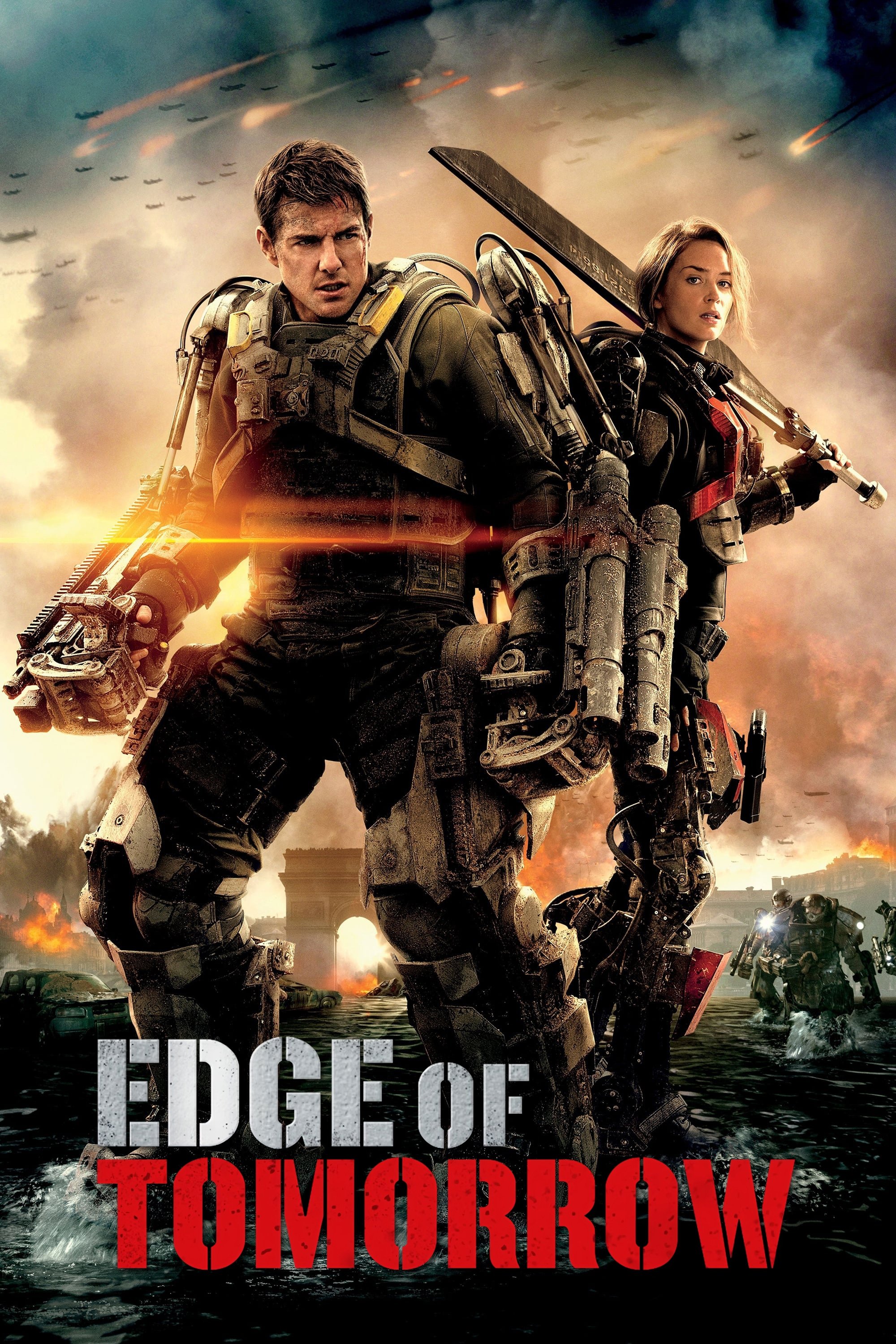
Edge of Tomorrow poster

Edge of Tomorrow

113 minutes

Cast

Selected cast credits · Film reference

Tom Cruise Major William Cage
Emily Blunt Sergeant Rita Vrataski
Bill Paxton Master Sergeant Farell
Brendan Gleeson General Brigham
Noah Taylor Dr. Noah Carter
Kick Gurry Griff
Jonas Armstrong Skinner
Tony Way Kimmel
Lara Pulver Karen Lord
Madeleine Mantock Corporal Julie Montgomery
Martin Hyder Drunk
Harry Landis Old Man 3
Terence Maynard Cruel Sergeant

Edge of Tomorrow | The Rewatchables

Explore episodeClose episode

Producer credits not yet identified.

Half-Assed Internet Research

Screenplay development history; the novel's video-game origin; Cruise's Oblivion turnaround; the helicopter line; the Matrix-like Louvre scene; beach plates; heavy battle suits; Rita's blade

In the discussion (17)
Approx. transcript time · 00:21:57Read transcript
  • Getting ahead of half-ass internet research, the hosts read that eight people contributed to the screenplay and that the producers developed a spec script, sending writer Dante Harper the novel.
  • They read that Harper found the book too complex but risked not being paid and spent eight months on it; Warner Brothers bought it for $3 million in April 2010, hired Liman, and Harper's script made the 2010 Black List.
  • The story prompts a Barton Fink joke, corrected from Michael Gambon to Michael Lerner ("It's a wrestling picture").
  • The Butterworths were later brought in; Jez is called an accomplished playwright who worked on some of the Craig Bond movies and Simon Kinberg also took a shot.
  • The hosts say Cruise compared Cage's violent deaths to a Wile E. Coyote and Roadrunner cartoon, and that McQuarrie finally found the funny tone the earlier drafts lacked.
  • Movies with eight screenwriters are usually bad; the guess is that Harper's shape, the Butterworths' plotting and McQuarrie's dialogue survived.
  • Resuming the segment, the hosts say Sakurazaka got the idea for the novel from resetting video games until finding the winning strategy.
  • Asked about resetting FIFA, the answer is going further: looking up cheat codes online for 100 lives, which dates the last time he played video games. — Chris Ryan
  • The movie integrates first-person-shooter and video-game logic seamlessly, making it the best video game movie without being an adaptation; Scott Pilgrim is the only comparison, while boss-level logic in Star Wars movies is annoying.
  • The hosts read that Cruise began pre-production on July 20, 2012, less than a week after wrapping Oblivion.
  • The farmhouse line about knowing how to take off but not land is linked to Cruise later flying helicopters in Mission Impossible.
  • The hosts read that the Louvre scene with aliens attacking the ship resembles the sentinels at the end of The Matrix.
  • They read that visual effects artists extended the beach with plates shot at Saunton Sands in North Devon, and that the battles were meant to recall Normandy and Dunkirk, discussed with Quentin Tarantino last year.
  • They read that Cruise and Blunt wore the battle suits for real, averaging 85 pounds and up to 130 pounds, and hung from chains on iron frames between takes, which is likened to Aliens.
  • They read that in the novel Rita uses a melee weapon because she ran out of ammo on resets; her blade is iconic but practically stupid, alongside the Full Metal Bitch bus graffiti and her crew's skeleton masks.
  • Blunt's introduction doing the plank is called probably the movie's most iconic shot.
  • Asked whether he can do that plank, the answer is no. — Chris Ryan

Most Rewatchable Scene

The first drop and beach battle

In the discussion (21)
Approx. transcript time · 00:30:22Read transcript
  • The movie cuts so quickly that it has more flashes of scenes than scenes, but about eight rewatchable scenes are listed.
  • First on the list is Major Cage's first meeting with General Brigham, where he is told he will be on the beach with the first wave.
  • Casting Brendan Gleeson in a small part signals the character matters, like a Montgomery or Patton; it is contrasted with a day-player walk-on in Devs, discussed with Greenwald.
  • Gleeson, who can ham it up as in Troy, underplays the moment, has his shirt tucked in and looks as big as the wrestler Big Van Vader.
  • Waking up in Master Sergeant Farell's J Squad is next; the speaker's wife gets anxious at how unfair it is that Cage is stripped of rank, and the movie wisely avoids showing it too many times.
  • A joke asks whether the mimics would have won if Cage had simply agreed to make the documentary.
  • The first airdrop and beach battle are called incredible and heart-racing, with Cruise's great scared-stiff performance ("How do I turn the safety off?").
  • Casting unknowns in J Squad means no one seems protected, so the hit on the plane before the doors open is shocking.
  • The beach storming works despite coming in Saving Private Ryan's wake; the mimics are just CGI and not very interesting, and the movie wisely stops dealing with them for a while after the first alpha death and reset.
  • The hosts mention that Guillermo del Toro worked on some of the mimic designs.
  • Cage seeking out Rita and the training montage are listed; training montages are called mostly corny, with Creed the exception and Blades of Glory a joke contender.
  • The drive that leads to the farmhouse and the return engagement with General Brigham are on the list; the final battle is called bad, with a steep drop-off in about the last 35 minutes.
  • The farmhouse is like finding water in the desert: a human moment in which the characters actually go on a journey.
  • An added pick is Cage walking into the J Squad camp and reading everyone's poker hands ("Kimmel's working on a flush").
  • Cage becomes the smartest guy in every room; despite a flawed final 30 minutes, the final action shot of his hand opening to show grenade pins and the zippy ending where Rita asks if she has something on her face are praised.
  • The pick is the drop landing and storming of the beach: the heavy, tactile mech suits recall Ripley's loader in Aliens, the speaker says they were mostly real rather than CGI, and the scene is redone four or five times.
  • The hosts say the CGI is sparing: per making-of featurettes, portable green screens were carried alongside running actors, a beach was built in a studio, and an entire Heathrow airport army base was built instead of shooting at Heathrow.
  • Understanding how mainstream action movies get made is fun; Cruise, the quote-unquote hardest-working guy who does his own stunts, tends to get results that feel more real.
  • The other host agrees that the first battle sequence is the most rewatchable scene.
  • Neither host cares about the romance; it ranks about eighth or ninth in importance, the kiss plays as a farewell, and critics called it unearned.
  • Cruise as a romantic lead is harder to accept as he keeps pairing with actresses about 31; Kubrick and his personal life ended his youthful sex-icon status, and the movie could have done without the romance.
In the discussion (7)
Approx. transcript time · 00:44:11Read transcript
  • Emily Blunt as an action star is the first answer, with a great two-year run here and in Sicario; the hosts want more, questioning whether Jungle Cruise counts but counting A Quiet Place.
  • A Quiet Place's ending, cutting hard to credits after she does something cool, looks borrowed from this movie by Krasinski and again casts her as a Ripley-like survivor against aliens.
  • She is tough, cool, funny when needed and no-nonsense, which nobody would have guessed from Devil Wears Prada.
  • Smarmy Cruise has aged well, recalling Jerry Maguire, like Daniel Kaffee from A Few Good Men 20 years later.
  • The mix of green screen and practical effects, and not being afraid to riff on Groundhog Day, are also cited.
  • The sci-fi World War II setting, a Rosie the Riveter, keep-calm-and-carry-on England in 2020 with everyone working for the war effort, is a world worth spending time in.
  • Blunt is named as what has aged best and the other host gives her his vote.
In the discussion (6)
Approx. transcript time · 00:47:05Read transcript
  • The alien plot (what the Omega wants, how alien blood works) doesn't matter; the romantic subplot and the unoriginal mimics are also listed, and the score is called blah.
  • Liman loves techno, as in Go and the song that drops at the end of Bourne, a remnant of rising in the late '90s.
  • The Louvre section doesn't work because it is dark and confusing, unlike the daylight trailer-park car-stealing scene, a favorite, where you see the whole chessboard.
  • At the Louvre the internal logic unravels: characters fall 50 feet onto a car and keep running, while earlier a car hit would kill Cage.
  • Going into a huge action movie without the final 30 pages makes the ending feel like a different movie; it was probably shot at night because night CGI is cheaper.
  • The ending in general is named what has aged worst and the movie's key flaw.

Casting What-Ifs

Jeremy Piven's cut scenes; Brad Pitt or Ryan Gosling as Cage; The Artist star as Rita

In the discussion (6)
Approx. transcript time · 00:50:06Read transcript
  • The hosts read that after filming concluded by August 2013, Jeremy Piven was added and extra scenes were shot, but he does not appear in the finished film; they call it an editing what-if.
  • Piven's energy would not have worked, though a liked comedian popping up in J Squad would have been welcome.
  • A sarcastic line about marveling that Tom Hardy was in J Squad leads to the point that none of the J Squad actors have become big names in six years.
  • The hosts read that Brad Pitt was originally considered for Cage; it would need the winking Pitt of Once Upon a Time in Hollywood or Mr. and Mrs. Smith rather than the self-serious World War Z version, and Cruise is judged the better fit.
  • The hosts read that Ryan Gosling was also considered because Cage is younger in the novel; comic Nice Guys Gosling would work, but blank Drive, Only God Forgives or Blade Runner Gosling would not.
  • The hosts read that an actress best known for The Artist was up for Rita, which seems odd; she is called a good actor, possibly also in a Bond movie, and both hosts are glad they got Blunt.
In the discussion (4)
Approx. transcript time · 00:53:44Read transcript
  • Only one name is written down: Gleeson.
  • Paxton is raised as an alternative, noting the hosts had mentioned Aliens three times without discussing him; Gleeson is still the choice.
  • The late Bill Paxton is praised as an icon of One False Move, Aliens and Near Dark, doing a bit of R. Lee Ermey and Hudson from Aliens and crushing the repeated Farell speech; he's never done anything but make a movie better.
  • In a making-of featurette, Blunt and Cruise love Liman's chaotic style while Paxton, a veteran of James Cameron movies such as True Lies, looks uneasy as Liman rewrites his lines between takes, though he stays respectful.
In the discussion (4)
Approx. transcript time · 01:03:57Read transcript
  • Terence Maynard, the "on your feet, maggot" sergeant, is said to appear in Guy Ritchie's Revolver and often on British TV.
  • The J Squad actors are not in much; the hosts say Kimmel is the most familiar, having played Dontos Hollard on Game of Thrones.
  • Charlotte Riley, who plays Nance and is said to be in Peaky Blinders, goes "full Hillbilly Elegy" with an invented British hick accent.
  • "I guess we should just go with Tony Way" is the Joey Pants pick; no one disputes it.

Picking Nits

Easy hospital escape; Rita's simulator offer; the daily re-explanation; how Rita knew she lost the power; the mimics' blood-loss plan; repeat farmhouse trips; fleeing with the transponder; Rita's executions

In the discussion (9)
Approx. transcript time · 01:06:06Read transcript
  • After being locked up near the end, they break out of the hospital suspiciously easily.
  • The scene where Rita offers to train Cage in the simulator, though she has been training him all along, feels left over from another script, maybe footage for the techno song, or meant to show accumulated experience.
  • How many hours of every day go to explaining the situation to Rita before training can start?
  • Rita could not know she had lost her reset power unless she died and the day did not reset; who explained that possibility to her is confusing.
  • The mimics bleeding Cage at a dam makes no sense, since blood-loss death is like any other death; they would need to give him a transfusion.
  • If they had been to the farmhouse many times, they could have found gas elsewhere and had no reason to return; the counterpoint is that the area may have no gas.
  • After stealing the transponder from the General in London, they could have used it in his office and killed Cage rather than fleeing, or asked him to call off the guards.
  • Rita's body count: she shoots Cage every time he is injured in training, so what happens when there is a dead major in her gym? A court-martial, with a Daniel Kaffee joke.
  • The lesson is don't write your movie while shooting it, at least not one about time travel and alien robots.

The Neil McCauley “A Book about Metals” Award for Best Line from the Movie

"On your feet, maggot!"; "There's a dead guy in it."; "Have I got something on my face, soldier?"; "We've never gotten this far."; "I've never been with two girls at the same time."; "Battle is the great redeemer."; "Come find me when you wake up."

In the discussion (6)
Approx. transcript time · 01:11:53Read transcript
  • "On your feet, maggot" and the "something wrong with your suit ... there's a dead guy in it" exchange are memorable because they are heard over and over.
  • "Have I got something on my face, soldier?" is cited with its callback.
  • The funniest moment is in General Brigham's office after getting the transponder, when Rita asks what now and the answer is "I don't know. We've never gotten this far."
  • Griff's reply that he has never been with two girls at the same time but will make it work when that day comes is cited.
  • Farell's "battle is the great redeemer" speech is iconic but ironically bad sergeant patter, from someone who loves the St. Crispin's Day speech.
  • "Come find me when you wake up" and the other poster-style lines are called really good.
In the discussion (6)
Approx. transcript time · 01:13:28Read transcript
  • No, but a General Brigham show with Brendan Gleeson as the Patton of an alien invasion would be welcome.
  • A sequel is reportedly written; the hosts say Liman claimed it would redefine sequels, Cruise and Blunt are asked about it every six months, and Blunt now sounds busy.
  • Uncharted is joked about as the major film covered on Sean Fennessey's The Big Picture podcast.
  • Liman's next blockbuster is uncertain; there was talk of him doing Justice League Dark.
  • Chaos Walking is described as one of the great misbegotten productions: the hosts say it has seven credited screenwriters including John Lee Hancock and Charlie Kaufman, stars Tom Holland and Daisy Ridley, began shooting around summer 2017 and is still awaiting release.
  • That experience might make it hard for Liman to get a sequel made, though the hosts hope he does.

Probably Unanswerable Questions

How many times did Cage die?; Is the movie responsible for the 2016 election?

In the discussion (3)
Approx. transcript time · 01:16:34Read transcript
  • Rita watching Hendricks die 300 times is the baseline; applying Gladwell's 10,000 hours, Cage probably died close to a year's worth of deaths. — Chris Ryan
  • The hosts say the opening news montage includes Hillary Clinton, implying she is president in 2020, in a movie released in 2014 before the 2016 election; the question is whether the movie is responsible for the 2016 result.
  • The joking answer: disaffected voters saw it and said not my president; others blame the Russians, Facebook disinformation or a heartland backlash, but it's Doug Liman's fault, and the other host agrees.
In the discussion (4)
Approx. transcript time · 01:18:07Read transcript
  • Blunt is raised first, then the question turns to whether Liman's apex is Bourne; the answer is "It's Bourne," because he still had some "kwan" back then.
  • Liman never had a smooth ride: the hosts recount that Favreau did not speak to him for years over a side deal on Swingers, and that Bourne was a troubled shoot after which he was removed from the franchise.
  • Bourne would probably be his apex as the moment everyone thought he had figured out action movies; the pushback is that he did figure them out, but they are risky and difficult for him to make.
  • Blunt had mostly thankless parts in big-budget movies after Devil Wears Prada (The Wolfman, The Adjustment Bureau, the Huntsman sequel); this movie or Sicario is probably her apex, with possible disagreement acknowledged.
In the discussion (4)
Approx. transcript time · 01:20:16Read transcript
  • Recent episodes seem to end with a case for Pacino; the pick here is Cruise, with Blunt raised as the alternative.
  • A joke answer of Donald John Trump; Cruise, Liman and Blunt all have a lot to be proud of, and this will be one of the most liked Blunt and Liman movies.
  • For Cruise it probably sits somewhere in his top 20 on a tough curve, with War of the Worlds well ahead; the other host agrees.
  • The movie is still great and really rewatchable, and its resetting quality is still surprising.
Podcast choices
Speaker not identified
Tom Cruise

More from the conversation

A State Farm ad is followed by a trailer cold open ("On your feet, maggot!") and the rating card for Edge of Tomorrow.
Approx. transcript time · 00:00:32Read transcript
The episode is recorded remotely over Zoom, a first for the show, and joked about as living, podding and repeating.
Approx. transcript time · 00:01:15Read transcript
The host reads the data points: directed by Doug Liman, credited writers Christopher McQuarrie and Jez and John-Henry Butterworth, adapted from the 2004 Japanese light novel All You Need Is Kill, and, per the host, released June 6, 2014 by Warner Bros. on a $178 million budget with $350 million worldwide, zero Oscar nominations, 90% on Rotten Tomatoes and the tagline Live Die Repeat.
Approx. transcript time · 00:01:38Read transcript
The movie is set in 2020 and was released on the D-Day anniversary; a joke asks how it feels to be six months from fighting mimics.
Approx. transcript time · 00:02:17Read transcript
The movie is pitched as Saving Private Ryan meets Aliens, told from the point of view of Paul Reiser's character instead of Ripley; its capture of World War II iconography is the special sauce and makes it more grounded than the novel.
Approx. transcript time · 00:03:25Read transcript
The hosts say the film was a big flop that tracked poorly and found a second life on home video; like World War Z it smashed low expectations, and it is called much better than World War Z.
Approx. transcript time · 00:04:49Read transcript
The hosts say filming began in mid-2012 and release came in summer 2014; Liman made Bourne, Mr. and Mrs. Smith, Swingers and Go but also Jumper, and accounts of his shoots read like Cimino or Herzog even though he respects genre.
Approx. transcript time · 00:06:26Read transcript
'Limania', Liman's habit of constantly changing things on set, is for once described positively by Cruise and Blunt, though the story frays, especially in a third act that did not exist when production began; his gift is humane moments such as the Bourne haircut scene and the farmhouse.
Approx. transcript time · 00:08:18Read transcript
The hosts say the film was shot seven days a week with two crews for 20 extra days and that the first day of shooting was scrapped; one host calls it probably the last great non-franchise Tom Cruise movie, and the other says he has that exact sentence in his notes.
Approx. transcript time · 00:10:49Read transcript
The hosts say Valkyrie, Knight and Day, Jack Reacher and Oblivion did not do well at the box office, though Jack Reacher and Valkyrie did okay; this is framed as the death knell of the original Cruise movie; Liman is said to have been drawn by a Cruise character who is bad at his job, and it maximizes Cruise's grin, run and self-deprecation.
Approx. transcript time · 00:10:49Read transcript
It is called his best performance since Tropic Thunder or War of the Worlds; Cruise is compared to a Bruce Willis who stayed in shape or a Lee Marvin/Charles Bronson type, and the host says he was initially attached to Once Upon a Time in Hollywood, the great what-if of his career.
Approx. transcript time · 00:13:03Read transcript
Valkyrie is called the Rosetta Stone of 21st-century Cruise; the hosts say McQuarrie wrote it and built his partnership with Cruise there, whom one host interviewed on The Big Picture; two more Mission Impossible films are theoretically due next year if productions resume.
Approx. transcript time · 00:15:02Read transcript
McQuarrie keeps returning to a complicated hero archetype, and the hosts muse about unwritten "Cruise rules", chiefly that he is always a messiah who saves the world.
Approx. transcript time · 00:16:14Read transcript
Cruise rarely makes non-spectacle movies now (Lions for Lambs is the last recalled); 1999 with Magnolia and Eyes Wide Shut is the turning point, and American Made with Liman is called underrated.
Approx. transcript time · 00:18:33Read transcript
Audiences miss seeing Cruise age on screen the way Redford, Streep or Denzel have; the hosts want his Roman J. Israel, Esq., and note this movie followed the similar Oblivion.
Approx. transcript time · 00:19:37Read transcript
The hosts want a forensic accounting of whose draft ended up on screen; McQuarrie is a funny writer (Way of the Gun should be a Rewatchable), and Jez Butterworth may be behind the London pub scene.
Approx. transcript time · 00:21:04Read transcript
Groundhog Day, a frequent request, has not yet been covered; this movie's knowing winks include naming Rita as an homage, unlike Yesterday; the 40-minute exposition dump with Noah Taylor comes at the right time, and the movie works best as a Looney Tunes cartoon rather than hard sci-fi.
Approx. transcript time · 00:25:26Read transcript
Emily Blunt is the true revelation; her haircut is defended; the character is modeled on Ripley, with Alien, The Matrix and Starship Troopers as influences, and Full Metal Bitch suggests heroes are made by practice.
Approx. transcript time · 00:28:24Read transcript
A host asks Chris whether he knew Noah Taylor also played a tech-support role in Vanilla Sky; Cameron Crowe movies are called almost all rewatchable, including Elizabethtown, with a Roadies joke.
Approx. transcript time · 00:53:30Read transcript
Liman anecdotes: a possibly apocryphal story of paying overtime to light a Prague forest for night paintball during Mr. and Mrs. Smith, and a J Squad actor finding Liman taking two to three hours of tennis lessons each morning in the hangar set.
Approx. transcript time · 00:56:55Read transcript
A suggestion that The Big Picture chronicle the long-stalled Uncharted adaptation is declined.
Approx. transcript time · 00:59:39Read transcript
After production resumes, theaters may be left to franchise and kids movies with mid-budget films moving to streaming, leaving genre directors like Liman and McQuarrie in a holding pattern.
Approx. transcript time · 01:15:54Read transcript
Closing thought: you can pick the movie up almost anywhere in the first hour for a great 40-minute run.
Approx. transcript time · 01:21:18Read transcript
Sign-off promises two episodes a week and a special episode later that week with Bill Simmons and Ryen Russillo on The Karate Kid.
Approx. transcript time · 01:21:54Read transcript