
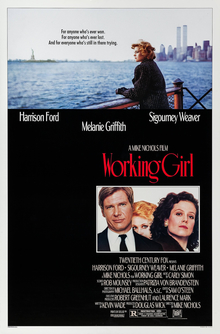
End elevators; bar meet-cute; opening; wedding.
Those receive final support; many other scene proposals are retained separately.
In the discussion (16)
- The opening credits, ferry, Statue of Liberty, and New York skyline are proposed.
- The Spacey limo encounter and Tess’s typed insult are proposed.
- Tess’s early office exchange with Katharine is proposed.
- The bar meet-cute is a final choice. — Joanna Robinson
- The fight after the party is proposed.
- The luau wedding, bathroom scene, cameos, and Trask dance are proposed.
- Jack changing his shirt in the office is proposed.
- The postcoital conversation is proposed.
- Jack visiting Katharine while Tess hides is proposed.
- The boardroom and elevator showdowns are proposed.
- Tess meeting her new assistant is proposed.
- Jack caring for an unconscious Tess is proposed for its physical comedy despite later objections.
- The boss-secretary impersonation farce is proposed.
- The elevator ending is a final choice.
- The wedding is initially selected and then withdrawn for the elevator.
- The bar is another final choice.
Hair, makeup, and eye shadow.
Shoulder pads, wedding clothes, Twin Towers, secretary terminology, cigarettes, print media, radio, exercise bike, monitors, and printouts are also proposed.
In the discussion (6)
- Hair, makeup, and eye shadow are the leading answer.
- Visible shoulder pads under a translucent blouse are proposed.
- The wedding tuxedo, Twin Towers, and women calling themselves secretaries are proposed.
- Lark cigarettes, print media, and radio are proposed.
- Katharine’s exercise bike is proposed as the strongest runner-up.
- Computer monitors, printouts, and email are proposed.
Let the River Run and its score; supportive work husband; clothes; underestimated heroine archetype.
The roundtable, tequila order, production-history game, television adaptation, life advice, and Officer and a Gentleman homage are also retained.
In the discussion (10)
- Let the River Run, the score, and their repeated use are selected.
- Jack as a supportive work husband is proposed.
- The late-film roundtable is proposed.
- Jack ordering tequila before it became common is proposed.
- Harrison Ford’s clothes and the character-defining costume design are proposed.
- The underestimated hot-mess but intelligent heroine archetype is proposed.
- Guessing which scenes followed a late night is proposed as a rewatching game.
- The short-lived Sandra Bullock television adaptation is discussed as an enduring curiosity.
- Never burn bridges because today’s junior employee may become tomorrow’s senior partner is proposed.
- The Officer and a Gentleman homage at the end is proposed.
Final office pullback; opening; nighttime ferry shot.
The final shot receives the fullest thematic case.
In the discussion (3)
- The opening credits are proposed.
- The final office pullback is proposed for expressing the movie’s larger idea.
- The nighttime ferry and skyline shot after the breakup is proposed.
Doreen’s implausible reaction; the premise’s extreme implausibility.
The second objection is accepted as absurd but emotionally effective.
In the discussion (2)
- Doreen’s fake crying during the affair is proposed as unbelievable.
- Tess secretly executing a merger from her absent boss’s office is rated nearly impossible.
Remote work breaks the plot; workplace treatment; hair; Jack undressing Tess; paper trails.
Additional objections cover Motor Trend, pre-deal sex, and hygiene.
In the discussion (8)
- Remote work and LinkedIn would prevent the broken-leg absence from enabling the plot.
- Most hairstyles and workplace treatment of women are proposed.
- Reading Motor Trend in bed and gloomy ferry shots are proposed.
- The hot dog crumb on Jack’s mouth is debated and ultimately defended.
- Jack not washing his hands is criticized.
- Sleeping together before closing the deal is proposed but disputed.
- Hard-copy records, dictation, and day planners are proposed as obsolete plot machinery.
- Jack removing Tess’s dress is criticized as unnecessary.
Kevin Spacey.
He is the clear selection.
In the discussion (1)
Working Girl deserved Best Picture; I’m So Excited is a defining pop-culture song.
The first is agreed but called tepid; the second is defended across movies, television, and NBA advertising.
In the discussion (2)
- Working Girl should have won Best Picture over Rain Man.
- I’m So Excited is proposed as the most important pop-culture song of its era.
Philadelphia law-firm employee; Trask actor; Caroline Aaron; Oliver Platt.
The Philadelphia performer is favored because even his role here cannot be recalled.
In the discussion (4)
- Oliver Platt is ruled eligible under a younger-audience test.
- The actor who plays Trask is proposed via a Beverly Hills Cop 3 reference.
- A Philadelphia law-firm character actor is favored.
- Caroline Aaron is proposed through Sleepless in Seattle and Maisel roles.
Nora Dunn.
Joan Cusack, Olympia Dukakis, Kevin Spacey, Robert Easton, and Carly Simon are considered; Simon is ineligible.
In the discussion (4)
Melanie Griffith: yes; Sigourney Weaver: near peak; Harrison Ford: no.
Carly Simon, workplace movies, Staten Island Ferry, hairstyles, and disparaging terms are also discussed.
In the discussion (7)
- Melanie Griffith is at Apex Mountain.
- Harrison Ford is not.
- Sigourney Weaver is at or near her peak between Aliens and this film.
- Female workplace-struggle movies are rejected as an apex because they are evergreen.
- Carly Simon is discussed.
- The Staten Island Ferry is proposed.
- Massive hairstyles and repeated disparaging terms are proposed.
Jack begins as creepy and sleazy.
His anonymous double tequila order, undressing Tess, next-day gift, fast declaration of love, and shifting characterization support the case.
In the discussion (1)
- Jack is proposed as creepy and sleazy early in the film.
Tom Hanks.
Hanks is the consensus choice, partly because Cruise is judged too powerful.
In the discussion (1)
Untouchable.
The existing television version is acknowledged, but no new remake is endorsed.
In the discussion (1)
- The movie is declared untouchable despite the prior television adaptation.
Wilford Brimley in The Firm.
He is imagined bringing compromising photographs to Catherine.
In the discussion (1)
- Wilford Brimley’s character from The Firm is selected for a photograph-reveal scene.
Melanie Griffith; Joan Cusack defended; Carly Simon already won.
The discussion distinguishes the hypothetical acting choices from the song’s actual win.
In the discussion (3)
Warhols; dress; bunny; gorilla; novelty wedding glasses.
The gorilla receives strong support.
In the discussion (3)
- Katharine’s Warhols and Tess’s expensive dress are proposed.
- The bunny and gorilla are proposed.
- The novelty wedding glasses with straws are proposed.
Make opportunities happen; check Valium dosage.
Both lessons are stated.
In the discussion (2)
- Do not wait for what you want; make it happen is selected.
- Check the milligrams for Valium is proposed.
Melanie Griffith.
Two choices and agreement support the result; Roger Ebert’s comparison to Dustin Hoffman is cited.
In the discussion (2)
Podcast choices